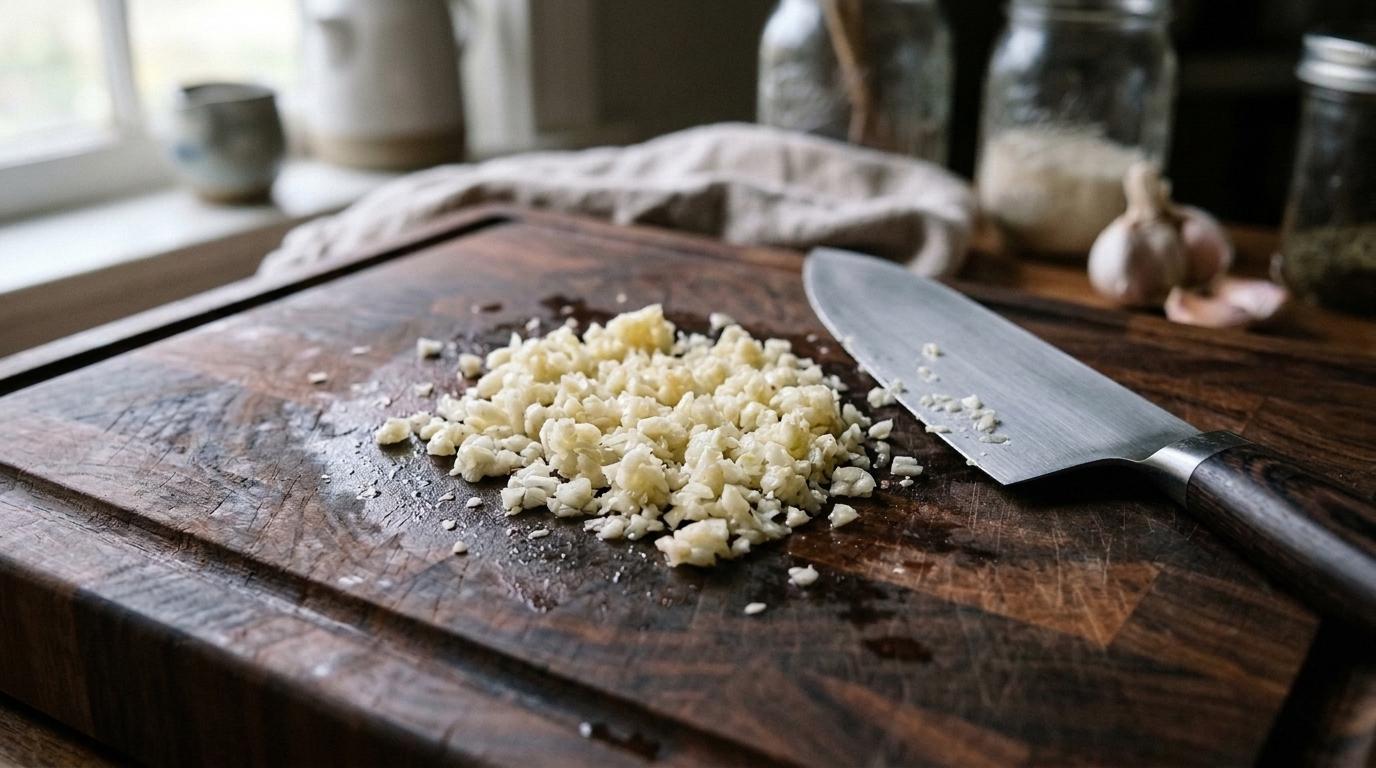
In home kitchens and restaurant lines across the world, one common routine repeats thousands of times every evening: a clove of garlic is smashed with the flat side of a chef's knife, minced finely, and immediately tossed into a smoking skillet of hot olive oil or melted butter. Within seconds, a fragrant aroma fills the kitchen. But according to food biochemists and molecular culinary researchers, this near-universal habit forfeits the vast majority of garlic's flavour complexity and virtually all of its potent biological compounds.
If you pause for exactly ten minutes between mincing garlic and exposing it to heat, something extraordinary happens on the cutting board. An intricate chemical cascade, dormant inside the intact clove for months, sparks into life. Enzymes and sulfur-rich precursors held in separate microscopic compartments collide, synthesizing a reactive, volatile organosulfur compound called allicin. 
Understanding the delicate enzymology behind allicin synthesis, the thermal vulnerability of the catalyst that creates it, and how culinary technique dictates the chemical profile of your food transforms garlic from a simple seasoning into a masterclass in kitchen biochemistry.
The Secret Architecture of an Intact Garlic Clove
#To understand why chopped garlic demands patience, one must first examine the evolutionary defence system of the garlic plant, Allium sativum. In its natural environment, a garlic bulb sits beneath the soil, vulnerable to soil-borne fungi, bacteria, nematodes, and burrowing herbivores. To defend itself, garlic developed a sophisticated two-component chemical weapon.
Critically, garlic does not contain active allicin while it remains whole. Allicin is chemically reactive, unstable, and toxic to living cells, including the plant's own tissue if allowed to circulate freely. Instead, the bulb stores the inert precursor molecule and the activating enzyme in completely separate cellular compartments.
Inside the cytoplasm of intact garlic cells resides an odorless, sulfur-containing amino acid derivative called alliin, chemically known as S-allyl-L-cysteine sulfoxide. Kept isolated within separate cellular structures called vacuoles is a specialised, highly concentrated enzyme known as alliinase, or alliin lyase.
As long as the clove remains uninjured, alliin and alliinase never meet. A whole, unpeeled clove of garlic possesses virtually no pungent odour because neither compound is volatile or pungent on its own. The chemical weapon remains disarmed, awaiting an attacker.
The Collision: What Happens When the Knife Falls
#When a knife blade slices through a garlic clove, or when teeth crush it, the mechanical force tears open millions of plant cell walls and ruptures the vacuolar membranes. This structural breach allows the cellular contents to flood together, mixing alliin with alliinase in an aqueous environment.
The moment they contact each other, alliinase acts as a high-speed biochemical catalyst. The reaction proceeds through a rapid two-step enzymatic cleavage:
Alliinase binds alliin and cleaves the carbon-sulfur bond, splitting alliin into allylsulfenic acid and dehydroalanine. Dehydroalanine quickly hydrolyzes into pyruvate and ammonia.
Two molecules of the highly reactive allylsulfenic acid spontaneously condense without needing any enzyme, eliminating a molecule of water to forge a single molecule of diallyl thiosulfinate, universally known as allicin.
This enzymatic reaction is extraordinarily fast. Laboratory assays using purified alliinase show that the enzyme can process hundreds of substrate molecules per second. However, because crushing releases substrate and enzyme unevenly across millions of ruptured and intact cells, the total yield of allicin across a pile of minced garlic takes several minutes to reach its theoretical peak.
The 10-Minute Window: Measuring Reaction Kinetics
#Chromatographic studies measuring allicin concentration over time following mechanical crushing show a distinct kinetic curve. Immediately after crushing, allicin levels begin rising rapidly. Between 60 seconds and three minutes, approximately 40 to 60 percent of total potential allicin has formed.
By five to seven minutes, the reaction velocity begins to taper off as the available pool of free alliin is consumed. Between eight and ten minutes, the concentration of allicin reaches a steady plateau, representing near-complete stoichiometric conversion of alliin into allicin throughout the crushed tissue.
Allowing minced garlic to rest on the cutting board for a full ten minutes guarantees that this biochemical cascade reaches completion before any culinary interference takes place.
| Resting Time After Crushing | Relative Allicin Formation | Enzymatic Status | Culinary Characteristic |
|---|---|---|---|
| 0 Minutes (Immediate Cooking) | Under 15 Percent | Unreacted Precursors | Mild Sweetness, Low Pungency |
| 2 Minutes | 35 to 45 Percent | Rapid Conversion Phase | Noticeable Sharpness Developing |
| 5 Minutes | 65 to 75 Percent | Intermediate Plateau | Balanced Fragrance and Bite |
| 10 Minutes | 90 to 98 Percent | Peak Stoichiometric Yield | Maximum Pungency and Bioactivity |
| 30 Minutes | 85 to 92 Percent | Gradual Secondary Degradation | Mellowing Sulfur Profile |
The Thermal Destruction of Alliinase
#Why does it matter if allicin forms on the cutting board rather than inside the cooking pan? The answer lies in the thermal sensitivity of proteins.
Alliinase is a glycoprotein enzyme composed of two identical catalytic subunits. Like most complex biological enzymes, its catalytic function depends entirely on its three-dimensional tertiary structure. The active site where alliin binds is held in its precise geometric configuration by delicate non-covalent interactions, including hydrogen bonds, hydrophobic interactions, and ionic bridges.
When heat is applied, thermal energy causes the atoms within the protein to vibrate with increasing violence. At temperatures above 60 degrees Celsius (140 degrees Fahrenheit), these delicate stabilizing bonds break. The enzyme unfolds, loses its shape, and coagulates into an inactive tangle. This process is irreversible thermal denaturation.
Cooking tests reveal the stark speed of this inactivation. In boiling water at 100 degrees Celsius, alliinase is completely and permanently denatured in under 60 seconds. In hot cooking oil, which typically sits between 160 and 190 degrees Celsius (320 to 375 degrees Fahrenheit), alliinase is wiped out in less than fifteen seconds.
If you toss freshly minced garlic straight into hot fat without resting, the oil rapidly heats the garlic pieces past 60 degrees Celsius long before alliin and alliinase have had time to fully react. The enzyme is destroyed mid-process, freezing the conversion in its tracks. The remaining unreacted alliin is left stranded without a catalyst, unable to transform into allicin.
In contrast, if you allow the garlic to rest for ten minutes at room temperature, the alliinase finishes synthesizing allicin before you ever turn on the burner. While allicin itself is also heat-sensitive over extended cooking periods, its thermal degradation products differ dramatically from unreacted alliin. Once allicin is formed, heat breaks it down into aromatic polysulfides and dithiins that deliver the deep, savory, complex aroma associated with sautéed garlic.
Mechanical Technique: Slicing vs. Mincing vs. Microplaning
#The degree of cell disruption directly dictates how much alliin and alliinase are liberated, shaping both the speed of the reaction and the final concentration of allicin.
A whole clove, gently crushed with the heel of a hand to crack its skin, ruptures only a small fraction of its outer cell layers. Minimal alliinase is released, producing a gentle, subtle garlic note suitable for infusing warm butter or broth.
Slicing garlic with a razor-sharp knife cleanly severs cells along the plane of the cut while leaving the interior cells intact. This produces moderate allicin synthesis, yielding a clean, delicate garlic flavor without aggressive pungency.
Mincing garlic repeatedly multiplies the number of cut surfaces exponentially, rupturing a vast percentage of the clove's microscopic architecture. This generates substantial allicin, producing the robust punch required for hearty sauces, stir-fries, and marinades.
Using a fine rasp grater or microplane obliterates nearly 100 percent of the cellular structure, grinding the clove into a wet puree. Alliin and alliinase are brought into immediate, intimate contact across the entire mass, resulting in explosive, instantaneous allicin formation. This produces the searing, raw heat familiar in aioli, toum, and traditional pestos.
| Preparation Method | Cellular Rupture Rate | Allicin Yield Potential | Optimal Culinary Use |
|---|---|---|---|
| Whole Bruised Clove | 5 to 10 Percent | Very Low | Slow Braises, Infused Oils |
| Thinly Sliced | 20 to 30 Percent | Moderate | Aglio e Olio, Quick Sauté |
| Finely Minced | 60 to 75 Percent | High | Tomato Sauces, Curries, Stir-Fries |
| Microplaned or Crushed in Mortar | 90 to 98 Percent | Maximum | Toum, Raw Dressings, Aioli |
What Allicin Does in the Human Body
#Beyond its unmistakable culinary punch, allicin has fascinated pharmacological researchers for decades. The compound is an electrophilic organosulfur agent capable of readily crossing biological membranes due to its lipophilic structure.
Once ingested, allicin reacts transiently with free thiol groups (sulfhydryl groups) on proteins and cellular enzymes. This interaction, known as thiol-disulfide exchange, underpins much of allicin's documented antimicrobial and antioxidant activity. In bacterial cells, allicin binds to essential sulfhydryl-containing metabolic enzymes, inhibiting bacterial proliferation.
In human cardiovascular physiology, allicin and its downstream metabolites, such as diallyl trisulfide, interact with red blood cells to stimulate the enzymatic release of hydrogen sulfide. Hydrogen sulfide acts as an endogenous cell-signaling molecule that relaxes vascular smooth muscle cells, promoting vasodilation and supporting healthy arterial blood pressure regulation.
However, none of these biological benefits can occur if the enzyme responsible for synthesizing allicin is destroyed by premature cooking. The simple act of waiting ten minutes bridges the gap between culinary tradition and nutritional efficacy.
The Chemistry of Acid and Garlic
#Heat is not the only environmental factor that can deactivate alliinase. The enzyme is equally sensitive to pH extremes.
Alliinase operates with peak catalytic efficiency in a narrow pH window between 6.0 and 7.0, which matches the natural physiological pH of a raw garlic clove. When the pH drops below 3.5, the acidic environment disrupts the ionic bonds that maintain alliinase's active conformation, rapidly denaturing the enzyme.
This has major practical implications for marinades, dressings, and ceviches. If raw garlic is minced directly into lemon juice, vinegar, or wine (which typically have a pH between 2.2 and 3.0), the high acid concentration instantly deactivates the alliinase before it can generate allicin. The resulting mixture retains a sharp, raw, sulfurous acidity without the round, sweet, deeply aromatic depth that allicin and its derivative polysulfides provide.
To master garlic chemistry in acidic dishes, the sequence of assembly is paramount: mince the garlic on a cutting board, let it rest for ten minutes in the open air to allow allicin synthesis to complete, and only then combine it with your vinegar, citrus juice, or acidic sauces.
The Allium Family Connection: Onions and Garlic
#The chemical weapon system in garlic shares evolutionary origins with other members of the Allium genus, notably onions, shallots, leeks, and chives. However, while garlic channels its enzymatic machinery into producing allicin, onions take a distinct chemical path.
In onions, cell disruption releases alliinase alongside a secondary enzyme called lachrymatory factor synthase. Instead of allicin, this dual-enzyme pathway converts isoalliin into syn-propanethial-S-oxide—a volatile, lachrymatory gas that vaporizes into the surrounding air, contacts the corneal surface of the human eye, and triggers immediate tear production. Readers interested in the complementary enzymatic mechanics of the allium family can explore the volatile chemistry of onion tearing, which details how cellular disruption generates sensory irritation.
While onions produce an airborne tear-gas defence, garlic chose a contact weapon: an oily, highly concentrated, non-volatile antimicrobial compound designed to punish herbivores upon the first bite.
Practical Culinary Guidelines for Maximizing Garlic
#To leverage this biochemistry in daily cooking without adding unnecessary complexity to your dinner routine, adopt these evidence-based kitchen practices:
Mince or crush your garlic at the very beginning of your meal preparation, before peeling carrots, chopping onions, or measuring spices. By the time your other prep work is finished, the mandatory ten-minute resting window will have elapsed naturally without slowing down your workflow.
If you are cooking a delicate sauce or stir-fry where garlic can easily burn, cook at moderate temperatures. While rested garlic already has its allicin formed, scorching the garlic above 190 degrees Celsius produces bitter acrolein and harsh oxidized sulfur compounds that ruin the dish.
For long-simmered stews, soups, and curries, consider a split addition. Add half of your minced, rested garlic early in the cooking process to establish a deep, mellow, background savory foundation, and stir in the remaining minced rested garlic during the final two minutes of cooking to preserve brighter, punchier top notes.
When making cold sauces, vinaigrettes, or garlic butter, always crush the garlic with a pinch of coarse kosher salt. The rough salt crystals act as a microscopic abrasive against the cutting board, rupturing cellular walls far more thoroughly than knife steel alone, accelerating allicin synthesis while drawing out cell fluids through osmotic pressure.
The humble garlic clove demonstrates that great cooking is rarely about complicated tools or exotic ingredients. Often, it is simply about respecting the biological machinery that nature spent millions of years perfecting—and giving an ancient enzyme ten quiet minutes to do its work.