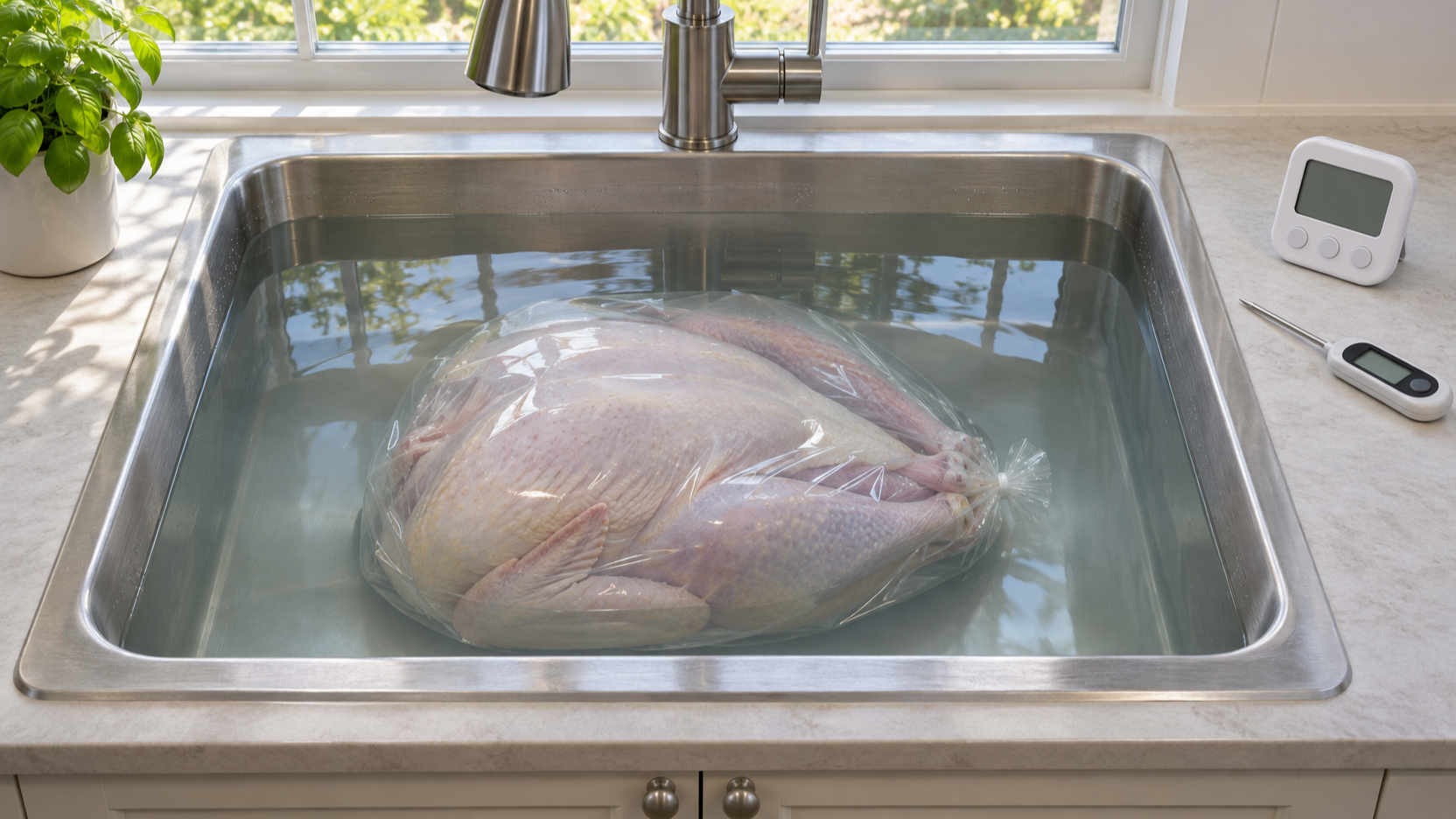
If the turkey is still frozen and Thanksgiving is close, use cold water. Keep the bird in its sealed wrapper, submerge it in cold tap water, change the water every 30 minutes, and plan on about 30 minutes per pound (a little over an hour per kilogram). A 14-pound (6.4 kg) turkey takes around 7 hours, and you cook it as soon as it's thawed.
If you don't have 7 hours, skip thawing and roast it from frozen. That's safe too. It just takes at least 50% longer in the oven.
What you can't do is leave it on the counter or soak it in hot water. Everything below follows US guidance from the USDA's Food Safety and Inspection Service (FSIS). Thanksgiving this year is Thursday 26 November 2026, so if you're reading this on the 24th or 25th, you still have options.
Which method fits the time you have left
#Work backwards from the time you want the turkey in the oven. This table is for a typical 12 to 16 pound (5.4 to 7.3 kg) bird. Bigger birds need more of everything.
| Time before the oven | What to do |
|---|---|
| 4 days or more | Fridge. Easiest and most forgiving. |
| Under 3 days | The fridge probably won't finish it. Use cold water, or roast from frozen. |
| 6 to 10 hours | Cold water. Start now. |
| Under 5 hours | Roast it from frozen. Cold water won't finish in time at this size. |
| It's the morning and the middle is still icy | Roast it anyway and let the thermometer decide. See the section further down. |
The microwave isn't in the table because most whole turkeys don't fit in one.
Why the counter and hot water are out
#A frozen turkey is safe for as long as it stays frozen. The trouble starts when it warms up. The outside thaws first, and while the middle is still a block of ice, the outer layer is sitting in what the USDA calls the "Danger Zone", between 40°F and 140°F (4°C to 60°C). In that range bacteria can double in as little as 20 minutes.
The USDA says a package thawing on the counter for more than 2 hours is not at a safe temperature. Hot water does the same thing faster, because it warms the outside of the bird into the danger zone while the center stays frozen.
The same warning covers the garage, the porch, the car trunk, the basement and the dishwasher. Leaving it outside in cold weather sounds sensible, but the USDA lists the porch as a place to avoid, because you can't control the temperature there.
That leaves three safe methods: the fridge, cold water and, with limits, the microwave.
Cold water: the fast method, step by step
#Cold water is the one most people want on Tuesday or Wednesday. It's faster than the fridge, but it needs you around.
Check the wrapper first. If the turkey's original packaging is sealed and intact, leave it on. If it's torn, or you aren't sure, put the whole bird in a leak-proof bag. A leak lets bacteria in from the water or air, and the meat soaks up water and turns out watery.
Then set it up.
- Use a clean sink or a large food-safe pot, bucket or cooler.
- Fill it with cold tap water until the turkey is fully covered. Put a plate or a heavy pan on top if it floats up.
- Set a timer for 30 minutes. Each time it goes off, drain the water and refill with fresh cold water.
- Keep going until the bird is thawed. Then cook it straight away.
Changing the water is the step people skip. The turkey chills the water around it, and left alone that water creeps back up to room temperature. Then the bird is sitting in the warm range you were trying to avoid.
Don't leave it soaking overnight. Nobody is up every 30 minutes at 3 a.m. If it's late evening, put the bird in the fridge and restart in the morning.
And plan the oven first. The USDA is clear that a turkey thawed in cold water should be cooked immediately. You can't finish a cold-water thaw on Wednesday and park the bird in the fridge until Thursday. The thaw and the oven time are really one block.
How long each method takes, by weight
#The fridge and cold-water columns are the USDA's figures for a whole turkey, with kilograms added. The last column is my own arithmetic. It takes the USDA's unstuffed oven timetable at 325°F (163°C), adds 50% and rounds up a little. The USDA says "at least 50% longer", so treat those as minimums and trust a thermometer over the clock.
| Weight | Fridge (40°F / 4°C or colder) | Cold water | Roast from frozen, unstuffed |
|---|---|---|---|
| 8 to 12 lb (3.6 to 5.4 kg) | 1 to 3 days | 2 to 6 hours | about 4 to 4½ hours |
| 12 to 14 lb (5.4 to 6.4 kg) | 3 to 4 days | 6 to 8 hours | about 4½ to 5¾ hours |
| 14 to 16 lb (6.4 to 7.3 kg) | 3 to 4 days | 6 to 8 hours | about 5¾ to 6½ hours |
| 16 to 18 lb (7.3 to 8.2 kg) | 4 to 5 days | 8 to 10 hours | about 5¾ to 6½ hours |
| 18 to 20 lb (8.2 to 9.1 kg) | 4 to 5 days | 8 to 10 hours | about 6½ to 6¾ hours |
| 20 to 24 lb (9.1 to 10.9 kg) | 5 to 6 days | 10 to 12 hours | about 6¾ to 7½ hours |
The USDA's thawing bands are 4 to 12, 12 to 16, 16 to 20 and 20 to 24 pounds. I split some rows only so the roasting column lines up. The quick fridge rule is about 24 hours for every 4 to 5 pounds (1.8 to 2.3 kg), and a colder fridge is slower. If yours runs near 35°F (2°C), allow extra time.
The fridge, if you still have days
#If you're planning ahead, this is the one to use. Leave the bird in its original wrapper, set it on a tray or in a pan to catch drips, and keep it on a low shelf so raw juices can't land on other food.
Once it's thawed in the fridge, it can stay there for 1 to 2 days before you cook it. That's the current USDA figure, and it's why the fridge is forgiving. If you're a day early, nothing goes wrong.
Microwave: only if the bird fits
#Most whole turkeys don't fit in a home microwave, and the USDA says so. A small bird or a turkey breast might. Check your microwave's manual for the largest turkey it takes, the minutes per pound and the power level for thawing. I won't give a figure here, because it changes with the model and your manual is the right source.
A few rules hold for every model. Take off all the outside wrapping and put the turkey on a microwave-safe dish to catch the juices. Use the defrost setting.
Then cook it immediately. Parts of the bird can warm up or even start cooking during the thaw, and a partly cooked turkey that's held for later isn't safe, because the bacteria weren't destroyed and the temperature suited them. Don't put it back in the fridge, and don't refreeze it.
Thawing in the microwave is fine. Cooking a frozen turkey in the microwave isn't recommended, because it can cook unevenly.
Roasting it frozen is a real option
#People worry this is a risky shortcut. It isn't. The USDA says it's safe to roast a turkey from the frozen state. It takes at least 50% longer than the timetable for a thawed bird, and you don't stuff it.
Here's how.
- Heat the oven to 325°F (163°C) or higher. The USDA's roasting advice is no lower than 325°F.
- Take the bird out of its packaging. Put it breast-up on a rack in a shallow roasting pan.
- Giblets and the neck can be in the main cavity or tucked under the flap of skin at the front of the breastbone. They're frozen in at the start. Wait until the bird has loosened, then pull them out with tongs or a fork.
- Slide the thermometer into the innermost part of the thigh once it has softened enough to take it.
- Check the temperature often toward the end of the estimated time. The timings are approximate.
- Take the turkey out when it reads 165°F (74°C) in three places: the innermost part of the thigh, the innermost part of the wing and the thickest part of the breast.
Check how the giblets were packed. Most come in paper, and if a paper-wrapped pack cooks completely inside the bird, there's no safety concern. If they came in a plastic bag and the bag melted or changed, the USDA says to throw away the giblets and the turkey.
Skip the oven bag with a frozen bird. Opening a bag to get the giblets out mid-cook risks scalding, and spilled juices and fat can cause an oven fire. Don't smoke, grill, deep fry or microwave a frozen turkey either. Deep frying needs a completely thawed bird.
A thawed or nearly thawed bird can also go faster if you flatten it. You can't cut the backbone out of a block of ice, though. Our spatchcock turkey guide covers that route for a bird that thaws late.
A worked example: a 14-pound bird and dinner at 5 p.m.
#This is an example with made-up times, so adjust it to your own oven and dinner time. Say you have a 14-pound (6.4 kg) unstuffed turkey, still frozen, and you want to eat at 5:00 p.m. on Thursday.
The USDA's timetable at 325°F gives 3 to 3¾ hours for a 12 to 14 pound bird, plus 20 minutes' rest before carving. In cold water, 30 minutes per pound works out to 7 hours for this one, inside the USDA's 6 to 8 hour band.
Plan A: cold-water thaw, then roast
- 5:00 a.m. Check the wrapper, put the turkey in cold water, weigh it down and start the 30-minute timer.
- 5:30 a.m. to noon. Change the water every 30 minutes. That's about 14 changes, so set a phone alarm.
- From about 11:00 a.m. Start checking whether it's pliable and the cavity is clear. It might be early.
- Around noon. If it's thawed, take it out, pat it dry, pull out the giblets and neck, season it and put it on the rack. Preheat the oven first so the bird isn't waiting around.
- 12:30 p.m. In the oven at 325°F (163°C).
- 3:15 p.m. Start checking the thigh with a thermometer.
- Around 4:15 p.m. It's out at 165°F (74°C) in all three spots. Let it rest 20 minutes.
- 4:35 p.m. onward. Carve, and dinner is at 5:00.
The weak point is the 8-hour end of the range. If the bird isn't thawed until 1:00 p.m., it goes in at 1:30 and finishes somewhere between 4:30 and 5:15, which is late. If it still isn't ready by about 12:30, roast it partly frozen, as described below.
Plan B: roast it frozen
- 10:00 a.m. Preheat to 325°F (163°C).
- 10:30 a.m. Unwrap the bird, put it on the rack and put it in the oven. No stuffing.
- From about 1:00 p.m. See whether the giblets and neck will come out, and if the thigh will take a thermometer.
- From about 2:45 p.m. Check often. The estimate is about 4½ to 5¾ hours, so roughly 3:00 to 4:15 p.m.
- 4:15 p.m. Latest sensible finish. Rest 20 minutes, carve, and dinner is at 5:00.
Plan B asks much less of you. Nobody is at a sink at 5 a.m. The cost is that the oven is busy for hours longer, so plan the sides around it. Either way the thermometer makes the call. If you need help with one, see our guide to using a food thermometer correctly or the food thermometer buying guide.
It's Thursday morning and the middle is still icy
#Don't turn the oven up. Work out how many hours you have first. If dinner is 7 or more hours away, cold water still works for a bird around 14 pounds. Start it right now.
With less time than that, roast it. The bird doesn't have to be fully thawed first, because the USDA says roasting from frozen is safe. A bird that's partly thawed will land somewhere between the thawed and frozen timetables. I wouldn't guess where. The thermometer will tell you.
Stay at 325°F (163°C). Pull the giblets and neck as soon as they come loose. Don't stuff the bird. The USDA recommends cooking stuffing in a separate dish, and it needs to reach 165°F (74°C) too.
Then push dinner back, or serve the sides first. Nobody minds waiting an hour. They do mind a turkey that's still pink at the thigh.
How to tell it's thawed enough
#The USDA doesn't give a visual test, so these are practical checks. They aren't official rules.
- The legs and wings move freely and the bird flexes when you lift it.
- Nothing solid in the main cavity. The neck and giblets slide out.
- The thickest part of the breast gives when you press it, with no hard core.
- The thermometer goes into the thigh with a gentle push and doesn't hit ice.
A few ice crystals deep in the thigh aren't a problem if the bird is going straight into the oven. Hard ice only means a longer cook. The thermometer is the final check in every case, not how the bird feels.
And once a cold-water bird is thawed, don't let it sit while you finish something else. The clock is running.
Fresh, brined and pre-basted turkeys
#If you bought a fresh turkey, it doesn't need thawing at all. The USDA says to buy it only 1 to 2 days before cooking and keep it in the fridge until then, on a tray to catch any leaks.
A turkey labeled self-basting, marinated or "for flavoring" has had a solution added during processing, up to 3% of its weight for bone-in poultry. Thawing doesn't change. I'd just go easy on extra salt.
If you brine your own bird, do it after it's thawed, in the fridge. A frozen bird can't take a brine, and a cold-water turkey has to be cooked immediately, so a long brine doesn't fit that route. On a rushed day, skip it and season the bird just before it goes in.
Frozen pre-stuffed turkeys are different again. The USDA says not to thaw those. Cook them from frozen and follow the packaging directions exactly.
Can you refreeze it?
#It depends how it was thawed.
- A turkey thawed in the fridge can be refrozen without cooking, though the quality may drop a bit.
- A turkey thawed in cold water or in the microwave must be cooked before it goes back in the freezer. Cooked meat from it can be frozen after that.
Counter or hot-water thawing isn't on that list, because the USDA doesn't consider it safe at all. Food left out for more than 2 hours, or 1 hour above 90°F (32°C), is past the safe limit.
Mistakes that cause real trouble
#- Leaving it on the counter overnight. The USDA says that's not safe. If it was out all night, I'd throw it away.
- Warm or hot water. Same danger-zone problem, only quicker.
- Skipping the water changes. The bath warms up and the method stops being safe.
- Ignoring the wrapper. A split means bacteria in and water absorbed.
- Washing the thawed bird. The USDA recommends against it. Rinsing raw poultry splashes germs around the kitchen, and cooking to 165°F is what kills them. Pat it dry with paper towels. Never use soap or detergent on the meat.
- Cooking by the clock. Timetables are estimates. Check three spots with a thermometer.
Clean the sink and counters afterwards
#If the turkey sat in your sink, treat the sink as raw-poultry territory. The USDA notes that Campylobacter can survive in a kitchen for up to 4 hours and Salmonella for up to 32 hours.
Do it in this order.
- Wash your hands with soap and water for at least 20 seconds after handling the bird or its packaging.
- Empty the container or sink. If you used a cooler or a bucket, wash it with hot, soapy water.
- Clean the sink, the tap handles and the counters first with warm, soapy water. Cleaning removes dirt and some bacteria but doesn't kill germs.
- Then disinfect sinks and counters with a product that's approved for those surfaces, and follow its label. Cutting boards and utensils that touch food need a sanitizer meant for food-contact items, not a disinfectant.
- Let everything air dry or wipe it with single-use paper towels, then wash your hands again.
Our clean vs sanitize guide goes into why that order matters.
When to throw it out or call someone
#When in doubt, throw it out. That goes for a bird that spent the night on the counter, sat in hot water, or lay in a bath that went warm.
If you're unsure about your own situation, call the USDA Meat and Poultry Hotline at 1-888-674-6854. Food safety specialists staff it, and the USDA lists it as open for part of Thanksgiving Day. If anyone gets vomiting, diarrhea or a fever after the meal, especially a baby, an older adult, someone pregnant or someone with a weak immune system, talk to a doctor. This is general food-safety guidance, not medical advice.
For leftovers, our guide to freezing, thawing and reheating leftovers safely is a good place to go next.