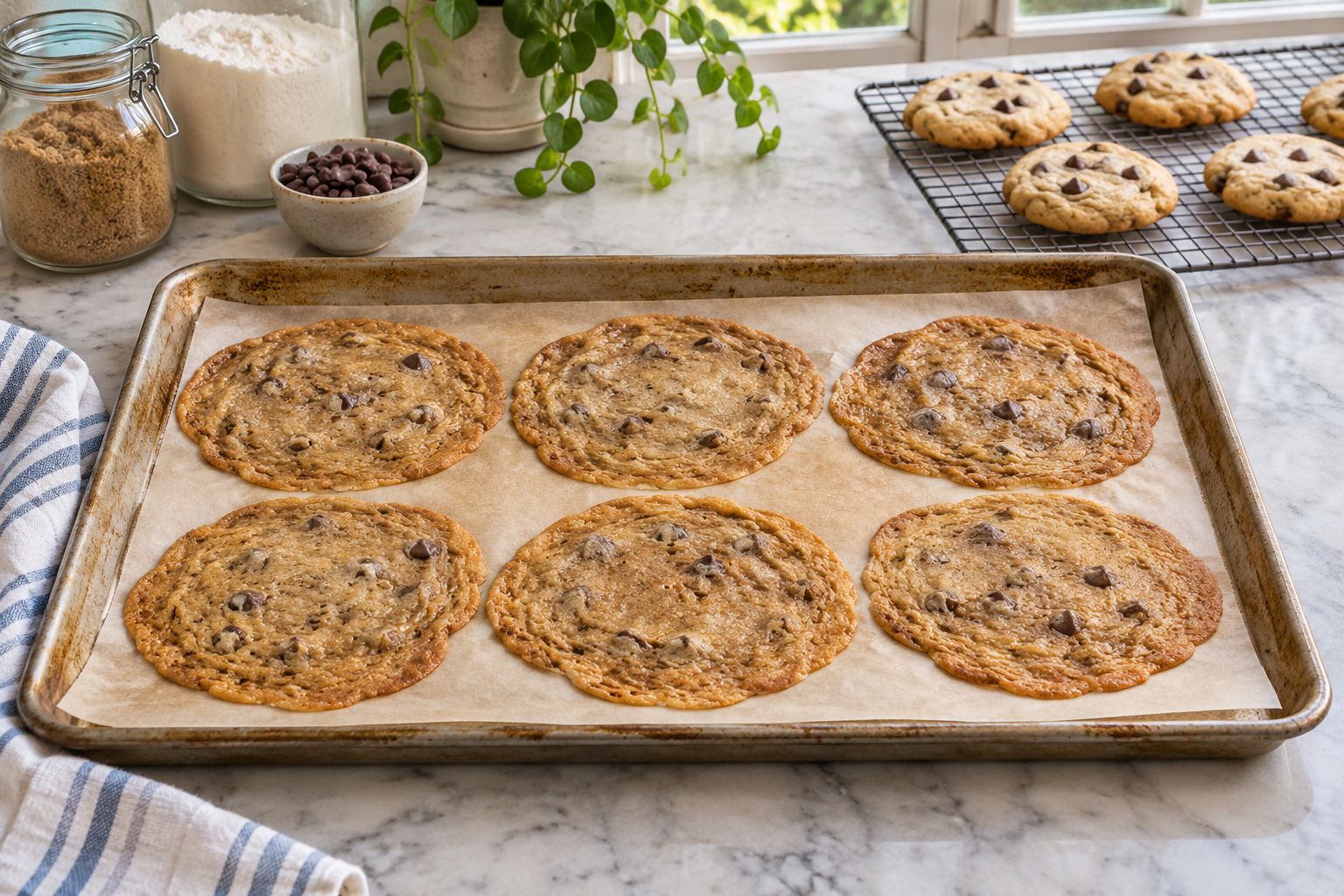
Three cookies have run into each other in the middle of the tray. The ones around the edge are thin enough to pick up by a chocolate chip. There’s still half a bowl of dough on the counter. At that point I’d put the bowl in the fridge, get a cool baking sheet and bake a pair of cookies before I commit the rest.
Cookies can spread too far when the dough or sheet is warm, when the dough has too little flour for the recipe, or when the fat, sugar or pan lining changes. A cool sheet and a small test batch give you an answer while there’s still time to save the dough. Which change I’d try first depends on what happened to the first tray.
What the first tray tells you
#| What you see | What I’d check first | What I’d try |
|---|---|---|
| The first tray was fine and the second spread | Was the second tray still hot when you scooped onto it? | Start the next tray with a cool sheet |
| Every cookie spread after dough sat on the counter | Did the recipe call for chilled dough? | Chill a few portions and bake them on a cool sheet |
| Dough looks unusually loose even when cold | Did the flour, fat or sugar measurement change? | Compare what went in with what the recipe asks for |
| Two cookies look good but a full tray touches | Scoop size and spacing | Give each scoop more room or bake fewer at once |
| Edges are dark while centers stay very pale | Pan color, rack position and oven temperature | Follow the written setup, then assess a small test |
Think back to the last good tray if there was one. A dough problem tends to follow the dough. If the first six baked well and the next six melted across the pan, I’d look at the pan or the wait on the counter before second-guessing the whole recipe. The last six might have spent another half hour in a warmer kitchen while the oven was on.
Bake two cookies before the next full tray
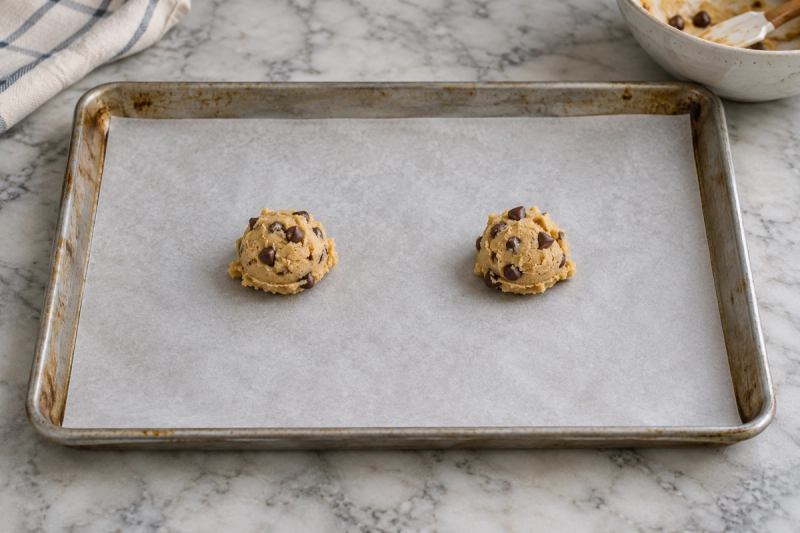
#Put two equal scoops on a cool pan with the lining the recipe specifies. If you’re checking warm dough, chill those scoops first. Keep the rest refrigerated while they bake. Give the oven time to reach the set temperature, use the recommended rack and bake for the recipe’s starting time. Once they’re out, let them settle on the sheet before deciding how they turned out.
You can run a more useful comparison if the first tray gives you no clear clue. Put one portion in the fridge and keep an equal portion in the condition that produced the first tray while the oven comes back up to temperature. Place them far apart on the same cool sheet. If you’ve already chilled the whole dough, test a pair as it is and save comparisons for a future batch. I’d rather use two more cookies to get an answer than ask the oven to do an experiment with twelve.
I’d also pay attention to how I line the pan. King Arthur Baking tested different linings with the same recipe and found the choice changed the spread. Follow your recipe first. If you’ve already changed the lining and are having trouble, return to what it calls for or compare two small bakes with everything else as similar as you can make it. Extra grease can be one more variable to account for.
Look back at how the dough was mixed
#When a recipe says softened butter, I’d check whether a finger leaves a dent while the butter still holds its shape. Some cookies call for melted butter, so read the method before changing the temperature of the fat. If a recipe asks for softened butter and you melted it on the highest microwave setting, chilling may help the next tray hold together. It can’t recreate all the texture you’d get from the written mixing method.
Look at flour next. If the recipe gives grams, use those for the next batch. If it gives only cups, follow the author’s measuring instructions. Same-sized scoops of finished dough can bake differently when the flour was measured differently at the start. And if the dough you already have feels soft, I wouldn’t pour more flour in just because the first tray spread. Try the cool-pan test first. Only adjust a known measurement mistake, and only if you can work out how much went missing.
Sugar changes how a cookie behaves as well as how it tastes. The same goes for replacing one kind of fat with another. If you made a few changes at once, a single bumpy bake can’t tell you which one mattered. I’d use the written recipe for the next full batch, then test one substitution on its own when it’s easier to see what it did.
Read the two cookies before deciding what to change
#Say both scoops started at the same size. The chilled one ends up with a plump middle and the one that sat out has a wide, crisp edge. You’ve got a workable fix for the dough in front of you. Keep it cold, portion it consistently and cool the baking sheet between rounds. If you’re using a single tray, let it cool on a rack while the finished cookies set. There’s no need to speed things up by dropping the next scoop straight onto warm metal.
If both spread, I’d look at what the two scoops had in common. Was the pan greased when the recipe wanted parchment? Did you double the butter and lose track of which ingredients you’d already doubled? I’d put the recipe next to the bowl and mentally replay the mixing. That’s especially helpful after interruptions. The second number is easy to forget when one ingredient was measured for a double batch and another came straight from a partly opened packet.
Sometimes the two cookies look fine and the real problem was fitting twelve onto a tray made for eight. Look at where the baked edges land, then leave a little space beyond that footprint. Two extra trips to the oven may be less work than separating a whole sheet of joined cookies. If a test on the cool pan still burns on the underside while the middle barely sets, check that you used the specified rack and pan. A dark pan can brown the bottom faster, so it’s worth trying the recipe on the sheet it expects before changing the bake time and the temperature together.
On the recipe card I’d pencil in what worked: cold dough, cool pan, eight per sheet. That’s the note I want to find next December.
If you’re making cut-out cookies
#I’d bake a spare shape before cutting the rest of the dough. Choose the shape that has the smallest details, like a star with narrow points. Cut it from dough at the thickness the recipe gives. Cool the cut-out as directed, move it with a thin spatula and check the tip of one point after baking. If it rounds off more than you want, try the recipe’s chill again with a second piece. If the dough is designed for soft drop cookies, choose a formula written to hold a cutter’s shape for the next batch.
Spacing matters even after the shape is stable. Leave room around the widest parts. Cookie cutters make it tempting to pack the sheet by fitting a star point into the gap beside another cookie. A little more room makes the result easier to judge.
What I’d do with the flat batch
#If the cookies are fully baked and taste good, I’d cool them and see what texture I got. Crisp pieces can go beside ice cream or over pudding, and an intact thin cookie can still be a good cookie. If edges just touch, separate the pieces after they’ve set enough to handle. Keep the unbaked dough for your test. That gives you a chance at a second finish from the same afternoon, even if the first finish involves a spoon and a bowl of ice cream.