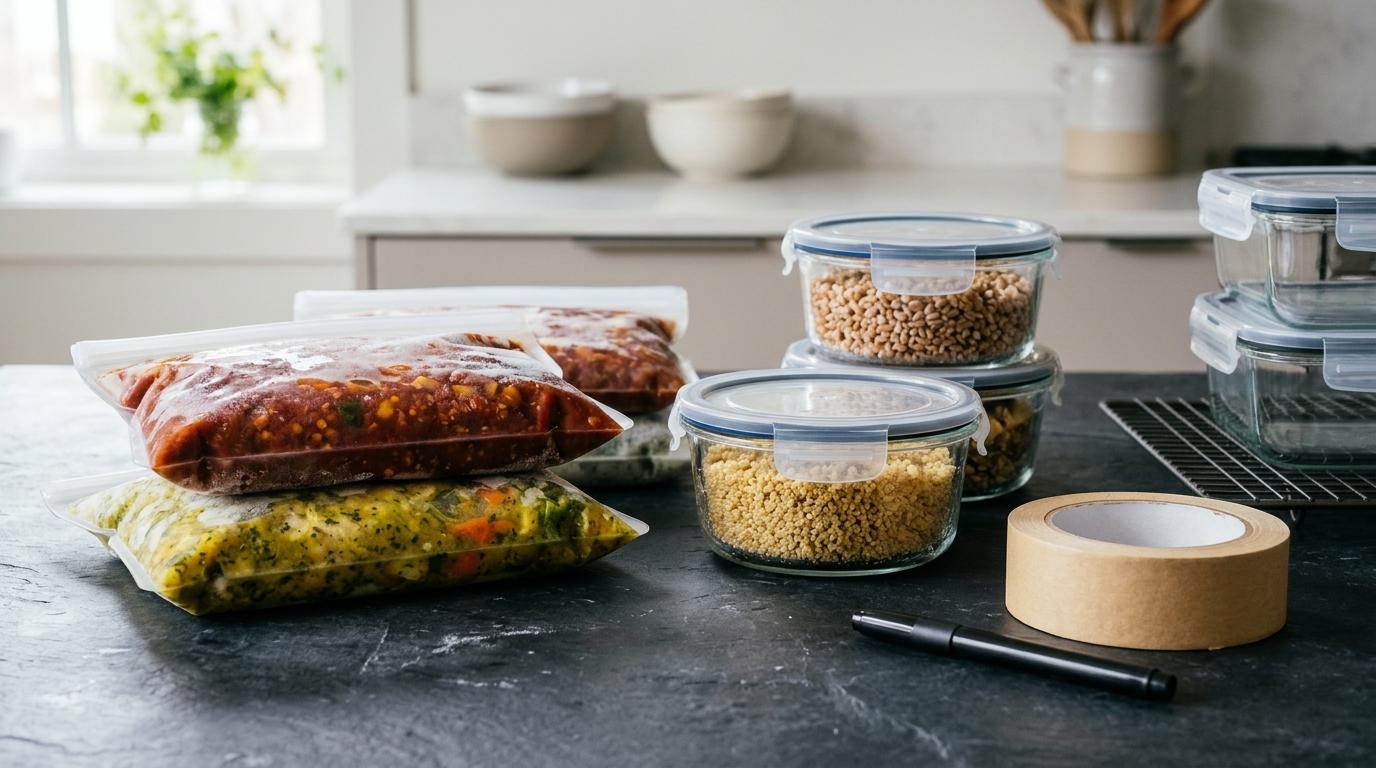
Good freezer meal prep starts before the pot hits the burner: build batches around moisture-stable bases like tomato sauces, lentils, and braised meats, cool them fast in shallow trays, press out trapped air before sealing, and reheat to 74°C (165°F). When freezer meals disappoint, the freezer itself is rarely to blame. Most failures happen because ice crystals shred delicate cell walls, cream sauces split, or warm pots sit out too long before hitting cold air.
Once you stop freezing dishes that hate the cold and tweak a few textures upfront, a stocked freezer stops feeling like emergency leftovers. It turns into five-minute weeknight dinners that actually taste fresh.
Safety vs. Quality at -18°C (0°F)
#Keeping food continuously at or below -18°C (0°F) pauses bacterial, yeast, and mold growth indefinitely. According to UK Food Standards Agency (FSA) guidance and U.S. Cooperative Extension standards, food stored solid at that temperature stays safe to eat well past a few months.
That pause button has one catch: freezing does not kill bacteria. It only puts microbes to sleep. The moment your meal thaws above 4°C (40°F)—or 8°C under UK FSA rules—any surviving bacteria wake up and start multiplying again.
Safety is permanent while frozen, but flavor and texture have a clock. For peak taste before moisture slowly migrates out, plan to rotate most cooked dishes within 2 to 4 months:
- Braised meats, chicken curries, and meat chilis hold best quality for about 2 to 3 months.
- Tomato sauces, cooked beans, lentil stews, baked goods, and blanched vegetables hold nicely for 3 to 4 months, with well-sealed bean stews lasting up to 6 months.
- Fat-bound mashed potatoes lose quality quickly and work best within 2 weeks.
That pale, leathery crust you sometimes find on older packages is freezer burn. It is surface dehydration caused by moisture escaping into dry freezer air and forming ice crystals, not food poisoning. You can safely trim off dry edges before or after cooking, though preventing air exposure in the first place saves the whole texture.
Do not guess freezer health from a generic 1-to-5 appliance dial. Drop an inexpensive appliance thermometer inside both your fridge and freezer so you know the fridge stays at 0–4°C (32–40°F, or 0–5°C in UK guidance) and the freezer holds steady at -18°C (0°F) or colder.
Why Some Foods Turn Mushy or Split When Frozen
#Water expands as it freezes. Inside soft vegetables and dairy sauces, growing ice crystals pierce cell walls and break delicate fat-and-water emulsions. When the meal melts in your pan, trapped liquid leaks out and leaves solids either water-logged or grainy.
Check what breaks before you double a recipe, and swap the fragile part instead of abandoning the whole dish.
| Ingredient or dish | What goes wrong after thawing | Practical batch-cooking fix |
|---|---|---|
| Heavy cream, milk sauces, sour cream | Fat separates from water, leaving curdled or grainy gravy | Freeze tomato, broth, or full-fat coconut bases; stir in fresh cream or yogurt after reheating |
| Boiled or baked potato chunks in stew | Cells collapse into a mealy, crumbly, water-logged sponge | Leave diced potatoes out at freeze time, or substitute par-cooked waxy chunks or fat-bound mash |
| Raw lettuce, cucumber, celery, radish | Turns limp, translucent, watery, and stale | Pack crisp greens and fresh toppings separately in the fridge for serving day |
| Cooked pasta or rice frozen soft | Soaks up extra liquid and turns mushy on reheat | Undercook pasta 2 to 3 minutes shy of al dente; tray-freeze cooked grains dry |
| Crisp fried or battered foods | Trapped steam softens crunchy coatings during storage | Freeze unbreaded or finish reheating uncovered in a 200°C (400°F) oven or air fryer |
| Cooked egg whites and mayo dressings | Egg whites turn rubbery; mayo breaks into oily puddles | Freeze scrambled whole egg mixes inside wraps; use mustard, broth, or butter binders instead |
Watch your spice jar too. According to the National Center for Home Food Preservation (NCHFP), black pepper, cloves, garlic, green bell peppers, and certain dried herbs sharpen or turn slightly bitter over months in frozen storage. Salt loses punch and can speed up fat rancidity in fatty meats. Season batches lightly when you cook them, then adjust salt, cracked pepper, lime juice, and fresh herbs right before eating.
Tofu is the classic exception where ice damage works in your favor. Freezing firm tofu creates small ice pockets that press out water and leave a chewy, porous texture that drinks up curry and stir-fry sauces. Silken tofu, on the other hand, breaks apart completely. If you batch-cook plant proteins, check how to freeze and thaw tofu without ruining texture before choosing your block.
Cool, Seal, and Blanch Before Food Hits the Freezer
#Putting a deep, steaming stockpot straight into the refrigerator or freezer raises the appliance temperature around neighboring food while the pot core stays warm for hours. Leaving that same big pot on the kitchen counter all afternoon creates the opposite problem: bacteria multiply rapidly in the 4–60°C (40–140°F) danger zone, and some strains leave behind heat-resistant toxins that reheating cannot fix.
Follow the 2-hour rule. Perishable cooked food should chill and move into cold storage within 2 hours of cooking—or within 1 hour if room temperature is above 32°C (90°F). UK FSA guidelines similarly advise cooling cooked food and chilling it within 1 to 2 hours.
To drop heat quickly without heating up your fridge:
- Divide big pots of chili, dal, curry, or soup into shallow containers no deeper than 5 cm (2 inches) so heat escapes fast.
- Set a hot metal pot into a sink filled with ice and cold water, stirring every 5 minutes until steam stops rising.
- Once warm steam is gone and the food feels cool to a clean spoon check, seal and move it to the fridge or freezer immediately.
If you regularly cook large batches of rice, curries, or broth, review this quick workflow to cool cooked food safely before putting it away so big pots never linger in the danger zone.
Packing Flat and Managing Headspace
#Air and warm moisture inside a package cause frost sheets and dry spots. Heavy-duty freezer bags (specifically labeled for freezing, not thin sandwich bags) let you ladle in cooled stews, press out every pocket of air, zip tight, and lay the bag flat on a rimmed baking tray. Once frozen solid overnight, those flat slabs stand upright like books in a bin, thaw twice as fast as a round tub, and show what is inside without digging.
If you prefer rigid glass or BPA-free plastic tubs, pick wide-mouth containers and leave 1.5 to 2.5 cm (0.5 to 1 inch) of empty headspace at the top for soups, sauces, and stocks. Liquids expand as they freeze, and full jars crack or pop their lids right off.
Also avoid stuffing 10 kg of warm unfrozen food into a home freezer at once. Clemson Cooperative Extension recommends freezing no more than roughly 2 to 3 pounds per cubic foot of freezer space within 24 hours, leaving small air gaps between fresh packs until solid so the core freezes cleanly.
Label every single bag or lid before it hits the cold—dish name, date frozen, portion count, and whether it needs extra broth on reheat. Tape and permanent freezer marker save you from mystery blocks three months later.
When and How to Blanch Vegetables
#If you are freezing raw chopped vegetables for stir-fry packs or soup kits, skipping blanching leads to faded color, grassy off-flavors, and tough stems. Fresh vegetables carry active enzymes that keep breaking down flavor and vitamins even at -18°C (0°F). Only a handful of aromatics—like chopped onions and sliced sweet peppers bound for cooked dishes—hold up well raw.
Proper blanching takes exact heat and an immediate cold stop, because under-blanching actually stimulates enzyme activity faster than no blanching at all:
- Boil at least 3.8 liters (1 gallon) of water per 450 grams (1 pound) of cut vegetables so the pot bounces back to a full boil within 1 minute after you drop the basket in.
- Start counting only once the water returns to a rolling boil: 2 minutes for sliced carrots or hardy greens like spinach, and 3 minutes for cauliflower or 3–4 cm broccoli florets and snap beans. Steam blanching takes about 1.5 times longer (around 5 minutes for broccoli).
- Plunge immediately into an ice-water bath at 15°C (60°F) or colder—roughly 450 grams (1 pound) of ice per pound of veg—for the exact same number of minutes you blanched.
- Drain thoroughly in a colander and pat dry with a clean towel before bagging, because surface water turns into jagged frost inside the pack.
8 Batch-Cooking Freezer Categories That Hold Their Texture
#Instead of chasing dozens of fragile one-off recipes, build your freezer stash around eight workhorse categories that survive freezing without losing structure. Notice how every category relies on one simple pre-freeze adjustment.
1. Tomato, Bean, and Meat Chilis
#Thick chilis are arguably the most forgiving freezer meals you can make. Acidic tomatoes, long-simmered spices, ground meat or diced chuck, and sturdy beans protect moisture and mask minor ice texture shifts. Keep a roughly balanced ratio of 1 part protein/beans to 1 part rich tomato-broth sauce so solids stay coated. Pull the pot off the burner while beans are just tender so skins do not split when reheated, cool in shallow trays, and save fresh toppings—cilantro, diced red onion, grated cheese, avocado, and sour cream—for serving night.
2. Lentil Dals and Spiced Curries
#Red, yellow, and brown lentils, chickpeas, and black-eyed peas hold up brilliantly in spiced tomato-onion or coconut-milk gravies. Use full-fat canned coconut milk or blended tomato-cashew bases instead of heavy dairy cream or yogurt, both of which split into grainy curds after thawing. Simmer until legumes are tender with a slight bite, cool completely, pack flat in single- or two-serving portions, and swirl in fresh yogurt, cream, or lemon juice only after the dish comes back up to steaming heat.
3. Braised Meats and Shredded Roasts
#Dry cooked chicken breast turns stringy in the freezer because lean muscle fibers squeeze out moisture. Dark meat chicken thighs, pork shoulder, lamb shank, and beef chuck stay juicy because melted collagen coats the meat fibers. Trim thick surface fat caps before packing (fat turns stale sooner than lean protein), shred or chunk the meat, and submerge every piece in its own skimmed braising broth before sealing. That liquid barrier blocks oxygen and prevents freezer burn for 2 to 4 months.
4. Raw Marinated Grill and Skillet Packs
#Instead of cooking everything ahead, assemble raw boneless chicken thighs, pork tenderloin strips, or firm tofu cubes inside freezer bags with an oil, spice, citrus, and garlic-ginger marinade. Keep added salt modest so the meat does not cure into a spongy ham texture while thawing. Press flat, freeze, and move a bag to the fridge 24 hours before cooking—the meat marinates as it thaws and cooks crispy and caramelized on a hot skillet, grill, or sheet pan with zero "reheated leftover" flavor.
5. Breakfast and Bean-and-Rice Burritos
#Wraps make effortless one-handed lunches when built dry enough not to steam the tortilla into mush. Combine cooled scrambled eggs (or crumbled spiced tofu), drained cooked black beans, cooled rice, roasted peppers, and shredded cheddar—around 120 to 150 grams of filling per large tortilla. Never wrap hot filling inside a cold tortilla; trap zero steam by chilling every component first. Skip watery salsa, guacamole, and sour cream inside the wrap (dip on the side after reheating), roll tight, wrap individually in parchment paper, then pack several together inside one large freezer bag.
6. Cooked Grains and Home-Cooked Legumes
#Cooking rice, quinoa, farro, or dried beans from scratch takes 25 to 60 minutes on a weeknight, yet frozen portions thaw in minutes. Cook grains in slightly less water than usual so kernels stay firm and separate.
Spread cooked rice or beans in a thin single layer across a parchment-lined baking sheet, let steam evaporate completely, and freeze uncovered on the tray for 1 to 2 hours until firm. Scoop the loose grains or beans into a freezer bag and press out the air so you can shake out one cup at a time without chiseling a frozen brick.
7. Concentrated Soup Bases, Stocks, and Marinara
#Storing gallons of thin water wastes precious freezer drawer space. Simmer vegetable, chicken, or bone stocks and marinara sauces down by about a quarter to concentrate flavor before cooling and freezing in 250 ml (1 cup) or 500 ml (2 cup) portions.
Leave dairy, pasta, and diced potatoes out of soup bases before freezing. On a busy weeknight, melt a brick of concentrated broth or tomato base in a pot with a splash of water, toss in fresh pasta or diced potatoes for 10 minutes, and finish with a swirl of cream so it tastes freshly cooked.
8. Baked Meatballs, Bean Patties, and Par-Cooked Pasta Bakes
#Cooked meatballs, falafel, and black-bean patties freeze like building blocks when tray-frozen on parchment first and bagged once solid, ready to reheat straight from frozen on a hot tray in 15 to 20 minutes.
For baked ziti, lasagna, or enchilada casseroles, boil dried pasta 2 to 3 minutes shorter than the package al dente timing and use slightly looser tomato or ricotta sauce than usual. That extra sauce hydrates the pasta during reheating instead of drying it out. If you assemble a batch of frozen base sauces alongside quick fridge salads and bowls, these easy meal prep ideas for busy weeks help round out lunches without extra cooking.
Safe Thawing Methods and Speed Tradeoffs
#Never thaw cooked meats, curries, or marinated packs on the kitchen counter, in hot water, or in an unheated oven. Even when the center still feels frozen solid, the outer edges warm quickly into the 4–60°C (40–140°F) danger zone where dormant bacteria multiply fast.
Choose your thawing path based on how much clock time you actually have.
| Thawing method | Typical timing | Safe handling rule | Refreezing rule |
|---|---|---|---|
| Refrigerator (0–4°C / 32–40°F) | About 24h for flat bags or 450g (1 lb); 24h per 2.2 kg (5 lb) roast | Place on a rimmed tray on the bottom shelf; use cooked food within 24–48h | Raw meat can only refreeze if cooked first; cooked meals thawed in fridge can refreeze with minor texture loss |
| Cold tap water (<21°C / 70°F) | 30 minutes to 2 hours for flat or thin packs | Keep inside a leak-proof sealed bag and swap cold water every 30 minutes | Cook or reheat to safe temperature immediately; do not refreeze raw |
| Microwave defrost | Minutes in short rotating stages | Stir or flip halfway because edges begin cooking while centers stay icy | Must cook or reheat thoroughly to 74°C (165°F) immediately |
| Cook straight from frozen | Adds roughly 50% extra cooking or baking time | Works well for soups, stews, curries, meatballs, and unstuffed meats; never stuff poultry frozen | Once cooked all the way through, remaining safe leftovers can be cooled and frozen once |
If a dish was frozen in a flat zip bag, cold water thawing is the unsung hero of weeknight cooking: a thin slab of chili or pulled chicken softens enough in 20 to 30 minutes of cold water (with one water swap) to slide cleanly into a pan.
Reheating to 74°C (165°F) Without Drying Out Dinner
#Every reheated freezer meal—soups, stews, curries, rice bowls, and pasta casseroles—needs to reach an internal temperature of at least 74°C (165°F) in the thickest center before eating. Bring liquid sauces, soups, and gravies to a rolling boil while stirring so cool pockets cannot hide near the bottom. Use an instant-read digital thermometer in the center of dense casseroles or thick chicken thighs rather than trusting warm edges or surface steam.
Do not dump a solid frozen block of meat or frozen chili straight into a slow cooker on Low. Per USDA and Clemson Extension slow-cooker safety rules, slow cookers heat so gradually that frozen meat spends hours trapped inside the 4–60°C (40–140°F) danger zone before reaching bacteria-killing heat.
Always thaw raw meat or poultry before slow cooking, and never use a slow cooker to reheat cold leftovers from scratch. Bring frozen cooked meals up to 74°C (165°F) on the stove, in the oven, or in the microwave first, then transfer to a preheated slow cooker set at 60°C (140°F) or higher only if keeping food warm for a buffet.
Small moisture habits save reheated texture just as much as safe heat:
- Add 2 to 3 tablespoons of water or broth to rice bowls, dals, or shredded meats before covering on medium-low heat so steam warms the center without scorching the pan bottom.
- Microwave in 60-to-90-second bursts, stirring from the cold center outward and resting 1 minute at the end so temperatures even out.
- Reheat thawed or frozen pasta bakes covered tightly with foil at 165–175°C (325–350°F) until the center hits 74°C (165°F), uncovering only for the last 10 minutes to crisp cheese or breadcrumbs.
- Check container ratings before moving from freezer to oven: never place a frozen cold glass dish directly into a hot preheated oven unless the manufacturer explicitly rates it freezer-to-oven safe, because sudden thermal shock can shatter glass.
Quick Pre-Freezer Kitchen Checklist
#Run this fast check before sealing any batch for the freezer:
- Pull pasta, beans, and sturdy vegetables off heat slightly early so reheating finishes them instead of turning them soft.
- Hold delicate dairy cream, yogurt, mayo, raw greens, and crisp toppings back for serving day.
- Cool cooked dishes below steam point in shallow containers under 5 cm (2 inches) deep or an ice-water bath within 2 hours (1 hour above 32°C / 90°F).
- Squeeze air out of flat freezer bags or leave 1.5 to 2.5 cm (0.5 to 1 inch) of headspace in rigid tubs for liquid expansion.
- Write dish name, freeze date, portion count, and finishing steps clearly before stacking packs flat.
- Keep your freezer thermometer at -18°C (0°F) or lower and eat older dated meals first.