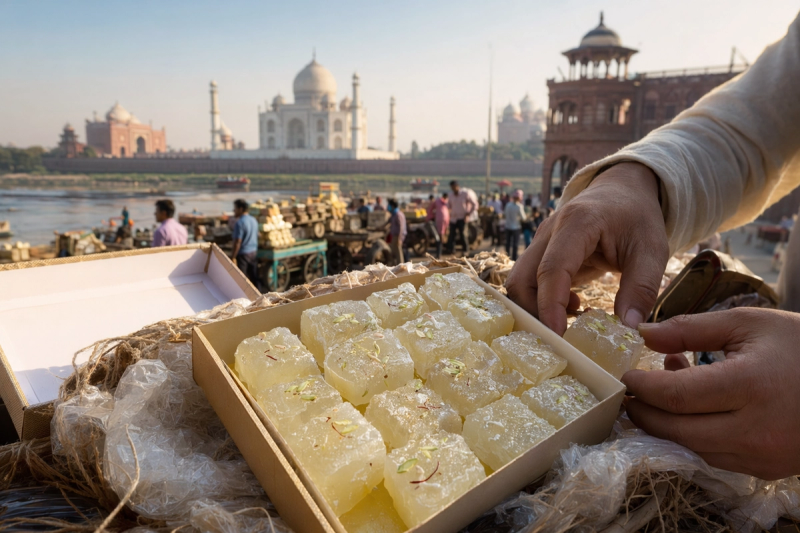
The petha box I almost ruined on the train
#I have a very specific memory of Agra: one hand holding a paper cup of over-sweet railway chai, the other hand guarding a white cardboard box of petha like it had diamonds inside. This was at Agra Cantt station, late afternoon, when everyone seemed to be dragging luggage, children, and snacks in every direction. My train was delayed just enough to make me hungry and annoyed, and the petha box was getting warm on my lap. Not hot, exactly. Just that slightly sweaty warmth that makes you think, hmm, maybe sugar syrup and North Indian heat are not best friends.
Agra petha is one of those sweets that people talk about like a souvenir, but it’s more than that. It’s made from ash gourd, also called winter melon, cooked into this translucent, chewy-soft candy soaked in sugar syrup. When it’s good, it has this clean sweetness that doesn’t feel as heavy as gulab jamun or jalebi. When it’s bad, or badly packed, it becomes sticky, leaky, and sad. I’ve carried it on trains, buses, and once in a backpack that also had camera batteries and a half-crushed packet of namkeen. Bad idea. Very bad idea.
So this is my slightly obsessive, very lived-in guide to buying Agra petha, packing it properly, and surviving train travel with it. Because yes, you can take it home fresh. But you do need to think a little. Not panic, not over-engineer it like you’re transporting a kidney, but just be sensible.
First, don’t buy petha like you’re panic-shopping before the train
#This is the mistake I made on my first Agra trip. I spent the whole day doing the Taj Mahal, Agra Fort, Mehtab Bagh, and then suddenly, 45 minutes before my train, I remembered: petha! So I ran into the nearest sweet shop outside a busy road, pointed at the prettiest colorful pieces, and walked out with two boxes. One was decent. The other tasted like sugar and fridge smell had a baby.
Agra has petha everywhere, especially around tourist routes and railway-station-adjacent markets. You’ll see plain white petha, kesar petha, paan petha, angoori petha, dry petha, chocolate petha, sandwich-style petha, and probably some flavor that didn’t exist the last time you visited. Some shops are old and reputed, some are newer, some use famous-sounding names that can confuse visitors. My rule now is boring but useful: don’t buy only by the signboard. Look at turnover, packaging, smell, and how the staff handles the sweet.
If a shop is busy with locals buying small quantities for home, that’s usually a better sign than a counter stacked with dusty gift boxes. Ask when it was made. Check if the box has a packing date or manufacturing date, especially if you’re buying sealed packs. If there’s an FSSAI license number on packaged sweets, good. If the petha is sitting open near flies and exhaust fumes, maybe admire it emotionally and keep walking.
Fresh petha versus dry petha: this choice matters more than people admit
#Fresh, syrupy petha is lovely when you eat it in Agra. I mean, really lovely. The texture is softer, juicier, almost glassy. I like eating it slightly cool, after a spicy kachori breakfast, when my mouth is still recovering from hing and chilli. But for travel? Fresh petha can be a drama queen.
The wetter varieties leak more easily, absorb smells, and get weird if left in heat for too long. Dry petha, the kind with a drier sugar-coated exterior, usually behaves better in trains because it doesn’t slosh around in syrup. Angoori petha can travel okay if packed well, but the syrupy ones need more care. Paan petha and chocolate-coated types are fun for novelty, but I don’t trust them for long journeys unless I know the shop and the weather is kind.
If I’m travelling within 4 to 6 hours, I’ll consider fresh petha. If it’s an overnight train, a summer trip, or I’m changing trains somewhere chaotic like Delhi, I choose dry petha or a sealed pack. It’s not as romantic, but neither is opening your bag and finding your kurta smelling like sugar syrup. For a similar Indian sweet packing dilemma, I had the same kind of “should I carry it or just eat it there?” debate with Chhena Poda Travel Packing: Freshness & Carry Tips, because some sweets are emotionally perfect and logistically annoying.
My buying checklist, learned through sticky fingers
#- Ask for a small tasting piece if the shop allows it. Good petha should not taste stale, sour, smoky, or like old sugar syrup.
- Look at the syrup. If it’s fresh petha, the syrup should look clean, not cloudy or fermented-looking. I know, “fermented-looking” is not a technical term, but you’ll know.
- Choose pieces that are intact. Broken petha gets mushier faster and releases more moisture in the box.
- For train journeys, ask for travel packing. Some shops will add butter paper, plastic lining, sealed trays, or sturdier boxes.
- Don’t mix flavors in one box if you’re carrying it far. Paan petha perfume can take over everything, and chocolate petha near plain petha is just… no.
- Buy closer to departure, but not at the last second. Give yourself time to inspect the packaging and repack if needed.
One shopkeeper in Agra once told me, “Madam, dry wala le jao, train mein safe rahega,” and I ignored him because the fresh kesar petha looked prettier. By Mathura, the syrup had leaked into the carry bag. By Delhi, I was holding the box upright like a science experiment. The shopkeeper was right. They often are, especially when they’ve watched thousands of tourists make the same dumb choice with confidence.
What to pack before you leave your hotel
#This is the part nobody wants to do because it sounds unglamorous. But five minutes of prep can save your luggage. I now carry one extra zip pouch or reusable food-safe bag whenever I travel for food shopping. Not fancy. Just something that seals. If I know I’ll buy sweets, I also keep a few paper napkins and one thin cloth bag, because Indian sweet boxes are often sturdy until they meet real travel.
For petha, the dream setup is: shop box inside a sealed food bag, then that inside a rigid-ish outer bag or a small tote, kept upright. If you have a hard lunchbox or plastic container, even better. Don’t put the petha box directly in your suitcase between clothes unless it’s very dry and properly sealed. Sugar finds a way. It always finds a way.
Also, don’t pack petha with strong-smelling food. I once kept it near garlic pickle from a dhaba stop, and the plain petha picked up this faint achar smell. Some people might call that fusion. I call it a personal failure.
Train travel tips: Agra station to your kitchen without heartbreak
#Agra is well connected by train, and many food travelers do exactly what I do: visit the Taj, eat too much, buy sweets, then hop onto a train toward Delhi, Jaipur, Lucknow, Gwalior, Bhopal, or wherever the next plan is. Train travel is actually pretty good for petha if you don’t treat your snack bag like a punching bag. The problem isn’t the train itself. It’s heat, pressure, delays, and your own laziness after a long sightseeing day.
- Keep petha in your hand luggage, not deep inside a suitcase that may be thrown under the berth.
- Place it flat and upright. Sounds obvious, but I’ve seen people tilt sweet boxes sideways to fit them into backpacks. Please don’t.
- Avoid the window ledge in strong sun. Train windows can heat up boxes faster than you expect.
- Don’t open the box repeatedly during the journey unless you’re eating it. Every opening adds dust, humidity, fingers, and temptation.
- If the train is delayed badly and it’s peak summer, eat the more delicate pieces first or share them. This is not defeat, this is wisdom.
I like keeping petha in the upper part of my tote with water bottle on one side, not pressing into it. If I’m carrying other food, like kachori or bedai, I separate them completely. Fried food smell is powerful. You think the box is closed, but by evening your sweets taste like station breakfast. Not always terrible, honestly, but not what you paid for.
Summer, monsoon, winter: the weather changes the whole game
#Agra can be brutal in summer. I’ve walked around there in May and felt like the road was breathing hot air back at me. In that weather, I don’t buy very wet petha unless I’m eating it the same day. Heat makes sweets sweat, packaging softens, and anything dairy-adjacent or cream-filled is obviously a bigger risk, though traditional petha itself is mainly ash gourd and sugar.
Monsoon is sneaky. It may not feel as hot, but humidity makes packaging damp and sugar-coated pieces can get sticky quicker. If you’re travelling during wet weather, ask for sealed packaging and avoid buying from open trays that look like they’ve been sitting uncovered for ages. Dry petha is still your better friend here.
Winter is the easiest time. The petha stays calmer, your bag doesn’t become a sauna, and you can be slightly more relaxed. Slightly. I still wouldn’t leave it in a taxi boot all afternoon while you go sightseeing. Food souvenirs need respect, ya know.
How long does petha stay fresh? The honest answer is annoying
#People love asking, “How many days will it last?” and I get why. You want to take it home for parents, office people, neighbors, maybe that one auntie who judges sweets very seriously. But the real answer depends on the type, how fresh it was when packed, how much moisture it has, weather, packaging, and whether you kept it cool and clean.
Instead of chasing a magic number, I follow a simple rule: buy as fresh as possible, carry as cool as practical, and eat sooner rather than later. If the shop gives a best-before date on sealed packaging, follow that. For loose fresh petha, I try to finish it quickly after reaching home, especially in warm weather. If it smells sour, looks slimy in a new way, grows anything suspicious, or tastes off, don’t do the “maybe it’s fine” thing. It’s sugar, not a life goal.
Once home, I usually transfer it to a clean airtight container and refrigerate the wetter kinds. Dry petha can sit better, but I still don’t leave it open. Sugar attracts ants with the confidence of a political rally.
What else to eat in Agra before you even think about packing sweets
#Agra is not only petha, though petha gets the souvenir fame. I actually think your petha-buying decisions get better after you’ve eaten properly. Start the morning with bedai and aloo sabzi if you can handle spice early in the day. It’s crisp, hot, messy, and the potato curry often has that hing-heavy punch that wakes you up faster than coffee. Then there’s kachori, jalebi, lassi, chaats, and Mughlai-style gravies depending on where you go and what mood you’re in.
Around the old city and busy markets, food is not always polished, but it has personality. Sadar Bazaar is popular with visitors, and Kinari Bazaar has that older market chaos where you’re dodging scooters and suddenly smelling frying dough. Near the Taj side, plenty of restaurants cater to tourists, some good, some just convenient. I’ve had both “wow, I’m so glad I stopped here” meals and one very boring paneer dish that tasted like the chef had emotionally resigned.
My favorite food days in Agra are the ones where I don’t overplan. A small breakfast, one proper local snack, a slow lunch if the heat allows, then petha shopping near the end. If your stomach is sensitive, or it’s a hot travel day and sugar feels like a bad idea, gentler local options can be smarter. I’ve written down similar thoughts around Gut-Friendly Uttar Pradesh Foods for Travelers, because sometimes the most delicious travel choice is the one that doesn’t ruin your train ride.
The great petha suitcase debate: cabin bag, backpack, or checked luggage?
#For trains, keep it with you. That’s my firm opinion. In flights, I prefer cabin baggage for sealed dry petha, but always check airline rules and common sense around liquids or syrupy foods. For trains though, the answer is simple: hand luggage. Indian train luggage spaces are not gentle little shelves designed for fragile sweets. They are survival zones. Your box might get crushed under someone’s steel trunk, a backpack, or a child who has decided the berth is a climbing wall.
Backpacks are okay only if the box is rigid and you don’t overstuff. Soft tote bags are okay if you keep the box flat. Suitcases are okay for dry sealed packs, but I still put the box inside another bag. If you’re carrying fresh syrupy petha, suitcase packing is risky unless you have a leakproof container.
And please don’t put it near toiletries. I once carried sweets next to a small bottle of hair oil. Nothing leaked, technically, but the smell got into everything. There are few sadder things than opening a box of sweets and thinking of coconut hair oil before sugar.
Packing petha with other snacks: possible, but don’t be reckless
#I love a travel snack bag. I’m that person with roasted chana, namkeen, fruit, sometimes thepla, and emergency chocolate that melts anyway. But petha needs its own little territory. It doesn’t like moisture from fruit, it doesn’t like masala dust from chips, and it definitely doesn’t like being squeezed by water bottles.
If you want a safer crunchy snack for long travel, Bikaneri bhujia is honestly easier to carry than petha, though it has its own enemy: humidity. A sealed pack of bhujia can survive a journey better than fresh sweets, as long as you protect it from moisture and crushing. I compared those snack-packing headaches in Bikaneri Bhujia as a Travel Snack: Packing Guide, and it made me realize how different Indian food souvenirs behave once they leave their hometown.
My current snack bag order is: dry snacks at the bottom, water bottle upright on the side, petha on top or in a separate hand bag, napkins shoved somewhere I can actually reach. It sounds fussy until you’re on a moving train with sticky fingers and no tissue. Then you become religious about napkins.
How I serve petha after bringing it home
#This is my favorite part. Coming home, opening the box, and watching people pretend they’ll “just take one piece.” Nobody takes one piece. Petha looks innocent, but it disappears in a very sneaky way.
I serve plain petha chilled sometimes, especially after a heavy meal. Kesar petha goes nicely with tea, though some people find it too sweet with chai. Dry petha is good for gifting because it looks cleaner and holds shape better. Paan petha is divisive in my house. My cousin loves it. My mother says it tastes like mouth freshener trying to become dessert. Both are right, somehow.
If the pieces are very sweet, cut them smaller before serving. This sounds like auntie advice, but it works. Small pieces make it easier to enjoy without sugar overload. Also, don’t serve all varieties together if you bought flavored ones. The strong aromas mix, and suddenly everything tastes vaguely paan-chocolate-kesar, which is not a flavor journey I recommend.
A small reality check on gifting petha
#Food gifts are emotional. You bring petha because it says, “I thought of you in Agra.” But if you’re travelling far, don’t buy huge quantities just because the shopkeeper offers a deal. Buy what people can eat while it’s still at its best. A smaller fresh box is better than a giant stale one. I know this, and still I sometimes overbuy because I get excited. Human weakness.
For office gifting, dry petha or sealed mixed boxes work better. For family, fresh petha is fine if you’re reaching soon. For someone elderly or health-conscious, maybe ask first, because petha is sweet-sweet. Like, not pretending otherwise sweet. And if anyone has dietary restrictions, diabetes concerns, or is avoiding sugar, don’t force it as “just one piece.” Indian families do this too much.
Also carry the bill if you’re buying from a known shop and gifting formally. It helps if someone wants to know the shop name or date, and it’s useful if there’s any issue. Not romantic, but practical.
My final petha train formula
#If you want the short version, here’s mine: buy from a busy, clean shop, choose dry petha for longer train journeys, get proper travel packing, keep it upright in hand luggage, protect it from heat, and eat it soon after reaching. That’s it. No need to make it complicated, but don’t treat it like a packet of biscuits either.
The best Agra petha experience, for me, is still eating a piece in the city itself. Maybe after walking too much near the Taj, maybe in a market where the traffic is loud and your feet hurt, maybe standing outside a shop while the guy behind the counter tells you which flavor is freshest. Travel food has this magic because it belongs to a place. Bringing it home is wonderful, but it’s also a little negotiation with weather, trains, bags, and patience.
And honestly, that’s why I love food travel. It’s never just “buy sweet, go home.” It becomes a story. A sticky box on a train. A shopkeeper’s advice you should’ve listened to. A cousin fighting over the last kesar piece. Next time I’m in Agra, I’ll probably still buy too much petha, because of course I will. But I’ll pack it better. Maybe. If you like these slightly messy food-and-travel notes, I keep finding more lovely rabbit holes on AllBlogs.in.