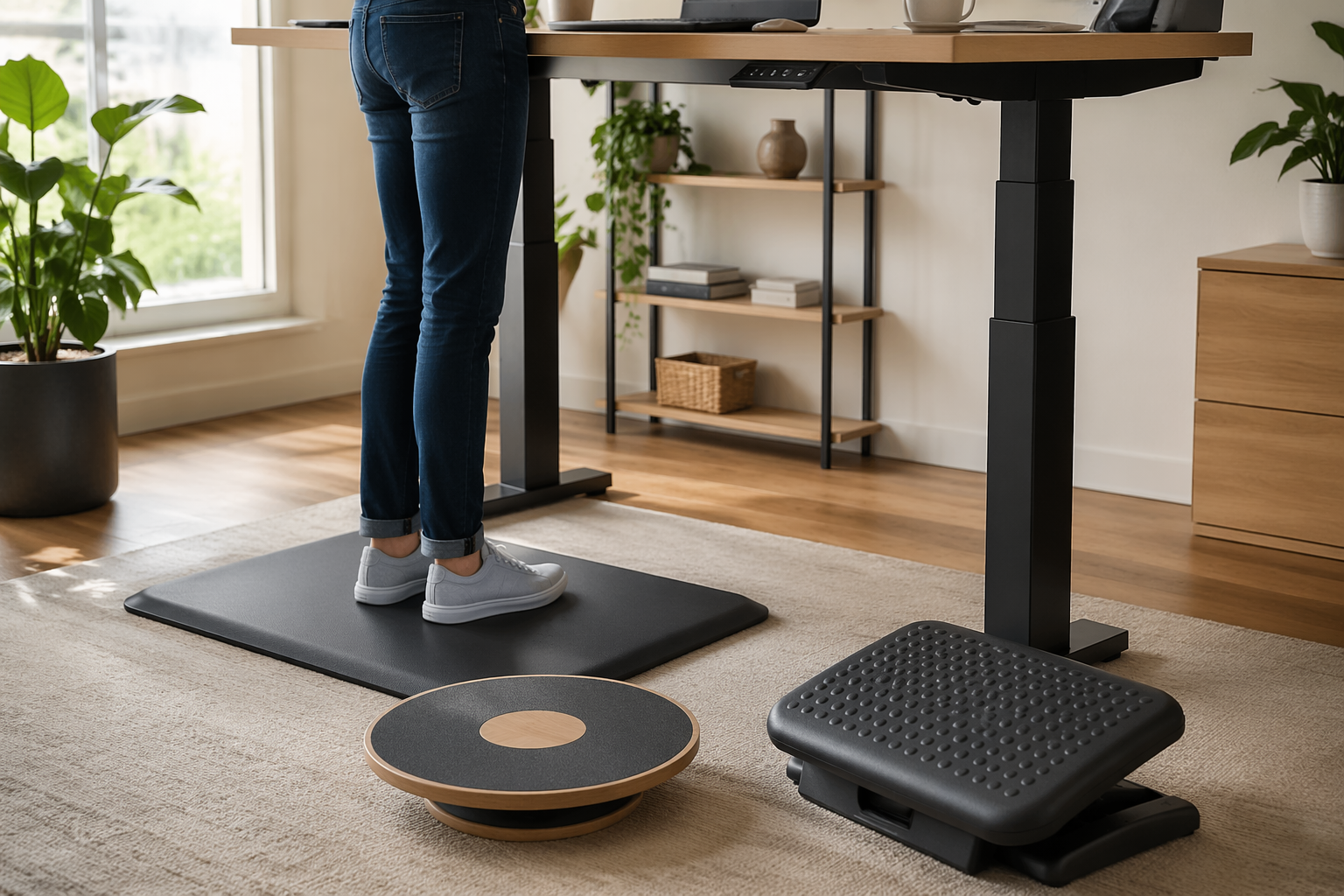
If you’re trying to choose between an anti-fatigue mat, a balance board, and a footrest for your standing desk, here’s the short version:
For most people, start with an anti-fatigue mat.
It’s simple, comfortable, beginner-friendly, and you don’t need to “figure it out.” You place it under your feet and get on with your work.
A balance board is great if you like moving while you work. A standing desk footrest is better if your lower back gets tight because you tend to stand too stiffly.
So yes, all three can be useful. But they solve slightly different problems.
Quick Answer: What Should You Buy First?
#Best first buy for most people: Anti-fatigue matBest for active movement: Balance boardBest for lower-back relief and posture changes: Standing desk footrest
Quick comparison:
- Anti-fatigue mat for standing desk: Best for longer standing sessions, foot comfort, heel and knee pressure relief. Not ideal if you mainly want active movement or light exercise while working.
- Balance board for standing desk: Best for restless workers, fidgety people, light movement and dynamic standing. Not ideal for beginners, deep-focus work, balance issues or ankle problems.
- Standing desk footrest: Best for lower-back tightness, shifting weight, compact desk setups and sit-stand use. Not ideal if you mainly need cushioning under both feet.
Why This Choice Actually Matters
#A standing desk is helpful, but it is not magic.
If you stand on a hard floor for too long, your heels can ache, your knees can start to feel stiff, and your lower back may quietly begin complaining by the end of the day.
And honestly, that’s normal. Standing is still standing.
The mistake many people make is thinking they need to buy every standing desk accessory at once. You really don’t.
A better approach is to buy the one accessory that solves your biggest problem first. Use it for a while. Then, if something still feels off, add another.
So let’s compare the three most common options: an anti-fatigue mat, a balance board, and a footrest. No overcomplication. No turning your desk area into a mini gym.
Anti-Fatigue Mat for Standing Desk: The Best First Upgrade for Most People
#An anti-fatigue mat is a cushioned mat that sits under your feet while you work at a standing desk.
That’s it. Nothing fancy.
But if you’re standing on tile, concrete, hardwood, laminate, or any other hard surface, it can make a surprisingly big difference.
The mat gives your feet a softer, more forgiving surface. It also encourages tiny movements in your feet and legs, even if you don’t notice them. That means you’re less likely to stand completely stiff with your knees locked.
The best part is that it doesn’t ask anything from you. You don’t have to balance. You don’t have to change how you work. You just stand on it.
Who should buy an anti-fatigue mat?
#Buy an anti-fatigue mat if:
- You are new to standing desks.
- You stand for longer work sessions.
- Your heels, knees, calves, or lower back feel tired on hard floors.
- You want comfort without distraction.
- You do focused work like writing, coding, studying, designing, or editing.
- You want the safest first standing-desk accessory.
For most people comparing an anti-fatigue mat vs balance board vs footrest, the mat is the easiest recommendation. It helps the most people with the least effort.
Who should avoid an anti-fatigue mat?
#You may not need one right away if:
- You want movement more than cushioning.
- You already walk around often and rarely stand still.
- Your desk area is very tight.
- You prefer resting one foot on something raised.
- Your main issue is lower-back tightness, not sore feet.
Best use case
#An anti-fatigue mat is best for steady work.
If you want to stand comfortably during writing, calls, coding, studying, design work, editing, or general office tasks, this is usually the place to start.
Balance Board for Standing Desk: Best If You Hate Standing Still
#A balance board for standing desk use is a very different experience.
An anti-fatigue mat gives you a stable, cushioned surface. A balance board gives you controlled instability.
In plain English, it wobbles a little. Your body has to make small adjustments to stay balanced.
Some people love this. It keeps them awake, alert, and lightly active while working.
Other people find it annoying within five minutes.
That’s why a balance board is not really a basic comfort accessory. It’s more of an active-standing tool.
Who should buy a balance board?
#Buy a balance board if:
- You naturally fidget while working.
- You get bored standing in one place.
- You want light core and leg engagement.
- You like moving during calls or casual work.
- You already feel comfortable standing for a while.
- You want standing to feel more active.
A balance board can make standing feel less boring. For some people, that little bit of movement is exactly what helps them stay at their desk instead of sitting back down after ten minutes.
Who should avoid a balance board?
#Be careful with a balance board, or skip it, if:
- You are brand new to standing desks.
- You need deep focus and movement distracts you.
- You have balance issues.
- You have ankle, knee, or foot problems.
- You work on thick carpet.
- You just want comfort, not another thing to manage.
A balance board sounds more exciting than a mat, and honestly, it is. But exciting does not always mean better.
If your feet already get tired from standing, adding wobble can make standing feel harder instead of easier.
Best use case
#A balance board is best for short active-standing sessions, meetings, brainstorming, casual admin tasks, and people who genuinely enjoy moving while they work.
It is not always the best option for intense writing, detailed spreadsheets, editing, or any task where you need to stay very focused.
Standing Desk Footrest: A Small Fix That Can Help Your Lower Back
#A standing desk footrest gives you a raised place to rest one foot while standing.
It sounds almost too simple, but it can be very helpful.
When both feet are flat on the floor, many people naturally lock their knees and stand in one rigid position. After a while, that can make the lower back feel tight.
A footrest changes that.
When you place one foot on it, your hips shift slightly, your stance changes, and your lower back gets a break from the same fixed posture. Then you switch feet. Then you switch again.
It’s not soft like a mat. It’s not active like a balance board. It sits somewhere in the middle: simple, stable, and useful.
Who should buy a standing desk footrest?
#Buy a footrest if:
- Your lower back gets tight when standing.
- You tend to lock your knees.
- You want to shift weight more often.
- You have a small desk area.
- You switch between sitting and standing.
- You want something compact and easy to keep under the desk.
A footrest is especially helpful if your main problem is not sore feet, but standing too stiffly.
Who should avoid a standing desk footrest?
#Skip it if:
- Your feet hurt because you stand on a hard floor.
- You want cushioning under both feet.
- You want active movement.
- You don’t like changing foot positions while working.
- You prefer a larger standing surface.
Best use case
#A standing desk footrest is best for people who switch between sitting and standing, workers with compact home-office setups, and anyone who feels lower-back strain from standing in one position for too long.
Anti-Fatigue Mat vs Balance Board vs Footrest: Direct Comparison
#Here’s the practical comparison. No fake scoring system. No dramatic claims. Just what each one is actually good at.
Anti-fatigue mat:
- Comfort style: passive cushioning.
- Best first buy: yes, for most people.
- Learning curve: very low.
- Distraction level: low.
- Space needed: medium.
- Best for deep work: yes.
- Helps with foot pressure: yes.
- Helps with lower-back stiffness: sometimes.
- Best for small spaces: choose a smaller flat mat.
Balance board:
- Comfort style: active movement.
- Best first buy: usually not.
- Learning curve: medium.
- Distraction level: medium to high.
- Space needed: small to medium.
- Best for deep work: not always.
- Helps with foot pressure: somewhat.
- Helps with lower-back stiffness: through movement.
- Best for small spaces: depends on the board size and floor type.
Standing desk footrest:
- Comfort style: weight shifting.
- Best first buy: yes, if back tightness is your main issue.
- Learning curve: very low.
- Distraction level: low.
- Space needed: small.
- Best for deep work: yes.
- Helps with foot pressure: not much.
- Helps with lower-back stiffness: often, yes.
- Best for small spaces: yes.
The Simplest Buying Order
#If you’re building your standing-desk setup one piece at a time, this order makes the most sense:
- Start with an anti-fatigue mat if you want general comfort.
- Add a footrest if your lower back still feels tight.
- Try a balance board if you want more movement and can focus while using it.
That order works well because it solves the basic problem first: standing comfortably.
Once that’s handled, you can think about posture variety or active movement.
What to Check Before Buying
#Before you buy anything, run through this quick standing desk comfort checklist.
1. Check your floor type
#Hard floors usually pair well with anti-fatigue mats. If you’re standing on tile, concrete, hardwood, or laminate, a mat can make the floor feel much less harsh.
Thick carpet is different. A mat may feel too soft, and a balance board may not tilt properly. If you have hardwood floors, also check whether the accessory has a non-slip base and won’t scratch the surface.
2. Check your available space
#Small rooms and compact desk corners need more planning.
A large mat may feel great, but it can get annoying if your chair keeps catching on it. A balance board may be easy to store, but you still need enough space to use it safely. A footrest is usually the easiest to tuck under the desk.
Before buying anything bulky, measure the area where your feet actually go.
3. Check your work style
#Think about what you do while standing.
If you write, code, study, edit, design, or do detailed work, you’ll probably prefer something stable. That usually means a mat or footrest.
If you take calls, brainstorm, or do lighter tasks, a balance board may feel more natural.
4. Check your footwear habits
#Be honest about how you actually work at home.
Do you stand barefoot? In socks? Slippers? Shoes?
A soft anti-fatigue mat can feel great barefoot. A harder balance board or metal footrest may not. Buy for your real habits, not the ideal version of yourself who suddenly wears supportive shoes all day.
5. Check whether you sit and stand
#If you switch between sitting and standing, think about how easy the accessory is to move.
A footrest can usually stay under the desk. A flat mat is often easier to manage than a bulky contoured mat. A balance board may need to be moved aside every time you sit down, which can get annoying fast.
Common Mistakes to Avoid
#Mistake 1: Buying the most exciting accessory first
#A balance board is more fun than a mat. No argument there.
But if you’re not already comfortable standing for a decent work session, it may become tiring quickly.
Start with comfort. Add movement later if you still want it.
Mistake 2: Standing too long just because you bought an accessory
#A mat, board, or footrest does not mean you should stand all day.
The goal is not to replace eight hours of sitting with eight hours of standing. The better habit is to move between sitting, standing, stretching, and walking when you can.
Mistake 3: Ignoring how you naturally work
#Some people stand still. Some sway. Some pace during calls. Some don’t notice their posture until something starts hurting.
Your accessory should match your natural work style.
If you hate standing still, a balance board may help. If you like feeling stable while you work, it may drive you crazy.
Mistake 4: Buying something too bulky for your space
#Floor clutter matters more than people think, especially in a small home office.
A huge mat or wide balance board may look useful online, but if it gets in the way every day, you’ll stop using it.
Measure first. Buy second.
Mistake 5: Expecting one product to fix everything
#These accessories overlap a little, but they are not the same.
An anti-fatigue mat helps with standing comfort.A footrest helps you change posture.A balance board adds movement.
Pick the tool that matches your main problem.
Which One Should You Buy Based on Your Problem?
#“My feet hurt when I stand.”
#Buy an anti-fatigue mat for standing desk use.
It is the most direct fix for hard floors and sore feet.
“My lower back gets tight.”
#Try a standing desk footrest.
It encourages you to raise one foot, switch sides, and avoid staying locked in one posture.
“I get bored standing still.”
#Choose a balance board for standing desk use.
Just make sure you’re comfortable with movement while working.
“I have a very small desk area.”
#A footrest is usually easiest to manage.
A smaller flat mat can also work. Be more careful with large contoured mats or wide balance boards.
“I am buying my first standing-desk accessory.”
#Start with an anti-fatigue mat, unless your main issue is clearly lower-back tightness.
For most people, it’s the safest and most useful first purchase.
Final Takeaway: The AllBlogs Buying Verdict
#If you want the safest first purchase, buy an anti-fatigue mat.
It is practical, comfortable, low-effort, and useful for the widest range of standing-desk users.
If your lower back gets tight, add a standing desk footrest. If you want more movement and enjoy active standing, try a balance board once you’re already comfortable standing.
The smartest setup is not the one with the most accessories.
It’s the one you’ll actually use every day.