
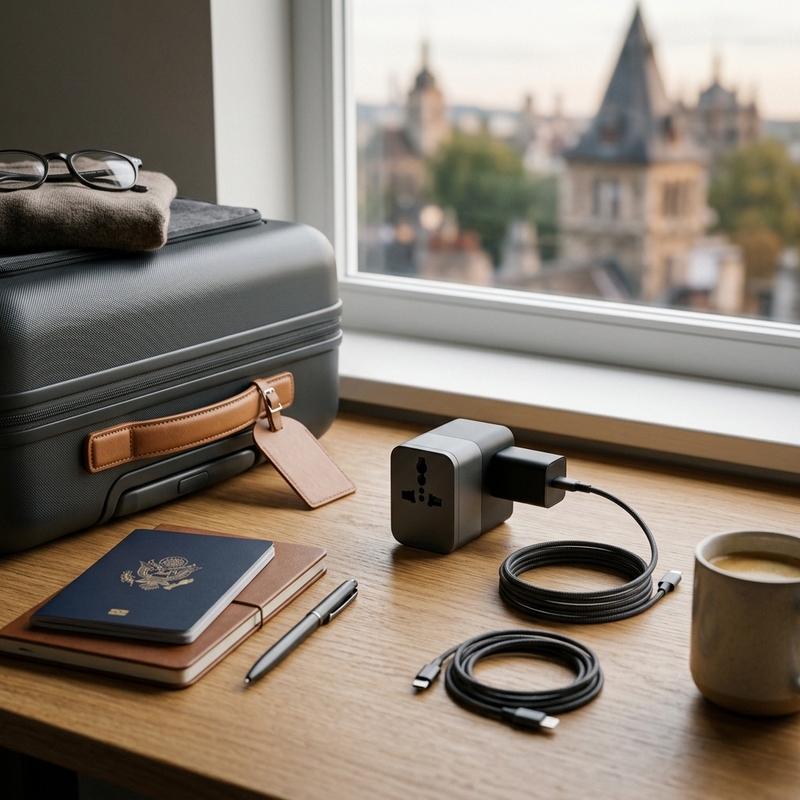
If you’re travelling abroad from India and wondering whether to buy a universal travel adapter or a GaN charger, here’s the simplest answer: most Indian travelers should carry a destination-compatible plug adapter plus a compact multi-port USB-C GaN charger. If you visit multiple plug regions often, a GaN universal travel adapter is the cleanest all-in-one choice.
Quick Answer
#- Universal travel adapter: Helps your Indian plug fit into foreign sockets. It does not convert voltage.
- GaN charger: A compact, efficient fast charger, usually with USB-C ports.
- Best option for most frequent travelers: A GaN universal travel adapter with EU, UK, US, and Australia plug support.
- Best wattage range to check: Phone-only travelers can choose lower wattage; laptop users should check their laptop charger label and buy enough USB-C PD output for that device.
- Best for families: A compact travel power strip, especially if the hotel room has limited plug points.
Planning an international trip already comes with enough small decisions: passport, visa, forex card, roaming pack, travel insurance, luggage weight, hotel bookings, airport rules, local SIM cards — and then you suddenly realise your Indian charger may not even fit the wall socket abroad.
Every product says “universal”, “worldwide compatible”, “fast charging”, “PD”, or “GaN”. It sounds useful, but it’s not always obvious what you actually need.
For Indian travelers, the real question is not just: “Will my plug fit?” The better question is: “Can I safely charge my phone, laptop, power bank, smartwatch, camera battery, and earbuds without carrying half my electronics drawer?”
Who this guide is for
#This guide is for:
- Indian travelers going abroad for the first time.
- Students moving overseas.
- Families sharing one hotel room with too few sockets.
- Remote workers carrying a laptop and phone.
- Travelers confused by plug adapters, USB-C PD, GaN chargers, and travel power strips.
Universal Travel Adapter vs GaN Charger vs Travel Power Strip
#Basic universal travel adapter
#A basic universal travel adapter helps your Indian plug fit into wall sockets in other countries.
It is useful if you’re carrying devices that already have their own chargers, such as:
- Laptop charger
- Camera battery charger
- Trimmer
- Electric toothbrush
- Any device with an Indian plug
A basic travel adapter only changes the plug shape. It does not make your device charge faster. It does not convert voltage. And if it has USB ports, those ports may be slow on cheaper models.
Best for: short trips, one or two devices, and travelers who already have reliable chargers.
Avoid if: you need fast USB-C laptop charging or want to charge many devices at once.
GaN charger for travel
#A GaN charger is a newer type of charger that is usually smaller, faster, and more efficient than many older bulky chargers.
It is useful for:
- Phones
- Tablets
- USB-C laptops
- Earbuds
- Smartwatches
- Power banks
But a GaN charger is not automatically an international plug adapter. If your GaN charger has an Indian plug, you may still need a travel adapter abroad.
Best for: travelers who already know their destination plug type and want compact fast charging.
Avoid if: you expect it to fit every foreign wall socket without an adapter.
GaN universal travel adapter
#This is often the simplest option for frequent Indian travelers.
A GaN universal travel adapter combines international plug support with built-in USB-C charging. So instead of carrying a separate adapter and a separate charger, you carry one device.
Look for:
- USB-C PD support.
- EU, UK, US, and Australia plug support.
- Clear per-port output details.
- Safety markings and fuse protection.
- A design that sits firmly in wall sockets.
Best for: solo travelers, students, remote workers, and frequent flyers.
Avoid if: you only travel once to one country and already own a good charger.
Travel power strip
#A travel power strip is useful when your problem is not speed, but lack of sockets.
This happens a lot when travelling with family. One hotel room, one plug point near the bed, and four people trying to charge phones, watches, tablets, and power banks at the same time.
Best for: families, content creators, students in shared rooms, and travelers with many devices.
Avoid if: you travel light or only need to charge one phone and one laptop.
What to check before buying
#1. Plug type coverage
#For many international trips, your adapter should support:
- EU-style plugs for many European countries.
- UK-style plugs for the United Kingdom, Singapore, and some other regions.
- US-style plugs for the United States, Japan-style Type A sockets, and some other countries.
- Australia-style plugs for Australia and New Zealand.
Always check the destination country before you buy. Some countries use more than one socket type.
2. USB-C PD support
#USB-C alone is not enough.
For fast charging, especially for laptops, look for USB-C Power Delivery, usually written as USB-C PD.
Check your own laptop charger label first. If your laptop needs more power than the adapter can provide, it may charge slowly or not charge while in use.
3. Total wattage vs per-port wattage
#A charger may advertise a high total output, but that does not always mean every port gives that much power.
Before buying, check:
- Maximum output from one USB-C port.
- Total output when multiple ports are used.
- Whether the laptop port still gets enough output when your phone is also plugged in.
- How the wattage changes when two or three devices are connected.
4. Voltage compatibility
#A universal travel adapter changes the plug shape. It does not convert voltage.
India uses 230V. Some countries use lower voltage. Many modern phone and laptop chargers support 100V to 240V, which generally makes them suitable for worldwide travel.
Check the label on your charger. If it says Input: 100-240V, it is generally designed for international use.
Be extra careful with heat-based appliances such as:
- Hair dryers
- Hair straighteners
- Electric kettles
- Steam irons
- Some grooming devices
These appliances can use a lot of power and may be unsafe if voltage or wattage does not match.
5. Safety and build quality
#Look for:
- Recognised safety markings.
- Fire-resistant material.
- Fuse protection.
- Solid pins that don’t wobble.
- Clear voltage and wattage information.
- A spare fuse if the adapter uses replaceable fuses.
A loose adapter hanging out of a hotel wall socket is not something you want connected to your laptop.
Practical buying checklist
#Before you buy, ask these questions:
- Which country or countries am I visiting?
- Which plug types do those countries use?
- Does my laptop charge through USB-C?
- What wattage does my laptop charger label mention?
- Do I need to charge one device or several devices together?
- Will I share a hotel room with family?
- Does the adapter clearly mention USB-C PD and per-port output?
- Does the product clearly say it is not a voltage converter?
- Does it have safety markings and a sturdy build?
- Have I tested it at home before flying?
Best setup by traveler type
#Short solo trip
#Carry:
- One GaN universal travel adapter or one country-specific plug adapter plus a GaN charger.
- One USB-C to USB-C cable.
- One phone cable.
- One compact power bank in cabin baggage.
Student going abroad
#Carry:
- One reliable GaN universal travel adapter.
- One spare USB-C cable.
- One basic plug adapter as backup.
- Original laptop charger if your laptop needs higher wattage.
- Power bank in cabin baggage.
Family vacation
#Carry:
- One good universal adapter.
- One compact travel power strip.
- Two to three charging cables.
- One or two power banks in cabin baggage.
- Original chargers for important devices.
Camera, drone, or content gear
#Carry:
- One GaN universal adapter.
- One travel power strip if you charge multiple batteries.
- Original camera or drone battery charger.
- Extra cables.
- Power bank in carry-on baggage.
Do not assume one small adapter can handle everything at once. Check the total load before plugging in multiple battery chargers.
Mistakes to avoid
#Thinking an adapter is a voltage converter
#This is the biggest mistake. A travel adapter changes plug shape. It does not convert voltage.
Ignoring power sharing
#A charger may work well when only your laptop is connected. Add a phone and smartwatch, and the laptop may charge slowly. Test your real setup before travel.
Packing power banks in checked luggage
#Power banks with lithium-ion batteries should go in cabin baggage, not checked luggage. The same cautious approach applies to small rechargeable devices such as portable hand fans.
Buying at the airport after landing
#Airport electronics shops may be expensive and may not have the wattage or plug type you need. Buy before leaving India and test once.
Forgetting backup cables
#A good adapter is useless if your cable fails. Carry at least one reliable spare cable, especially if both your phone and laptop use USB-C.
Final takeaway
#If you’re comparing a universal travel adapter vs GaN charger, the best answer for most Indian travelers is not always one or the other.
For frequent international travel, a GaN universal travel adapter is the cleanest choice because it combines plug compatibility and compact USB-C charging. For one-country trips, a destination plug adapter plus your existing charger may be enough. For families, a compact travel power strip is often more useful than another small charger.
Before buying, check destination plug type, USB-C PD output, voltage compatibility, per-port wattage, and build quality. That small check can save you from a dead phone, a slow laptop charge, or an unsafe hotel-room charging setup.