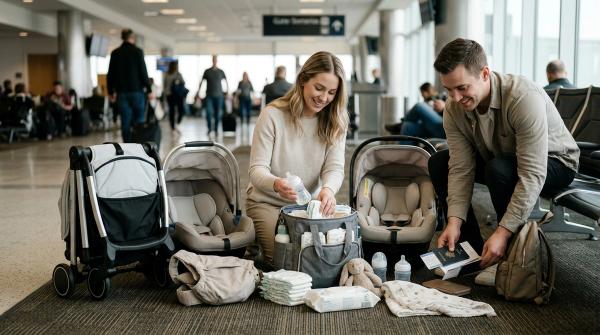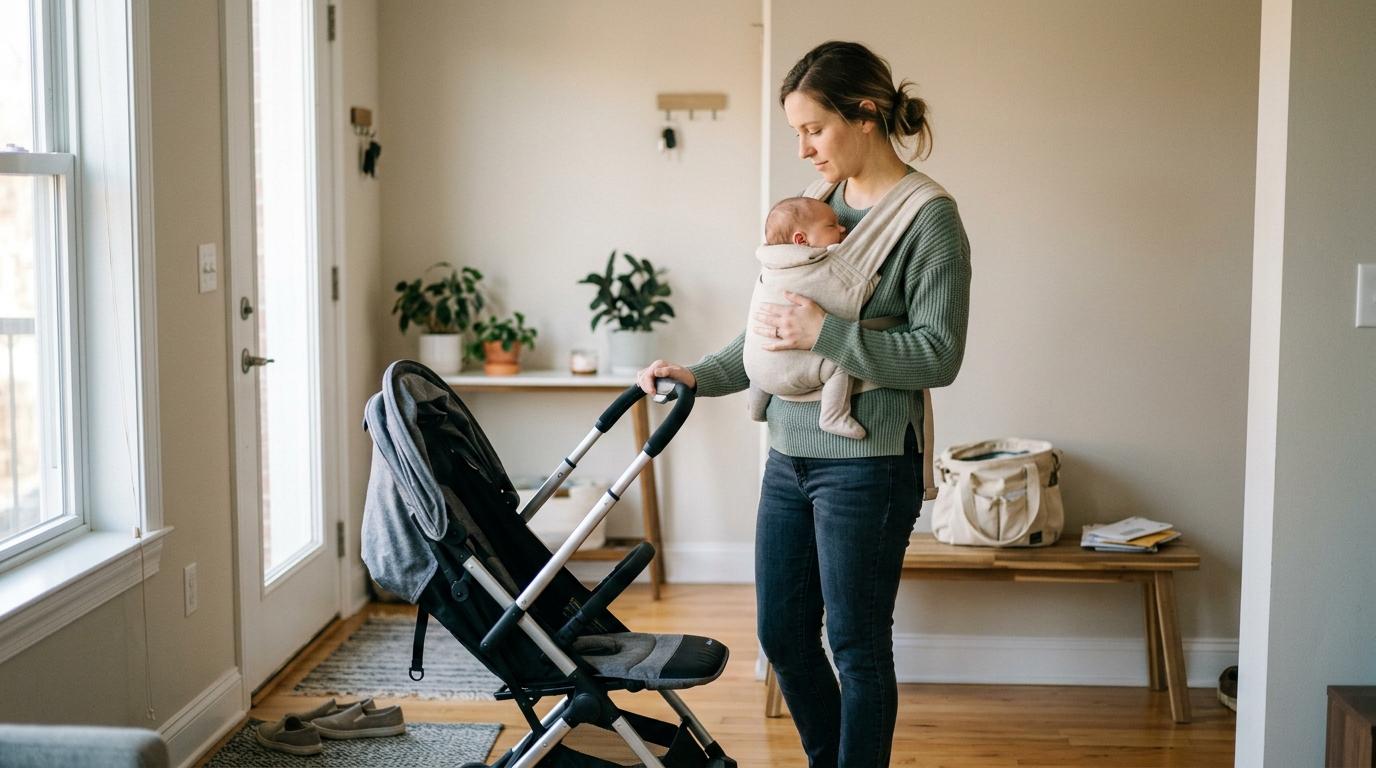
If you’re trying to choose between a stroller vs baby carrier, the most honest answer is this: buy the one that fits your real life, not the one that looks nicest online.
For many new parents, a baby carrier is the better first buy if daily life includes stairs, small lifts, public transport, crowded markets, narrow lanes, tiny apartments, or quick errands.
A stroller is the better first buy if you have smooth walking paths, reliable lifts, space at home, longer walks, or you need somewhere to keep the diaper bag, shopping, bottles, and all the extra things that somehow appear once you have a baby.
Most families eventually use both. But if you’re buying one first, choose the item that will make your normal day easier and safer.
Quick Comparison: Baby Carrier vs Stroller
#The Simple Way to Decide
#A baby carrier answers the question:
“How do I move around with my baby when life is busy, crowded, or cramped?”
A stroller answers the question:
“How do I go for longer walks and carry more stuff?”
That’s really the heart of the stroller vs baby carrier decision.
If your day involves stairs, public transport, metros, autos, narrow shops, busy markets, small lifts, or quick visits, a carrier can feel like a lifesaver in the early months.
If your day involves parks, malls, smooth pavements, long walks, car trips, and enough space at home, a stroller may be the more useful first purchase.
Neither one is automatically better. The better choice depends on your baby, your body, your home, your city, and your daily routine.
When a Stroller Makes More Sense
#A stroller is wonderful when your surroundings are stroller-friendly. Smooth paths, ramps, wide pavements, working lifts, and open spaces make a big difference.
It also gives your baby a separate place to rest, which can be helpful when you’re out for longer. And honestly, the storage basket is not a small thing. Diapers, wipes, bottles, extra clothes, toys, snacks, groceries, your own water bottle — it adds up quickly.
Choose a stroller first if:
- You take long walks often. Carrying a baby for a long time can become tiring, especially on your shoulders, back, and hips.
- Your neighbourhood has smooth paths. Wide pavements, ramps, parks, and working lifts make stroller life much easier.
- You need storage. A stroller basket is genuinely useful for diaper bags, shopping, bottles, snacks, and extra clothes.
- You drive often. If most outings start with a car, a foldable stroller can be convenient for parks, clinics, malls, and family visits.
- Your baby is getting heavier. Many parents start wanting a stroller once longer carrying sessions feel too tiring.
- You want a shaded resting spot. A stroller with a good canopy, recline, and ventilation can help during outdoor naps.
For newborns, don’t just ask, “Can this stroller be used from birth?”
Ask, “Is this stroller actually safe for my newborn’s position and breathing?”
A newborn usually needs a flat or near-flat supported position, depending on the stroller design and manual. A regular upright stroller seat is not suitable for a young baby who cannot yet control their head and neck.
When a Baby Carrier Makes More Sense
#A baby carrier is often the most practical first baby item for crowded cities, small apartments, and everyday movement.
Your baby stays close, your hands are free, and you don’t have to think about ramps, stairs, footpaths, or whether the lift is working.
Choose a baby carrier first if:
- You live in a walk-up apartment. Carrying a stroller up and down stairs while managing a baby is difficult and exhausting.
- Your lift is small or unreliable. A stroller may technically fit, but not when the lift is crowded or someone is already inside with bags.
- You use public transport. Buses, metros, trains, stations, and security checks are usually simpler with a carrier.
- You visit crowded markets. A carrier takes up roughly the same space as your body, which matters in narrow aisles and busy lanes.
- You want quick errands to stay quick. Pharmacy runs, clinic visits, school pickups, and short family visits are often easier with a carrier.
- You have limited storage at home. A carrier takes up very little space compared to a stroller.
A carrier can also help at home when your baby wants to be held but you still need to move around.
Just be careful. Don’t cook near hot oil, handle sharp objects, drink hot tea over the baby, or do risky chores while babywearing. It sounds obvious, but tired parents are running on very little sleep, and small mistakes can happen.
Newborn Safety Checks Before You Buy
#Safety should decide the final purchase. A product can be popular, expensive, beautiful, and highly rated, but still not right for your baby’s age, size, or daily use.
Before buying either a stroller or a carrier, read the manual, check the age and weight limits, and make sure it suits your newborn’s stage.
Stroller Safety Checklist
#Before buying a stroller, check:
- Harness: Look for a secure harness, usually a 5-point harness with shoulder, waist, and crotch straps. It should hold your baby safely without being too loose.
- Brakes: Test the brakes. They should lock firmly and be easy for an adult to use.
- Newborn position: For a newborn, check the manual for flat recline or bassinet compatibility. Your baby’s chin should not slump onto the chest.
- Stability: The stroller should not feel like it will tip easily, especially while turning or when the basket has items in it.
- Manual: Read the product manual for age limits, weight limits, recline positions, folding instructions, harness use, and basket limits.
- Recalls: Check the exact brand and model against official recall information. In the United States, parents can check the CPSC recall database. The eCFR stroller safety standard is listed under 16 CFR Part 1227 for carriages and strollers.
- Wheels and terrain: Match the wheels to your roads. Tiny wheels may be fine in malls, but frustrating on broken pavements.
- Canopy and ventilation: Shade matters, especially in hot weather, but airflow matters too.
Baby Carrier Safety Checklist
#Before buying a carrier, check:
- Airway first: Your baby’s face should always be visible. Fabric should not cover the nose or mouth.
- TICKS guidance: Follow the TICKS babywearing checks: Tight, In view at all times, Close enough to kiss, Keep chin off chest, Supported back.
- Fit for newborns: Check the manual for minimum weight and newborn instructions. Some carriers need an insert or special adjustment for smaller babies.
- Head and neck support: A newborn needs support, but not in a way that curls them too tightly or affects breathing.
- Hip position: The carrier should support the baby’s thighs, with knees higher than the bottom in a comfortable “M” position.
- Parent fit: The carrier should fit the caregiver too. Straps should adjust well, and the weight should feel supported, not like it is pulling on your neck.
- Manual: Read the instructions before using it outside. Practice at home first.
- Recalls: Check the exact model against official safety or recall notices in your country where available.
Start with short babywearing sessions at home. Watch your baby’s breathing, temperature, and position. If something feels wrong, stop and adjust.
India-Aware Buying Notes: Heat, Monsoon, Apartments, and Family Visits
#Many baby gear guides assume wide pavements, cool weather, and easy lifts.
But real life can be very different, especially in Indian cities and similar urban areas. Stairs, autos, crowded markets, uneven footpaths, small lifts, and hot weather can completely change what feels practical.
Heat
#In hot weather, a carrier can feel sweaty because your body and your baby’s body are close together.
If you choose a carrier, look for breathable fabric, mesh panels, and a design that does not have too much thick padding. Dress your baby lightly and check the back of their neck to see if they are getting too warm.
A stroller may allow more airflow, but only if it has good ventilation. A large canopy helps with shade, but don’t cover the stroller with a thick cloth that blocks air. That can make the inside hotter, not cooler.
Monsoon
#Rain can quickly change the stroller vs baby carrier decision.
Puddles, mud, slippery entrances, broken footpaths, and uneven roads can make stroller use frustrating. You may end up carrying the stroller more than pushing it.
A carrier may be easier for short trips because you can keep your baby close and move around obstacles more easily.
A stroller can still be useful in covered spaces like malls, clinics, airports, and smooth apartment complexes. But during heavy rain, be honest with yourself: will you actually be able to push it where you need to go?
Apartments and Lifts
#If your building has a small lift, no lift, narrow corridors, or frequent power cuts, think carefully before buying a large stroller first.
Measure your doorway, lift, hallway, car boot, and storage corner before you buy. A stroller that looks compact online can feel huge once it is sitting in your living room.
For walk-up homes, a carrier is usually the easier first choice.
Markets, Autos, Metros, and Family Visits
#Crowded markets are rarely stroller-friendly. Narrow entrances, parked two-wheelers, steps, uneven paths, and busy lanes make a carrier much simpler.
For autos and public transport, a carrier is often easier than folding, lifting, carrying, and opening a stroller again and again.
For family visits, especially in buildings with tight staircases or small living rooms, a carrier can save space and effort.
That said, if your family visits are long and involve naps, bags, waiting around, or older relatives who may want to take turns watching the baby, a compact stroller can be useful once you are inside a smoother space.
Who Should Buy Both?
#Many families eventually use both, and that doesn’t mean the first choice was wrong.
A carrier and stroller solve different problems.
Buying both may make sense if:
- One caregiver prefers carrying and another prefers pushing.
- You use public transport during the week but go to parks or malls on weekends.
- Your baby likes contact naps sometimes, but also rests well in a stroller.
- You need a carrier for stairs and quick errands, plus a stroller for longer outings.
- You have enough storage space and budget for both.
If you are unsure, buy the item you are most likely to use in the first three months. You can always add the other one later, once your routine becomes clearer.
What You Can Skip at First
#You do not need the biggest or fanciest setup on day one.
Skip oversized stroller systems if your home is small, your lift is tight, or your streets are uneven. Big wheels and large frames can be helpful in some places, but they are frustrating if you cannot store, fold, lift, or move them easily.
Skip complicated carriers if you already feel nervous about using one. Wraps can work beautifully for newborns, but they take practice. If you want something quicker, a soft structured carrier with clear buckles and newborn settings may feel easier.
Also, avoid buying for rare situations only. A stroller that helps once a month may not be the right first purchase if a carrier would help every single day.
Final Checklist: Stroller or Carrier for a Newborn?
#Ask yourself:
- Does my baby need newborn support? Check age, weight, recline, airway position, and manual instructions.
- Do I have stairs or a reliable lift? Stairs usually favour a carrier.
- Are my roads smooth enough for stroller wheels? If not, the stroller may stay at home.
- Do I need storage for bags and shopping? If yes, a stroller helps.
- Will the weather make carrying too hot? In high heat, compare breathable carrier fabrics and stroller ventilation.
- Can I use the product safely every time? Harness, brakes, airway, fit, manual, and recalls all matter.
- Where will I store it? Measure before buying a stroller.
Final Recommendation
#For many newborn families, especially those living in apartments, crowded cities, or places with stairs, markets, autos, metros, and public transport, a baby carrier is the better first buy.
It is smaller, easier to manage, and useful from the first weeks if it fits your baby safely.
Choose a stroller first if your daily life includes smooth paths, long walks, reliable lifts, enough storage space, and a real need to carry bags or let your baby rest separately.
The best answer to stroller vs baby carrier is not:
“Which one is better?”
It is:
“Which one will make my real day easier and safer?”