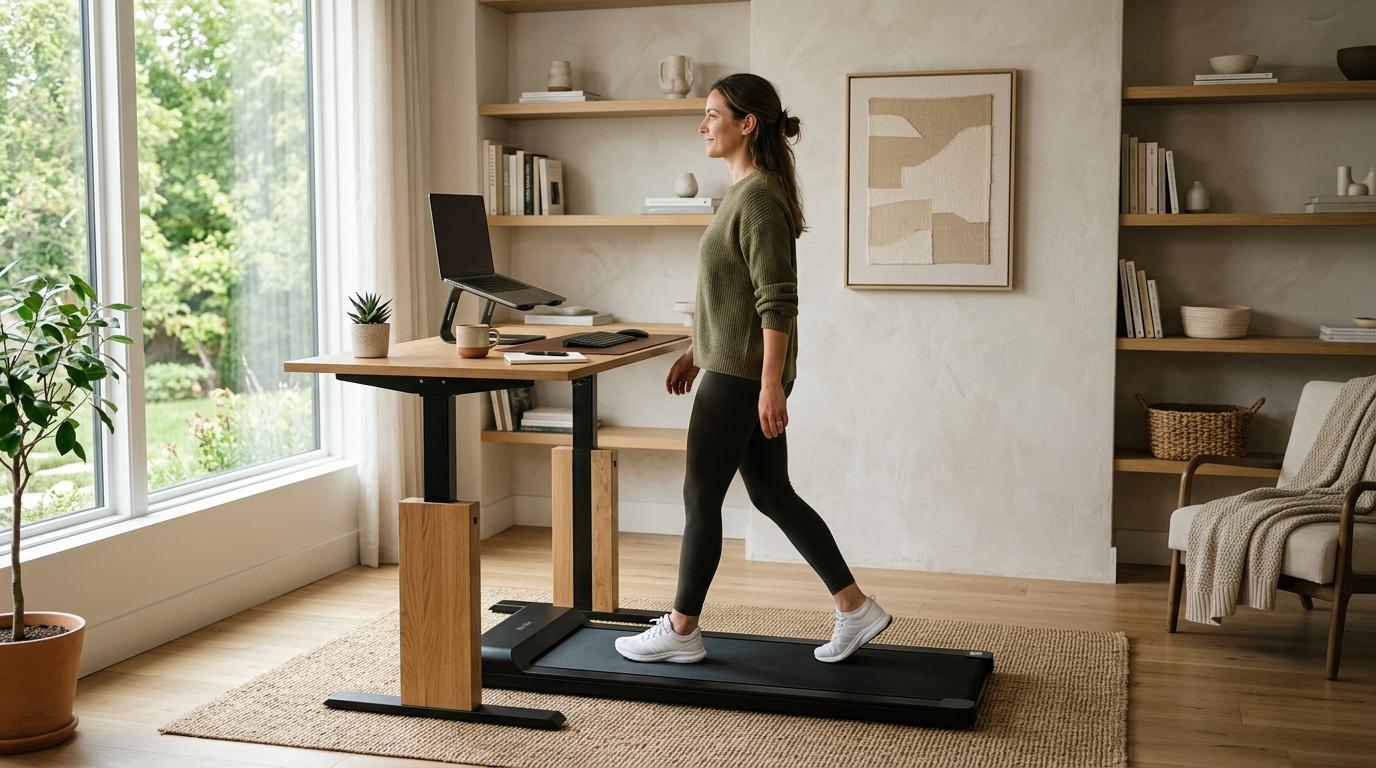
If you want to walk while you work, a simple flat walking pad is usually the easiest place to start. You don’t need a giant treadmill for slow desk walking, and you probably don’t need handrails either. For most people, a top speed somewhere around 2.5 to 4 mph is plenty.
But if you’re hoping to jog or run on the same machine after work, that’s a different story. In that case, you’ll likely be happier with a larger under-desk treadmill that has a foldable handrail and a higher speed range.
This guide covers the things that actually matter before you buy: belt size, motor type, weight capacity, desk height, noise, storage, and a few easy-to-miss details that can make or break the experience.
Quick Summary
#- Best option for working while walking: A flat walking pad with no handrails.
- Best option if you also want to jog or run: A larger under-desk treadmill with a foldable handrail.
- Most important specs to check: Belt width, continuous motor horsepower, weight capacity, and deck height.
- Big thing people forget: A walking pad can raise you about 4 to 6 inches at your desk.
- Main apartment concern: The motor may be quiet, but your footsteps can still be noisy.
- Common buying mistake: Expecting a small walking pad to perform like a full running treadmill.
Walking Pad vs Under-Desk Treadmill vs Compact Treadmill
#Shopping for these can get confusing quickly because product listings often use “walking pad” and “under-desk treadmill” almost interchangeably.
Sometimes that’s fine. Other times, it hides some pretty important differences.
Here’s the simple version.
- Walking pad: Best for slow walking while typing, reading, or taking calls. Usually flat, no handrails, often around 2.5 to 4 mph, and easiest to slide under a desk, bed, or sofa.
- Under-desk treadmill: Best for workday walking with some models allowing jogging or running. Often includes a foldable handrail, can reach higher speeds depending on model, but is larger and heavier.
- Compact treadmill: Best for dedicated workouts and running. Usually has fixed handrails and a console, so it needs more space and may not fit under a standing desk.
Walking Pad
#A walking pad is the simple, low-profile option. It’s usually flat, fairly compact, and designed for slow walking while you work.
This is the right fit if your main goal is to sit less, get more steps, and add some gentle movement to your day without needing a full workout area.
Most walking pads are not made for running. The belt is usually shorter, the motor is usually smaller, and many models don’t have handrails. That’s totally fine for walking, but it’s not ideal if you want a serious cardio machine.
Under-Desk Treadmill
#An under-desk treadmill is usually a little bigger and more powerful. Some models still work well under a standing desk, but they may also have a foldable handrail you can lift when you want to go faster.
This is a better choice if you want one machine for workday walking and light jogging after hours.
The tradeoff is size. These models are often heavier, taller, and more annoying to move around every day.
Compact Treadmill
#A compact treadmill is closer to a regular home treadmill. It’s better for workouts and running than for casual walking under a desk.
Some compact treadmills fold, but the fixed handrails and console can make them hard or impossible to use with a standing desk. If your goal is walking while answering emails, this may be more machine than you need.
Who Should Buy a Walking Pad?
#A walking pad makes sense if you want gentle, steady movement during normal desk time.
You may like one if you are:
- A desk worker or remote worker who sits for long stretches and wants more daily steps.
- An apartment dweller who needs something compact and easy to store.
- A beginner who wants light movement instead of intense cardio.
- Someone who likes habit stacking, like walking while reading, replying to emails, or watching videos.
- A person who focuses better with light movement, as long as walking doesn’t distract you from work.
A walking pad can be especially useful in a small apartment because it doesn’t require a dedicated workout room. But you still need enough floor space to use it safely and enough storage space to keep it easy to access.
That last part matters more than people think. If it’s a pain to pull out, you probably won’t use it much. Good intentions only go so far when a machine is awkward and heavy.
Who Should Avoid a Walking Pad?
#A walking pad is not the right choice for everyone.
You may want to skip it if:
- You want to run seriously. Most walking pads don’t have the belt length, motor strength, or stability for running.
- You struggle with balance. Walking while typing can feel strange at first, and flat walking pads usually don’t have handrails.
- You type heavily all day. Some people can walk and work easily. Others find it slows them down or breaks their focus.
- Your standing desk does not go very high. A walking pad can add about 4 to 6 inches to your height, which can throw off your posture.
- You live above noise-sensitive neighbors. The motor might be quiet, but your footsteps can still travel through the floor.
If you already know you want speed workouts, incline training, or regular running, look at an under-desk treadmill with a handrail or a compact treadmill instead.
What to Check Before Buying a Walking Pad
#The best walking pad features are not always the flashy ones on the product page.
Apps, remotes, LED displays, and fitness tracking can be nice. But they matter a lot less than the basics: the belt, motor, weight capacity, desk height, noise, and storage.
Before you buy, check these things first.
1. Belt Width
#Belt width matters more than many first-time buyers expect.
When you walk normally, your feet do not land in a perfectly straight line. Your stride shifts a little from side to side. That still happens on a walking pad, especially when your eyes are on a laptop instead of the belt.
If the belt is too narrow, you may feel tense, boxed in, or like you need to constantly correct your steps.
As a rough guide, a belt under 44 cm, or about 17.3 inches, may feel narrow for many users. A wider belt gives you more room to walk naturally and makes longer sessions feel less stressful.
If you’re choosing between two similar models, the wider belt is usually the more comfortable pick.
2. Belt Length
#Belt length affects how natural your stride feels.
Walking pads are usually shorter than regular treadmills, which is part of why they’re easier to store. That’s fine for slow walking. But it can feel limiting if you’re tall, have a long stride, or try to walk at a faster pace.
If you are tall, don’t automatically choose the smallest model just because it looks easier to hide under the sofa. A belt that is too short can make you shorten your steps, look down too often, or worry about stepping off the back.
That is not exactly the calm, productive walking setup most people are hoping for.
3. Motor Power: Peak HP vs Continuous HP
#This is one of the biggest specs to understand before you buy.
Many product listings highlight “peak horsepower.” Peak HP is the highest power the motor can hit briefly. It does not tell you how well the motor performs during a long walking session.
What matters more is continuous duty horsepower, often listed as CHP. That tells you what the motor can sustain over time.
This matters because slow walking still puts strain on the motor. The belt has to keep moving under your body weight for long periods. A weak motor may heat up, slow down, get louder, or wear out faster.
So don’t buy based only on the biggest horsepower number in the title. Look for clear information about continuous motor performance whenever the brand provides it.
4. Maximum User Weight
#Weight capacity is not just about whether the walking pad can technically hold you.
It also gives you a clue about build quality. A higher max user weight often points to a stronger frame, sturdier deck, and more durable motor. If you are close to the listed limit, it’s usually better to choose a model with more headroom.
This matters even more if you plan to use the walking pad every day.
A machine that feels fine for occasional use may not hold up as well under daily sessions if it’s constantly working near its limit.
5. Deck Height and Desk Height
#This is the hidden detail that catches a lot of people off guard.
A walking pad can raise you by about 4 to 6 inches. That changes your standing desk setup immediately. If your desk was already close to its maximum height, adding a walking pad may make your keyboard and monitor too low.
For taller users, this is especially important. Some people may need a standing desk that reaches around 48 inches or higher to keep a comfortable posture after stepping onto the pad.
Before buying, measure:
- Your current standing desk height.
- The walking pad’s deck height.
- Your comfortable keyboard height while standing.
- Your monitor height and viewing angle.
If the numbers don’t work, you may end up with neck, shoulder, wrist, or back discomfort. And at that point, the walking pad is solving one problem while creating another.
6. Noise, Especially Footstep Noise
#Most walking pad listings talk about quiet motors. That’s useful, but it’s only part of the noise story.
The bigger issue is often footstep noise: the repeated thump of your shoes hitting the deck. That sound can show up on video calls, travel through floors, and annoy roommates, family members, or downstairs neighbors.
If you live in an apartment, share a home, or spend a lot of time in meetings, take noise seriously before you buy.
A thick rubber treadmill mat can help absorb some vibration, especially on hard floors. Walking slower during calls also makes a noticeable difference.
7. Storage and Daily Setup
#A walking pad is only useful if using it is easy.
Check the product weight before you buy. Also check whether it has front transport wheels. A machine can look sleek and compact online but still be heavy, awkward, or annoying to move in real life.
Ask yourself honestly:
- Will I need to move it every day?
- Can I slide it under my desk, sofa, or bed?
- Is there enough clearance where I plan to store it?
- Will I have to lift it, or can I roll it?
- Will I actually bother setting it up regularly?
That last question is the real one.
If setup becomes a daily chore, the walking pad may end up parked in a corner collecting dust. Most of us have owned at least one “great idea” purchase like that.
8. Speed Range
#For working, faster is not always better.
Many people walk pretty slowly while typing, often under 2 mph during focused work or calls. A walking pad with a top speed of 2.5 to 4 mph is usually enough for desk walking.
If you want to jog or run, don’t try to force a basic walking pad to do that job. Choose an under-desk treadmill with the right speed range, a longer belt, and a handrail.
You’ll be safer, and the machine will be better suited to the way you actually want to use it.
9. Carpet Use and Ventilation
#Some walking pads can be used on carpet, but you need to be careful.
Thick carpet can block vents underneath the machine, trap heat, and pull more dust into the unit. That can make the motor work harder than it should.
If you need to place a walking pad on carpet, use a hard, flat treadmill mat underneath it. This gives the machine a more stable surface and helps protect the underside.
It can also make the walking pad feel less wobbly while you’re using it.
Common Walking Pad Mistakes to Avoid
#Mistake 1: Buying a Walking Pad for Running
#A walking pad is built for walking. That sounds obvious, but a lot of people buy one hoping it can also handle the occasional run.
Usually, it can’t do that well.
The shorter belt, smaller motor, and lack of handrails make most walking pads a poor fit for running. If running matters to you, buy the right type of treadmill from the start.
Mistake 2: Ignoring Desk Height
#This is one of the easiest mistakes to make.
You measure the floor space, check the price, read the reviews, and forget that the walking pad raises your whole body several inches. Then it arrives, you step onto it, and suddenly your desk feels too low.
Always check desk height before buying.
Your wrists, shoulders, and neck will thank you.
Mistake 3: Choosing the Narrowest Model Just to Save Space
#A narrow walking pad may look perfect for a small apartment, but it can feel cramped once you actually use it.
Saving a few inches in storage is not worth it if you feel tense every time you walk.
Comfort matters because consistency matters. If the walking pad feels awkward, you’ll use it less.
Mistake 4: Underestimating Noise
#Even if the motor is quiet, your steps might not be.
That matters for video calls, roommates, family members, and downstairs neighbors. If noise is a concern, plan ahead with a thick mat and slower walking speeds during meetings.
You don’t need total silence, but you do need the setup to work for your actual living situation.
Mistake 5: Forgetting About Daily Movement and Storage
#A walking pad that is hard to move basically becomes furniture.
Check the weight, wheels, and storage position before you buy. If you can’t realistically picture yourself setting it up and putting it away, choose a lighter model or rethink whether it’s the right purchase.
The best walking pad is the one you’ll actually use.
Quick Buying Checklist
#Before you buy a walking pad or under-desk treadmill, confirm that:
- The belt width feels comfortable, ideally around 44 cm or wider.
- The belt length suits your height and stride.
- The motor rating is clear, especially continuous performance.
- The max user weight gives you enough margin.
- The deck height works with your standing desk.
- The noise level is realistic for your home or office.
- It has wheels if you need to move it often.
- It fits your storage space.
- The speed range matches your real use: walking, jogging, or running.
- Carpet use will not block ventilation.
Final Thoughts
#A walking pad is worth considering if your goal is simple: move more during desk time.
It is not a full treadmill replacement, and it is usually not the right choice for running. But for slow, steady walking while you work, it can be a genuinely practical tool.
Focus less on the flashy extras and more on the basics: belt width, continuous motor power, weight capacity, desk height, noise, and storage. Those are the details that determine whether your walking pad becomes a daily habit or just another expensive thing you have to step around.
Fitness and product disclaimer: This guide is for general informational purposes only and is not medical advice. Speak with a qualified healthcare professional before starting a new exercise routine, especially if you have health concerns, pain, balance issues, or mobility limitations. Product features, prices, and specifications can vary by model and region, so always check the current manufacturer details before buying.