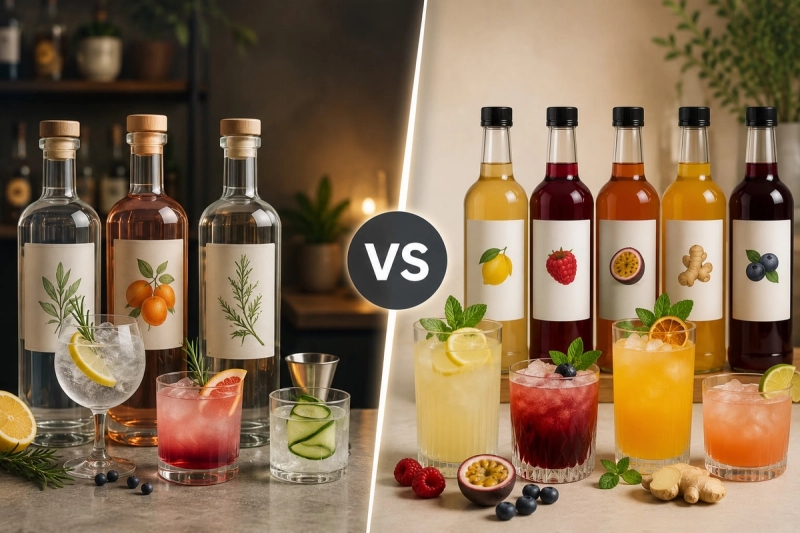
If you’re trying to choose between non-alcoholic spirits vs mocktail syrups, I’d start with mocktail syrups.
Not because non-alcoholic spirits are bad. Some are genuinely great. But if you’re new to making alcohol-free drinks at home, syrups are usually easier, cheaper, and more useful right away.
With one good syrup, soda water, citrus, and ice, you can make something that actually feels like a drink. Not just juice in a nice glass. Not just sparkling water pretending to be exciting. A real, refreshing mocktail.
Non-alcoholic spirits come in handy later, especially if you want something more bitter, herbal, dry, smoky, or “cocktail-like.” But most of them need support. They need tonic, soda, citrus, syrup, garnish, or another mixer to taste complete.
So if you’re building a small alcohol-free bar from scratch, start with syrups and mixers. Then add a non-alcoholic spirit once you know what kind of drinks you actually like.
Quick Answer
#A simple starter setup looks like this:
- One citrus-friendly syrup
- One fruit, ginger, or herb syrup
- Soda water
- Fresh lemons or limes
- Plenty of ice
That alone gives you a lot to play with.
Once you’ve made a few drinks and figured out what you enjoy, then buy one non-alcoholic spirit that matches your taste.
For a bigger home setup, you can also check allblogs’ guide to mocktail bar essentials.
The Main Difference: Syrups Build Flavor, Spirits Add Structure
#Here’s the simplest way to think about it.
A mocktail syrup adds flavor, sweetness, and body. It can make a drink taste fruity, spicy, floral, herbal, citrusy, or dessert-like. Add syrup to soda water and lime, and you already have something good.
A non-alcoholic spirit is usually trying to play the role of a base spirit. It might be botanical like gin, bitter like an aperitivo, smoky or spiced like a whiskey-style bottle, or earthy like a tequila-style alternative.
But here’s the catch: many non-alcoholic spirits taste a little strange on their own. That doesn’t mean they’re bad. It just means they’re designed for mixing.
A gin alternative probably needs tonic.A bitter aperitivo alternative probably needs bubbles.A whiskey-style bottle may need citrus, bitters, syrup, or a strong mixer.
So the real question is not “Which one is fancier?” It’s:
Which one helps me make better drinks right now?
For most people, that answer is mocktail syrup.
Non-Alcoholic Spirits vs Mocktail Syrups: Side-by-Side
#- Mocktail syrups: best for adding sweetness, flavor, and body to spritzes, lemonades, sodas, iced teas, dessert drinks, and party pitchers. They are usually the easiest beginner option.
- Non-alcoholic spirits: best for adding structure, bitterness, botanicals, or spirit-like depth to zero-proof G&Ts, spritz-style drinks, whiskey-style serves, and margarita-style drinks.
- Best first buy for most people: mocktail syrups plus soda water, citrus, and simple mixers.
Labels, recipes, bottle sizes, prices, ABV, sugar levels, allergens, and storage instructions can change. Always check the current bottle before buying, especially if any of those details matter to you.
Who Should Buy Mocktail Syrups First?
#Mocktail syrups are the better first buy for most home drink makers.
They’re easy to use, they work in lots of drinks, and they don’t require much technique. You don’t need bar tools. You don’t need a perfect recipe. Most of the time, you can just mix syrup, citrus, ice, and something fizzy.
Buy mocktail syrups first if you:
#- Are new to alcohol-free drinks
- Want something simple and reliable
- Like fruity, citrusy, spicy, floral, or dessert-style drinks
- Want one bottle to work in several drink styles
- Host people with different tastes
- Need easy drinks for parties
- Want to spend less upfront
- Already drink soda water, iced tea, lemonade, tonic, or juice
- Are slowly building a non-alcoholic home bar
They’re also great if you like non-alcoholic dessert drinks. Think vanilla sodas, coffee mocktails, fruit coolers, creamy after-dinner drinks, or anything with caramel, chocolate, berry, or spice flavors.
You may want to skip or limit syrups if you:
#- Avoid sugar
- Don’t enjoy sweet drinks
- Prefer dry, bitter, or spirit-forward drinks
- Want something closer to a classic cocktail base
A syrup can make a drink taste finished, but it won’t automatically give you bitterness, tannin, burn, or complexity. For that, you may need tonic, tea, citrus peel, bitters, herbs, or a non-alcoholic spirit.
Who Should Buy Non-Alcoholic Spirits First?
#Non-alcoholic spirits make more sense if you already know what kind of cocktail experience you’re chasing.
For example, maybe you miss gin and tonics. Or spritzes. Or negroni-style drinks. Or margaritas. Or something dark, spiced, and slow-sipping.
In that case, a non-alcoholic spirit might be worth buying earlier.
Buy a non-alcoholic spirit first if you:
#- Want the ritual of a cocktail without standard alcohol
- Prefer bitter, herbal, smoky, spicy, dry, or botanical flavors
- Like drinks built like G&Ts, spritzes, old fashioned-style drinks, or margarita-style drinks
- Already have tonic, soda water, citrus, ice, and mixers at home
- Want something that feels more grown up than juice or lemonade
- Are hosting sober-curious guests who prefer drier drinks
Wait on non-alcoholic spirits if you:
#- Need a strict 0.0% ABV product
- Are shopping on a tight budget
- Expect an exact copy of gin, whiskey, rum, tequila, or aperitivo
- Don’t have good mixers yet
- Usually prefer sweet, fruity, fizzy, or refreshing drinks
- Want something delicious straight from the bottle
That last point matters.
A lot of non-alcoholic spirits are not meant to be sipped neat. If you pour one into a glass, taste it plain, and think, “Hmm, I don’t know about this,” that does not always mean the bottle is a failure.
It may just need tonic, lime, soda, syrup, ice, or garnish to come alive.
What to Check Before You Buy Anything
#Use this as a simple mocktail syrup buying guide and zero-proof drinks buying guide before spending money.
1. Check the ABV
#“Non-alcoholic” does not always mean the same thing on every bottle.
Some products are 0.0% ABV.Some contain trace alcohol.Some are listed as under 0.5% ABV.
That may not matter to everyone, but it matters a lot to some people.
If you avoid alcohol completely for religious, medical, pregnancy, recovery, personal, or other reasons, read the label carefully every time.
2. Check the sugar level
#Syrups are usually sweet. That is their job.
But sweetness levels can vary a lot. Some are rich and intense. Some are lighter. Some are made with alternative sweeteners. Some are designed more for coffee or desserts than refreshing drinks.
If you like lighter drinks, start with less syrup and add more only if needed.
A good basic ratio is:
- A little syrup
- Fresh lemon or lime
- Lots of ice
- Soda water
That combination keeps things bright instead of sticky.
3. Check what job the bottle does
#Before buying any bottle, ask:
What will this help me make?
A few examples:
- Citrus syrup: good for spritzes, sodas, and lemonades
- Ginger syrup: good for spicy highballs and mule-style mocktails
- Berry syrup: good for fruity sodas, iced teas, and party pitchers
- Grenadine or pomegranate syrup: good for bright, sweet-tart drinks
- Botanical NA spirit: good with tonic or soda
- Bittersweet NA aperitivo: good for spritz-style drinks
- Dark or spiced NA spirit: good for richer mocktails
Buy by purpose, not just by bottle design.
Although, yes, the pretty bottles are very convincing.
4. Check storage instructions
#Some syrups need to be refrigerated after opening. Some have a shorter shelf life than you might expect. Some non-alcoholic spirits can sit in the pantry, while others may have specific storage instructions.
It’s boring, but it matters.
Nothing is more annoying than buying a nice bottle, using it twice, and then realizing it spoiled because it was stored wrong.
5. Check what you already have
#Before buying fancy bottles, make sure you have the basics:
- Soda water
- Citrus
- Ice
- A mixer you actually like
- A glass you enjoy drinking from
A simple syrup with fresh lime and sparkling water can taste better than an expensive NA spirit mixed with flat soda. Truly.
The Smart Buy-First Checklist
#If you’re building your non-alcoholic home bar essentials, don’t try to buy everything at once.
Start small. Make a few drinks. Notice what you’re missing. Then add another bottle.
Phase 1: Start with the basics
#- Soda water or sparkling water
- Fresh lemons or limes
- Simple syrup or one citrus-friendly syrup
- Plenty of ice
- One glass you actually like using
Phase 2: Add more flavor
#- One fruit syrup, such as berry, pomegranate, or grenadine-style
- One spice or herb syrup, such as ginger, mint, rosemary, or something similar
- Tea, tonic, juice, lemonade, or another mixer you already enjoy
Phase 3: Add your first non-alcoholic spirit
#Choose based on the drinks you already like.
- Botanical if you like tonic drinks
- Bittersweet if you like spritz-style drinks
- Dark or spiced if you like richer drinks
- Agave-style if you like margarita-style drinks
Phase 4: Add finishing touches
#- Fresh herbs
- Citrus peels
- Cucumber, berries, or seasonal fruit
- Non-alcoholic bitters, if the label and ingredients suit your needs
You do not need a huge shelf of bottles to make good mocktails. You just need a few ingredients that work well together.
Easy First Drinks to Try
#These simple drinks show why syrups are such a good first buy.
Citrus Ginger Fizz
#- 1 part ginger syrup
- 1 part fresh lime juice
- 4 to 5 parts soda water
- Ice
- Lime wheel or mint, if you have it
Build everything in a glass over ice. Stir gently.
It’s bright, spicy, and refreshing. Also very hard to mess up.
Berry Lemon Soda
#- 1 part berry syrup
- 1 part fresh lemon juice
- 4 parts sparkling water
- Ice
Add syrup and lemon to a glass with ice, top with sparkling water, and stir.
This is a great party drink because you can batch the syrup and lemon ahead of time, then add bubbles when serving.
Simple Pomegranate Spritz
#- 1 part pomegranate or grenadine-style syrup
- 1 part fresh lime or lemon juice
- 4 parts soda water
- Ice
- Orange slice or mint, optional
This gives you that sweet-tart spritz feeling without needing a non-alcoholic spirit.
Botanical Tonic
#Once you have an NA spirit, try this:
- 1 part botanical non-alcoholic spirit
- 3 parts tonic water
- Ice
- Lemon peel, cucumber, or herbs
This is where non-alcoholic spirits start to make more sense. The spirit adds shape and aroma, but the tonic still does a lot of the work.
Common Mistakes to Avoid
#1. Buying a non-alcoholic spirit before you have mixers
#A non-alcoholic spirit alone usually will not solve your drink problem.
You still need mixers, citrus, ice, and balance. If you don’t have those, start there.
2. Expecting exact alcohol copies
#Some NA spirits are inspired by gin, whiskey, rum, tequila, or aperitifs. But they rarely taste exactly like the alcoholic version.
That’s okay.
Judge them by whether they make a good drink, not whether they perfectly copy alcohol.
3. Buying too many similar syrups
#Three red fruit syrups can start to feel repetitive.
A better starter combo is:
- One fruit syrup
- One spicy, herbal, or citrus-friendly syrup
For example, berry plus ginger is more useful than berry plus raspberry plus strawberry.
4. Ignoring the label
#ABV, sugar, allergens, ingredients, storage rules, and serving suggestions can change.
Read the current bottle, not just an old review or product photo.
Not exciting advice, but very useful advice.
5. Forgetting the difference between mocktails and cocktails
#A cocktail traditionally contains alcohol.
A mocktail is a finished alcohol-free drink.
A non-alcoholic spirit is just one possible ingredient in a mocktail or zero-proof cocktail-style drink. You do not need one to make a good drink.
A Simple Buying Rule
#If you like drinks that are refreshing, fizzy, fruity, spicy, creamy, or easy to batch, start with mocktail syrups.
If you like drinks that are bitter, herbal, dry, smoky, or built like classic cocktails, add a non-alcoholic spirit once you already have mixers.
That way, you spend less at the beginning and your drinks taste better from day one.
Final Takeaway
#When comparing non-alcoholic spirits vs mocktail syrups, most people should buy mocktail syrups and good mixers first.
They’re easier, more flexible, more beginner-friendly, and better for parties. You can use them in fizzy drinks, lemonades, iced teas, dessert drinks, and simple spritzes without needing much skill.
Add a non-alcoholic spirit later if you want more bitterness, botanicals, dryness, or a classic cocktail feel.
The best non-alcoholic home bar is not the one with the most bottles. It’s the one where every bottle has a clear job.