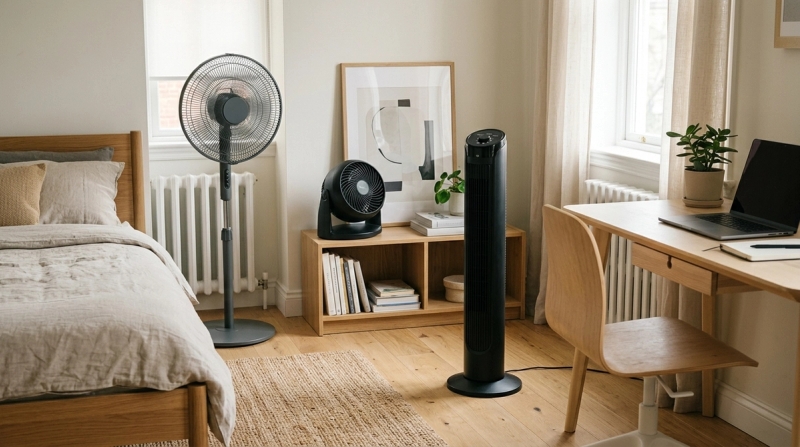
Trying to choose between an air circulator, tower fan, and pedestal fan for a small room? Get a tower fan if you’re tight on space, an air circulator if the room feels stuffy or unevenly cooled, and a pedestal fan if you want stronger direct airflow and have enough floor space.
Quick Answer
#Choose a tower fan if:You want a slim fan for a small bedroom, dorm room, rental room, apartment, or tight corner.
Choose an air circulator if:You want to move air around the room, reduce that closed-in feeling, or help your AC spread cool air more evenly.
Choose a pedestal fan if:You want strong, direct airflow and you don’t mind a wider base, visible grille, and a fan that takes up more space.
First, Ask This: Do You Want a Breeze or Better Air Movement?
#Most people ask, “Which fan cools better?”
That makes sense, but it’s not quite the right question.
A fan doesn’t cool a room the way an air conditioner does. It doesn’t lower the actual temperature. It moves air across your skin, which helps you feel cooler.
The real difference between these three fans is how they move air.
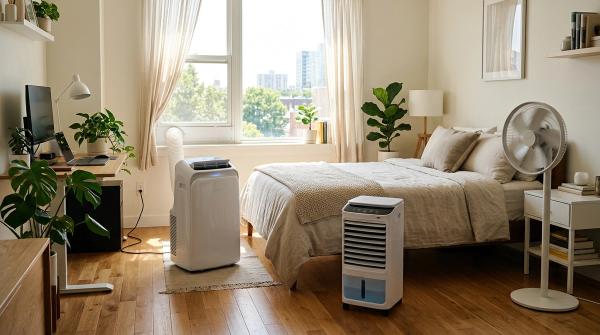
A tower fan gives you easy, gentle comfort in a slim body.An air circulator moves air around the room so it doesn’t feel stuck.A pedestal fan gives you a stronger breeze that you can aim directly at yourself.
And in a small room, that difference matters. A fan that works perfectly in a big living room can feel annoying in a tiny bedroom. It might block a drawer, sit too close to the bed, hit the curtains, or simply blow air in the wrong direction.
So this guide keeps things practical. No brand hype, no overcomplicated terms, and no “best fan ever” nonsense. Just what makes sense for a small room.
Who This Guide Is For
#This is for anyone buying a fan for a compact space, such as:
- A small bedroom
- A dorm room
- A rental apartment
- A home office
- A studio apartment
- A small living area
- A room with awkward furniture placement
- A room where a large fan base would get in the way
- A space with limited plug points
It’s also for people who don’t want to spend hours comparing fan types. You just want to know which one fits your room and your daily routine.
Air Circulator vs Tower Fan vs Pedestal Fan: How They Actually Work
#1. Air Circulator: Best for Moving Air Around the Room
#An air circulator can look like a regular compact fan, but it’s designed for a slightly different job.
Instead of just blowing air at one person, it sends air in a more focused stream. That stream can hit a wall, ceiling, or corner, then spread through the room. The goal is not just to feel wind on your face. The goal is to keep the air in the room moving.
That makes it useful in rooms that feel stale, closed-in, or unevenly cooled.
For example, if your AC is on one side of the room and the cool air never seems to reach your bed or desk, an air circulator can help. If your home office has one warm corner and one cooler corner, it can mix the air better.
What it feels like:Less like a soft fan breeze and more like the room is finally getting some movement.
Why it works well in a small room:
- Helps reduce stuffy corners
- Works well with AC by spreading cooled air around
- Can be pointed at a wall or ceiling instead of directly at you
- Usually compact enough for the floor, desk, or shelf
- Good for rooms where the air feels like it just sits still
Where it can be annoying:
- It can feel too direct if you point it straight at your face
- Some models get noisy on higher settings
- It may not give you that classic “fan blowing on me” feeling
- Placement matters more than it does with a regular fan
An air circulator is a smart buy when your room has an airflow problem, not just a heat problem.
2. Tower Fan: Best for Tight Spaces and Gentle Everyday Comfort
#A tower fan is tall, narrow, and easy to tuck into a corner. It usually pushes air through a vertical vent and oscillates from side to side.
For small rooms, the slim shape is the main reason to buy one.
Tower fans are popular in bedrooms, dorm rooms, and apartments because they don’t take over the room. A pedestal fan can feel bulky in a tight space, but a tower fan usually sits more neatly beside a bed, desk, or couch.
Many tower fans also have enclosed blades, which can feel safer and cleaner if you have kids, pets, or you simply don’t like the look of exposed fan grilles.
What it feels like:A softer, wider breeze. Comfortable, but usually not super powerful.
Why it works well in a small room:
- Slim footprint
- Easy to place near a bed, desk, or corner
- Looks neater than a pedestal fan in many rooms
- Enclosed design keeps blades out of direct reach
- Good for people who want airflow without a big fan dominating the space
Where it can be annoying:
- Usually not the strongest option for long-distance airflow
- Cleaning the inside vents can be a hassle
- Some models feel weak if you expect a powerful blast of air
- Works best when placed fairly close to where you sit or sleep
In the tower fan vs pedestal fan debate, the tower fan wins on space-saving convenience. But if you care most about airflow power, the pedestal fan often has the edge.
3. Pedestal Fan: Best for Strong Direct Breeze
#A pedestal fan, also called a stand fan in many places, is the traditional fan most people know. It has a fan head on a pole with a base at the bottom. You can usually adjust the height, tilt the head, and set it to oscillate.
If you want a clear breeze across your bed, desk, or seating area, a pedestal fan is still hard to beat.
It may not look as sleek as a tower fan, but it does the job well.
What it feels like:A stronger, more direct push of air.
Why it works well in a small room:
- Strong directional airflow
- Adjustable height is useful near beds, desks, and sofas
- Easy to aim where you want it
- Often easier to clean than a tower fan
- Good if you care more about power than looks
Where it can be annoying:
- The base takes up floor space
- The fan head and grille can look bulky
- It can become a trip hazard near a bed or doorway
- The grille collects dust and needs regular cleaning
- The airflow can feel too strong if the fan is very close to you
A pedestal fan makes sense when you have enough space and you want stronger airflow more than a neat, compact design.
The Easiest Way to Compare Them
#If your main problem is limited floor space
#Pick a tower fan.
It fits better in corners and narrow gaps. A pedestal fan might look fine in product photos, but in a small bedroom, the base can quickly become annoying.
If your main problem is stale air
#Pick an air circulator.
It’s better at moving air around the whole room instead of just blowing at one spot. This is especially helpful in rooms with poor ventilation, closed windows, or uneven cooling.
If your main problem is weak airflow
#Pick a pedestal fan.
It usually gives the strongest direct breeze of the three. If you want to feel air hitting you from across the room, a pedestal fan will probably feel more satisfying than a tower fan.
If your main problem is sleeping comfort
#Pick a tower fan, unless your room gets very stuffy.
A tower fan is usually easier to use beside a bed because it’s slim and gives gentler airflow. But if your room traps warm air, an air circulator may work better if you place it properly.
If you already use an AC
#Pick an air circulator.
It won’t replace your AC, but it can help spread the cool air around. Instead of having one cold patch and one warm patch, the room can feel more even.
If you want the easiest fan to aim
#Pick a pedestal fan.
The adjustable height and tilting head make it practical. You can aim it over furniture, toward the bed, or across a seating area.
What to Check Before Buying
#Use this as a simple buying checklist for air circulators, tower fans, and pedestal fans.
1. Check the actual space where the fan will go
#Don’t just check the product size online. Think about where the fan will sit in your real room.
A tower fan has a small base, but it still needs a stable spot. A pedestal fan needs more room because of the stand and wider base. An air circulator can sit on the floor, desk, or shelf, but it needs a clear path to move air properly.
Before buying, picture the exact spot:
- Beside the bed?
- Near the desk?
- Under a window?
- In a corner?
- Away from curtains?
- Away from walking paths?
- Close enough to a plug point?
Small rooms don’t leave much room for bad placement.
2. Decide where you want the air to go
#If you want air directly on your body, choose a pedestal fan or tower fan.
If you want air moving around the room, choose an air circulator.
This one decision clears up most of the confusion.
3. Think about cleaning
#Fans collect dust. In a small room, you notice it faster because the fan is usually close to your bed, desk, or face.
- Pedestal fans usually have visible blades and grilles, so they’re easier to wipe.
- Air circulators often have a front grille, but cleaning depends on the design.
- Tower fans can be more annoying because dust collects inside the vertical vents and blower area.
If you hate cleaning small vents, don’t ignore this part.
4. Consider noise at the speed you’ll actually use
#Most fans sound fine on low. The real test is medium or high.
For sleeping, a soft hum may be okay. But a rough motor sound, rattling, or choppy airflow can get irritating fast.
If you’re a light sleeper, don’t buy only for power. Buy for the speed setting you can actually live with every night.
5. Check oscillation clearance
#Tower fans usually rotate within a small footprint. Pedestal fans have a bigger moving head. Air circulators may or may not oscillate, depending on the model.
In a small room, check if the fan might hit:
- Curtains
- A wardrobe
- A desk
- Wall shelves
- A bed frame
- Loose cables
- Random stuff on the floor
Because somehow, there is always random stuff on the floor.
6. Make sure it feels stable
#This matters more than people think.
A tall tower fan or pedestal fan should feel steady in your room layout. If it sits near a walkway, bed, pet area, or kids’ play area, a wobbly fan will become annoying quickly.
7. Match the fan to your climate and habits
#If you keep your windows closed most of the day, an air circulator may help the room feel less stale.
If you sit in one place for long hours, like at a desk, a tower fan or pedestal fan may be enough.
If the room gets hot at night and you want air across the bed, a pedestal fan or tower fan will feel more direct than an air circulator pointed at the ceiling.
Best For and Avoid If
#Air Circulator
#Best for:
- Stuffy rooms
- Small home offices
- Rooms with poor air movement
- Rooms where AC cooling doesn’t spread evenly
- People who want whole-room airflow instead of direct breeze
- Closed rooms that feel stale after a few hours
Avoid if:
- You only want a soft breeze on your face
- You don’t want to think about placement
- You’re sensitive to fan noise on higher settings
- You expect it to feel exactly like a regular fan
Tower Fan
#Best for:
- Small bedrooms
- Dorm rooms
- Compact apartments
- Tight corners
- Bedside airflow
- People who want a slim, neat-looking fan
Avoid if:
- You need strong airflow across a bigger space
- You want the easiest fan to deep clean
- You expect a powerful direct blast
- You need height adjustment like a pedestal fan
Pedestal Fan
#Best for:
- Strong direct airflow
- Budget-conscious buyers
- Rooms where floor space is not too tight
- People who want adjustable height and tilt
- Situations where air needs to be aimed over furniture
Avoid if:
- Your room has narrow walking paths
- You dislike bulky bases
- You need a fan for a cramped bedside corner
- You want the most discreet-looking option
Common Mistakes to Avoid
#Mistake 1: Buying a pedestal fan without checking the base
#The fan head may look manageable, but the base is what takes over the floor.
In a small bedroom, that base can block drawers, doors, or walking space. If you already have limited room beside the bed, measure the area before buying a pedestal fan.
Mistake 2: Expecting a tower fan to feel like a pedestal fan
#Tower fans are great for slim placement and gentle airflow. But they’re not usually the best choice if you want a strong blast of air from across the room.
If you want power, choose a pedestal fan. If you want neatness and easy placement, choose a tower fan.
Mistake 3: Using an air circulator like a regular fan all the time
#An air circulator works best when it moves air through the room.
Often, that means pointing it toward a wall, ceiling, hallway, or cooler part of the room. If you only point it straight at yourself, you might miss the whole reason to buy one.
Mistake 4: Ignoring cleaning access
#A fan that’s annoying to clean will eventually become a dusty fan. And in a small room, that’s not ideal.
Before buying, check if the grille opens, if the vents are easy to wipe, and if dust will collect in places you can’t reach.
Mistake 5: Choosing only by looks
#Tower fans often look the neatest. Pedestal fans look familiar. Air circulators look compact and modern.
But the best fan for a small room isn’t always the one that looks nicest in photos. It’s the one that fits your space, airflow needs, cleaning habits, and noise tolerance.
So, Which One Should You Buy?
#For most small bedrooms and dorm rooms, a tower fan is the easiest recommendation. It saves space, looks tidy, and gives comfortable everyday airflow.
For stuffy rooms, rooms with AC, or compact home offices where the air does not move well, an air circulator is the smarter choice.
For people who want strong, direct airflow and have enough floor space, a pedestal fan still makes a lot of sense. It’s not the sleekest option, but it works well when power matters more than looks.
The simple buying rule:
- Small room with tight floor space: tower fan
- Small room with stale air: air circulator
- Small room where you need a strong direct breeze: pedestal fan
That’s the cleanest way to decide.