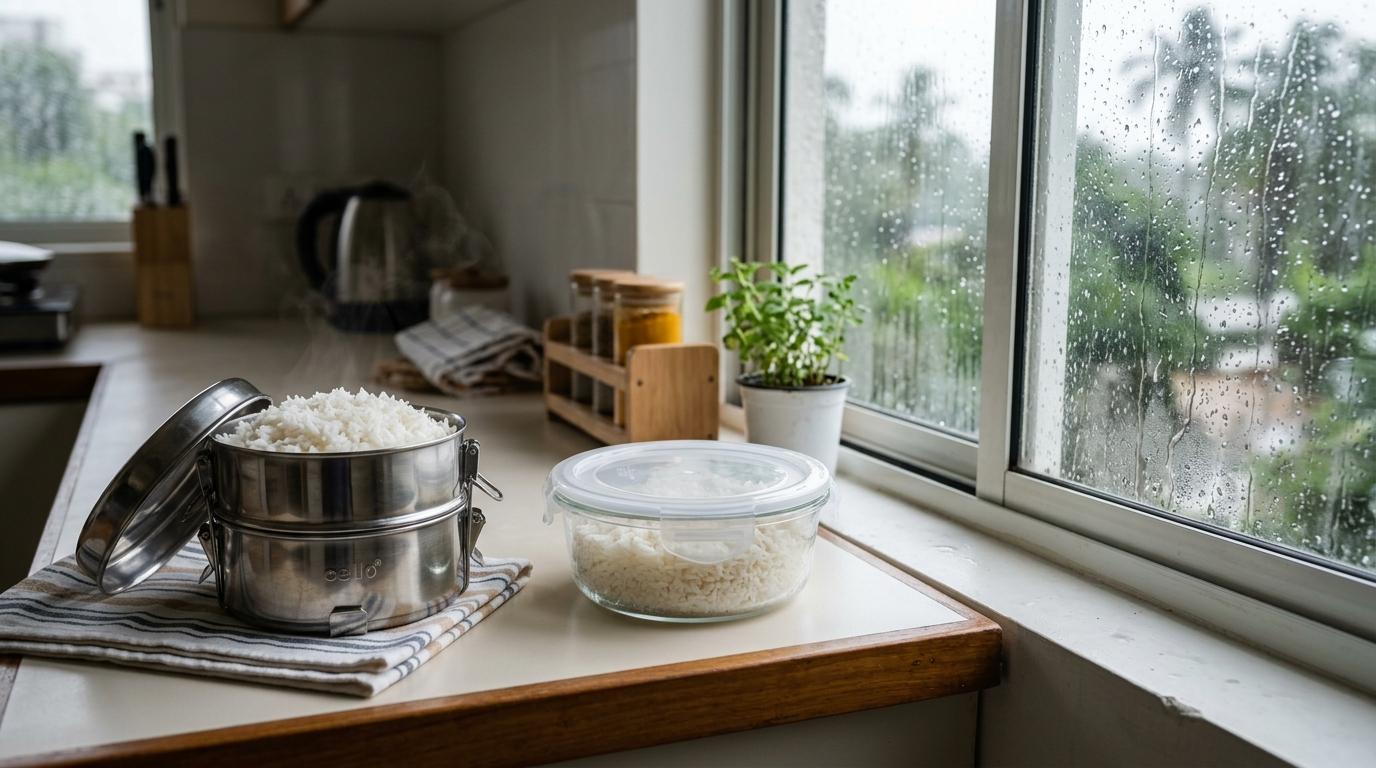
Monsoon changes the rules for cooked food.
In cooler weather, rice may seem fine sitting on the kitchen counter for a while. But during the rains, kitchens are warmer, damper, and often less ventilated. Food cools slowly, containers stay moist, and bacteria get exactly the kind of environment they need.
And let’s be honest: cooked rice is not an occasional food in Indian homes. It is in school tiffins, office dabbas, curd rice, lemon rice, leftover pulao, train lunches, and that small bit left in the cooker because “we’ll eat it tomorrow”.
During monsoon, that habit needs a little more care.
This guide explains how long cooked rice can safely stay outside, when to refrigerate it, when to throw it away, how to pack rice in tiffins, and why reheating is not always the rescue people think it is.
Quick answer
#Cooked rice should not stay outside for more than 2 hours during monsoon.
If your kitchen is hot, humid, or not air-conditioned, treat 2 hours as the absolute maximum — not a comfortable target.
Ideally, refrigerate cooked rice once the heavy steam has gone and the rice is still warm. Do not wait for it to become fully cold on the counter.
If rice has been outside for more than 2 hours, especially in a closed cooker, lunchbox, school bag, office bag, car, train bag, or warm kitchen, it is safer to discard it.
If it has been outside for 3 to 4 hours or longer in humid weather, do not try to save it by frying, reheating, or adding masala.
A simple monsoon rule:
Cool quickly, refrigerate early, reheat properly, and throw doubtful rice.
Why cooked rice becomes risky in humid weather
#Rice feels harmless because we eat it almost every day. Raw rice also stores well for months, so it is easy to assume cooked rice is equally safe.
But cooked rice is different.
One of the main food poisoning risks linked with rice is Bacillus cereus, a bacteria commonly associated with starchy foods. Raw rice can contain spores of this bacteria. These spores may survive normal cooking.
Once rice is cooked and left at room temperature, especially in a warm and moist place, those spores can grow into bacteria.
The tricky part is this: rice may still look normal. It may even smell fine. That does not always mean it is safe.
During monsoon, the risk increases because:
- Kitchens stay humid for longer.
- Cooked food cools slowly inside closed vessels.
- Lunchboxes trap steam and condensation.
- Power cuts can disturb refrigeration.
- School and office timings increase the gap between cooking and eating.
- Bags, counters, cloths, and containers often stay damp.
So this is not about being scared of rice. It is about not giving bacteria the warm, moist time they need to grow.
How long can cooked rice stay outside?
#Here is the safest way to think about cooked rice during monsoon.
Freshly cooked rice on the kitchen counter
#Do not leave cooked rice outside for more than 2 hours.
Once rice is cooked, avoid keeping it closed inside the pressure cooker or rice cooker for too long. A closed cooker traps heat and moisture, so the rice cools slowly.
If you are eating soon, serve it fresh.
If you are storing it, transfer the rice to a clean, shallow container so the steam can escape faster.
Do not wait for rice to become completely cold before putting it in the fridge. Once it has stopped steaming and is just warm, refrigerate it.
Rice kept in a lunchbox
#A packed lunchbox is not the same as rice kept open on a plate.
A closed dabba traps heat and moisture. If it then sits in a school bag, office drawer, scooter storage space, car seat, or train bag, it can stay warm for a long time.
For monsoon tiffins, keep the time between cooking and eating as short as possible.
If lunch will be eaten many hours later and there is no cooling, pack rice more carefully or choose a drier, safer food option.
Rice during travel delays
#If you are carrying rice on a train, bus, or long car ride in monsoon, be stricter.
Traffic jams, train delays, wet platforms, humid waiting rooms, and warm bags all add up. Rice kept in a normal container without cooling should ideally be eaten within the safe window.
If it has been sitting for several hours in a warm bag, do not trust smell alone.
For longer journeys, see AllBlogs’ guide to Indian Monsoon Lunchbox for Train & Bus Delays: https://allblogs.in/post/indian-monsoon-lunchbox-train-bus-delays-spoilage
Rice during a power cut
#If cooked rice is already in the fridge and the power goes out, keep the fridge door closed as much as possible. Opening it again and again lets cold air escape.
If the power cut is long and the fridge has warmed up, be careful with cooked rice and other leftovers.
For broader fridge and leftover rules, read Monsoon Power Cut Food Safety on AllBlogs: https://allblogs.in/post/monsoon-power-cut-food-safety-india-fridge-leftovers
Tiffin rules for rice during monsoon
#Rice in a tiffin needs a little planning during the rainy season.
A hot, moist, tightly closed lunchbox can become exactly the kind of place where bacteria grow well. These small habits can make a big difference.
1. Do not pack steaming hot rice and close the lid
#This is one of the most common monsoon mistakes.
When steaming hot rice is packed and sealed immediately, the steam turns into water droplets inside the box. That extra moisture keeps the food wetter and warmer for longer.
Instead, spread the rice on a clean plate or shallow vessel for a short time, just until the heavy steam reduces. Then pack it.
But do not leave it lying around for too long either.
2. Prefer drier rice dishes over very wet rice
#Soft, moist, plain rice can spoil faster than drier rice preparations.
During monsoon, rice mixed with watery gravies, thin dal, curd, coconut chutney, or dairy-heavy sides needs extra care.
Drier options like lemon rice or tamarind rice are usually better for tiffins when packed properly and eaten within a reasonable time.
This does not mean lemon rice is safe forever. It still needs time control. It is simply sturdier than very wet rice sitting for hours.
3. Keep wet sides separate
#If you are packing rice with dal, sambar, rasam, kadhi, curd, or gravy, keep the wet item in a separate leak-proof container.
Mix it only when eating.
This helps the rice stay less soggy and reduces the time it spends sitting in extra moisture.
4. Do not overpack the dabba
#A tightly packed box of rice cools slowly. If rice is pushed into a deep container, the centre may stay warm for longer.
Use a clean, dry container and avoid stuffing it right up to the top.
If possible, use a shallow lunchbox for rice instead of a deep one.
5. Think about when lunch will actually be eaten
#If rice is cooked at 7 am and eaten at 2 pm, that is a long stretch in monsoon weather unless the food is kept cool.
For office lunches that sit out for hours, choose the food and packing method carefully.
For more office-focused tips, read Office Lunch in Indian Heat: Safe Foods and Tiffin Rules on AllBlogs: https://allblogs.in/post/office-lunch-food-safety-india-summer-tiffin-rules
How to store leftover rice safely
#Leftover rice needs quick handling during monsoon.
The old habit of leaving rice in the cooker overnight is not safe, especially in humid weather.
Refrigerate rice early
#Once cooked rice has stopped steaming, transfer it to a clean, shallow container and refrigerate it.
Do not leave it out for hours because you are waiting for it to become fully cold.
A safer routine is:
- Cook the rice.
- Serve what you need.
- Transfer leftovers to a shallow container.
- Let the heavy steam escape.
- Refrigerate while the rice is still warm — not hot, and definitely not forgotten.
Use shallow containers
#A deep bowl of rice cools slowly. The rice in the middle can remain warm even when the outside feels cool.
Shallow containers help rice cool faster in the fridge.
If you have a large quantity, divide it into smaller portions instead of storing one big mound.
Do not store leftover rice for too long
#During monsoon, try to use refrigerated leftover rice within 24 hours, especially if your area has frequent power cuts or voltage problems.
Be more cautious if the rice has been:
- Taken in and out of the fridge
- Left open
- Handled with wet spoons
- Exposed during a power cut
- Stored in a fridge that may not be cooling properly
Reheat only once if possible
#Reheat only the portion you plan to eat.
Repeated cooling and reheating increases handling time and risk.
Reheat rice until it is steaming hot all the way through. Stir it while reheating so there are no cold patches.
But remember this important point: reheating can kill many live bacteria, but it may not remove toxins already produced if the rice sat outside too long.
So if rice was mishandled earlier, reheating does not make it safe again.
For more detail, see AllBlogs’ guide: Can You Reheat Rice Safely in Summer: https://allblogs.in/post/can-you-reheat-rice-safely-in-summer-2-hour-rule
Common mistakes to avoid
#Leaving rice in the pressure cooker overnight
#This is common, but risky in monsoon.
A closed cooker traps moisture. If rice is left there for many hours, especially overnight, it should not be treated as safe.
Judging only by smell
#Sour smell, stickiness, sliminess, or colour change are warning signs.
But unsafe rice may not always show these signs.
With rice, time and temperature matter more than smell.
Packing curd rice too early
#Curd rice is comforting, but it is not ideal for long unrefrigerated hours in humid weather.
If you pack it, keep it cool and eat it early.
Avoid sending curd rice for a long school day or commute unless you can control the temperature.
Mixing hot rice with wet gravy in the morning
#Hot rice plus wet curry plus a closed tiffin means trapped heat and moisture.
If you must pack rice with gravy, cool the rice slightly, keep the gravy separate, and eat it within a safe time.
Frying old rice that sat outside
#Fried rice is a good use for properly refrigerated leftover rice.
It is not a rescue method for rice that sat outside too long.
If rice was left out for several hours in monsoon weather, frying it does not erase the risk.
When should you throw cooked rice away?
#Throw cooked rice away if:
- It has stayed outside for more than 2 hours in warm, humid weather.
- It was left overnight in a cooker, pot, or serving bowl.
- It sat in a lunchbox for many hours and was not kept cool.
- It smells sour, fermented, or unusual.
- It feels slimy or strangely sticky.
- It has visible spoilage.
- It was in the fridge during a long power cut and the fridge warmed up.
- You are unsure how long it has been outside.
This may feel wasteful, especially when the rice looks fine. But food poisoning is worse.
With cooked rice, the safer decision is usually the right one.
Health caution
#Rice-related food poisoning can cause vomiting, nausea, stomach cramps, or diarrhoea.
Do not depend only on home remedies if symptoms are severe, persistent, or worrying.
Seek medical advice quickly if symptoms are severe, if there are signs of dehydration, or if the affected person is a child, elderly, pregnant, immunocompromised, or already unwell.