The first step to good couscous is checking which couscous you bought. Small, pre-steamed couscous usually needs hot liquid and a covered rest, with the heat turned off. Pearl couscous is larger, chewier pasta that needs a simmer. Use the method and liquid amount on your packet as the final guide: even two small-grain products can ask for different amounts of water.
That distinction saves the most common kitchen disappointment. Pour boiling water over pearl couscous as though it were instant and the center may stay hard. Simmer fine instant couscous like rice and it can turn heavy and clumpy. Here is how to tell them apart, cook each one, and adjust the result before dinner is lost.
First, identify what is in the packet
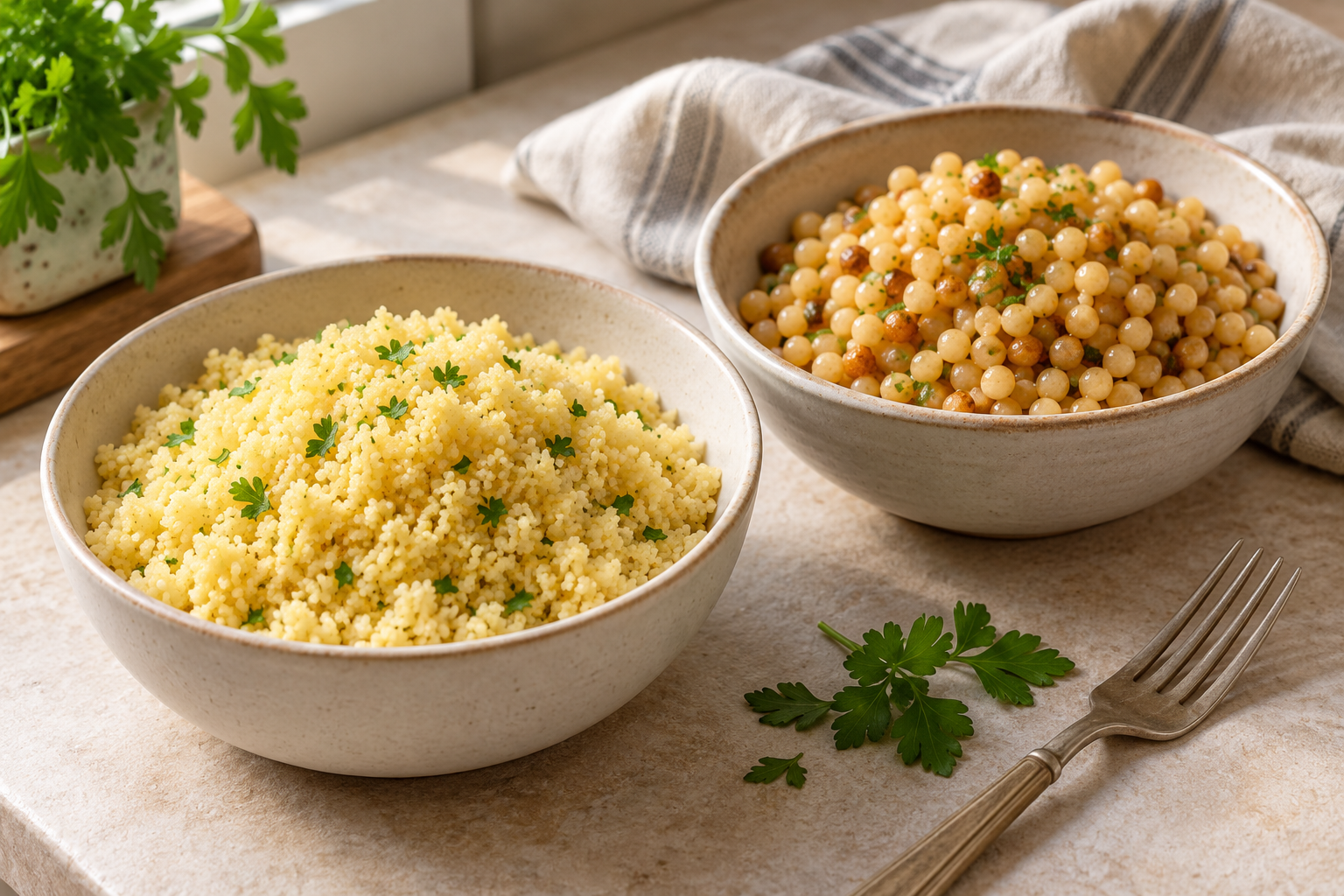
#Instant or small-grain couscous looks like fine, uneven granules. Most supermarket packs have already been steamed and dried. Hot liquid rehydrates the granules in a few minutes; a fork separates them afterward. Packages may simply say “couscous,” “Moroccan couscous,” or “quick couscous.” A whole wheat version can also be sold in this small-grain form.
Pearl couscous consists of noticeably larger, round beads. It is also sold as Israeli couscous or ptitim. Its firmer, pasta-like shape takes longer to become tender. A pan with simmering liquid or a pot of boiling water suits it better than a five-minute covered soak. Some products labeled “giant couscous” are larger still, so check the directions rather than transferring a pearl-couscous timing blindly.
Look at the ingredients if wheat matters to you. Standard semolina couscous and pearl couscous contain wheat and gluten. A packet marketed as gluten-free may use another ingredient and may need a different method. Never assume a substitute product follows the wheat-couscous directions.
There is also a cultural distinction worth keeping clear. Traditional couscous belongs to food traditions across North Africa and is prepared in many ways, including repeated steaming over a stew. UNESCO recognizes the shared knowledge and practices of communities in Algeria, Mauritania, Morocco and Tunisia. The quick packet method below is a convenient way to prepare a manufactured pre-steamed product; it is not a substitute description of every traditional dish.
A reliable method for small instant couscous
#Begin with the ratio printed on your packet. The Academy of Nutrition and Dietetics describes a one-to-one volume method for readily available pre-steamed couscous, while Bob's Red Mill specifies 1¼ cups liquid for 1 cup of its Golden Couscous. That difference is a useful warning against presenting one universal ratio. If the packet is missing, start near one cup boiling liquid for one cup dry fine couscous and add a little more hot liquid only if it remains dry after its covered rest.
For a plain side dish, measure the dry couscous and liquid with the same cup. Bring water or broth to a boil. Season the liquid rather than trying to distribute salt evenly through finished dry grains. Stir the couscous into the hot liquid once, cover the vessel, take it off the heat, and leave it undisturbed for the packet's stated time, commonly about five minutes for instant couscous. Then uncover and lift through the grains with a fork. A small amount of olive oil or butter can be folded in for flavor and separation, but it is optional.
Give the couscous enough room to expand. A bowl or saucepan that looks comfortably oversized when the granules are dry is easier to fluff than a crowded cup. The point of the covered rest is to trap steam while the granules absorb liquid. Repeated stirring during that rest presses wet granules together instead of helping them separate.
Taste a spoonful before serving. If the grains feel dry and firm, sprinkle on a little boiling water, cover again briefly, then fluff. If the grains are tender but wet at the bottom, remove the lid and let some steam escape before fluffing gently. Add herbs, lemon zest, cooked vegetables or a sauce only after you have judged the basic texture. A wet topping can make a correctly cooked bowl seem soggy if it sits there for a long time.
If you scale the batch up, scale the packet's measured couscous and liquid together. A larger batch also needs a vessel with enough surface area for even wetting. Pour hot liquid across the grains, stir once to reach the corners, and cover promptly. Do not pack a full bag into a narrow mug and expect the center to hydrate like the edges. For a small portion, a heatproof bowl and a plate as a cover may be enough; for several servings, a lidded saucepan is easier to manage.
Water gives you a neutral base. Broth changes the flavor and may already contain salt, so taste it before seasoning. If the final dish will be heavily sauced, a lightly seasoned batch often works better than trying to make the couscous carry every flavor. These choices affect taste; they do not change whether a small-grain product rests off the heat or pearl couscous needs a simmer.
What changes with whole wheat couscous?
#“Whole wheat” tells you about the flour, not necessarily the size of the granules. A fine whole wheat product is often prepared by the same covered-rest principle, but the needed liquid and rest can vary by brand. The Whole Grains Council's cooking chart uses a different liquid amount and a longer off-heat rest for whole wheat couscous than some regular instant-pack instructions. Follow your specific packet, then check tenderness. Avoid treating the whole wheat label as a reason to boil fine couscous continuously.
How to cook pearl couscous
#Pearl couscous needs active cooking. Bob's Red Mill's traditional pearl product specifies 1½ cups water to 1 cup couscous, a covered simmer of about 15 minutes, and draining any remaining water. Food Network also describes a pasta-style method: boil pearl couscous in plenty of salted water until it has a tender center and a slight bite, then drain. Either approach can work, but keep to the directions for the actual product you have.
For the measured-liquid method, bring the specified water to a boil, add the pearl couscous and salt, return to a boil, then lower the heat and cover. Stir occasionally if your pan or packet calls for it. Begin tasting before the stated endpoint. When the beads are tender rather than chalky in the center, drain any excess water and loosen them gently. Do not keep cooking them simply to evaporate every drop of liquid if they are already done.
For the pasta method, use enough boiling water that the beads can move, taste them as they cook, and drain in a sieve whose holes are smaller than the beads. This approach makes tenderness easier to judge and is useful when the package ratio is unclear. It also removes some cooking liquid, so add your chosen dressing or sauce after draining.
Toasting pearl couscous in a little oil or butter before the liquid goes in adds a deeper, nutty flavor. Watch and stir the beads so they color without scorching. This step is optional; it does not replace the simmer. If the packet says the product is already toasted, you can cook it directly and still get a pleasant texture.
Which type fits the meal?
#Use fine couscous when you want a light bed for a saucy vegetable, bean, fish or meat dish. Its tiny granules absorb the liquid around them, so spoon the sauce on near serving time if you want a fluffy contrast. Fine couscous also works in a quick herb-and-vegetable bowl, but cool it and fluff it before adding chopped produce so the dressing does not disappear into a warm, compact mass.
Choose pearl couscous when you want distinct, chewy pieces in a salad or a brothy dish. It stands up better to stirring and to chunky vegetables. In soup, cook it according to the recipe's liquid and timing, remembering that pasta continues to take up liquid as it sits. If you are adapting a recipe written for small couscous, cook the pearl version separately; a five-minute off-heat soak will not do the same job.
For a simple weekday bowl, start with either type cooked according to its pack. Add a cooked vegetable, a protein such as beans or eggs, and a sauce or dressing whose amount you can adjust at the table. This is an assembly example, not a tested formula. The useful decision is texture: fine couscous makes a soft base for sauce, while pearl couscous stays more separate under a tossed dressing.
If you are replacing rice or quinoa in an existing meal, think about the role of the base rather than swapping raw volumes without checking yield. Fine couscous absorbs a sauce quickly and feels softer. Pearl couscous behaves more like tiny pasta. Neither is a direct cooking-method substitute for rice or quinoa, which have their own preparation. Cook the replacement separately first, then decide how much finished food the dish needs.
Fix the texture you have, not the ratio you wish you had
#Fine couscous is dry or hard. Check whether there is dry powder at the bottom or just a few firm granules. Sprinkle a small amount of freshly boiled water over the dry areas, cover, wait briefly, and fluff. Adding a full extra cup at once can overshoot. If the product is a larger grain or an unfamiliar gluten-free substitute, return to its package method instead of continuing to guess.
Fine couscous is wet or clumped. Uncover it and spread it across a wider bowl or tray so steam can leave. Use a fork to break up the largest clumps without mashing. A little oil may help separate tender grains, but it will not reverse overcooking. If the texture is already very soft, serve it under a stew rather than promising it will turn crisp and separate.
Pearl couscous is firm in the middle. It needs more cooking, not another quick fluff. Add a splash of hot water to a nearly dry pan and continue simmering, tasting every few minutes. In a pot of abundant water, simply keep boiling until the center is tender.
Pearl couscous is sticky. Drain it when tender, spread it briefly so excess steam escapes, and toss gently with a little dressing or oil. A thick sauce can be a deliberate finish, but don't call a gluey texture “risotto” unless the recipe actually built that sauce.
The most useful habit is tasting at the transition point. Ratios and minutes are starting instructions; granule size, the maker's processing and your pan change what you see and feel. A forkful tells you more than an extra minute guessed from the clock.
Buying, storing and serving without confusion
#Read the front and ingredient panels together. “Couscous” can mean small pre-steamed granules, larger pasta beads or a non-wheat alternative. For a recipe promising fluffy fine grains, buy the small type. For a chewy salad, choose pearl. If a recipe calls for whole wheat couscous, check both the whole wheat wording and the grain size.
Keep the dry product closed in a cool, dry place and follow the pack's storage date. Once cooked, cool it promptly in a shallow container and refrigerate. The Academy of Nutrition and Dietetics advises refrigerating cooked couscous for up to four days. If you mix it with meat, dairy or another perishable ingredient, handle the whole dish according to that more sensitive ingredient and local food-safety guidance. A pleasant smell alone is not a reliable safety test.
For a hot meal, make the sauce or vegetables first and cook small instant couscous near the end. For a cold salad, cook the couscous, spread or fluff it to cool, then add the dressing and delicate herbs. Taste again before serving: chilled grains may need a little more dressing, while a saucy hot dish may need less. This sequencing is more useful than insisting on one liquid ratio for every pack and every meal.
The short answer is simple: small instant couscous rests covered off the heat; pearl couscous simmers until tender. Let the package decide the starting liquid and timing, then use your eyes, fork and a taste to finish the job.