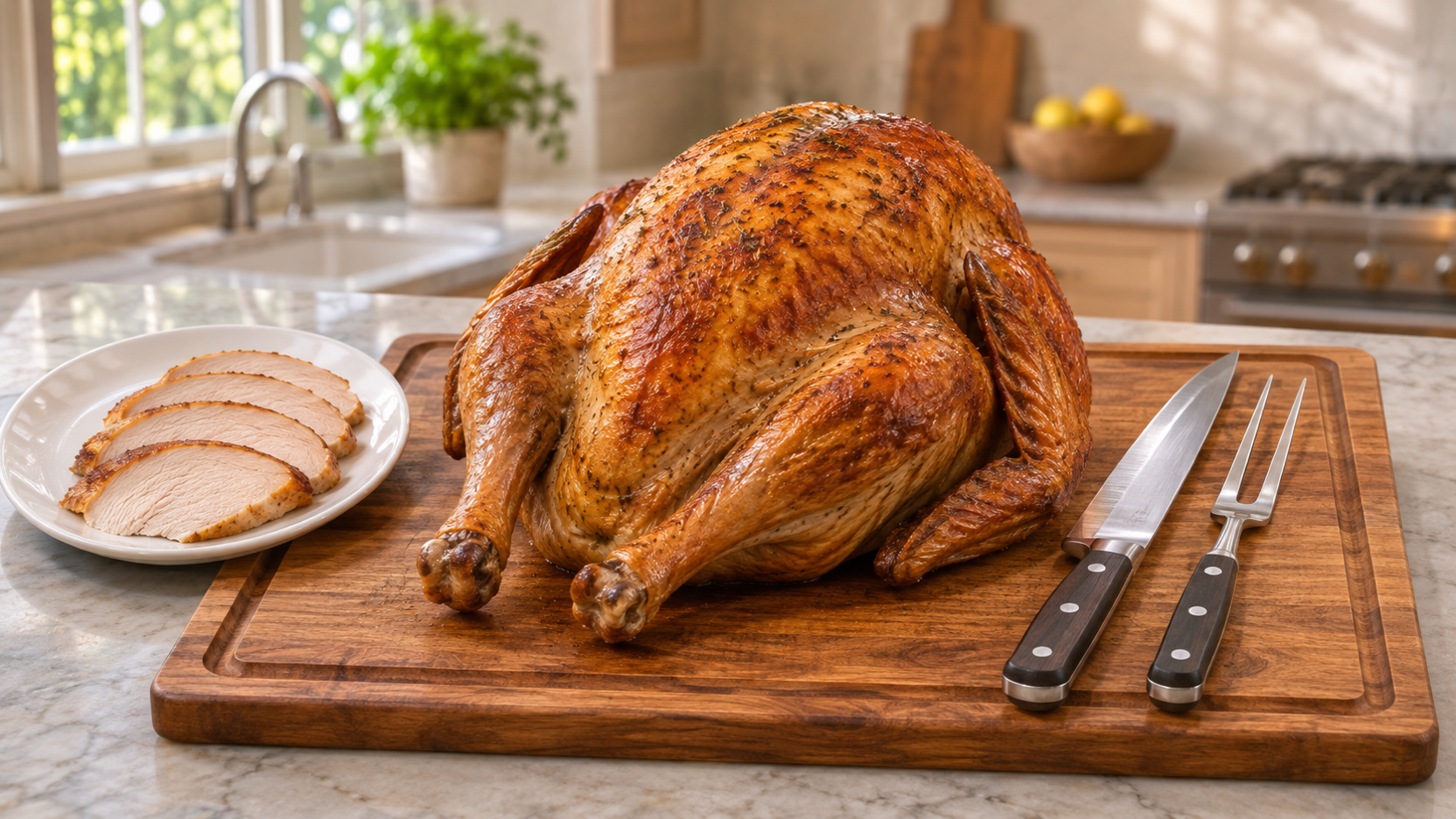
Let the turkey stand for at least 20 minutes, then carve it in this order: legs and thighs first, then the wings, then each breast half off the bone in one piece. Slice the breast across the grain, about ¼ to ½ inch (6 to 12 mm) thick, and the hard part is over.
The rest of this guide is the detail that keeps it from going wrong. How long to rest the bird, what to put on the counter, where each cut goes, how to keep the slices moist, and what to do if the turkey came out dry, was spatchcocked, or is down to the carcass.
It works for a Thanksgiving turkey or a Christmas one. Temperatures are in °F and °C, weights in pounds and kilograms.
Before you cut: check 165°F, then let it rest
#Carving really starts before the turkey leaves the oven. The USDA's safe minimum for a whole turkey is 165°F (74°C), measured with a food thermometer. Check the innermost part of the thigh, the innermost part of the wing and the thickest part of the breast. If your bird has a pop-up timer, check with a thermometer anyway.
Not sure where the probe goes? Our guide on how to use a food thermometer correctly covers it, and the food thermometer buying guide helps if yours is old or slow.
How long to rest a turkey
#The USDA says to let the cooked turkey stand 20 minutes before carving. It lists that as a quality step, not a safety one. The juices settle and the bird carves more easily. Cut straight away and a lot of that juice ends up on the board instead of in the meat.
Cooks go a bit longer. Food Network suggests 15 to 30 minutes depending on size. America's Test Kitchen says at least 30 minutes, and about an hour for a bigger bird. So for a 12 to 14 pound (5.4 to 6.4 kg) turkey, aim for 25 to 30 minutes. Go longer only if the rest of dinner isn't ready.
Two limits apply. The rest, the carving and the meal all sit inside the 2-hour window for getting leftovers into the fridge. And don't stretch the rest just because you can. Slices cool fast, so a bird that has sat for an hour is lukewarm before you cut it.
Foil is a coin flip. Some guides say to tent the bird loosely so it stays warm. Others say to leave it bare because foil softens the skin. Either way, don't wrap it tight. A sealed parcel traps steam against the skin.
The oven is empty while the turkey rests, so that's the window for sides that need it. A make-ahead mashed potato casserole bakes for about 45 to 50 minutes in total, so put it in as the turkey comes out and carve while it finishes.
What you need on the counter
#You don't need a special kit. This is enough:
- One sharp knife. A long, thin carving knife is made for the job, but a chef's knife works fine. Sharp matters more than the type. If yours can't slice a tomato cleanly, sharpen it before the turkey comes out.
- A carving fork or a folded towel, to steady the bird while you cut. Hold it steady rather than stabbing it over and over.
- A small paring or boning knife for tight spots and the wishbone.
- A big board with a juice groove. No groove? Set a regular board inside a rimmed baking sheet. Put a damp towel under it so it doesn't slide.
- Kitchen shears for any twine.
- A warm platter. Pop it in a 200°F (93°C) oven while the bird rests.
- A bowl or tray for bones, and paper towels.
An electric carving knife is optional. Some cooks like it for thin, even slices. It's not needed.
Set up the station so nothing raw touches cooked turkey
#The turkey is cooked, but plenty of things in your kitchen touched it raw. The CDC says to use separate boards for raw turkey and for other foods, and to wash boards, utensils and counters with hot soapy water after raw turkey. The USDA says the same about anything that came in contact with the raw bird or its juices.
In practice, that means a clean board for carving. If the one on the counter held the raw turkey on prep day, wash it first or grab another. Tongs, towels and anything else that handled the raw bird get washed or swapped too.
Then set the bird breast side up on the board, legs toward you, and snip off the twine. Carve in the kitchen where you have room, then carry the platter to the table.
Carve a turkey step by step
#Start with the legs, then the wings, then the breast. Legs first is how most guides do it, and the reason is simple. They sit on the outside, and once they're off you can see the sides of the breast.
You'll find disagreement about the wings. Some cooks take them off before the breast. One guide leaves them on until the end because they help keep the breast from rolling. Both work. What doesn't work is trying to lift the breast off while both legs are still on.
Take the legs and thighs off first
#Pull one leg away from the body and cut through the skin where it meets the breast. Then press the leg down and away until the hip joint pops, and cut through the joint with the tip of the knife. Aim for the joint, not the bone. If you're hitting bone, shift the knife and feel for the gap.
Lift the whole leg, thigh and drumstick together, onto the board. Repeat on the other side.
Look for the oyster too. It's a small, round piece of dark meat on the back of the bird beside the thigh, and it often stays behind on the carcass. Tip the bird slightly and ease it out with the knife tip. It's tender, and it's the piece most people forget.
Split the drumstick from the thigh
#Lay the leg on the board and find the joint between the drumstick and the thigh. Bend it and you'll feel where it gives. Cut straight through there.
For the thigh, slice along both sides of the thighbone to free the meat, then lift the bone out. Cut the meat into slices about ½ inch (1.2 cm) thick. Drumsticks can go on the platter whole, or you can slice the meat parallel to the bone.
Take off the wings
#Pull a wing away from the body to find the shoulder joint, then cut through it. Leave the wings whole, or split each one at its middle joint into a drumette and a flat. Save the wing tips for stock.
Lift each breast off the bone
#Find the breastbone, the ridge down the middle of the top. Cut straight down along one side of it with the tip of the knife. Then follow the curve of the rib cage with long, steady strokes, lifting the meat away with your other hand or the fork as it frees up. The whole breast comes off in one piece, skin on. Repeat on the other side.
Cutting the breast off whole is easier than slicing straight off the bird. When you slice on the carcass you're cutting across a curve at an awkward angle, and the slices come out uneven. Lifted off, the breast lies flat on the board and you can slice it evenly.
Slice the breast across the grain
#Lay the breast skin side up. The muscle fibres run lengthwise, so cut across them, ¼ to ½ inch (6 to 12 mm) thick. Hold the skin in place with your free hand so each slice keeps a strip of it.
Use long, pulling strokes. Sawing tears the meat, and pushing down hard squashes it. If it's tearing, the knife is the problem, not your technique.
As you carve, move slices to the warm platter. When the carcass is bare, add any juice from the board to your gravy.
How to carve a spatchcocked turkey
#If you flattened the bird using our spatchcock turkey guide, the sequence stays the same. Only the setup changes.
The backbone is already gone, so there's no round carcass to steady or tip. The bird lies flat, and the joints are easier to see.
- Rest it as you would any turkey, then slide it onto a clean board.
- Cut the skin between each leg and the breast, pull the leg away and cut through the hip joint. Split the drumstick from the thigh as above.
- Take the wings off at the shoulder.
- Find the breastbone. It was cracked flat, so it's now a ridge down the middle of the top. Cut down along one side, follow the ribs, and lift the breast off in one piece. Repeat.
- Slice the breast across the grain, same thickness.
The 165°F (74°C) check and the rest don't change either. A flatter bird carves faster, but it still needs to stand before you cut it.
A turkey crown, the breast-only roast many people cook for Christmas, skips the leg steps. Lift each breast half off the bone and slice it the same way.
Keep the slices warm and moist
#Carve as close to serving time as you can. Warm the platter, and don't slice everything at once if you can help it.
If you do need to carve ahead, here's how. Put the meat in a covered, ovenproof dish with a few spoonfuls of hot stock or pan juices, and hold it in a 200°F (93°C) oven. Keep it at 140°F (60°C) or above, and carve no more than about an hour before serving. The skin will soften, but the meat stays moist. Count that time inside the 2-hour limit from above, which drops to 1 hour if your kitchen is above 90°F (32°C).
For plates you serve straight away, spoon a little warm broth or pan juices over the slices and cover the platter loosely with foil for a few minutes. That also helps if you're waiting on a late side dish.
How much turkey you need, with a worked example
#Say you're feeding 10 people and you've roasted a 13 pound (5.9 kg) turkey. This is an example, not a rule, but the numbers come from real guidance.
The USDA suggests about 1 pound of whole turkey per person, so 10 guests need 10 pounds and 13 pounds leaves room for seconds. Rutgers Cooperative Extension suggests 1 to 1½ pounds per person and says that yields about 10 ounces of cooked meat each. That puts a 12 to 14 pound bird at roughly 8 to 14 people, depending on how much you want left over.
Ten ounces times 10 people is about 6¼ pounds (2.8 kg) of cooked meat on the table. A UK consumer guide from Which? suggests 200 to 300 grams of roast turkey per person, which comes to 2 to 3 kg for 10. The two figures line up.
How much cooked meat a bird gives varies with the bird, so count pieces rather than trusting a precise yield. A turkey has two breast halves, two thighs, two drumsticks and two wings. You can't give 10 people a drumstick each. Slice the breast for most plates, slice the thigh meat for anyone who wants dark meat, and offer drumsticks and wings to whoever asks.
Carve in two rounds. Do one breast half and both thighs first, then carve the second half when the platter runs low. Leave the uncarved half on the carcass, covered, in the kitchen. Seconds stay hotter and moister that way.
Plating for the table
#Warm the platter. Shingle the breast slices, slightly overlapping, on one side. Put the thigh meat, drumsticks and wings on the other. That way guests can see the light and dark meat and choose.
Keep any garnish off the meat itself. Serve gravy on the side, warm. Take the carcass out of sight.
What to do with the wishbone, skin and back
#The wishbone. It's easiest to remove before roasting. If it's still in, find it at the neck end of the breast, cut around where it meets the cartilage with a paring knife, and pull it free before you lift the breast off. Or just carve around it, then pull it out when the breast comes away.
The skin. Keep it on the slices. It holds them together and carries flavour. If it has gone soft on the sides after resting, trim that off and serve the crispest pieces on top.
The back and carcass. After you've removed the breast, the carcass still has meat on the back and around the oysters. Pull what you can for sandwiches or soup. Don't toss it yet. See the last section.
Common carving mistakes
#- Carving too early. Juice runs out onto the board. Wait the 20 minutes.
- Carving far too late. The slices go cold. Don't push the rest past 45 minutes or so.
- A dull knife. It tears and squashes the meat. Sharpen first.
- Sawing. Use long strokes with the weight of the knife, not downward pressure.
- Slicing with the grain. You get long, stringy pieces. Cut across the fibres.
- Hacking through bone. Cut at the joints. If it feels like work, you've missed the joint.
- Skipping the thermometer. Colour can mislead. If a piece reads under 165°F (74°C), it goes back in the oven.
If the turkey is dry
#You can't put moisture back into overcooked meat. You can make it eat a lot better, though.
Slice the breast thinner. Slice it across the grain, which makes dry meat easier to chew. Spoon warm broth or pan juices over the slices, and keep plenty of hot gravy on the table. The USDA recommends adding a little broth or water and covering the meat when you reheat turkey, and the same idea helps here. Dark meat usually holds up better, so lean on it.
Next year, our guide to dry brining versus wet brining is a place to start, and a thermometer will tell you when to pull the bird.
What to do with the carcass and leftovers
#Pull the remaining meat off the carcass before it goes anywhere. The CDC and USDA both say to refrigerate leftovers within 2 hours of cooking, or within 1 hour if the room is above 90°F (32°C). Put it in shallow containers so it cools quickly. Rutgers recommends containers no deeper than 2 inches (5 cm).
Leftover turkey keeps in the fridge for 3 to 4 days, according to the CDC, or you can freeze it. Reheat it to 165°F (74°C). Our guide to freezing, thawing and reheating leftovers covers the general rules. We also have a separate guide to how long leftover turkey keeps, how to freeze it and how to reheat it.
The carcass, wing tips and neck make good stock. Simmer them the same day, or freeze the bones for later. Don't leave the carcass out overnight.