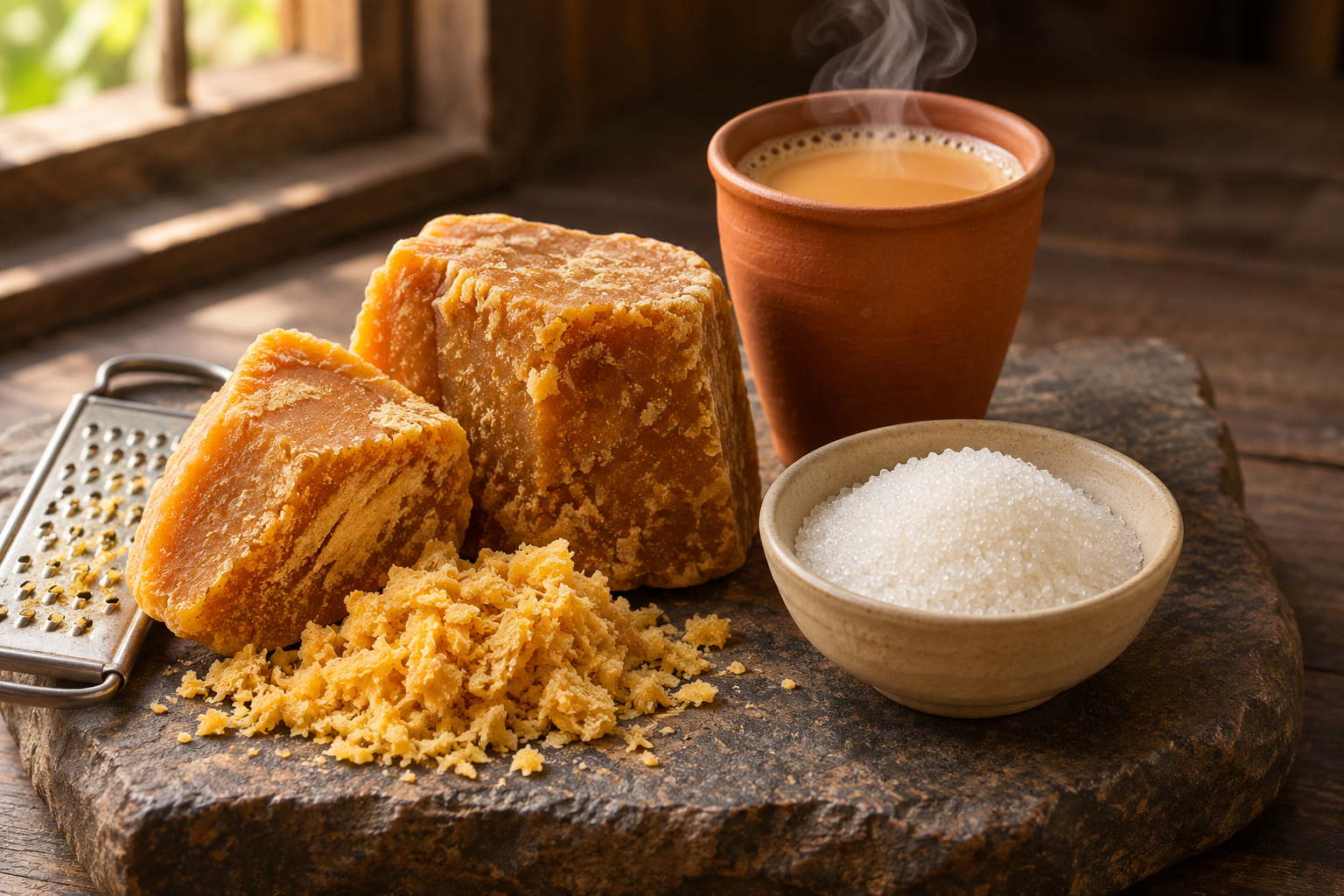
Jaggery is not meaningfully healthier than white sugar. Both are added sugar, both have almost the same calories, and the extra minerals in gur are real but tiny at the amounts people actually eat.
So pick jaggery for its taste and how it behaves in your recipe, not as a health upgrade. The thing that actually matters for your health is how much total sugar you eat in a day, whichever kind it is.
Below is the honest comparison, with real numbers per teaspoon, what it means for blood sugar, how to check the jaggery you buy, and how to swap one for the other in tea, halwa, baking and chikki.
What jaggery actually is
#Jaggery, gur or gud is sugar made by boiling plant juice until it turns solid, without separating out the molasses part the way a sugar mill does. Most jaggery in Indian shops is cane jaggery, made from sugarcane juice.
There are also palm jaggeries. India's food regulator, FSSAI, defines gur or jaggery as the product made from the juice of palmyra palm, date palm or coconut palm, and keeps a separate standard for cane jaggery. In West Bengal, nolen gur is made from date palm sap collected in winter, roughly November to February.
Outside India you will see close cousins under other names. An FAO food composition table puts jaggery, ghur, panela and piloncillo in one group as crude sugars from cane, palm, coconut or maple. If you have tried aguapanela in Colombia, you have already tasted this family of sweeteners.
How gur is made, and how that differs from white sugar
#Here is the basic jaggery process, as described in training material from NIFTEM, a national food technology institute:
- Crush and filter. Cane is crushed, and the juice is filtered to remove bits of fibre and dirt.
- Clarify. The juice is cleaned so impurities rise as scum and can be removed. Traditional makers use plant mucilage such as deola (wild okra). Some also use lime, and some add sodium hydrosulphite or sodium bicarbonate to bleach and brighten the colour.
- Boil down. The juice is boiled in open pans until it reaches the "striking point", about 115 to 118°C, where it will set.
- Cool and mould. The thick mass is cooled and poured into moulds, or worked into powder or cubes.
White sugar goes further. The juice is boiled into a syrup, sugar crystals are grown, and the crystals are spun away from the dark syrup (molasses) and refined until almost nothing but sucrose is left.
That is the whole difference. Jaggery keeps the molasses part, so it keeps some minerals, some moisture and a deeper caramel taste. White sugar removes them, so it is close to pure sucrose and tastes only sweet.
One teaspoon of each, side by side
#ICMR-NIN uses 5 g as one teaspoon in its household measures, so the table below uses 5 g. Jaggery values are from ICMR-NIN's Indian Food Composition Tables 2017 (cane jaggery). White sugar values are from the US Department of Agriculture's food database, because the Indian tables do not list refined sugar.
| Per 5 g teaspoon | Cane jaggery | White sugar |
|---|---|---|
| Energy | about 18 kcal | about 19 kcal |
| Carbohydrate (almost all sugar) | about 4.2 g | about 5 g |
| Water | about 0.6 g | practically none |
| Iron | about 0.23 mg | practically none |
| Calcium | about 5 mg | practically none |
| Magnesium | about 6 mg | none |
| Potassium | about 24 mg | practically none |
On paper, jaggery wins every mineral row. White sugar has close to zero of everything except sugar.
But look at the size of those numbers. The next section puts them in context.
The iron in jaggery: real, but small
#Iron is the main reason people call gur healthy, so let's check it properly.
ICMR-NIN's 2020 recommended dietary allowance for iron is 19 mg a day for adult men and 29 mg a day for adult women. One teaspoon of jaggery gives about 0.23 mg. That is under 1% of a woman's daily iron and about 1.2% of a man's.
Calcium and magnesium look the same way. A teaspoon gives about 0.5% of the 1,000 mg calcium allowance and roughly 1.3 to 1.6% of the magnesium allowance.
Here is the clearest way to see it. To get a woman's full day of iron from jaggery alone, you would need to eat over 600 g of it, which is more than 2,000 kcal of sugar. For a man's allowance, it is about 410 g and roughly 1,450 kcal. Nobody should eat that, and nobody does.
Two more things make the iron story weaker:
- Values vary a lot. The Indian Food Composition Tables 2017 report 4.63 mg of iron per 100 g of cane jaggery, with a wide spread between samples. The same book notes that an older 1989 edition listed 11.4 mg. Many websites still copy the older or higher figure.
- Tea blocks iron anyway. A lot of jaggery goes into chai. ICMR-NIN's dietary guidelines say tea binds dietary iron and suggest avoiding it for at least an hour before, during or soon after meals. So the small iron in gur chai is even less useful than the label number suggests.
If you want more iron, look at pulses, green leafy vegetables and, if you eat them, meat, fish and eggs. Jaggery is not an iron food.
Calories: call it a tie
#Gram for gram, cane jaggery has about 354 kcal per 100 g and white sugar about 387 kcal. That is roughly 9% less for jaggery.
Most of that gap is water. About 11% of cane jaggery's weight is moisture, while white sugar is almost completely dry. You are not getting a lighter sugar, just a slightly wetter one.
In real life the difference is about 1 to 2 kcal per teaspoon. If you add a little extra jaggery to get the sweetness you like, even that gap closes.
What jaggery does to blood sugar
#Jaggery is mostly sucrose, the same sugar that white sugar is made of. The FSSAI standard for cane jaggery requires at least 70% sucrose and at least 90% total sugars on a dry-weight basis. In other words, the law expects jaggery to be nearly all sugar.
So your body handles jaggery much like sugar. The small amount of minerals does not change that in any useful way.
ICMR-NIN's Dietary Guidelines for Indians (2024) is direct about this. It lists added sugars as including sucrose (table sugar), jaggery, honey, glucose, fructose and dextrose. It also says added sugar adds no nutritive value beyond calories.
What this means in practice:
- If you have diabetes or prediabetes, count jaggery exactly like sugar. Do not assume it is "allowed" because it looks natural. Follow the plan your doctor or dietitian gives you, and ask them before changing sweeteners.
- For babies and toddlers, ICMR-NIN says no added sugar for children under two years. Jaggery counts as added sugar, so that includes gur.
- For everyone else, the question is not "gur or sugar" but "how much in total".
If you are working out portions for blood sugar more broadly, the same portion-first approach to fruit and diabetes applies here: the amount on your plate matters more than the type.
How much is too much
#Two official limits are useful, and they land in the same place.
- ICMR-NIN (India): avoid sugar, or restrict it to 20 to 25 g a day for adults, and keep added sugar under 5% of daily energy.
- WHO (global): keep free sugars under 10% of daily energy, and ideally under 5%, which is roughly 25 g a day. Free sugars include any sugar added by the cook, the manufacturer or you at the table, plus honey, syrups and fruit juices.
Using ICMR-NIN's 5 g teaspoon, 25 g is five level teaspoons a day. WHO describes the same 25 g as about six teaspoons, which works out to a slightly smaller spoon. Either way, it is not much.
Example: say you drink two cups of chai a day with two teaspoons of jaggery in each. That is about 20 g, already close to the whole ICMR-NIN range, before any sweets, biscuits or packaged drinks. Switching those four teaspoons from sugar to jaggery saves you about 6 kcal a day and gives you about 1 mg of iron. Cutting to one teaspoon per cup saves you around 35 kcal a day whichever sweetener you use.
That example shows the real lever. Reducing the amount does far more than changing the type.
How to tell if the jaggery you buy is good
#Jaggery quality varies a lot, especially loose blocks sold without a label. A few checks help, but none of them proves purity on their own.
Don't judge it by colour
#Many people think dark jaggery is pure and light jaggery is fake, or the opposite. Colour is a poor guide.
Colour mainly reflects the juice and how it was clarified and processed. Processing material from NIFTEM notes that some makers add sodium hydrosulphite or sodium bicarbonate to bleach and brighten the colour. FSSAI allows sodium bicarbonate for clarification if it is food grade. So a bright golden block is not automatically adulterated, and a dark block is not automatically better.
What FSSAI does not allow is added colour in cane jaggery. A block that looks unnaturally bright yellow or orange, very even and shiny, is worth avoiding, especially from an unknown seller.
Check the label when there is one
#For packaged jaggery in India, look for an FSSAI licence or registration number, a manufacturer address, and an ingredient list that says only jaggery (or cane jaggery). Be careful with "jaggery-flavoured" or blended products, which may contain added sugar.
For date palm gur, sugar syrup is a known way to stretch volume when sap is short. Down To Earth reported sweet shop owners in Bengal describing this. Buying from a seller you trust matters more here than any home test.
A simple water check
#Dissolve a small piece in a glass of warm water and let it settle.
A thin film of fine sediment can be normal. FSSAI's standard allows up to 2% extraneous matter that does not dissolve in water. But a thick white, chalky layer at the bottom is a warning sign, because chalk-type fillers do not dissolve.
About the acid "fizz" test
#FSSAI has shared a home test where a little crushed jaggery is mixed with hydrochloric acid, and fizzing suggests baking soda. Two problems: hydrochloric acid is a corrosive lab chemical, not a kitchen item, and food-grade sodium bicarbonate is itself permitted for clarification. A fizz is a hint, not proof. If you are seriously worried about a batch, a food testing lab is the right step.
Taste and smell
#Good jaggery smells sweet and caramel-like. One recipe writer notes that old jaggery can taste salty or bitter. If yours does, use it up in cooking quickly or skip it for tea.
Cooking with jaggery instead of sugar
#Jaggery and sugar are not perfect swaps. Jaggery is wetter, softer, darker and has a molasses taste. That is great in some dishes and annoying in others.
In tea
#The common problem is curdled milk. Cooks avoid adding jaggery while milk tea is still boiling.
Two methods that work in Indian kitchens:
- Add it off the heat. Switch off the flame, wait 20 to 30 seconds, then stir in finely grated jaggery.
- Dissolve first. Boil water, tea and spices, melt the jaggery into that liquid, then add the milk.
Grate the jaggery fine so it dissolves fast without lumps. And as covered above, gur chai is still sugary chai. The healthier move is using less, not switching.
In halwa and kheer
#Jaggery suits atta halwa, gajar halwa, sheera and payasam-style kheer because its caramel taste fits these dishes.
- Melt jaggery with a little water first and strain the syrup. This removes any grit or bits of fibre.
- In milk-based dishes, add the jaggery syrup after the milk has reduced and the heat is low or off. The same curdling risk applies as with tea.
- Expect a darker colour. Gajar halwa made with jaggery will look brown rather than bright orange.
In baking
#Start with recipes written for jaggery when you can. If you are swapping it into a sugar recipe, these points help:
- Use powdered or finely grated jaggery and break up lumps, or it will not cream with butter evenly.
- Start with the same weight. Because jaggery is about 11% water, the same weight gives slightly less sugar. Adjust after one test batch if you want it sweeter.
- Expect a moister, denser crumb and a darker colour. It works well in spiced cakes, banana bread, cookies and muffins where a brown sugar taste fits.
- Skip it in recipes that depend on white sugar's dryness or colour, like meringues, light sponges and pale icing.
In chikki and gajak
#Chikki and gajak are traditionally made with jaggery, and this is where jaggery really shines.
The process NIFTEM describes for commercial gajak is a good guide at home too: melt jaggery with a little water, strain it, then cook it while stirring continuously so it does not burn. Use the drop test. Drop a little syrup into cold water. If it turns hard and snaps crisp, it is ready. If it stays chewy, keep cooking.
The same material notes that jaggery and sugar can be used half and half in gajak. That is a handy option if you want a lighter colour or crisper texture.
Storing jaggery
#Jaggery pulls moisture from the air. NIFTEM's material notes that jaggery is safest to store at around 5 to 7% moisture and that a lot of it spoils after the rainy season.
Keep it in an airtight container in a cool, dry place, and use a dry spoon or knife. If it has turned sticky or weepy, use it soon in cooking rather than keeping it for months.
Why jaggery feels like a winter food
#In many parts of India, jaggery is tied to winter, and that link is cultural and seasonal.
- Makar Sankranti. In Maharashtra, people exchange tilgul, sesame and jaggery sweets, in mid-January with a greeting asking each other to speak sweetly.
- Nolen gur. In West Bengal, date palm sap is collected in the cold months and turned into nolen gur. The sap has to be boiled the same day or it ferments, which is why it is so seasonal.
- Chikki and gajak. Peanut chikki and til gajak are classic cold-weather snacks in many north and west Indian homes.
You will often hear that gur "keeps the body warm". That is a long-standing belief, not a proven medical effect. Enjoy these foods as part of the season, and count them as the sweets they are.
If you want festive sweets with less added sugar, date and nut based sweets are worth a look. Dates are still sugary, so portion still matters.
When to pick jaggery, and when to pick sugar
#Here is a simple way to decide.
Pick jaggery when:
- You want its caramel, molasses taste, as in chikki, gajak, tilgul, halwa, payasam, some dals and chutneys, and spiced bakes.
- A traditional recipe calls for it and the flavour is part of the dish.
- You can buy it from a clean, labelled or trusted source.
Pick white sugar when:
- You need a neutral taste or light colour, as in meringues, light sponges, pale icing, or drinks where you only want sweetness.
- You need precise, dry measuring for baking.
- The jaggery available to you is unlabelled, odd in colour or has a chalky residue.
Either is fine, if you keep the total low, for everyday tea, coffee and home desserts. Choose by taste and cost.
Neither is a health food. If you have diabetes, are watching your weight, or are cooking for a child under two, the useful step is reducing added sugar overall, not switching between gur and sugar.
Nutrition guidelines and food standards get updated. Before making changes for a medical condition, or before relying on a quality rule, check the latest guidance from ICMR-NIN, WHO or FSSAI, and talk to your doctor or dietitian.