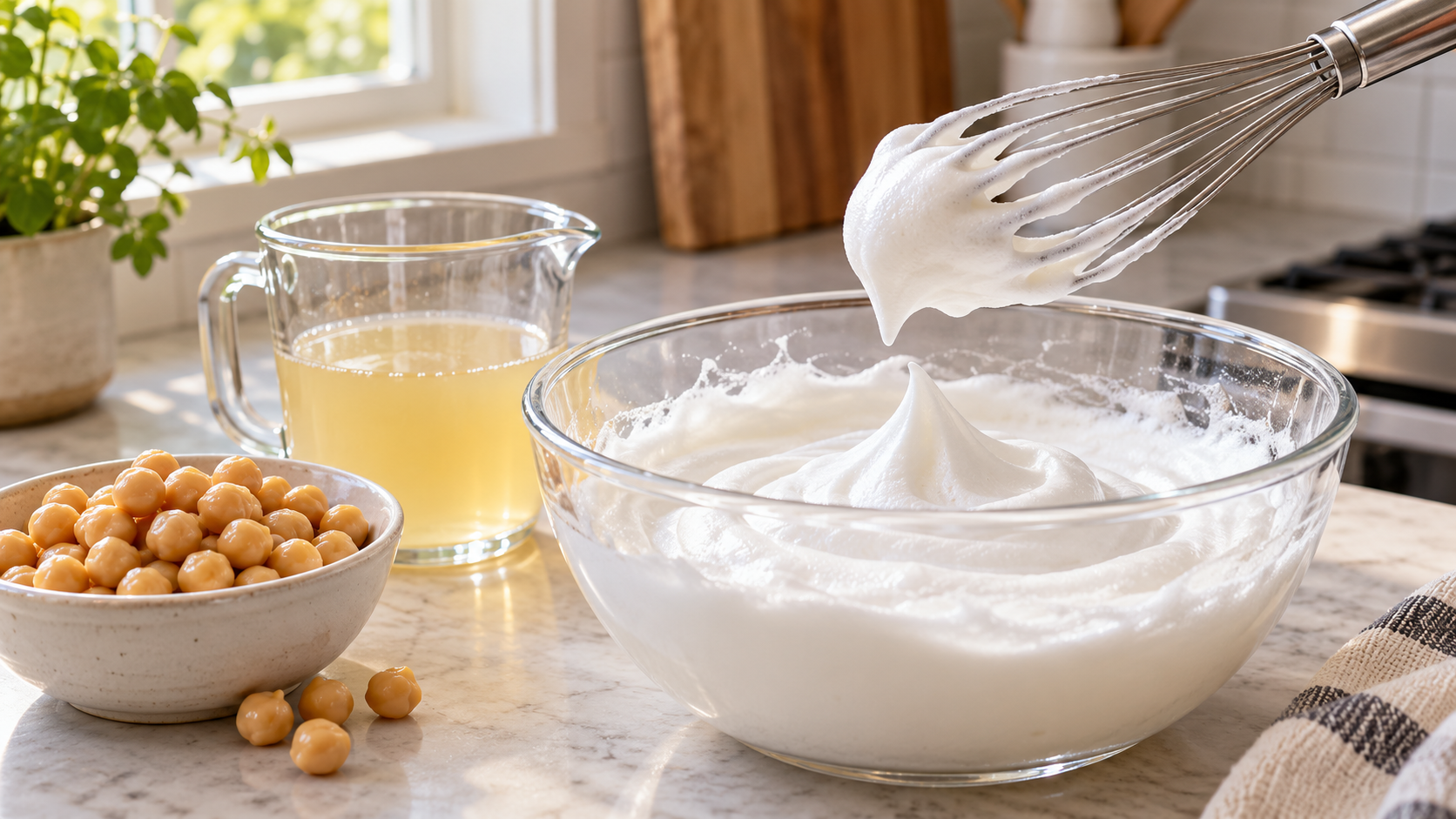
Aquafaba can whip into a light foam, but the liquid in one can of chickpeas may behave differently from the next. Start with plain chickpea liquid that feels slightly viscous, strain out the beans, and beat it in a clean bowl with an electric mixer. Give it time to move from large bubbles to soft peaks before deciding that it has failed. If it stays as thin as water, the liquid itself may need gentle reduction and cooling, or you may need a different can. A stabilizer can help a foam hold its shape; it cannot turn every egg-white recipe into a reliable aquafaba recipe.
This guide is for the moment when you have liquid in a bowl and need to decide what to do next. It covers the visible stages, the most useful fixes, and the recipes where a successful-looking foam can still disappoint.
What aquafaba is, and why two cans can act differently
#Aquafaba is the liquid left after chickpeas have been cooked. The liquid in a can is the easiest version to obtain: drain the chickpeas over a clean bowl and keep what runs through the strainer. It contains dissolved material from the chickpeas that allows it to form bubbles and helps those bubbles last long enough for some cooking uses.
That description is more useful than calling it “vegan egg white.” Egg whites and aquafaba overlap in what they can do, but they are different ingredients. One batch of aquafaba may make a glossy, firm foam; another may make a large volume of bubbles that slowly sinks. The chickpeas, amount of liquid, processing and concentration can all affect what comes out of the package. There is no universal can-to-can guarantee.
For a first attempt at a whipped dessert, canned chickpea liquid is a practical starting point because it is usually more predictable than the water from a home-cooked pot. Homemade liquid can work, but the amount of water left after cooking varies considerably. If you need to debug a recipe, changing the recipe and the aquafaba source at the same time makes the result harder to interpret.
Read the can before draining. Plain chickpeas are the simplest choice for a sweet foam. A can with salt or other seasonings may still whip, but those ingredients can affect the flavor of a delicate meringue. For a savory use, flavor may be less of a problem. If the liquid looks or smells spoiled, or the package is damaged, do not treat whipping as a way to make it usable.
Check the liquid before you switch on the mixer
#Pour the aquafaba through a strainer so chickpea pieces do not interrupt a smooth foam. Look at how it runs off a spoon. The useful starting point is slightly slippery or viscous, roughly like a lightly beaten egg white. It still pours. A liquid that runs exactly like water can sometimes whip, but it is a less promising batch for a firm, lasting foam. A thick gel is not the goal either.
If your liquid is noticeably watery, gently simmer a portion in a small pan to remove some water, then cool it completely before whipping. Reduce a little at a time and compare the consistency again. A modest reduction is easier to control than boiling it down to a syrup. The exact amount to remove depends on the liquid you started with; copying a fixed reduction from another person's can can take yours too far. When it cools, it should still pour readily.
Cooling matters for two reasons. It lets you judge the final thickness, and it keeps a hot liquid out of a recipe that expects a cool foam. Do not add sugar or other ingredients while the liquid is being reduced unless the particular recipe tells you to do that. You are correcting one variable: the concentration of the aquafaba.
Use a clean, dry mixing bowl and whisk or beaters. Fatty residue is especially unhelpful when you are trying to build a stable foam. Wash and dry the tools if they previously held oil, butter or a rich batter. A deep enough bowl reduces splashes while letting the beaters reach the liquid. For a very small amount, a huge stand-mixer bowl may leave too little liquid for the whisk to catch; a hand mixer and a narrower bowl may be easier.
How to whip aquafaba and read the peaks
#An electric hand mixer or stand mixer is the most dependable tool for a firm foam. Whisking by hand can make bubbles, but it is difficult to reach the same stable peaks. Start beating the plain, strained liquid and watch its appearance rather than racing a timer. It should first become bubbly, then paler and finer. As the bubbles get smaller, the mixture gains volume and starts leaving tracks behind the whisk.
For a sweet meringue, follow one complete aquafaba recipe for the amount and timing of sugar. In general, adding sugar gradually after the foam has begun to develop is easier on the structure than dumping it in at once. Keep beating until the recipe's stated endpoint, then stop. The foam can look abundant long before it is ready to be piped or folded.
Lift the whisk to read the stage. Soft peaks form a point that bends over. They suit a recipe that asks for an airy mixture but does not need the foam to stand upright. Firm or stiff peaks hold a more defined point and keep visible ridges. The bowl should look glossy and cohesive rather than watery at the bottom with a cap of bubbles on top. A recipe may ask for a particular stage; that instruction matters more than a photograph from a different preparation.
Aquafaba often takes longer to reach peaks than egg whites. King Arthur Baking's practical guidance treats a batch still failing after roughly 10 to 15 minutes of electric mixing as a reason to consider another can or a different approach. That is a diagnostic cue, not a promise that every good batch finishes by a set minute. Mixer power, amount of liquid and the desired peak all affect the clock. Pause to inspect the foam before deciding to beat indefinitely.
A small amount of cream of tartar can improve stability when the recipe calls for it or allows it. King Arthur Baking gives a starting example of one eighth of a teaspoon for two tablespoons of aquafaba. That is an example from its own baking guidance, not a rule to multiply without considering a complete recipe. If the recipe already includes a stabilizer, do not add another large dose simply because the foam is slow. Taste and structure both matter.
Diagnose the bowl before changing the recipe
#Different failures point to different causes. The quickest useful fix is the one matched to what you see, not a collection of extra ingredients thrown in together.
| What you see | First check | Useful next move |
|---|---|---|
| Liquid splashes but barely bubbles | Is it very watery, and are the beaters reaching it? | Use a narrower bowl or hand mixer; if the liquid is thin, reduce gently and cool, or try another can. |
| Large bubbles appear but no lasting peaks form | Has it had enough electric mixing, and is the bowl clean? | Keep mixing while the bubbles become finer; wash oily tools before a fresh attempt. |
| Soft peaks form but slump quickly | Does the recipe call for sugar or a small stabilizer? | Follow that recipe's gradual addition and finish to its requested stage. |
| It becomes glossy, then loses volume while you mix in other ingredients | Was the added ingredient heavy or oily, or was it added too quickly? | Fold as the recipe directs; use a formula designed for aquafaba rather than a direct swap. |
| The foam looked fine but the baked food spread or collapsed | Does the recipe rely on egg whites for most of its structure? | Choose a proven aquafaba recipe for that product or a different egg-free formula. |
If there is almost no foam
#First check the equipment. If the whisk is spinning above a shallow puddle, the liquid is not being worked effectively. Move to a smaller bowl or use hand beaters that reach it. If the equipment is suitable, compare the liquid with the spoon test above. A watery batch may need careful concentration. Pouring in more cream of tartar does not replace the dissolved chickpea material missing from a very thin liquid.
If you have already mixed for a substantial stretch with an electric mixer and the liquid still behaves like water, start again with another can. That can be more efficient than chasing a weak batch through several additions. Save the chickpeas for a separate meal; the failure of the liquid as a foam says nothing about whether the beans themselves are useful.
If there is foam but it falls before you can use it
#Large bubbles are an early stage, not a finished meringue. Continue until the bubbles are fine and the whisk leaves clear tracks. Check the peak the recipe asks for. A stabilizer may help, but the timing and sugar in the complete formula matter too. If a sweet mixture collapses just after sugar is added, consider whether the sugar went in all at once or before the initial foam developed.
Work with the foam soon after it reaches the intended stage. It is easier to preserve a formed structure than to let it sit on the counter and then try to revive it. If the foam repeatedly drains or separates despite a clean bowl, adequate mixing and a suitable recipe, the liquid may be the limiting factor. Try a different source rather than assuming you need a more powerful mixer.
If it collapses when you fold it into batter
#This is a different problem from a liquid that never whipped. Check whether the batter is much heavier than the foam, whether you stirred vigorously, or whether you changed several ingredients in a recipe designed around eggs. Fold gently according to a tested aquafaba formula, accepting that some volume loss is normal. A stable bowl of foam does not prove it will survive a particular batter or oven.
This distinction can save a second failed cake. You may have whipped the aquafaba correctly and chosen a recipe that asks it to provide more structure than it can reliably supply. Change the formula, not just the whipping time.
Choose a use that matches what aquafaba can do
#Whipped aquafaba is especially attractive in recipes designed around its foam: some meringues, airy toppings and marshmallow-style spreads. It can also lighten a batter that has other ingredients providing structure. These are applications, not permission to replace egg white in every recipe by volume.
King Arthur Baking's tests illustrate the boundary well. Its aquafaba meringues worked, while direct substitutions in several cookies and egg-white-dependent cakes did not give the intended structure. That does not mean no aquafaba cookie or cake can succeed. It means the whole recipe must be designed and tested for the ingredient. When the original recipe depends on eggs to set a tall cake or hold a delicate cookie shape, a simple liquid swap is risky.
The same care applies to conversion ratios. You may see an amount of aquafaba described as equivalent to one egg white. Such figures can help you understand the scale of a recipe, but they cannot account for the difference between cans or the role eggs play in a specific batter. For an important dessert, choose a recipe that names aquafaba in its ingredient list and describes the target foam. That removes a major guess.
Flavor deserves a check too. Plain aquafaba can taste slightly of chickpeas. In a strongly flavored dessert that may be hard to notice; in a delicate topping it may stand out. Use the flavoring from the chosen recipe, and taste the mixture when appropriate. Salted or seasoned canned liquid is a poor surprise in a mild sweet foam. For savory applications, the same flavor may be acceptable, but still check what the can contains.
A practical example: a weak bowl before a dessert
#Imagine you have drained a can of plain chickpeas and plan to make an egg-free meringue from a recipe written for aquafaba. The liquid pours like water. Instead of immediately adding sugar and hoping the mixer will fix it, put a spoonful aside to compare, simmer the rest gently until it is a little more viscous, and let it cool completely. Then put it in a clean bowl that the beaters can reach.
Beat it until the bubbles become fine and the whisk leaves tracks. Add sugar in the sequence and quantity specified by that meringue recipe, then check for its required peak. If the mixture stays thin after a substantial attempt, another can is a sensible next trial. If it whips but the finished dessert fails, compare the full recipe and baking instructions rather than assuming the foam was the only cause.
The example is a decision process, not a claim that a particular can was tested here. Its value is keeping each change visible. When you reduce, change the mixer, add stabilizer and alter sugar all at once, you cannot tell which action mattered.
Store the unused liquid with the same care as the chickpeas
#Once a can is opened, its liquid is no longer a shelf-stable sealed product. Transfer unused aquafaba to a clean covered container and refrigerate promptly. US public food safety guidance says to chill perishable food within two hours, or within one hour when it is exposed to temperatures above 32°C (90°F). Keep the refrigerator at 4°C (40°F) or below. Its general advice is to use refrigerated leftovers within three to four days; use that as a conservative window for the saved liquid too. Follow a shorter period if the package says so.
If you will not use it soon, freeze measured portions. King Arthur Baking and the aquafaba practitioner community both describe freezing it for later use. Label the portions so you know what you have, thaw them in the refrigerator, and assess the liquid again before whipping. Freezing is a storage choice, not a guarantee that every thawed portion will whip exactly like a fresh one.
Keep it out of recipes if it has an off smell, unusual appearance, or uncertain storage history. A pleasant smell does not prove that food held too long at room temperature is safe. When in doubt about how long the opened liquid sat out, discard it and start with a fresh can.
The simple decision to make next
#If your aquafaba is slightly viscous and your bowl is clean, keep whipping until you reach the stage your recipe asks for. If it is thin as water, correct the liquid or try another can. If it whips and then your dessert fails, examine the complete recipe: the foam may be doing exactly what it can, while the formula asks it to do more. That distinction is the most useful way to stop repeating the same failed batch.