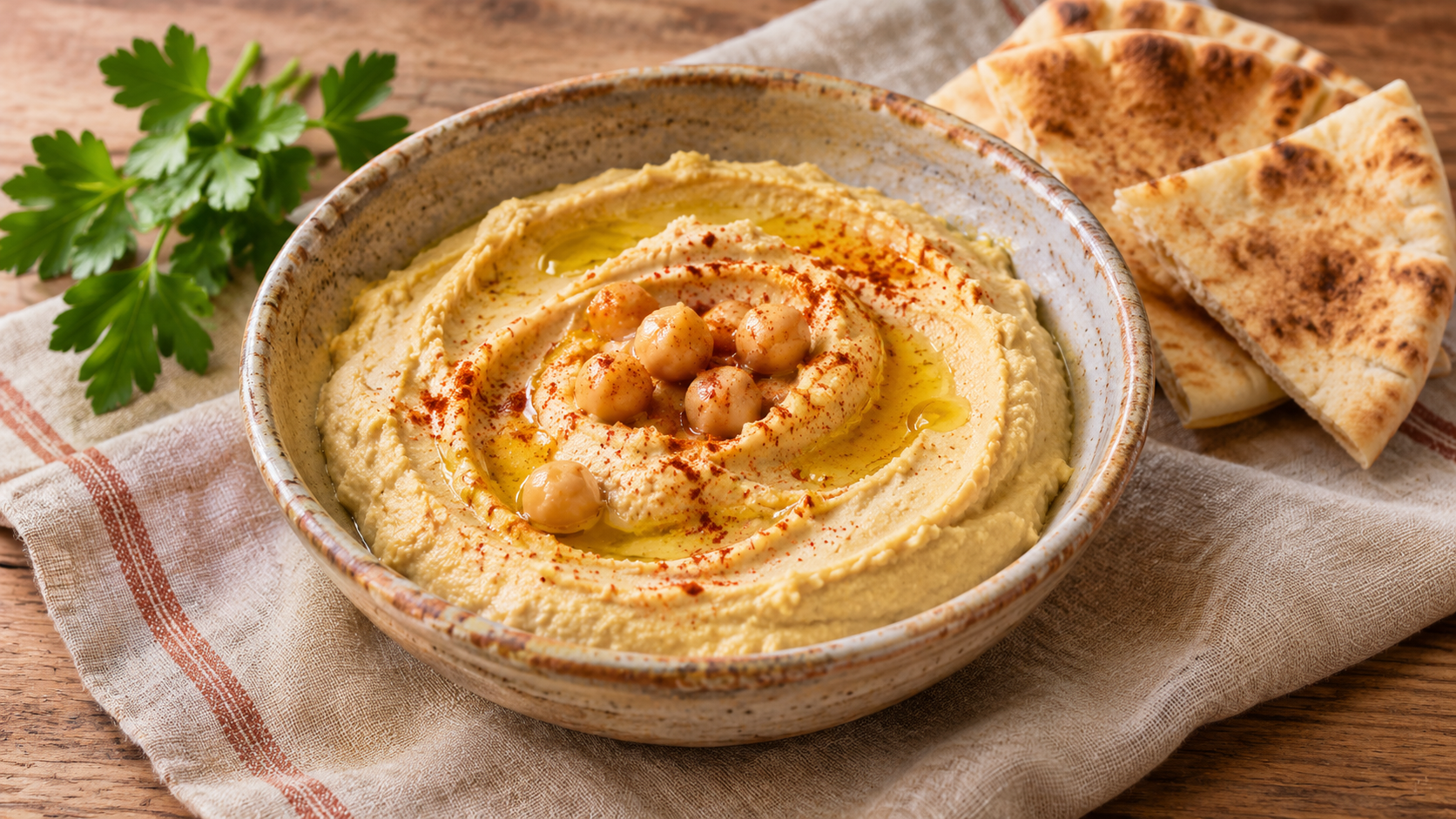
Smooth hummus comes down to four things: chickpeas that are properly soft, enough tahini, a long blend, and water added slowly at the end. You do not need a complicated trick. You do need to stop treating a thick, grainy dip as finished just because the food processor has made some noise.
This is a simple home-kitchen version built around canned chickpeas. It is not trying to settle every regional argument about hummus. The useful goal is more practical: a bowl that is creamy enough to scoop with pita, tastes of sesame and lemon instead of raw garlic, and can be adjusted before it reaches the table.
If I were making hummus for the first time, I would use canned chickpeas and focus on the texture before changing the spices. It is easy to blame a less-than-perfect bowl on the recipe, then add cumin, chilli, herbs and extra oil until the original problem is harder to find. I would rather make a plain, balanced version once. After that, I would know whether I want more lemon, more garlic or a looser finish.
What makes hummus smooth
#Hummus is not supposed to feel like mashed chickpeas with flavouring mixed through it. The ingredients need to become one mixture. That happens when the chickpeas are tender enough to break down, the tahini has been loosened with lemon and water, and the machine runs past the point where the mixture merely looks combined.
The order helps. Start by blending tahini, lemon juice, garlic and salt. At first, the tahini may tighten and look oddly thick. That is normal. Add cold water a spoonful at a time and it relaxes into a pale, creamy base. Then add the chickpeas and keep going until the bowl looks lighter and the graininess is gone.
This is why adding all the water at the start can be frustrating. You lose control of the texture. A little water may be enough with one brand of chickpeas and nowhere near enough with another. Keep the final spoonfuls for the end, when you can see what the hummus actually needs.
Canned chickpeas work, but soften them first
#Canned chickpeas make a good everyday hummus. Rinse them well to remove the canning liquid, then give them a short warm-up in a small pan with water. The aim is not to cook them into soup. You want them hot and soft enough that one will crush easily between two fingers.
If your chickpeas are still firm after warming, add a little more water and keep them over low heat until they yield. A food processor cannot turn hard skins into silk. It can only work with what it is given.
Dried chickpeas give you more control, especially if you like a very soft, loose hummus. Soak and cook them until they are genuinely tender, not just technically edible. That is a nice option for a weekend, but it is not a rule for a good bowl on a Tuesday night.
Do you need to peel every chickpea?
#No. Peeling can make the texture a little finer, but it is a lot of effort for a small difference when the chickpeas are soft and the machine is strong. Try the easier fixes first: warm the chickpeas, blend longer, and add water gradually. If you still want an extra-smooth batch for a special dinner, peel a portion of the skins rather than turning the whole recipe into a project.
If I had dried chickpeas, I would use them this way
#I would soak them, cook them until very tender, and keep some of the cooking liquid nearby. The important point is not a rigid soak schedule. It is the texture. A chickpea that still feels firm in the middle will make hummus feel textured, however long the processor runs.
Dried chickpeas make more sense when I am cooking a larger batch, feeding a group or already planning a bean-based meal. For a quick bowl, I would not turn the dried-versus-canned choice into a purity test. A good canned batch is better than an ambitious dried batch that never gets made.
Tahini is not just a garnish
#Tahini gives hummus its sesame depth and most of its creamy feel. A thin or dry hummus is often blamed on the chickpeas when the real issue is too little tahini or too little water.
Stir the tahini in its jar before measuring it. Sesame solids settle at the bottom, while oil rises to the top. If you scoop only the oil, the hummus will taste flat. If you hit the packed paste at the bottom without mixing, the result can be overly thick and bitter. A properly stirred tahini should pour slowly and look even all the way through.
Taste it before you use it. Tahini can vary a lot. Some jars are mild and rounded; others are more bitter or roasted. If yours is assertive, begin with the smaller amount in the recipe and add more after blending. That is better than trying to bury the bitterness under extra lemon or garlic.
Lemon, garlic and salt: make small changes
#The first taste of hummus can be misleading. Right after blending, it may feel a little blunt because the texture is dense and the flavours have not settled. Let it sit for a few minutes, then taste it with a piece of pita or a vegetable, not only from the spoon.
If it needs brightness, add lemon juice a little at a time. If it needs more savoury depth, add a small pinch of salt. If it tastes raw and sharp, the garlic is usually the problem, not the lack of lemon. One small clove is enough for a first batch. You can always add more, but you cannot easily take raw garlic back out.
There is no prize for making hummus aggressively garlicky. The best version is the one you want another scoop of.
The recipe method
#The full ingredient list and instructions are in the recipe card. The short version is simple:
- Make the tahini, lemon, garlic and salt base first.
- Add soft, warm chickpeas in batches so the machine does not stall.
- Blend until the mixture stops looking sandy.
- Add cold water slowly until it is creamy and scoopable.
- Taste after a brief rest, then adjust lemon, salt or tahini with a light hand.
A food processor is the easiest tool here because it has space for a thick mixture to move around. A powerful blender can work too, but it may need more scraping and a little more water. A small blender cup can turn the hummus into a stubborn paste around the blades, so work in batches if that is what you have.
How to fix the common problems
#It is thick and stiff
#Do not solve this with olive oil alone. Olive oil adds flavour, but water is what loosens the texture cleanly. With the machine running, add cold water a spoonful at a time. Scrape the sides, blend again, and repeat until the hummus spreads easily. Tahini also thickens as it sits, so a hummus that looks perfect in the processor may need another splash of water before serving.
It is grainy
#The most likely causes are under-softened chickpeas or not enough blending. Warm the chickpeas before processing next time. For the batch in front of you, keep blending and scrape the bowl. If the texture is still rough, add a little water and keep going. Do not rush this part; smoothness often arrives late.
It tastes bitter
#Check the tahini first. A bitter tahini will stay bitter no matter how much lemon you add. Try a small extra pinch of salt and a little lemon, then stop. If the taste is still harsh, use less of that tahini next time and choose a milder jar when possible. Raw garlic can also read as bitter, especially after it sits.
It tastes flat
#Flat hummus usually needs salt, lemon or both. Add one small adjustment, blend, and taste again. A little ground cumin is optional, but it should support the chickpeas and sesame rather than make the bowl taste like a spice mix.
It looks pale or plain
#That is not a failure. Good hummus is not required to be bright yellow, heavily spiced or covered in toppings. A shallow bowl, a spoon swirl, a drizzle of olive oil and a pinch of paprika or sumac are enough. Save crunchy toppings, herbs and whole chickpeas for the moment before serving so they still look fresh.
Serve it in a way that makes sense
#Hummus is useful because it can be the centre of a simple meal or part of a bigger spread. Serve it with warm pita, cucumbers, carrots, radishes or roasted vegetables. Spread it inside a sandwich before adding salad and grilled vegetables. Use it under a spoonful of beans or roasted mushrooms when you want a more substantial bowl.
If you are serving it as part of a mezze-style table, keep the toppings modest. A mountain of seeds, herbs, oil and chopped vegetables can hide the thing you worked to make smooth. Put the extras around the bowl and let people add what they like.
The equipment choice I would make
#I would use the widest food processor available, not a tiny cup meant for smoothies. Hummus needs space to circulate and get pushed back toward the blades. In a small container, the mixture can sit above the blades while the motor spins underneath it. That is not a technique problem; it is the wrong shape of tool for a thick paste.
With a blender, I would stop and scrape more often, use a tamper only if the appliance is designed for it, and add water slowly. With a stick blender, I would make a smaller quantity in a narrow container and accept a slightly more rustic texture. None of these tools make one version morally better. The useful choice is the one that lets you see and adjust the mixture instead of fighting it.
I would also use a flexible spatula, not only a spoon. A surprising amount of thick hummus clings to the side of a processor bowl. Scraping it down midway through is often what turns a lumpy mix into a uniform one.
Make-ahead and storage
#Hummus is often better after a short rest in the fridge because the garlic and lemon settle into the tahini. Keep it in a clean covered container, then stir before serving. If it has thickened, loosen it with a spoonful of cold water rather than more oil.
For food safety, keep homemade hummus chilled and follow the storage guidance for the ingredients and container you use. Do not leave a large bowl out for hours at a party. A practical approach is to put out a smaller portion and refill it from the fridge when needed.
If I were taking hummus to someone else's table, I would pack it in a shallow covered container and bring toppings separately. A small container is easier to chill, easier to set out in portions, and less likely to come home as an awkward half-warm bowl. The olive oil, paprika and herbs can wait until just before serving.
The point is not perfection
#There are lots of valid ways to make hummus. Some cooks use dried chickpeas, some prefer canned, some add cumin and some do not. What matters in a home kitchen is knowing what each choice changes.
Start with soft chickpeas, let tahini do its job, and make the final texture decision yourself. Once you have done that a couple of times, you will not need a strict formula every time. You will know when the bowl needs one more splash of water, one more squeeze of lemon, or simply another minute in the processor.