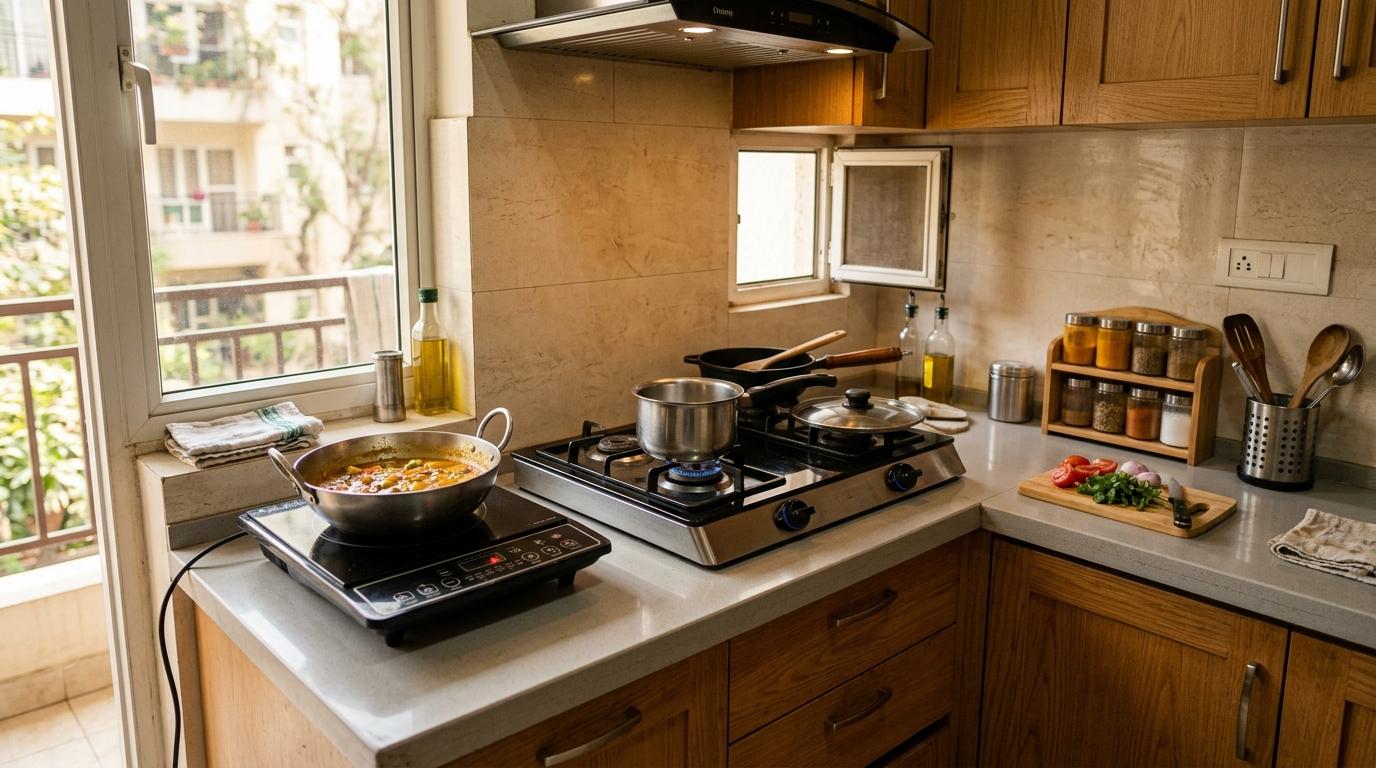
If you can buy only one appliance right now, here’s the simple answer.
Choose a gas stove first if your area has regular power cuts, you make phulkas on direct flame every day, or you want to use almost any vessel without thinking too much.
Choose an induction cooktop first if your kitchen is small, gets very hot, has poor ventilation, or you want something easy to clean with no open flame.
But for many Indian renters and small apartment homes, the most practical setup is this: keep a basic 2-burner gas stove and add a portable induction cooktop when your budget allows.
That combination handles real Indian cooking better than either option alone. Gas helps with phulkas, roasting and traditional cookware. Induction helps with tea, milk, dal, rice, reheating, quick cooking and keeping the kitchen cooler.
Still, the right answer depends on your home. Your electricity supply, LPG access, ventilation, cooking style and existing vessels all matter.
Quick Comparison: Induction Cooktop vs Gas Stove
#The Short Answer for Indian Apartments
#For a small apartment kitchen, induction is often easier to live with.
It heats the vessel directly, gives off less heat into the room, has no open flame and is much easier to wipe clean. This makes a big difference in compact Indian flats where the kitchen may be close to the hall, have poor airflow, or become uncomfortable in summer.
But gas still has its place.
If you make phulkas on flame, use round-bottom kadhais, cook with older aluminium or copper vessels, or live in an area where electricity is not dependable, a gas stove is still the safer first purchase.
So, practically:
- Buy induction first if your kitchen is small or poorly ventilated, electricity is reliable, and you mostly cook tea, milk, rice, dal, curries, breakfast items and reheated food.
- Buy gas first if power cuts are common, you need direct flame, or you want to use all types of vessels without checking compatibility.
- Buy both if possible: a simple gas stove for traditional cooking and a portable induction cooktop for quick daily tasks.
For many Indian homes, this mixed setup is the most comfortable option.
Why Small Apartments Make This Choice Different
#In a large kitchen, both gas and induction are easy to manage. In a small apartment, the problems show up quickly.
A tiny kitchen heats up fast. Tadka smoke can fill the room in minutes. Food smells stay longer. If there is no proper window, exhaust fan or chimney, even normal cooking can make the space feel stuffy.
Renters also have limits. You may not be allowed to install a chimney, change gas lines or add a heavy electrical connection. So the induction stove vs gas stove India debate is not just about taste, speed or modern looks. It is about what your actual home can handle.
Before deciding, ask yourself:
- Is the kitchen open or closed?
- Does the exhaust fan actually work?
- Does the window open outside or only into a shaft?
- Are power cuts frequent?
- Is LPG delivery reliable in your area?
- Do you cook phulkas every day?
- Are your current vessels induction-compatible?
Your answers to these questions matter more than any general “winner.”
Heat Efficiency and Kitchen Comfort
#A gas stove uses an open flame. Some heat goes into the vessel, but a lot of it escapes into the air. In a small Indian kitchen, you feel this quickly, especially in summer.
Induction works differently. It uses electromagnetism to heat the cookware directly. There is no flame under the vessel. The US Department of Energy and ENERGY STAR note that induction cooking is about three times more efficient than gas and around 5 to 10% more efficient than conventional electric cooking.
In daily use, this usually means:
- Water may boil faster.
- The kitchen may feel less hot.
- Less heat is wasted around the pan.
- Heat control can feel more precise once you get used to it.
That said, induction is not completely cold or risk-free. The glass surface can become hot because the hot pan transfers heat back to it. You still need to be careful.
Ventilation and Indoor Air Safety
#Ventilation is a bigger part of this decision than many people realise.
The US Environmental Protection Agency talks about two important ideas for indoor air: source control and ventilation. In simple words, reduce pollutants where possible and let bad air move out.
The US Government Accountability Office has also noted that gas stoves can produce pollutants such as nitrogen dioxide and particulate matter. This does not mean every gas stove is automatically unsafe. It means gas cooking should be done with proper ventilation and basic caution.
If You Use a Gas Stove
#Try to have at least one of these:
- A working exhaust fan
- A chimney that vents properly
- A window that opens outdoors
- Good airflow while cooking
Avoid long gas cooking in a fully closed kitchen. If your kitchen feels smoky, hot or suffocating, ventilation needs attention.
If You Use Induction
#An induction cooktop does not burn LPG, so it does not create combustion byproducts from the appliance itself. That is a big advantage in a closed apartment kitchen.
But induction does not remove every indoor air problem. Indian cooking still creates:
- Oil smoke
- Tadka fumes
- Steam
- Food smells
- Smoke from overheated pans
So yes, even with induction, you still need ventilation.
The difference is simple: gas needs ventilation for both combustion and cooking fumes, while induction mainly needs ventilation for cooking fumes.
Indian Cooking Fit: Phulkas, Tadka, Dal, Chai and Kadhai Cooking
#Indian cooking is not one fixed style. A home that makes phulkas twice a day has different needs from a home that mostly cooks rice, dal, sabzi, dosa, oats, tea and reheated meals.
Where Gas Works Better
#Gas is still better for:
- Phulkas roasted directly on flame
- Papad roasting
- Baingan bharta-style direct roasting
- Round-bottom kadhais
- High-flame tossing
- Aluminium, copper, clay and older steel vessels
- Cooking where you want to see and control the flame
If your cooking depends on direct flame, gas has a clear advantage. Induction cannot copy that exact technique because there is no open flame.
Where Induction Works Better
#An induction cooktop for Indian cooking works very well for many everyday jobs:
- Boiling milk
- Making tea
- Cooking rice
- Making dal
- Simmering curries
- Making poha, upma, pasta, noodles and soup
- Cooking dosa or paratha on a flat induction tawa
- Reheating leftovers
- Steaming vegetables or idlis, if the vessel works on induction
Induction is especially nice for controlled heat. Once you understand the settings, simmering dal or stopping milk from boiling over becomes easier.
What About Tadka?
#You can do tadka on induction if your pan is induction-compatible and flat-bottomed.
Start carefully. Induction can heat very fast. If you use the same high heat you use on gas, mustard seeds, jeera, garlic or curry leaves may burn before you realise it.
Start a little lower, then adjust.
Cookware Compatibility: The Biggest Catch With Induction
#Gas is forgiving. Almost any vessel works on it.
Induction is more particular. It needs cookware that is:
- Magnetic
- Flat-bottomed
- Stable on the glass top
- Suitable for induction heating
The easiest check is the magnet test. Put a fridge magnet on the base of your vessel. If it sticks firmly, the vessel may work on induction. If it does not stick, it will not work.
Usually Works on Induction
#- Cast iron
- Carbon steel
- Some stainless steel marked induction-compatible
- Induction-base pressure cookers
- Flat induction tawas and kadhais
Usually Does Not Work on Induction
#- Pure aluminium
- Pure copper
- Glass
- Clay pots
- Many older stainless steel vessels
- Round-bottom kadhais without an induction base
Before choosing induction as your main stove, check your cookware. If most of your vessels do not work, add the cost of new cookware to your budget.
Electricity vs LPG: The Backup Question
#In India, backup matters.
An induction cooktop depends fully on electricity. If the power goes and your building backup does not support kitchen appliances, you cannot cook.
A gas stove has the opposite strength. If LPG is available, it works during a power cut. Manual ignition works even without electricity.
But gas has its own problems too. LPG cylinders need booking, delivery and safe storage. If your cylinder gets over and you do not have a spare, cooking stops. Piped gas solves some of this, but not every building has it.
Choose Gas First If:
#- Power cuts are common.
- Building backup is limited.
- You cook at fixed times and cannot wait for electricity.
- You need a dependable stove during outages.
- You make flame-based food often.
Choose Induction First If:
#- Electricity is reliable.
- LPG booking or cylinder storage is a headache.
- Your kitchen is poorly ventilated.
- You want a compact and portable appliance.
- You mostly boil, simmer, reheat and cook simple meals.
Choose Both If:
#- You want flexibility.
- You cook traditional meals but also want quick boiling and reheating.
- You are renting and may move homes.
- You want backup for both LPG delays and power cuts.
For many Indian apartments, the hybrid setup is the most practical: gas for direct flame and heavier cooking, induction for quick everyday work.
Safety in Apartment Cooking
#Both gas and induction can be safe if used properly. Neither should be treated casually.
Gas Stove Safety Points
#- Keep the kitchen ventilated.
- Check the knobs after cooking.
- Keep cloth, paper and plastic away from the flame.
- Do not ignore gas smell.
- Clean burners so the flame burns properly.
- Follow LPG provider and appliance instructions.
Gas gives visible heat, which many people like. But open flame also means you need to stay alert, especially in a tight kitchen.
Induction Safety Points
#- Use compatible cookware only.
- Keep the glass surface dry and clean.
- Do not drag heavy vessels on the glass.
- Remember that the surface can stay hot after cooking.
- Use child lock or auto shutoff if available.
- Check appliance rating and your apartment’s electrical load before buying a large built-in hob.
A portable single-zone induction cooktop is usually easier for renters. Built-in multi-zone induction hobs need more planning and proper electrical support.
Cleaning and Daily Convenience
#This is one area where induction clearly feels easier.
A gas stove has burners, pan supports, knobs and small gaps where food can fall. Milk spills, oil splatter and dal overflow can take time to clean.
An induction cooktop has a flat glass surface. Once it cools, you can wipe it clean. Because there is no open flame, spills are less likely to burn badly around the cooking area.
For a small rental kitchen, this is a real everyday convenience.
Gas still makes sense if you use very heavy vessels, rough cookware or do a lot of high-heat frying in traditional pans. Induction needs slightly more care because of the glass top.
Cost Trade-Offs
#The cost comparison depends on your local electricity tariff, LPG price, family size, cooking time, cookware and whether you already have a gas connection.
Broadly:
- Gas may be cheaper to start if you already have LPG and suitable vessels.
- A single portable induction cooktop can have a low entry cost.
- Induction may require new cookware.
- Gas depends on LPG refills or piped gas billing.
- Induction shifts cooking cost to your electricity bill.
Do not decide only by one monthly bill. Think about the full setup:
- Appliance cost
- Cookware cost
- LPG connection or refill process
- Electricity reliability
- Ventilation needs
- Cleaning effort
- Your actual cooking style
The cheapest option on paper may not be the most useful one in your kitchen.
What Should Different Indian Homes Buy First?
#Single Renter in a Studio or 1BHK
#If you mostly make tea, coffee, oats, rice, dal, noodles, eggs or simple sabzi, a portable induction cooktop can be enough to start.
It is compact, easy to shift and does not need LPG storage.
But if your area has frequent power cuts, gas is the safer first appliance.
Couple in a Small Rented Flat
#A hybrid setup works very well.
Use induction for quick morning tasks like tea, milk, boiling eggs, oats or reheating. Use gas for phulkas, frying and direct-flame cooking.
Family That Cooks Full Indian Meals Daily
#Gas is usually the better first purchase if phulkas, pressure cooking, deep frying and kadhai cooking are part of daily life.
You can add induction later for boiling milk, making tea, reheating and quick backup cooking.
Apartment With Poor Ventilation
#Induction deserves serious consideration.
If the kitchen has no proper exhaust, no usable window and poor airflow, reducing combustion inside the kitchen is useful.
Still, ventilate when doing tadka, frying or anything smoky.
Area With Frequent Power Cuts
#Gas should come first unless your building has reliable backup that supports cooking appliances.
Induction is convenient, but without electricity it is useless.
Buying Checklist for a Small Apartment Kitchen
#Kitchen and Ventilation
#- Does the kitchen have a window that opens outdoors?
- Is there a working exhaust fan or chimney?
- Does smoke stay after tadka or frying?
- Is the kitchen very small or closed?
If ventilation is poor, induction becomes more attractive. If you choose gas, ventilation becomes more important.
Electricity and Backup
#- Are power cuts common?
- Does your building backup support kitchen appliances?
- Is there a suitable plug point near the counter?
- Are you buying a portable unit or a built-in induction hob?
If electricity is unreliable, do not depend only on induction.
LPG Access
#- Do you already have an LPG connection?
- Is cylinder delivery reliable?
- Is there safe space to store the cylinder?
- Is piped gas available in the building?
Cookware
#- Do your vessels pass the magnet test?
- Is your pressure cooker induction-compatible?
- Do you have a flat-bottom tawa?
- Do you use round-bottom kadhais often?
- Are you willing to replace some cookware?
Cooking Style
#- Do you make phulkas on direct flame every day?
- Do you roast papad, brinjal or other foods on flame?
- Do you deep fry often?
- Do you mostly boil, simmer, steam, reheat or cook curries?
- Do you need quick tea, milk and breakfast cooking?
Related AllBlogs Guides to Read Next
#- Kitchen Chimney vs Exhaust Fan vs Air Purifier: What Should You Use for Cooking Smoke?
- LPG Gas Leak Checklist India: Emergency Safety Steps
- Spike Guard vs Surge Protector vs Extension Board: What Should Indian Homes Buy?
- Dishwasher for Indian Apartments: Hand Washing vs Countertop vs Full-Size
- Second-Hand Appliance Buying Checklist: Test Before You Pay
Final Recommendation
#For the induction cooktop vs gas stove decision in a small Indian apartment, there is no single winner.
Choose gas if your cooking needs direct flame, your electricity is unreliable, or you want maximum cookware flexibility.
Choose induction if your kitchen is small, hot, poorly ventilated and your electricity supply is dependable. It is especially useful for tea, milk, rice, dal, curries, reheating and quick everyday meals.
If your budget and counter space allow it, choose both.
A simple gas stove plus a portable induction cooktop handles Indian cooking habits, LPG delays, power cuts and ventilation problems better than either one alone.