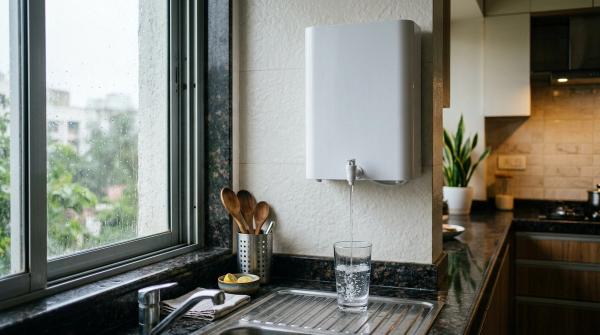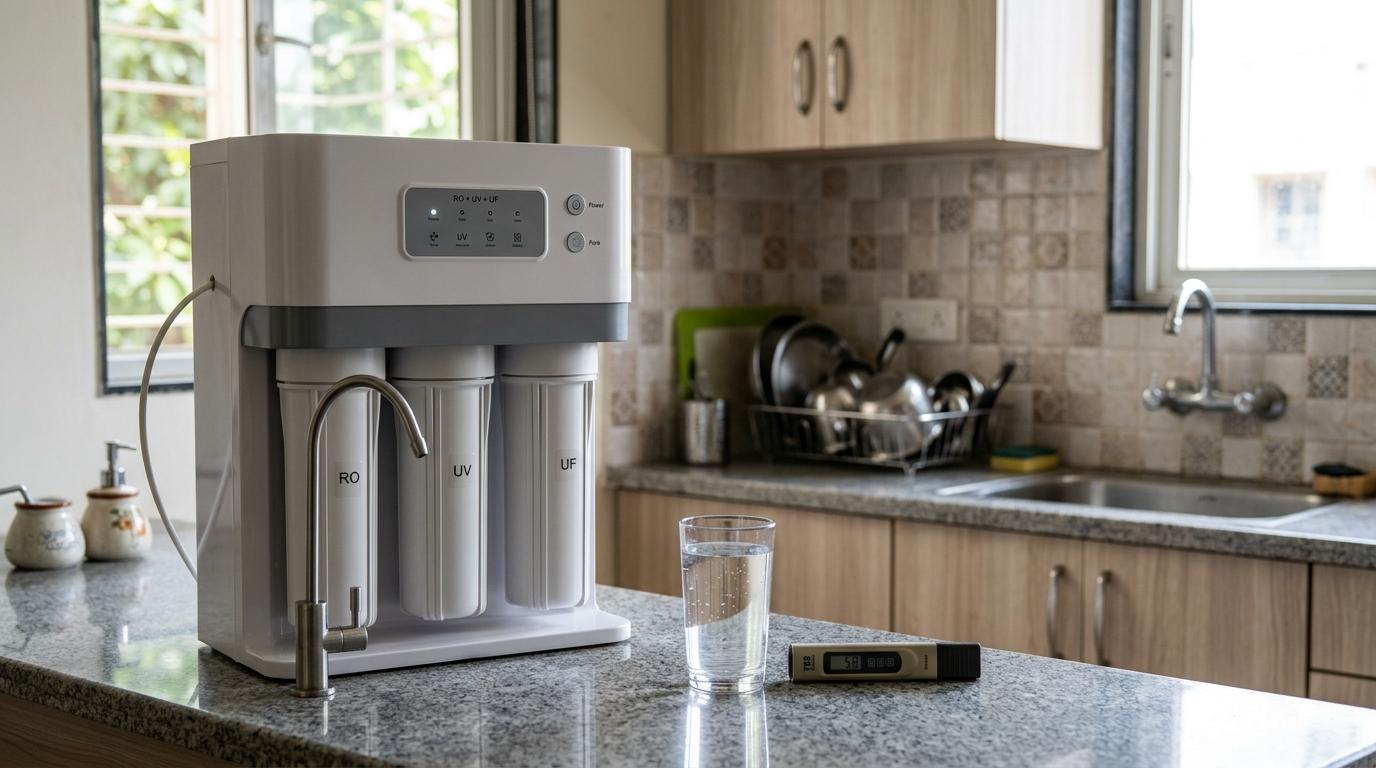
Short answer: Don’t buy a purifier just because it has the longest feature list. Buy it based on your water source and TDS level. For most homes with low-TDS municipal water, UV + UF is enough. For borewell or tanker water with high TDS, RO is usually needed. If your water is visibly muddy but TDS is low, UF with sediment filtration can help. Test your water before deciding, because RO is not automatically the best choice for every Indian home.
Buying a water purifier in India sounds simple until you actually start looking.
One model says RO. Another says RO + UV + UF. Then there is TDS controller, mineralizer, copper, alkaline, 8-stage purification, 10-stage purification, and suddenly you are wondering if your drinking water needs a PhD-level decision.
But here’s the truth: the best purifier is not the one with the most technology packed into it.
The best purifier is the one that solves your water’s actual problem.
A family getting treated municipal water in Mumbai, Bengaluru, Pune, Delhi, Chennai, Ahmedabad, or Kolkata may not need the same purifier as a family using borewell water in Gurgaon, Hyderabad outskirts, Noida, Faridabad, or a fast-growing apartment complex on the edge of a city.
And if you are living in a rented flat, the decision becomes even more practical. You need something that is easy to install, not too expensive to maintain, and possible to shift when you move.
So before asking, “Which purifier should I buy?”, ask this instead:
What kind of water am I getting at home?
This guide explains RO, UV, and UF in simple language, with India-specific examples, TDS guidance, maintenance tips, and a practical buying checklist.
First, What Do RO, UV, and UF Actually Do?
#RO, UV, and UF are not just three fancy purifier labels. They do different jobs.
Think of them like three different tools.
- RO deals with dissolved salts and high TDS.
- UV deals with germs.
- UF deals with particles, dirt, and some larger microbes.
That is why choosing the right one depends on what is wrong with your water.
RO: Reverse Osmosis
#RO stands for Reverse Osmosis.
It pushes water through a very fine membrane. This membrane helps reduce dissolved salts, hardness, and many dissolved impurities that normal filters cannot remove.
This is why RO is commonly used for:
- Borewell water
- Tanker water
- Hard water
- Salty-tasting water
- High-TDS groundwater
If your water tastes heavy, salty, bitter, or leaves white scaling on taps and vessels, RO may be useful.
But RO also has some downsides.
It needs electricity. It produces reject water. It usually costs more to maintain. The RO membrane and filters need replacement from time to time.
So yes, RO can be very useful. But it is not something every home automatically needs.
For low-TDS municipal water, RO may simply be overkill.
UV: Ultraviolet Purification
#UV purification uses ultraviolet light to inactivate microorganisms like bacteria and viruses.
In simple terms, UV does not “filter out” germs physically. It makes them inactive so they cannot multiply and cause infection.
UV is useful when your water is already fairly clear but you are worried about contamination from:
- Old pipelines
- Apartment overhead tanks
- Irregular water supply
- Municipal supply interruptions
- Storage tank hygiene issues
But UV has limits.
It does not remove:
- Dissolved salts
- Hardness
- Mud
- Sand
- Dust
- Chemical contaminants
- Bad taste caused by high TDS
Also, UV works best when water is clear. If the water is muddy, the UV light may not properly reach microorganisms. That is why UV purifiers usually need sediment filters or UF along with them.
For many Indian homes with low-TDS municipal water, UV + UF is a very practical combination.
UF: Ultrafiltration
#UF stands for Ultrafiltration.
It uses a membrane with tiny pores to block suspended particles, dirt, cloudiness, and many larger microorganisms.
UF can help if your water has:
- Visible particles
- Cloudiness
- Muddy appearance
- Suspended impurities
- Some bacteria or cyst risk
One big advantage is that many UF systems do not need electricity, especially gravity-based filters.
But UF also has a clear limitation: it does not remove dissolved salts or reduce TDS.
So if your water is salty or hard because of borewell supply, UF alone will not solve the problem.
UF is useful for low-TDS water with dirt or cloudiness. It is not a replacement for RO when TDS is high.
RO vs UV vs UF Water Purifier Comparison Table
#Start With Your Water, Not the Purifier
#Before comparing brands, offers, and online reviews, check two basic things:
- Where does your water come from?
- What is the TDS level?
A basic TDS meter is inexpensive and easy to use. It will not tell you everything about water safety, but it gives you a helpful starting point.
TDS means Total Dissolved Solids. It measures dissolved minerals and salts in water, usually in ppm or mg/L.
High TDS water may taste:
- Salty
- Hard
- Bitter
- Heavy
- Metallic
Low TDS water may sometimes taste flat, but low TDS does not automatically mean unsafe water.
Also remember this clearly:
TDS is not a complete water safety test.
A TDS meter does not detect all bacteria, viruses, pesticides, lead, arsenic, industrial chemicals, or other specific contaminants.
Still, when you are deciding between RO, UV, and UF, TDS is one of the most practical first checks.
Simple TDS Guide for Indian Homes
#Use this as a starting point, not as a final medical or safety verdict.
If TDS Is Below 200 ppm
#Common source: Treated municipal or corporation waterUsually suitable purifier: UV + UF, or UV with sediment and carbon filterRO needed? Usually no
If your home gets reliable municipal water and the TDS is below 200 ppm, RO is often not required.
In this situation, the bigger concern is usually not dissolved salts. The more common worry is contamination through:
- Old pipes
- Unclean apartment tanks
- Leaky pipelines
- Irregular supply
- Poor storage hygiene
A UV + UF purifier is usually a sensible choice here.
UV helps with microbial risk. UF and sediment filtration help with particles and cloudiness.
Using RO for already low-TDS water may reduce minerals further and waste water without giving much extra benefit.
If TDS Is Between 200 and 500 ppm
#Common source: Municipal water mixed with borewell, tanker, or apartment storage waterUsually suitable purifier: UV + UF if taste is fine, RO if taste or test results justify itRO needed? Depends
This is the grey area.
If the water tastes normal, does not smell strange, and comes from a treated source, UV + UF may be enough.
But if the water tastes salty, hard, bitter, or unpleasant, RO may make sense.
Some homes in this range buy RO with a mineralizer or TDS management feature. That can be okay, but do not blindly trust the sticker on the purifier.
Ask what the TDS controller or mineralizer actually does. Also make sure the purifier is serviced regularly, because poor maintenance can affect final water quality.
If TDS Is Above 500 ppm
#Common source: Borewell water, tanker water, groundwater-heavy supplyUsually suitable purifier: RO, often with UV and pre-filtrationRO needed? Usually yes
For high-TDS water, RO is generally the most relevant technology.
UV and UF cannot remove dissolved salts. So if your borewell or tanker water tastes salty, causes scaling, or has high TDS, a UV-only or UF-only purifier will not solve the main issue.
For many Indian homes using borewell water, RO + UV is a practical combination.
RO reduces dissolved solids. UV adds microbial protection.
If your borewell water has unusual smell, colour, staining, or sediment, it is better to get a proper lab test instead of relying only on TDS.
Water Source Checklist for Indian Homes
#Your water source matters as much as your TDS reading.
Here is a practical way to think about it.
If You Get Municipal Water
#Ask yourself:
- Is the TDS below 200 ppm?
- Is the water mostly clear?
- Does it taste normal?
- Is your apartment tank cleaned regularly?
- Are there frequent pipeline leaks?
- Does water supply stop and start often?
If the answer is mostly yes, UV + UF is usually a good choice.
If your water becomes muddy during monsoon, make sure the purifier has a sediment filter or UF membrane.
If your area has old pipelines or irregular supply, UV is useful because microbial contamination can happen after the water leaves the treatment plant.
If You Use Borewell Water
#Ask:
- Is the TDS above 500 ppm?
- Does the water taste salty, bitter, or hard?
- Does it leave white scaling on taps, buckets, or vessels?
- Is there yellow, brown, or black staining?
- Is the borewell near an industrial area, drain, farm, or sewage-risk zone?
If yes, RO is usually needed, preferably with proper pre-filters and UV.
For borewell water, do not choose a purifier only by looking at TDS. Groundwater quality can change a lot from one locality to another.
If there is unusual smell, colour, staining, or local contamination risk, get a lab test.
If You Use Tanker Water
#Tanker water is tricky because the source may not always be the same.
Ask:
- Is the tanker source consistent?
- Does the TDS change often?
- Does the taste change from week to week?
- Is the tanker filling your building’s storage tank?
- Is the tank cleaned regularly?
- Does the water smell different sometimes?
If you depend on tanker water, test the TDS more than once.
Many tanker-dependent homes choose RO because the water quality can vary. But still, the final decision should depend on actual readings and taste, not fear or guesswork.
If the TDS stays low and the main concern is tank hygiene, UV + UF may be enough.
If You Are a Renter
#Renters have a different problem. You are not only choosing a purifier. You are also thinking about installation, shifting, and service.
Ask:
- Can you install a wall-mounted purifier?
- Will the landlord allow drilling or plumbing changes?
- How long will you stay in this flat?
- Is service available in your area?
- Can the purifier be shifted later?
- What will reinstallation cost?
- Is there space near the sink?
- Does the flat have stable water pressure?
If your water has low TDS, a compact UV + UF purifier may be easier and cheaper to manage.
If your rented flat gets high-TDS borewell water, RO may be necessary. Just check installation, maintenance, and relocation costs before buying.
Many people forget this and regret it when they shift houses.
Which Purifier Combination Should You Choose?
#Most purifiers today combine multiple technologies. That can be useful, but only if every stage has a purpose.
Do not pay extra for stages your water does not need.
UV + UF
#UV + UF is good for:
- Low-TDS municipal water
- Homes worried about germs from pipes or tanks
- Mostly clear water with some particles
- Apartments with treated supply but poor tank hygiene
- Families who want to avoid RO water wastage
UV + UF is not enough for:
- High-TDS borewell water
- Salty or hard water
- Suspected chemical contamination
- Groundwater near industrial or sewage-risk areas
- Water with high dissolved solids
For many city apartments with municipal water, UV + UF is often the most balanced choice.
RO + UV
#RO + UV is good for:
- High-TDS borewell water
- Tanker water with changing quality
- Salty or hard-tasting water
- Homes where dissolved solids are the main problem
- Families who also want microbial protection
RO + UV is not ideal for:
- Low-TDS municipal water where RO is not needed
- Homes trying to avoid water wastage
- Buyers who want low annual maintenance costs
- People who may not service the purifier regularly
If you genuinely need RO, adding UV can make sense. But if your water does not need RO, adding it just because it sounds safer is not a smart move.
RO + UV + UF
#RO + UV + UF is good for:
- High-TDS water with visible particles
- Borewell or tanker water with inconsistent quality
- Areas where water condition changes by season
- Homes that need multiple layers of treatment
RO + UV + UF is not automatically needed for:
- Clean, low-TDS municipal water
- Homes buying it only because it sounds complete
- People who want lower maintenance costs
- Flats where service access is difficult
A full combination purifier can be useful in difficult water conditions. But for simple municipal water, it may be more than you need.
Gravity UF
#Gravity UF filters are good for:
- Low-TDS water
- Areas with power cuts
- Basic particle reduction
- Temporary setups
- Rental homes
- People who want a simple, low-cost option
Gravity UF is not enough for:
- High-TDS water
- Salty borewell water
- Heavy metal contamination
- Chemical contamination
- Strong virus-risk situations as a standalone solution
Gravity filters are convenient, but they should not be used as a shortcut when the water actually needs RO or UV.
Maintenance and Hidden Costs You Should Check
#A purifier is not a one-time purchase.
The real cost includes:
- Filter replacement
- Membrane replacement
- UV lamp replacement
- Service visits
- AMC plans
- Installation
- Reinstallation
- Water wastage in RO systems
Before buying, ask these questions.
1. What Is the Annual Maintenance Cost?
#RO purifiers usually cost more to maintain than UV or UF systems.
A typical RO service may include replacement of:
- Sediment filter
- Carbon filter
- RO membrane
- Post-carbon filter
- Mineralizer cartridge
- Other pre-filters
UV and UF systems usually have lower recurring costs, though UV lamps and filters still need periodic replacement.
Ask the seller for a proper estimate.
Not just, “Maintenance is very low, sir.”
Ask for actual numbers.
2. How Often Do Filters Need Replacement?
#Ask about each part separately:
- Sediment filter
- Carbon filter
- UF membrane
- UV lamp
- RO membrane
- Post-carbon filter
- Mineralizer, if present
Replacement frequency depends on your water quality and usage.
If your water has too much dirt, hardness, or sediment, filters can clog faster. That means higher maintenance cost.
3. Are the Filters Brand-Specific?
#Some purifiers use proprietary filters that only the company can supply.
This can make long-term maintenance more expensive.
Ask:
- Are replacement filters easily available?
- Are they available in your city?
- What does each filter cost?
- Can local technicians service the purifier?
- Will the purifier stop working if a non-brand filter is used?
- How much does an AMC cost?
This matters a lot if you live outside a major metro or if you move homes often.
4. How Much Water Does the RO Reject?
#RO purifiers produce reject water. This is normal, but it is still something you should understand before buying.
The amount of reject water depends on:
- RO model
- Source water quality
- Water pressure
- Membrane condition
- TDS level
If you pay for tanker water, RO wastage matters even more.
You can reuse reject water for:
- Mopping
- Flushing
- Cleaning balconies
- Washing outdoor areas
- Gardening, depending on TDS and plant tolerance
Do not use RO reject water for drinking or cooking.
5. Is Service Available Where You Live?
#A purifier is only as good as its service support.
Before buying, check:
- Local technician availability
- Service response time
- AMC cost
- Filter availability
- Installation charges
- Reinstallation charges
- Cost of shifting the purifier
- Warranty terms
This is especially important for renters.
Moving a purifier is not always as simple as unplugging it and carrying it to the next house.
6. Does It Need Stable Water Pressure and Electricity?
#RO and UV systems need electricity.
RO systems may also need suitable water pressure. In some homes, the technician may suggest extra plumbing or a pressure pump.
UF gravity systems are simpler because they may not need electricity, but they cannot replace RO when TDS is high.
So check your home conditions before buying, especially if you have:
- Low water pressure
- Frequent power cuts
- Limited sink space
- Shared plumbing
- Rental restrictions
Practical Buying Scenarios
#Let’s make this more real.
Scenario 1: Apartment With Municipal Water and TDS 120 ppm
#A UV + UF purifier is usually enough.
RO is likely unnecessary unless a lab test or local issue shows a specific dissolved contaminant risk.
For most homes in this situation, UV + UF gives a good balance of safety, cost, and lower water wastage.
Scenario 2: Borewell Water With TDS 800 ppm
#Choose RO, preferably with UV and proper pre-filtration.
UV-only or UF-only purifiers will not reduce TDS or hardness.
This is exactly the kind of situation where RO makes sense.
Scenario 3: Municipal Water Becomes Muddy During Monsoon
#Choose UV + UF with a good sediment filter.
If the TDS is still low, RO may not be required.
The main issue here is suspended particles and possible microbial contamination, not dissolved salts.
Scenario 4: Tanker Water With Changing Taste
#Test the TDS several times, not just once.
If the TDS is often high or the water tastes salty, RO + UV is usually more suitable.
If the TDS stays low and the issue is mainly storage hygiene, UV + UF may be enough.
Scenario 5: Rented Flat With Low-TDS Water and Frequent Power Cuts
#A gravity UF filter can help with basic filtration.
But if microbial contamination is a serious concern, UV is better — and UV needs electricity.
So think about both your water risk and your power situation before deciding.
Scenario 6: Low-TDS Water, but Apartment Tank Is Rarely Cleaned
#Choose UV + UF.
But also speak to your housing society or landlord about regular tank cleaning.
A purifier helps, but it should not be the only line of defence. Dirty storage tanks can keep creating problems no matter how good your purifier is.
What a Purifier Cannot Promise
#A purifier is useful, but it is not magic.
It works well only when:
- It matches your source water
- Filters are replaced on time
- The unit is serviced correctly
- The storage tank inside the purifier is clean
- Building tanks are cleaned regularly
- Water pressure is suitable
- Electricity supply is stable
- Installation is done properly
Also, do not rely only on taste.
Water can taste normal and still have contaminants. Water can have low TDS and still be unsafe if it has microbial contamination.
If you are unsure, test the water. Guessing is not a great strategy when it comes to drinking water.
When Should You Get a Professional Water Test?
#Get a proper lab test instead of relying only on a TDS meter if:
- You use borewell water for drinking
- You live near an industrial area
- You live near a landfill, drain, lake, or sewage-risk zone
- Your area has heavy agricultural activity
- The water suddenly changes colour, smell, or taste
- You notice oiliness, staining, or persistent sediment
- Infants, pregnant people, elderly people, or immunocompromised family members drink the water
- Your apartment uses mixed sources like municipal plus borewell plus tanker
- Your purifier filters clog unusually fast
- Your locality has known water contamination complaints
A lab test can detect issues that a TDS meter cannot show, including specific chemical and microbial risks.
Common Mistakes to Avoid
#Mistake 1: Buying RO Because It Sounds Safest
#RO is useful for high-TDS water.
It is not automatically the safest or best purifier for every home.
For low-TDS municipal water, RO may be unnecessary, wasteful, and more expensive to maintain.
Mistake 2: Ignoring Apartment Storage Tanks
#Even treated municipal water can become contaminated in dirty overhead tanks or old pipelines.
If your building tank is not cleaned regularly, your home purifier has to work harder.
In some cases, the tank itself is the bigger problem.
Mistake 3: Looking Only at Purchase Price
#A cheap purifier with expensive filters may cost more over five years than a slightly costlier model with affordable maintenance.
Always ask about annual service cost before buying.
Mistake 4: Trusting Taste Alone
#Taste is helpful, but it is not a safety test.
Some contaminants do not change taste, smell, or colour.
If something feels off, test the water.
Mistake 5: Forgetting Service Availability
#A purifier that cannot be serviced easily becomes a headache.
Before buying, check whether technicians and filters are available in your area.
This is especially important if you are not in a metro city.
Mistake 6: Assuming More Stages Means Better Water
#More stages do not always mean better purification.
A 7-stage or 10-stage purifier may sound impressive, but what matters is whether those stages match your water problem.
If your water does not need RO, adding RO does not automatically make it better.
Final Recommendation: Which Water Purifier Should Indian Homes Buy?
#If your water is low-TDS municipal water, choose UV + UF. It is practical, handles common microbial and particle concerns, and avoids unnecessary RO water wastage.
If your water is high-TDS borewell or tanker water, choose RO, preferably with UV and proper pre-filtration.
If your water is muddy but low in TDS, choose UF with sediment filtration, and add UV if microbial risk is a concern.
If you are unsure, start with a TDS test. If the water comes from a borewell, tanker, industrial-area groundwater, or keeps changing in colour, smell, or taste, get a proper lab test.
The best water purifier for Indian homes is not the one with the longest feature list.
It is the one that fits your water, your building, your budget, and your maintenance reality.