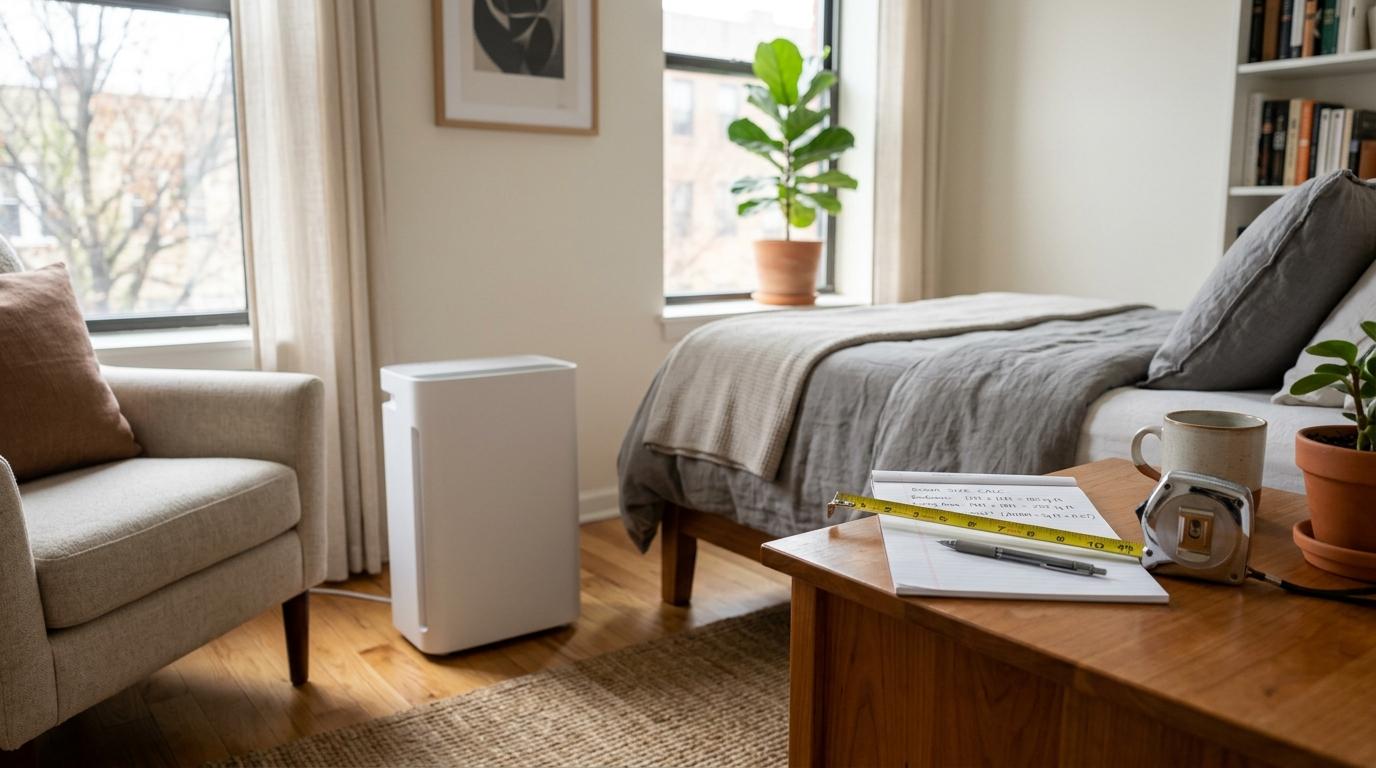
Choosing an air purifier gets much easier when you stop looking at the purifier first and start with the room.
Measure the room’s floor area, check the ceiling height, and then match the purifier’s CADR to the amount of air in that space. For a typical room with an 8-foot ceiling, a simple rule of thumb is this:
CADR in CFM should be around two-thirds of the room’s square footage for roughly 5 air changes per hour.
So, for a 150 sq ft bedroom, a purifier around 100 CFM CADR is a reasonable starting point.
If your ceiling is higher, the room is dusty, you have pets, outdoor pollution is a regular problem, or you want the purifier to run quietly at night, it is usually better to go one size up.
Most people do not buy an air purifier because they want to study airflow math. They just want to know whether the machine will actually help in a bedroom, living room, nursery, office corner, or apartment.
That answer depends on a few practical things:
- Room size
- Ceiling height
- CADR rating
- Air changes per hour
- HEPA and carbon filters
- Noise level
- Filter replacement cost
This guide keeps things simple and realistic. No brand hype, no miracle claims, and no confusing lab language. Just a practical way to choose an air purifier that fits the room you actually live in.
The short version
#If you only remember a few things, remember these:
- CADR tells you how much clean air the purifier delivers.
- Room volume matters, not just floor area.
- For standard 8-foot ceilings, CADR in CFM of about two-thirds of the room’s square footage gives roughly 5 air changes per hour.
- HEPA filters help with particles, such as dust, pollen, pet dander, smoke particles, and PM2.5.
- Activated carbon filters help with some smells and gases, but they do not remove every gas.
- Portable air purifiers are usually one-room machines, not whole-home solutions.
Air purifiers can reduce airborne particles, but they do not replace ventilation, cleaning at the source, or medical advice.
What CADR means in plain English
#CADR stands for Clean Air Delivery Rate. It tells you how much clean, filtered air an air purifier can deliver in a set amount of time.
You may see CADR listed as:
- CFM, or cubic feet per minute
- m³/h, or cubic metres per hour
A higher CADR usually means the purifier can clean more air faster, assuming the filters are effective and the unit is being used correctly.
Think of CADR as the purifier’s real working power.
A large purifier with a weak CADR may still struggle in a big room. On the other hand, a compact purifier with a strong CADR may work very well in a bedroom, study, or small living area.
This is why CADR is more useful than fan speed alone. A fan only tells you that air is moving. CADR tells you how much cleaned air is coming out.
Why room size is not just square feet
#A lot of product pages say something like “suitable for rooms up to 400 sq ft.” That sounds helpful, but it can be misleading.
Air purifiers do not clean a flat floor. They clean a volume of air.
For example:
- A 150 sq ft bedroom with an 8 ft ceiling has 1,200 cubic feet of air.
- A 150 sq ft bedroom with a 10 ft ceiling has 1,500 cubic feet of air.
The floor area is the same, but the second room has 25% more air to clean.
So if your home has high ceilings, a loft-style layout, or an open living and dining space, do not rely only on square footage.
Use this simple formula:
Room volume = floor area × ceiling height
Once you know the room volume, you can estimate the CADR you need much more accurately.
What ACH means and why it matters
#ACH means air changes per hour. It tells you how many times the purifier can filter the room’s air in one hour.
For many homes, a practical target is around 4 to 5 ACH for bedrooms and living rooms.
This does not mean the air becomes perfectly clean. It simply means the purifier is filtering the room air often enough to be useful.
If ACH is too low, the purifier may be underpowered for the room. It can still catch some particles near the machine, but it will take longer to clean the overall space.
Simple CADR formula
#If CADR is listed in CFM, use this formula:
Required CADR = room area × ceiling height × target ACH ÷ 60
For example, take a 150 sq ft bedroom with an 8 ft ceiling and a target of 5 ACH:
150 × 8 × 5 ÷ 60 = 100 CFM
So a 150 sq ft bedroom with a standard ceiling needs about 100 CFM CADR for roughly 5 air changes per hour.
If CADR is listed in m³/h, use this rough conversion:
1 CFM ≈ 1.7 m³/h
So 100 CFM is about 170 m³/h.
Practical air purifier sizing table
#Use this table as a starting point. These numbers assume a standard 8-foot or 2.4-metre ceiling and aim for around 4 to 5 air changes per hour.
If your room has a higher ceiling, an open layout, frequent dust, pets, or outdoor pollution, move up one size.
This table is not a medical standard and it is not a promise of perfect air quality. It is simply a practical buying guide.
How to choose CADR for a bedroom air purifier
#A bedroom air purifier needs two things: enough cleaning power and low noise.
Here is the part many people miss: most air purifiers reach their advertised CADR only on the highest fan speed. That setting may be too loud for sleeping.
So for bedrooms, it often makes sense to buy slightly more CADR than the bare minimum.
For example, if your room needs around 100 CFM, choosing a purifier rated above that may let you run it on medium or low at night. That can make a big difference if the purifier sits near your bed.
This is especially useful if:
- You sleep with the purifier running.
- You live near traffic, construction, or dusty roads.
- You spend long hours in the room.
- You have pets.
- Your city has seasonal smog or high PM2.5.
- Your bedroom has a high ceiling.
- You do not want a loud fan running while you sleep.
The goal is not to buy the biggest purifier you can find. The goal is to buy enough capacity so the purifier can do its job without annoying you.
HEPA filter, carbon filter, and what each one does
#A good air purifier is basically a fan plus filters. The filters decide what the machine can actually reduce.
HEPA filter
#A HEPA filter is designed to capture fine airborne particles. In a normal home, that may include:
- Dust
- Pollen
- Pet dander
- Mould spores
- Smoke particles
- PM2.5 particles
This is why HEPA filtration matters if you deal with dust, outdoor pollution, pollen, seasonal allergies, or fine particles entering from outside.
But there is one important limit: HEPA filters help with particles, not all gases or odors.
So if your main issue is smell, chemical fumes, cooking odor, or traffic gases, a HEPA filter alone may not be enough.
Activated carbon filter
#An activated carbon filter helps with some gases and odors. It can reduce certain smells from cooking, smoke, traffic exhaust, cleaning products, and other indoor sources.
But carbon filters are not all the same.
A thin carbon sheet is very different from a thick carbon bed. Many budget air purifiers include only a light carbon layer. That may help a little with odor, but it may not last very long.
A simple way to think about it:
- Choose HEPA for particles.
- Choose carbon for some gases and odors.
- Choose both if your home has dust, PM2.5, traffic smell, cooking odor, smoke, or mixed air problems.
For maintenance planning, see the related guide: HEPA Filter Replacement Checklist.
The one-room rule
#Portable air purifiers are best understood as one-room or one-area devices.
One large purifier in the living room will not reliably clean a closed bedroom down the hallway. Doors, walls, furniture, and corners all limit airflow. Even in an open layout, clean air does not spread perfectly everywhere.
If you live in a small apartment, you can move one purifier between rooms during the day and night. That can work. Just remember that while it is in one room, it is mainly cleaning that room.
For most homes, the practical approach is:
- Put the strongest purifier where you spend the most time.
- Use a quiet, correctly sized purifier in the bedroom.
- Consider separate units for rooms that stay closed for hours.
- Do not expect one portable purifier to clean a full multi-room home.
Windows, ventilation, and air purifiers need balance
#An air purifier works best when it can filter the same room air again and again.
If windows are wide open during heavy outdoor pollution, smoke, or dust, the purifier has to keep dealing with new dirty air coming in. It may still help, but it will be working much harder.
In places with high outdoor PM2.5, road dust, construction dust, or seasonal smog, people often get better results by keeping windows closed while the purifier is running during bad pollution periods.
But that does not mean ventilation is unimportant.
Air purifiers do not bring in fresh outdoor air. They do not add oxygen. They do not remove carbon dioxide. If a closed room feels stuffy, that may be a ventilation issue, not something an air purifier can fully fix.
When outdoor air quality is reasonable, ventilation still matters.
For more on this difference, read: CO2 Monitor vs Air Purifier.
If your main issue is dampness, musty smell, or humidity, compare your options here: Air Purifier vs Dehumidifier.
Noise matters more than people expect
#Noise is one of the biggest reasons people stop using an air purifier.
A purifier can look perfect on paper, but if it is too loud, you will probably switch it off. And a switched-off purifier has no CADR at all.
When comparing models, do not look only at the maximum CADR number. Ask:
- Is the CADR high enough at a fan speed I will actually use?
- Can I sleep with it on?
- Does it have a low mode or sleep mode?
- Will it sit close to my bed, sofa, or desk?
- Am I buying enough capacity so I do not need to run it on high all the time?
For bedrooms, nurseries, and work-from-home spaces, slightly oversizing the purifier is often more comfortable than buying the exact minimum.
Maintenance cost and filter replacement
#The purchase price is only part of the story. Filters need replacement, and a purifier with old or clogged filters will not perform properly.
Before buying, check:
- Are replacement HEPA filters easy to find?
- Are carbon filters sold separately or combined with the HEPA filter?
- How often does the manufacturer recommend replacement?
- Is the filter cost reasonable for your budget?
- Does the purifier have a filter replacement alert?
- Can you clean the pre-filter, if it has one?
Avoid choosing only by the lowest upfront price. A cheaper purifier can become frustrating later if filters are expensive, hard to find, or need replacing too often.
Filters are not forever, and that is easy to forget when you are comparing shiny new machines online.
Practical buying checklist
#Use this checklist before you buy.
1. Measure the room
#Write down:
- Room length
- Room width
- Ceiling height
Then calculate:
Room area = length × width
Room volume = area × ceiling height
2. Choose your target ACH
#For many homes, around 4 to 5 ACH is a practical target for bedrooms and living spaces.
Choose a higher-capacity purifier if:
- Outdoor pollution is often high.
- Your room has high ceilings.
- The room connects to an open area.
- You want lower noise.
- Dust enters often through doors, windows, or balconies.
- You live near traffic, construction, or dry dusty roads.
3. Check the CADR rating
#Look for CADR in CFM or m³/h.
Do not rely only on vague claims like “suitable for large rooms.” Match the CADR to your actual room size.
4. Check filter type
#At minimum, look for:
- A HEPA filter for particles
- A carbon filter if odors, smoke, or traffic fumes are a concern
Remember, HEPA helps with particles but not all gases or odors.
5. Think about noise
#If the purifier is for a bedroom, choose enough CADR so you can use a lower fan setting at night.
A purifier you can comfortably live with is better than one you keep turning off.
6. Plan for filter replacement
#Before buying, check replacement filter availability and long-term maintenance cost.
7. Buy for the room, not the whole home
#Portable air cleaners are meant for one room or area. If you need cleaner air in multiple closed rooms, plan for that from the start.
Common sizing mistakes to avoid
#Buying based only on coverage area
#Coverage area can be based on different assumptions.
One product may claim a large room size using low air changes per hour. Another may use a stricter standard. That is why two purifiers with very different CADR numbers can both claim to cover “large rooms.”
CADR is usually more useful than a broad room-size claim.
Ignoring ceiling height
#A room with a high ceiling contains more air. More air needs more clean-air delivery.
It sounds obvious, but it gets missed all the time.
Choosing a purifier that is too small for dust and pollution
#In dusty or high-pollution areas, an undersized purifier may struggle because new particles keep entering the room.
This is common near busy roads, construction zones, dry dusty areas, or during smog season. If you live next to traffic or construction, you already know how quickly dust comes back.
Running the purifier only for a short time
#Air cleaning works best when the purifier runs long enough to cycle the room air repeatedly.
Short bursts may help a little, but steady use at a comfortable fan speed usually works better.
Forgetting filter cost
#An air purifier is not a one-time purchase. If replacement filters are too costly or hard to find, the machine may end up sitting unused.
Important safety caveat
#Air purifiers can reduce airborne particles when they are correctly sized, placed, and maintained. They do not replace proper ventilation, source control, or medical advice.
They do not remove carbon dioxide. They do not add oxygen. They should not be treated as medical devices.
If someone in your home has asthma, COPD, severe allergies, respiratory symptoms, or another health condition, speak with a qualified medical professional about the right indoor air approach.