If your family uses RO water every day, especially from a borewell, tanker, or high-TDS source, a water purifier AMC usually makes more sense. It keeps servicing more predictable and reduces the chances of delayed filter changes.
If you have a simpler UV or UF purifier, fairly stable municipal water, or you may shift homes soon, pay-per-service can be a practical option.
In short, the better choice is not always the one that looks cheaper at first. It is the one that matches your water source, purifier type, usage, and how regularly you maintain the machine.
Most of us do not think about purifier servicing until something goes wrong. The water starts tasting different. The tank fills slowly. The service light blinks on a Monday morning when everyone is already late. It happens.
A water purifier sits quietly in the kitchen, so it is easy to treat it like any other appliance. But an RO, UV, or UF purifier is not like a mixer or toaster. It is a small water treatment system. If a filter is skipped, replaced late, or changed with a poor-quality part, the purifier may still run, but the water quality may quietly suffer.
So before you pay for a water purifier AMC, or decide to call a technician only when needed, check a few basics.
Start with your water source
#This is where many families make the first mistake. They compare AMC prices before asking the most important question:
What kind of water am I actually treating?
Your purifier should match your water source. You should not choose RO, UV, or UF only because it sounds advanced or expensive. You choose it because your water needs that kind of treatment.
In India, BIS IS 10500 is the main reference for drinking water quality. It looks at things like TDS, hardness, microbial safety, and other contaminants.
Here is the simple version.
RO, UV, UF, and TDS: the basics
#RO purifier
#RO stands for reverse osmosis. It is used when water has high dissolved salts, hardness, or dissolved impurities that normal filters cannot handle well.
RO purifiers are common in homes that use:
- Borewell water
- Tanker water
- Mixed water supply
- High-TDS water
- Hard water
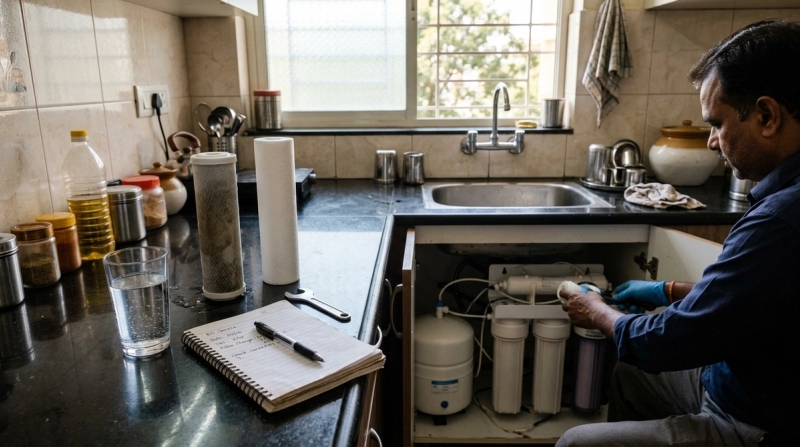
An RO system usually has more parts than a basic purifier. It may include a sediment filter, carbon filter, RO membrane, pump, valves, storage tank, and sometimes UV or UF stages too.
Because of this, RO maintenance cost depends a lot on your water quality and daily usage. If the inlet water is harsh, the filters and membrane work harder. That usually means more maintenance.
UV purifier
#UV purifiers use ultraviolet light to inactivate many microorganisms. But UV does not remove dissolved salts, hardness, mud, or visible dirt.
UV works best when the water is already reasonably clear. If the water has too much dirt or turbidity, UV may not work as effectively.
For many apartments with treated municipal water, UV can be a sensible option, depending on the actual water quality.
UF purifier
#UF stands for ultrafiltration. It uses a membrane to block fine particles and some biological contaminants.
UF does not reduce TDS like RO does. It is usually used when the water does not have high dissolved salts but still needs physical filtration support.
TDS meter
#A TDS meter gives a quick reading of total dissolved solids in water. It is useful, but it is not a full safety test.
TDS does not tell you whether your water has bacteria, pesticides, heavy metals, or every possible contaminant. It is just one clue.
If your water smells bad, tastes strange, looks cloudy, or you suspect contamination, do not depend only on a home TDS meter. Speak to a qualified technician or get the water tested through a suitable lab.
Why purifier maintenance is different in Indian homes
#In many Indian homes, water quality does not stay the same throughout the year.
During monsoon, municipal water can carry more suspended dirt, turbidity, or smell, especially in areas with old pipelines or poorly cleaned storage tanks. In such months, pre-filters may clog faster.
Borewell water has its own issues. It can have high hardness and TDS, and these levels may change by season, depth, and locality.
Tanker water can be even more unpredictable because the source may keep changing.
That is why two families with the same purifier model may have completely different maintenance needs. One family may manage well with pay-per-service. Another may keep replacing clogged filters and wonder why the same machine is becoming so expensive to run.
AMC vs pay-per-service: quick comparison
#The table tells the real story. An AMC is not automatically better. Pay-per-service is not automatically cheaper.
It depends on what is covered, what your water is like, and whether you are disciplined about maintenance.
When a water purifier AMC makes sense
#A water purifier AMC is worth considering if:
- You use an RO purifier every day.
- Your water comes from a borewell, tanker, or mixed source.
- Your water has high TDS or hardness.
- Your purifier has multiple stages like RO, UV, UF, or mineral cartridges.
- You do not want to track filter replacement dates yourself.
- Your purifier has had repeated breakdowns.
- The tank fills slowly or the flow keeps dropping.
- You prefer predictable maintenance instead of sudden repair bills.
- Your home has children, elderly people, or family members for whom you want fewer maintenance gaps.
For busy families, an AMC works almost like a reminder system. The benefit is not only about money. It also means someone is expected to inspect, clean, and replace parts before the purifier starts giving trouble.
But the word “expected” matters. A vague or weak AMC can be worse than simply paying per visit.
When pay-per-service may be enough
#Pay-per-service can work well if:
- You have low-TDS municipal water.
- You use a UV or UF purifier.
- Your purifier is basic and has fewer expensive parts.
- You are a renter and may shift soon.
- Your machine is still under manufacturer warranty.
- You have a reliable technician.
- You keep service records and do not delay maintenance.
This option works best for organised households.
If you wait until the water smells odd, the taste changes, or the flow becomes very slow, then you are not really saving money. You are only postponing maintenance.
For renters, especially, a long AMC may not be worth it unless it matches your stay duration or can be transferred to another address. Always ask before paying.
What a good water purifier AMC should include
#Before buying any RO AMC or water purifier AMC, ask for the details in writing. Do not depend only on what the salesperson or technician says verbally.
A useful AMC should clearly mention the following.
1. Scheduled service visits
#The plan should include planned maintenance visits, not just breakdown support.
Ask:
- How many visits are included?
- How often will they happen?
- What will the technician check during each visit?
2. Filter coverage
#Check whether the plan includes:
- Sediment filter
- Carbon filter
- Pre-filter
- Post-filter
- Mineral cartridge, if applicable
If filters are excluded, the AMC may only be covering labour. That may still be useful, but you should know what you are paying for.
3. RO membrane coverage
#For RO users, this is one of the biggest points.
The RO membrane is an important and costly part of the system. Some AMC plans include it. Some exclude it. Some include it only under certain conditions.
Ask clearly before paying.
4. UV lamp and related parts
#If your purifier has UV, check whether the plan covers:
- UV lamp
- UV chamber or sleeve cleaning
- Related electrical components
A UV purifier is only useful if the UV system is working properly.
5. Pump, adapter, valves, and sensors
#RO purifiers depend on electrical and pressure-related parts.
Ask whether the AMC covers:
- Pump
- Adapter
- Solenoid valve
- Float sensor
- Pressure-related parts
- Electrical components
If these are excluded, repair costs may still come separately.
6. Visit charges
#Some AMCs include unlimited visits. Some include a fixed number. Some charge after a certain point.
Ask this clearly:
Will I pay anything when the technician visits during the AMC period?
7. Original or compatible parts
#If your purifier needs brand-specific parts, the AMC should say so.
If compatible parts are used, ask what quality assurance is provided. Avoid unlabelled parts if the technician cannot explain what they are installing.
8. Complaint process
#A good AMC should explain how to raise a complaint and what kind of response you can expect.
Also ask whether you will receive a service record after every visit.
9. Exclusions
#This is where many surprises are hidden.
Check what is not covered. Common exclusions may include:
- External plumbing
- Damage due to misuse
- Pest damage
- Electrical surge damage
- Storage tank cleaning
- Non-standard installation
- Damage caused by third-party repairs
Do not skip this section.
Red flags before buying an AMC
#Pause and ask more questions if you notice any of these.
“Everything is covered” but nothing is written
#If someone says everything is included, ask for the document. If the document does not match the promise, trust the document.
Very cheap AMC with major exclusions
#A low-cost AMC may only include labour or basic inspection. That is not always bad, but it should not be sold as full protection.
Pressure to pay immediately
#Do not pay only because someone says the offer will end today.
Compare the plan, check reviews if possible, and understand what happens after the current warranty period.
No clarity on RO filter replacement
#If your main reason for buying an AMC is to control RO filter replacement costs, the plan must clearly mention filters and membrane.
If it does not, ask before paying.
Unbranded filters in sealed-looking packets
#Ask what part is being installed. You do not need to become an engineer, but you should know whether the part is original, approved, or compatible.
TDS adjustment without explanation
#Some technicians adjust taste or TDS using a bypass or mixing valve. This should be done carefully and explained properly.
Do not chase the lowest TDS number blindly. The goal is suitable treatment for your water source.
No service record
#Every visit should leave a record, either physical or digital.
It should mention:
- Date of service
- Parts replaced
- Readings checked, if any
- Technician details
- Payment details, if any
Ignoring smell, taste, or cloudiness
#If you complain about bad smell, strange taste, or cloudy water and the technician dismisses it without checking properly, call someone qualified.
These are not small cosmetic issues. They deserve proper attention.
Safety-first maintenance checklist
#Use this checklist before and after any water purifier service.
- Smell the water. Sewage-like, chemical, metallic, or stale smell needs attention.
- Look at the water in a clean glass. Cloudiness, particles, or colour change should not be ignored.
- Taste carefully only if there is no obvious smell or visible issue.
- Check whether the tank is filling faster or slower than usual.
- Look for leaks near the purifier and storage tank.
- Ask which filters were replaced.
- Keep the bill or service note.
- Tell the technician if your water source has changed.
- If contamination is suspected, stop drinking the water and arrange proper testing or service.
Also, do not accept medical promises from purifier sellers or service providers. A purifier can treat water based on its technology and condition. It cannot honestly promise to cure health problems.
A simple way to decide
#Here is a practical way to think about it.
If your home uses RO with borewell or tanker water, compare comprehensive AMC plans first. Focus on membrane, filters, pump, UV parts, visit charges, and exclusions.
If your home uses municipal water with a UV or UF purifier and no RO, pay-per-service may be enough, provided you maintain the schedule and respond quickly to any change in water quality.
If you are a renter, avoid locking money into a long plan unless it fits your rental timeline. A shorter plan or pay-per-service may be more practical.
If your water quality changes by season, especially during monsoon, choose the option that makes timely inspection and pre-filter replacement easier.
And if you do not know your water quality at all, do not start by shopping for an AMC. Start with the source. Check TDS, inspect storage tanks, ask your apartment association about the supply, and consider lab testing if there are warning signs.
Final verdict
#For many Indian homes using RO on hard borewell or tanker water, a clear and comprehensive water purifier AMC is the more predictable choice. It helps avoid skipped maintenance and sudden repair surprises.
For homes using simpler UV or UF purifiers on relatively stable municipal water, pay-per-service water purifier maintenance can be perfectly sensible.
The real decision is not simply AMC versus no AMC.
It is this:
Know your water. Know your purifier. Read the inclusions. And never ignore changes in smell, taste, or clarity.