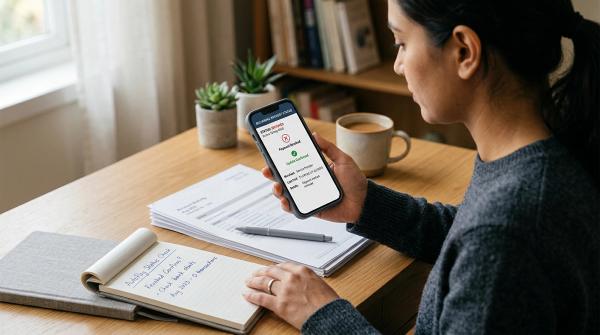
A lien amount in your bank account simply means that a part of your balance has been blocked. The money may still be visible in your account, but you cannot withdraw it, transfer it, or spend it.
In short: the money is showing, but it is not available for use.
For example, if your account balance is ₹25,000 and ₹2,000 is marked as lien, you may be able to use only ₹23,000.
A lien can happen for many reasons in India. Sometimes it is routine, like an IPO/ASBA block or a temporary transaction hold. Sometimes it may be due to unpaid EMI, credit card dues, tax instructions, court orders, or even a cyber fraud complaint.
So, if your banking app suddenly shows words like “lien marked”, “hold”, “blocked balance”, or “amount under lien”, don’t panic immediately. But don’t ignore it either.
A lien does not always mean fraud. It also does not always mean your money is gone forever. The right first step is to understand why the amount has been blocked and get the bank’s explanation in writing.
This guide explains what a lien amount means, why it may happen, what proof you should save, and what steps you can take safely.
Quick example: how a lien may appear
#Let’s say your account shows:
- Total balance: ₹25,000
- Lien amount: ₹2,000
- Available balance: ₹23,000
Here, ₹2,000 is blocked. You may still be able to use the remaining ₹23,000.
Different banks show this in different ways. One bank may call it “lien amount”, another may show “hold”, “blocked amount”, “uncleared balance”, or simply show a lower available balance than your total balance.
So don’t rely only on the wording in the app. Ask the bank what exactly has happened.
Lien vs hold vs full account freeze
#People often use these words as if they mean the same thing. But in banking, they can mean different levels of restriction.
Bank systems and rules differ. Always ask your bank for the actual reason, reference number, hold code, complaint number, or linked transaction details.
Common reasons for a lien amount in India
#A lien can be due to a normal banking process or something more serious. The important thing is to identify the reason instead of guessing.
1. Missed EMI, credit card dues, or bank charges
#If you have a loan, credit card, overdraft, or another banking facility with the same bank, the bank may block money against unpaid dues.
This can happen because of:
- Missed loan EMI
- Credit card overdue payment
- Overdraft adjustment
- Locker rent
- Minimum balance charges
- Account maintenance charges
- Other bank service charges
If this is the reason, the bank should be able to tell you which loan, credit card, or account is linked to the lien and how much is due.
2. ASBA, IPO, or investment application block
#If you applied for an IPO through ASBA, the application amount may be blocked in your account.
In this case, the money is not debited immediately, but you cannot use it while the block is active. If shares are allotted, the required amount is debited. If shares are not allotted, the block is usually released as per the IPO and bank process.
This type of lien is common and usually not alarming. Still, check whether the blocked amount matches your IPO application.
3. Cheque, card, UPI, or payment settlement issue
#Some holds are linked to transaction processing.
For example:
- Cheque clearing
- Failed UPI transaction
- Pending card reversal
- Merchant settlement issue
- Refund under process
- Temporary card authorization block
These are often routine. But if the amount is large, unexpected, or not released within a reasonable time, ask the bank for the transaction reference.
5. Cyber fraud complaint or disputed incoming money
#This is one of the most stressful reasons for a lien.
If someone files a cybercrime complaint saying money was fraudulently transferred, the money trail may pass through multiple accounts. Banks may receive instructions to block funds or mark a lien on accounts connected with that trail.
You may first notice this as:
- Blocked balance
- Lien amount
- Debit freeze
- Account restriction
- Failed UPI or transfer attempts
This does not automatically mean you committed fraud. It may only mean your account received money that someone has disputed, or your account appears somewhere in the transaction chain.
But yes, you should take it seriously.
If you lost money to cyber fraud, or your account has been misused, report it on the official National Cyber Crime Reporting Portal: cybercrime.gov.in. Also inform your bank immediately through official channels.
Do not call random “cyber help” numbers from social media, Google ads, WhatsApp forwards, Telegram groups, or unknown websites.
First checks before you panic or escalate
#When you notice a lien, start calmly. Your goal is to find the reason, save proof, and create a written record.
Step 1: Check whether it is a lien, hold, or full freeze
#Open your banking app or net banking and check:
- Total balance
- Available balance
- Lien or hold amount
- Whether UPI is working
- Whether ATM withdrawal is working
- Whether bank transfer is working
- Whether only one amount is blocked or the entire account is restricted
If your available balance is lower than your total balance, but some money is still usable, it may be a specific lien or hold.
If all debit transactions are failing, it may be a full debit freeze or a bigger restriction.
Step 2: Read transaction remarks carefully
#Check your latest account statement and recent transactions.
Look for words such as:
- LIEN
- HOLD
- BLOCKED
- ASBA
- IPO
- EMI
- LOAN
- CARD
- CHARGES
- TAX
- GST
- CYBER
- POLICE
- NCRP
- FREEZE
Sometimes banks use short codes or unclear remarks. Even then, these details can help the branch identify the issue faster.
Step 3: Match the amount with recent activity
#Think about what happened recently.
Ask yourself:
- Did I miss an EMI?
- Did I miss a credit card payment?
- Did I apply for an IPO?
- Did I receive a large or unusual payment?
- Did a customer, buyer, or unknown person transfer money to me?
- Did any UPI or card payment fail?
- Did I receive any tax, GST, or legal notice?
- Did I report fraud recently?
- Did I receive money from someone who may have later disputed it?
Don’t post screenshots publicly. Don’t message unknown people in panic. Make a private note and then contact the bank.
Step 4: Contact the bank only through official channels
#Use only trusted sources, such as:
- Your bank’s official app
- Your bank’s official website
- Customer care number printed on your debit card
- Your home branch
- Secure net banking message, if available
Avoid numbers from Google ads, Instagram posts, Telegram groups, WhatsApp forwards, or “bank agent” profiles. Many scams start exactly this way.
When you contact the bank, ask clearly:
- What is the exact reason for the lien or hold?
- Is it an internal bank lien or based on external instruction?
- What is the reference number, hold code, or complaint number?
- Which transaction, product, loan, card, or account is linked to it?
- What document, payment, or action is required from my side?
- Can you provide the response in writing or by email?
Step 5: Visit the branch if needed
#For simple bank dues, customer care may be enough. But for cybercrime, tax, legal, or unclear lien cases, visiting the branch is usually better.
Carry:
- ID proof
- Account details
- Screenshots of the lien or blocked amount
- Account statement
- Payment proof, if any
- Any notice or communication related to the issue
If the front desk cannot explain the matter, ask for the operations manager or branch manager.
Stay polite but firm. In some investigation-related cases, branch staff may not be allowed to share every detail. But they should still guide you about the reason category, available reference details, and next steps.
Step 6: Do not pay “lien removal” agents
#This is very important.
If someone claims they can remove your lien, unfreeze your account, or “settle cyber complaint” for a fee, treat it as a red flag.
Do not share:
- OTP
- ATM PIN
- UPI PIN
- Net banking password
- Debit card details
- Aadhaar OTP
- Remote screen access
- Full bank statement with sensitive details, unless submitting to official channels
A real bank or authority will not ask you to pay a private agent to remove a lien.
Proof checklist: save these before escalation
#Before visiting the branch or filing a complaint, collect your documents. It saves time and protects you if the matter goes further.
Basic proof
#- Screenshot of the lien or blocked amount
- Date and time when you first noticed it
- Screenshot of total balance and available balance
- Latest account statement
- Statement for the suspected transaction period
- Bank SMS or email alerts
- Failed transaction messages, if any
If linked to loan, EMI, or credit card dues
#- Loan account number or masked credit card number
- Payment receipt
- UTR or transaction ID
- Bank confirmation of payment
- Screenshot showing dues cleared, if available
If linked to ASBA or IPO
#- IPO application number
- ASBA reference number
- Bid confirmation
- Bank block message
- Allotment or non-allotment status
If linked to business or customer payment
#- Invoice
- Order details
- Delivery proof
- Buyer or customer communication
- Payment receipt
- GST invoice, if applicable
- Refund or dispute communication, if any
If linked to cybercrime or disputed funds
#- Transaction ID or UTR
- Sender details visible in statement
- Communication with sender, if any
- Complaint number, if provided
- Police station or NCRP reference, if shared
- Your written explanation of why you received the money
How to ask the bank for clarification
#A written request is better than only calling customer care. You can send it by email, secure banking message, or submit a letter at the branch.
You can use this format:
Subject: Request for clarification on lien amount in accountDear Sir/Madam,I noticed a lien/blocked amount of ₹_____ in my account number ending _____ on _____.Please provide the reason for the lien, the reference number or hold code, the linked transaction/product, and the steps required from my side for resolution.Kindly provide the response in writing.Regards,NameMobile numberDate
If you submit it at the branch, take acknowledgement on a copy. If you email it, save the sent email and ticket number.
When the lien is due to internal bank dues
#If the bank confirms that the lien is due to EMI, credit card dues, bank charges, or overdraft adjustment, then:
- Ask for the exact due amount.
- Ask which loan, card, or account it is linked to.
- Pay only through official bank channels.
- Save the receipt and UTR.
- Ask when the lien will be removed.
- If it is not removed within the stated timeline, file a written complaint with proof.
Do not pay to personal accounts or third-party agents. Even if someone says they are “from the bank”, verify through official channels first.
When the lien is due to cyber fraud or NCRP complaint
#If the bank says the lien is linked to a cybercrime complaint, disputed funds, NCRP reference, or police instruction, handle it carefully.
You should:
- Ask for the complaint or hold reference that the bank can share
- Ask whether only a specific amount is blocked or the whole account is frozen
- Ask which transaction is linked to the complaint
- Prepare proof showing why you received the money
- Avoid contacting unknown complainants directly unless advised through proper channels
- Cooperate with the bank and investigating authority through official routes
In such cases, your bank may not be able to remove the lien by itself. If the lien was placed because of an external instruction, the concerned authority may need to send clearance.
If you are the victim and you lost money, report it at cybercrime.gov.in and inform your bank quickly. Time can matter in cyber fraud cases.
But do not trust unofficial “recovery agents” who promise a guaranteed refund or lien removal.
RBI complaint and escalation cautions
#RBI has customer service expectations for banks and provides the Complaint Management System, also known as CMS, and the Ombudsman route for eligible complaints.
But RBI should usually not be your first step.
In most cases, you should first:
- File a formal written complaint with your bank.
- Keep the complaint number or acknowledgement.
- Wait for the bank’s response as per its complaint process.
- Escalate inside the bank to the nodal officer or principal nodal officer, if needed.
- Approach RBI CMS/Ombudsman only if the bank does not respond within the applicable time, or if you are not satisfied with the response.
One important point: RBI Ombudsman cannot be used to bypass a valid court order, tax attachment, police instruction, or cybercrime investigation.
If the lien is due to an external legal or authority instruction, the bank may have limited power until that authority gives clearance.
RBI escalation is more useful when the issue is about:
- Bank not responding
- Wrong lien marked by the bank
- No clear explanation given
- Delay after the issue is already resolved
- Bank refusing to provide basic information
- Service failure or complaint mishandling
What not to do
#Avoid these mistakes:
- Do not ignore the lien and assume it will go away.
- Do not call random numbers from search results or social media.
- Do not share OTP, UPI PIN, ATM PIN, or passwords.
- Do not pay “lien removal” or “account unfreeze” agents.
- Do not submit fake invoices or false explanations.
- Do not threaten branch staff. Ask for written clarification instead.
- Do not move disputed money through other accounts if fraud is suspected.
- Do not file an RBI complaint without first making a proper bank complaint, unless the process clearly allows it.
Related AllBlogs guides to read next
#- Bank Account Frozen After a Cyber Crime Complaint in India? What to Do First
- RBI Ombudsman Complaint in India: When to Escalate Bank, UPI, Card and Wallet Issues
- Payment Dispute Proof Checklist: Save These Details First
- UPI Fraud Complaint in India: What To Do First After Money Is Debited
Practical summary
#If you see a lien amount in your bank account:
- Check your total balance and available balance.
- Read the statement remarks carefully.
- Match the amount with EMI, card dues, ASBA, tax, business payments, or recent incoming transfers.
- Save screenshots, statements, SMS alerts, and emails.
- Contact the bank only through official channels.
- Ask for the reason, reference number, and next steps in writing.
- If cyber fraud is involved, use cybercrime.gov.in and cooperate carefully.
- Escalate to the bank grievance channel first, then RBI CMS/Ombudsman if suitable.
A lien can be stressful, especially when you need the money urgently. But a calm, documented approach gives you the best chance of getting it resolved safely.
Source-aware note
#This guide was prepared using current consumer-banking safety checks, RBI customer-service and complaint-route context, and India’s official cybercrime reporting channel. Bank-specific rules, legal instructions and authority-led holds can vary, so readers should confirm account-specific details with their bank through official channels.
Disclaimer
#This article by AllBlogs is for general information and consumer awareness only. It is not legal, tax, investment, loan, or financial advice. Banking policies differ by institution, and liens linked to legal, tax, police, or cybercrime matters may require official resolution through the concerned authority. Always contact your bank through official channels for account-specific guidance.