Why a luggage scale became my most boring-but-useful travel gadget
#I’ll be honest, I used to think luggage scales were for over-planners. Like those people who reach airport four hours early and carry photocopies of photocopies. Then one very sweaty evening at Delhi airport, I became that person repacking my suitcase on the floor near check-in, with one side of the bag open, jeans falling out, my mother’s thepla packet staring at everyone. Not my finest travel moment, haan.
For Indian flyers, especially us who travel with food, gifts, extra footwear, winter jackets, pressure cooker sometimes also, baggage weight is not some small detail. It can decide whether your trip starts peacefully or with a mini heart attack at the airline counter. Domestic flights, international flights, student baggage, Gulf routes, Europe holidays, family weddings, codeshare tickets... each one has its own drama. And the one tiny gadget that has saved me from paying excess baggage more than once is a luggage weighing scale.
This post is basically my luggage scale buying checklist for Indian flyers, but not in a dry Amazon-review type way. More like, what I wish someone told me before I bought a cheap one that showed 19.2 kg at home and 21.1 kg at the airport. Trust me, that 1.9 kg difference feels like betrayal.
First thing: understand your baggage situation before buying anything
#Before buying a luggage scale, please check the baggage rules for your actual ticket. Not what your cousin said. Not what happened last year. Your actual PNR, airline website/app, fare type, route, and connection. Indian domestic economy tickets often have a checked baggage allowance around 15 kg and cabin baggage around 7 kg, but it can vary by airline, fare family, membership tier, student offer, defence quota, international connection, and sometimes even promotional fares. International flights are even more confusing because some routes follow weight concept, some piece concept, and the number changes depending on destination.
Codeshare flights are where people get properly confused. Suppose you booked through one airline but the flight is operated by another airline. Which counter? Which baggage rule? Which seat policy? This is exactly why I always re-check the operating carrier and allowance before packing. If that sounds familiar, read this simple explainer on What Is a Codeshare Flight? Check-In, Bags and Seats before you weigh your bag at home and feel too confident.
Also, many Indian airport staff are not “rude” when they say your bag is overweight. They’re just following airline rules, and the check-in system doesn’t care that your auntie packed two extra sarees at the last minute. Some counters allow a tiny margin, some don’t. During peak travel windows like summer vacations, Diwali, Christmas-New Year, wedding season, student intake months, and Gulf worker return rush, counters can be stricter because flights are full. Better to know before, not after.
My basic luggage scale buying checklist, the one I actually use
#If you’re buying a luggage scale in India, don’t just pick the cheapest one because it has “50kg capacity” written in bold. Almost all of them write 50 kg. The useful part is how accurately it reads, how easy it is to hold, whether the strap can survive your 28-inch suitcase, and whether the display is readable when you’re half asleep at 3 am before an early morning flight.
| Feature to check | What I prefer | Why it matters for Indian flyers |
|---|---|---|
| Capacity | At least 40-50 kg | Good for international bags, student luggage, and big family suitcases |
| Accuracy | Within 50-100 grams if possible | Airport scales may differ slightly, so leave buffer |
| Strap or hook | Strong nylon strap with metal buckle | Works better with suitcase handles than tiny hooks |
| Display | Backlit digital display | Helpful when packing late night or in dim hotel rooms |
| Units | kg and lb both | Useful for US, Europe, Middle East tickets that show different units |
| Tare/zero function | Nice to have | Useful if you weigh a bag with a cover or basket style setup |
| Battery | Easy coin cell or AAA | Because rare battery sizes are a pain when travelling |
| Build | Solid grip, not flimsy plastic | You’ll be lifting 20-30 kg with it, so yeah, don’t ignore this |
| Auto lock | Display holds weight after lift | Very useful when the bag blocks your view |
| Warranty/return | At least easy replacement window | Cheap scales can be inaccurate out of the box |
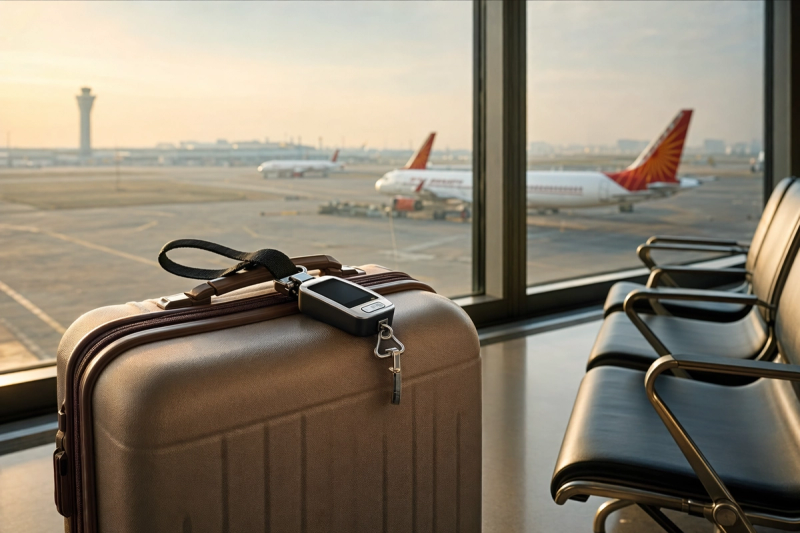
For most travelers, a digital hanging luggage scale is enough. You don’t need a fancy platform scale unless you’re a travel agent, tour operator, or that one family member who packs for six people in advance. I’ve used both cheap and mid-range ones, and honestly the mid-range type usually feels more stable. In India, you’ll commonly see simple digital luggage scales from roughly ₹250 to ₹800 online, and better-built ones around ₹800 to ₹1,500 or more depending on brand and features. Airport shops sell them too, but the price can make you say “arre yaar” immediately.
Accuracy: don’t chase perfection, chase consistency
#Here’s the thing no one tells you: your home scale, luggage scale, hotel scale, and airport scale may not match exactly. That doesn’t always mean someone is cheating you. Scales get calibrated differently, floors are uneven, bags swing while weighing, batteries weaken, and sometimes we hold the scale at a weird angle. I learnt this after fighting with my own scale like it personally ruined my trip.
What I do now is simple. I weigh the bag three times. If it shows 19.6, 19.7, 19.6, I trust it. If it jumps from 18.9 to 20.3 to 19.4, either I’m lifting it badly or the scale is nonsense. A decent luggage scale should give nearly the same reading again and again. Not perfect-perfect, but close.
- Keep at least 500 grams to 1 kg buffer below your airline allowance. For international flights with tight rules, I keep more.
- Don’t weigh while the suitcase is touching the floor, bed, wall, or your leg. Sounds obvious, but I’ve done it.
- Lift slowly and let the weight lock. If the bag swings like a temple bell, the reading will go mad.
- Replace the battery if readings become random. Low battery can act very drama queen.
Strap design matters more than people think
#My first luggage scale had a small metal hook. It looked neat in the photo but was irritating with modern suitcase handles. Some handles are thick, some are soft padded, and some international-size suitcases have awkward side handles. A strap with a buckle is much easier. You loop it through the handle, close it, lift, done. It feels safer too, because if the hook slips, your suitcase can drop on your foot and then your trip starts with Moov and bad words.
Check the stitching on the strap. Pull it a bit. If it already looks like school-bag strap from 2004, skip. For Indian family travel, the scale must survive overpacked bags, not just cute cabin trolley tests. Also, if your parents will use it, choose a model where the buckle is simple. My dad once spent 10 minutes trying to understand a fancy clip and finally used the bathroom weighing scale instead.
Display and grip: small details, big difference at 2 am
#A backlit display sounds like a luxury until you’re packing in a hotel room in Manali with one dim yellow bulb, or in a PG room before flying out for studies. Some scales show weight only while you’re holding the bag in the air, which is useless because your arm is shaking and the suitcase is blocking the screen. Look for “data lock” or “hold” feature. It freezes the reading after a few seconds so you can keep the bag down and read it peacefully.
Grip also matters. Thin plastic handles dig into your fingers when the suitcase is above 20 kg. I prefer a wider handle or rubberised grip. If you have wrist pain or you’re buying for parents, this is not a small point. Lifting 25-30 kg from a hanging scale is awkward, and two people trying to lift one scale together is comedy, but not always safe.
Battery type and charging: don’t get stuck with a dead gadget
#Most luggage scales use coin-cell batteries or AAA cells. I personally like AAA because you can find them anywhere from a kirana shop to airport convenience stores. Coin cells are also available, but not always the exact type when you need it urgently. Some newer models are rechargeable via USB, which sounds cool, but then it becomes one more thing to charge along with phone, power bank, earbuds, smartwatch, camera, and god knows what else.
If you travel rarely, remove the battery when storing the scale for months. Battery leakage can spoil the device. I learnt this with a TV remote, not a luggage scale, but same logic. Also, carry spare battery only if it makes sense. Don’t overpack accessories for an accessory, otherwise what are we even doing?
How much should you spend? My honest India price logic
#If you fly once in two years and mostly domestic, a basic digital luggage scale is fine. Don’t overthink. But if you fly international, travel with kids, carry gifts, study abroad, do work trips, or take multiple flights in one journey, spend a little more for reliability. The extra ₹300-₹500 you spend once can save you from excess baggage charges that feel like daylight robbery at the airport counter.
I don’t like buying the absolute cheapest travel gadgets anymore. Not because I’m fancy, I’m really not. It’s because cheap stuff fails at the worst time. My rule: read recent user reviews, check if people mention “accurate with airport scale” or “battery issue,” and avoid models where multiple buyers say readings fluctuate. Also check return window immediately after delivery. Test it with something whose weight you know, like a 5 kg rice bag or dumbbell. Very Indian calibration method, but works enough.
Domestic flyers: you still need a scale, boss
#People think luggage scale is only for Dubai, Singapore, Europe, US type trips. Nope. Domestic flights in India can be very unforgiving when your check-in bag crosses the limit. And because we often travel for weddings or family visits, domestic bags become heavier than international ones. Sarees, lehengas, sweets, dry fruits, kids’ toys, return gifts, extra chappals. Suddenly that “just one bag” is 18 kg.
Cabin baggage is another thing. Many airlines display cabin bag limits, and during busy routes or full flights, staff may check size and weight at the gate. Don’t assume cabin bag is invisible. If your trolley looks like it’s carrying bricks, someone may ask. I’ve seen passengers at Bengaluru and Mumbai trying to shift laptop chargers, books, and snacks from cabin to backpack at the last minute. It’s not fun, especially when boarding has started and your boarding group is already gone.
International flyers: leave extra buffer for shopping and food packets
#International travel is where a luggage scale becomes proper important. First, your baggage allowance may be generous while going out and tight while returning because shopping happened. Second, different legs may have different rules. Third, your bag weight can change because you added shoes, jackets, souvenirs, airport chocolates, and that “small” pressure cooker someone requested from India.
For students flying out from India, especially with two big bags, weigh each bag separately and label them. Don’t assume total allowance can be split any way you want. Some airlines allow total weight across pieces, some enforce per-piece limit. A 32 kg max per bag rule is common on many international sectors for handling safety, but your actual allowance can be lower, so check. If your bag is overweight per piece, they may ask you to redistribute even if total weight is within allowance.
For families, I suggest making one “adjustment pouch” with items that can move easily: snacks, extra clothes, books, toiletries that are allowed in checked baggage, etc. Keep it near the top. At the airport, if one bag is heavy and another is light, you don’t want to dig through layers of perfectly packed chaos while uncle is saying “jaldi karo beta.”
Packing weight trade-offs: every small thing adds up
#One thing I’ve become slightly obsessed with is weighing categories, not just the final suitcase. Toiletries are heavy. Books are worse. Shoes are silent criminals. Winter wear is bulky but not always heavy, except boots. Food packets can surprise you. Even travel gadgets add up: adapter, power bank, camera batteries, medicines, steel water bottle, neck pillow, all the “just in case” things.
For trekking or long trips, I now think twice before packing duplicate gear. For example, water safety gear can change your bag weight depending on what you choose. A filter bottle may weigh more but is reusable, while tablets are tiny but have their own limits. If you’re deciding what makes sense for your trip, this comparison on Travel Water Filter vs Purification Tablets: What to Pack is actually useful, especially if you’re trying to keep luggage light.
My slightly messy method: I put heavy maybes in one pile. Extra jeans, second pair of shoes, big shampoo bottle, books, snacks, hoodie. Then I weigh the suitcase. If it’s too close to the limit, I remove from that pile first. Emotional items are harder. Like homemade snacks. I won’t lie, I’ve removed a jacket before removing chakli. Priorities.
What to check when buying online in India
#Most of us will buy a luggage scale online because options are better and prices are lower than airport shops. But product listings can be copy-paste nonsense. So read properly. Don’t only see star rating. Open the negative reviews too. Sometimes a product has 4.3 stars but half the recent reviews say “not accurate” or “stopped working after one use.” That’s your warning.
- Check maximum capacity, but also minimum readable weight. Some scales don’t read very light items well, which is okay for suitcases but annoying for smaller bags.
- Look for kg/lb switching. Even if you mostly use kg, international tickets may show pounds and you don’t want mental maths at midnight.
- See photos from buyers, not only brand photos. Buyer photos show actual strap thickness, display size, and plastic quality.
- Check battery included or not. If battery isn’t included, order it together or you’ll recieve the scale and stare at it uselessly.
- Read return and replacement rules. Test it on the first day itself, not one night before flight.
Also, don’t buy only because it has thermometer, measuring tape, torch, or some fancy extra. I’ve seen scales with random features I never used. Better to have one job done properly: weigh the bag accurately.
Airport weighing vs home weighing: how I avoid last-minute tamasha
#My airport routine is now very boring, which is exactly why it works. I pack, weigh, remove, weigh again, then keep 700 grams to 1 kg gap if possible. If the trip involves shopping on return, I pack a small foldable duffel bag. Not always to check in, but to redistribute items if needed. A foldable bag weighs little and saves you when the suitcase becomes too full after shopping.
Some airports have weighing scales near entrances or check-in areas, but don’t depend on them. They may be crowded, not working, or located after you already dragged all your luggage inside. Hotels sometimes have weighing scales at reception, especially business hotels and airport hotels, but again, not guaranteed. Budget stays, hostels, homestays, and guesthouses may or may not have one. In Indian cities, decent hostels can range roughly from ₹500 to ₹1,500 per bed, budget hotels around ₹1,500 to ₹3,500, and airport-area hotels can go much higher depending on city and season, but luggage weighing is never something I assume unless I ask.
If you’re staying near airports like Delhi Aerocity, Mumbai Andheri/Sahar, Bengaluru Airport Road, Hyderabad Shamshabad, or Kochi airport side, many hotels are used to flyers asking for luggage help. Still, message them in advance if you are carrying heavy bags. Especially students and families relocating abroad. A simple “Do you have a weighing scale for luggage?” can save tension.
Seasonal packing tips for Indian flyers
#The best luggage scale is the one you use before the season tricks you. Summer trips from India are lighter clothing-wise, but sunscreen, liquids, snacks, and shopping can add weight. Monsoon travel means umbrellas, rain jackets, plastic covers, extra footwear, and sometimes wet clothes on return. Winter international trips are the worst for luggage volume. Coats, thermals, boots, scarves, gloves. The suitcase gets full before it gets overweight, which is another kind of problem.
For hill stations in India, like Kashmir, Himachal, Uttarakhand, Sikkim, or Arunachal side, bags get bulky because of warm clothes. For beach trips like Goa, Andaman, Kerala, or coastal Karnataka, people overpack footwear and toiletries. For religious travel, whether Vaishno Devi, Tirupati, Shirdi, Varanasi, or international pilgrimages, families often pack prasad, clothes, shawls, and medicines. Weigh before leaving and again before returning, because return bags are always mysteriously heavier. Science has not explained this fully.
Safety-wise, remember that luggage weight is only one part. Don’t pack power banks in checked baggage, because lithium battery rules generally require them in cabin baggage. Liquids in cabin baggage on international flights are usually restricted by the 100 ml container rule and transparent bag practice, though exact enforcement can vary by airport and route. Sharp items, big scissors, certain tools, and flammable stuff can create security issues. A luggage scale won’t save you if your packing itself is not airport-safe.
Common mistakes I see Indian flyers make
#The biggest mistake is weighing only the main suitcase and ignoring cabin bag plus backpack. Airlines may check both. Second mistake is weighing before adding final items: charger pouch, toiletries, medicines, snacks, slippers, documents folder, that one sweater mummy insists on. These “small” additions can become 1-2 kg without asking permission.
Another mistake is buying a luggage scale and then packing it inside the checked bag while returning. Keep it accessible. I usually keep mine in the front pocket of the suitcase or in cabin bag. If you’re shopping abroad or even in another Indian city, you’ll need it before checkout from hotel, not after your bag is sealed and wrapped.
- Don’t weigh the suitcase empty and estimate the rest. We are all bad at estimating, especially snacks.
- Don’t assume two airlines in one itinerary have same baggage rules.
- Don’t pack until suitcase zip is screaming. If the bag bursts, weight becomes secondary problem.
- Don’t forget baggage allowance can differ for infants, students, premium economy, business class, and loyalty tiers.
- Don’t fight at the counter if you’re overweight. Step aside, repack calmly, then come back. Saves everyone’s blood pressure.
Should you carry the luggage scale on the trip?
#For domestic weekend trips, I usually don’t carry it if I’m travelling light. For international travel, shopping trips, weddings, student travel, and family trips, yes, I carry it. A luggage scale weighs maybe 100-200 grams depending on model, so it’s not a huge burden. The peace of mind is worth it. Especially on return flights, when your suitcase has somehow swallowed half a market.
If you’re backpacking and every gram matters, then maybe skip carrying it and use hostel/hotel scales when available. But for trolley suitcase travelers, I say carry it. It also helps when travelling in groups because everyone suddenly becomes your friend: “Arre can I check my bag also?” You become the unofficial airport preparation desk.
My final buying recommendation, simple and no drama
#If I had to buy one luggage scale today for an average Indian flyer, I’d choose a digital hanging scale with 50 kg capacity, strong strap buckle, backlit display, hold function, kg/lb units, easy battery type, and good recent reviews saying readings are consistent. Not the cheapest, not the fanciest. Somewhere in the practical middle. The kind you can throw in a drawer and trust before every trip.
And please, once you buy it, actually use it properly. Weigh after final packing. Keep buffer. Check airline rules. Recheck if there is a codeshare or connecting flight. Keep the scale accessible on return. It’s not a glamorous travel gadget like a camera or noise-cancelling headphones, but it can save your mood before the holiday even starts.
A luggage scale doesn’t make you a boring traveller. It makes you the person who walks past the check-in counter without opening the suitcase in public. Big difference.
So yeah, that’s my very real, slightly over-experienced luggage scale buying checklist for Indian flyers. I’ve learnt most of it through small airport embarrassments, family packing battles, and the deep emotional stress of choosing between extra shoes and homemade snacks. If you travel even a few times a year, get a decent scale. Future you will say thank you. And if you like practical travel guides written from our Indian chaos-and-jugaad point of view, you’ll find more such stuff on AllBlogs.in.