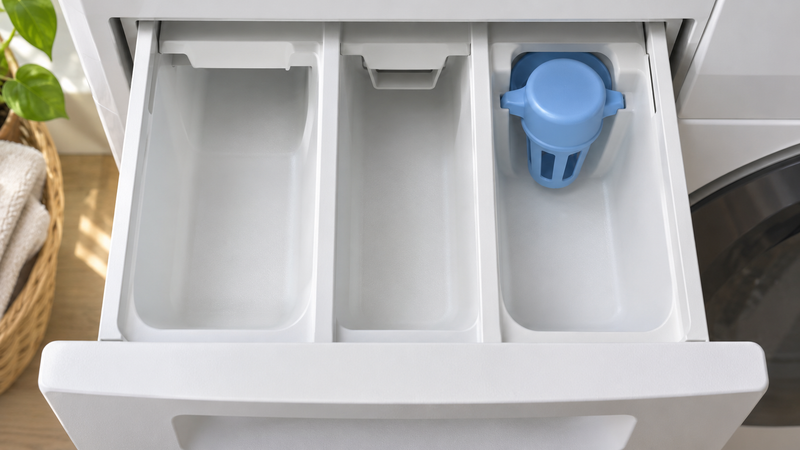
On a conventional washing machine drawer, II usually takes main-wash detergent, I takes detergent for a selected prewash, and the flower marks fabric softener. Read the symbols on your drawer before you pour. The compartments can sit in a different order on another machine.
Say you’ve just moved into a flat. There’s a pile of towels on the floor and three empty slots in the washer drawer. For an ordinary wash, you can usually make the decision with one check. Find II and use the detergent and amount your machine and product call for. Leave I empty when you’ve selected a cycle without prewash. Use the flower compartment only if you’re adding softener and the towel care label allows it.
Read the marks before you read the layout
#The number on the drawer tells you which part of the wash a compartment serves. It doesn’t tell you where that compartment should be on every machine. On a Bosch manual drawer that uses these marks, I and II identify prewash and main wash. Samsung’s support diagrams show different layouts across drawer types, including versions with automatic dispensers.
The labels can be small. Look on the rim, the bottom of the plastic and the top of any removable insert. If you can’t find a mark, pull up the manual for the exact model and compare the drawing with the drawer in front of you. A photo of a similar-looking washer can leave you looking at the wrong slot.
| Drawer mark | What it usually means | How to use it |
|---|---|---|
| I | Prewash detergent | Fill it only when you choose prewash and your manual calls for it. |
| II | Main-wash detergent | Add the measured dose here on a compatible manual drawer. |
| Flower | Fabric softener | Add it only when wanted and keep below the MAX line. |
| MAX | Fill limit | Use the correct dose and keep it under the mark. |
| Auto Detergent or Auto Softener | Refillable reservoir | Follow the model’s product and refill instructions. |
MAX is easy to misread. If your bottle calls for a dose that sits well below the line, that can be exactly right. The line tells you how much the compartment can hold. Check the detergent label for the amount to measure.
When does compartment I actually get used?
#Prewash adds a separate wash stage ahead of the main one. If your cycle includes it, the machine can draw from I during that first stage and from II for the main wash. Use the settings and amounts described in your machine’s instructions. Splitting a normal dose across the two slots by eye gives you no way to know what will reach the clothes at each stage.
For a normal load, treat I as optional. You can run the program with the compartment empty. If you’re looking at muddy clothes and considering a prewash, check the clothing’s care label and the available program first. A quick cycle and an extra rinse have different jobs. The extra rinse happens after washing. Filling the prewash slot just because you picked an extra rinse won’t give that setting its own detergent.
If the controls are unfamiliar too, check the washer settings guide before you choose a program.
If dirt needs treating before the clothes go in, check the garment and the treatment product first. Stain treatment applied to a garment and detergent delivered during a prewash are separate decisions. Keeping them separate helps when the stain label and your washer manual give different instructions about placement.
Where should liquid detergent go?
#Start with II on a conventional drawer if the washer supports liquid there. Some drawers rely on a small flap, cup or insert to hold liquid until the program draws it through. The manual tells you how to seat it and whether to change its position for powder. A removable piece can look like packaging until you see it in the diagram. Keep it with the washer.
If your machine or product instructs you to use a dosing cap in the drum, follow those directions for that combination. Check whether the instructions change on a program with prewash or a delayed start. Where the product sits while the machine waits can matter on models whose liquid insert has restrictions.
For powder, open the manual’s detergent section before you leave a liquid insert in place. A pool or clump in the drawer at the end of a cycle gives you a reason to check the insert, the MAX line and the amount you measured. It doesn’t tell you on its own that the washer needs a repair.
Pods and capsules need their own check
#Keep the box handy. For the Samsung drawers covered in its support guide, the manufacturer directs capsule and tablet detergents to the drum. Your detergent package also tells you how to position the capsule relative to the clothes. Follow both, especially if your machine is compact or the program is short.
A pod and a measured liquid dose are two ways of supplying detergent. Pick the method the washer supports for that load. When a machine has automatic dosing on, also check how to stop it from dispensing a second dose.
The flower slot releases product at a different time
#The softener compartment has a separate job because the program dispenses softener during a rinse. Think about when you want each product to meet the clothes. Main-wash detergent needs to be there while the machine washes. Softener belongs in its own compartment when you choose to use it.
The small removable cap over a softener compartment often forms part of a siphon. It needs to sit as shown in the manual. Pouring over MAX or leaving the cap loose after cleaning changes how that compartment behaves. If liquid is left behind, look at the fill level and cap before you replace anything.
A small amount of water after the cycle is a different observation from a compartment still full of concentrated softener. If you see the second pattern repeatedly, check for a blocked cap, confirm the compartment is assembled correctly and follow the appliance’s drawer-cleaning directions. Stop at the parts designed for routine cleaning. A persistent fault is a job for the manufacturer’s support or a technician.
A reservoir and a one-load tray can look similar
#Check whether you’re filling a tank for several loads or adding one measured dose. On models with automatic dosing, you may see separate detergent and softener reservoirs alongside a manual compartment. A lid, refill indicator or droplet icon can give you a clue. The controls and manual tell you which reservoir is active for the selected cycle.
Samsung describes compatible designs where the automatic detergent compartment accepts liquid detergent and the manual tray can take appropriate liquid or powder. Bosch’s i-DOS materials also distinguish a manual compartment from automatic reservoirs. They illustrate the same principle, with different layouts and settings.
Imagine you use auto dosing for everyday clothes and want to use a different product for one load. First check the cycle you’ll use and turn off the automatic dose for that load as the manual directs. Then add a measured amount to the manual compartment the appliance lists for that product. Check the settings again the next time you want to return to automatic dosing. If several people share the washer, a small note beside the detergent saves a guessing game.
If the refill light is on, start with the reservoir it names. Topping up the softener doesn’t fill the detergent tank. When the tank has product and the light stays on, make sure the drawer has closed properly and use the maker’s instructions to check for residue or an incorrect fit.
If you already poured into the wrong slot
#When the machine is idle and you can safely remove its drawer, check the manual for its release and cleaning procedure. Empty and rinse the removable compartment as directed, refit the inserts, then measure the right product into the right slot. Deal with a spill before you add anything else. Keeping the products apart is much easier with the machine stopped.
If the cycle is already running, keep the drawer closed and use the washer’s pause or cancel instructions if you need to stop it. Some machines retain water or lock the door during parts of a program. Wait for the machine’s own safe-access indication. When you know which product went where and how much, you can decide whether the load needs a rinse or a new wash using the garment and appliance instructions.
For a loose-powder mess, check that the powder reached the intended compartment and that an insert didn’t block it. For excessive suds, check the product type and compare the amount you used with its dosing directions. A single extra scoop can make a large difference in a small load. If residue or overflowing persists after you’ve followed the manufacturer’s basic checks, stop and get support.
Try the drawer decisions on two loads
#Take a load of everyday shirts. You’ve chosen the main wash without a prewash and have a powder the washer supports. If your manual drawer is marked I and II, measure the powder for II and make sure any liquid insert is out of the way as the instructions show. Leave I empty. If you aren’t using fabric softener, the third slot stays empty as well. Two empty compartments can be exactly what you want to see before you press Start.
Now picture muddy work clothes. The garment labels allow the cycle you’ve picked and the washer has a prewash option. Check whether the machine calls for detergent in I for that first stage and how it directs you to dose II. If you usually use liquid, look for the manual’s advice about liquid detergent with prewash. The instructions you used for the first load may change with the program.
If one cycle leaves residue and the other doesn’t, make a note of the cycle, product, amount and insert position. The next time you wash a similar load, change one thing you can verify against the manual. If you change the powder, the dose and the cycle at once, you won’t know what made the difference. A short note is also useful if you need to explain the issue to appliance support.
A quick way to set up an unfamiliar washer
#Write down the model number and keep its drawer diagram on your phone. The first time you use liquid, confirm the insert position. The first time you use powder, check it again. If there’s an auto-dosing tank, note what’s in each one and which setting turns it off.
Then think about the load in front of you. A regular wash with compatible detergent needs the main-wash dose. A program with prewash can use two compartments, each with its own purpose. Softener has its own slot and fill limit. Those decisions are small enough to check while you load the drum, and the marks will start to feel familiar after a few washes.