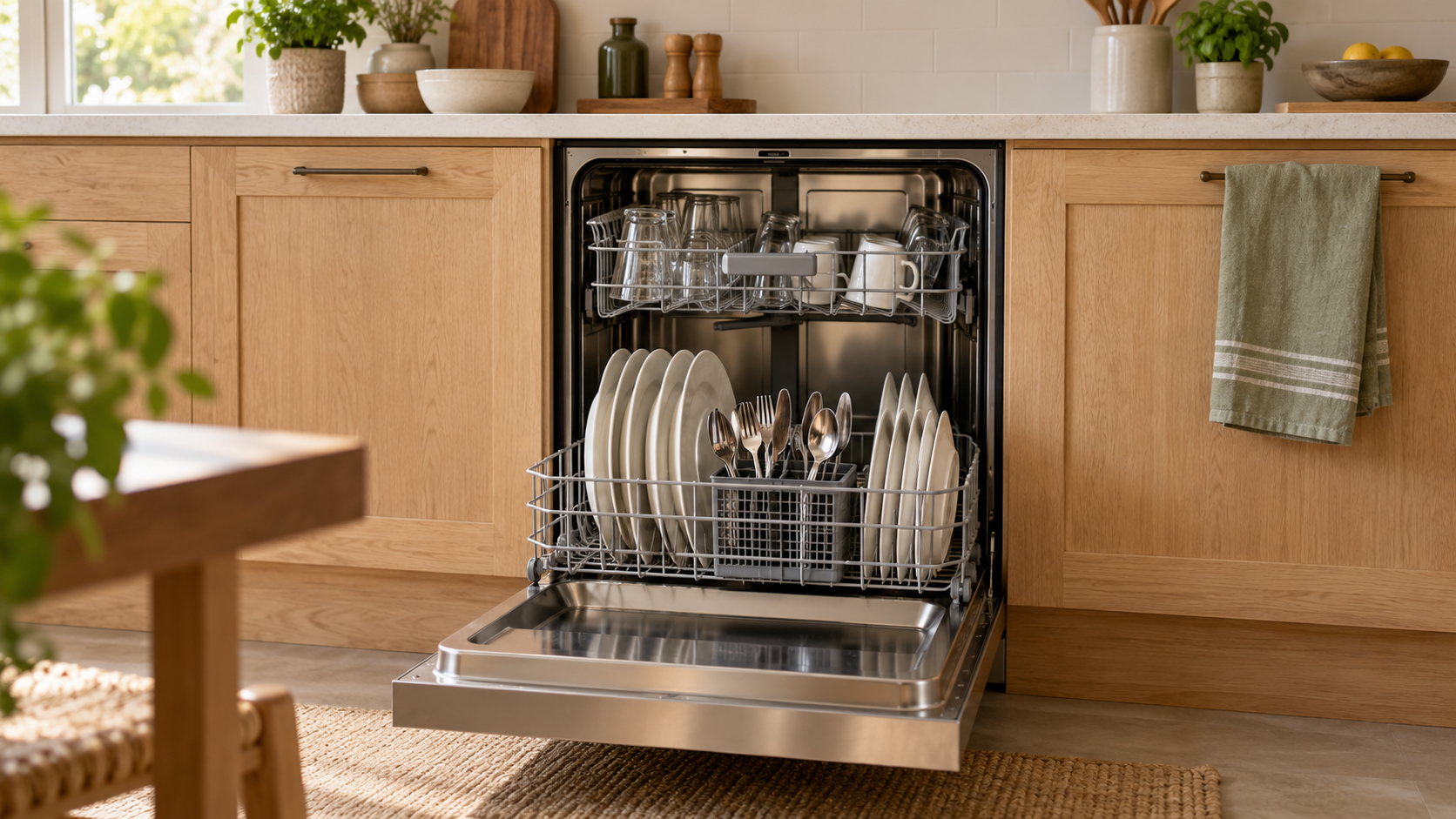
Dishwasher Eco mode often takes longer because it gives cleaning more time while reducing the demand for heated water. A longer programme can therefore use less electricity than a shorter one. The time on the display tells you when the dishes should be ready; the cycle’s kilowatt-hours tell you how much electricity it uses.
For a normally soiled, dishwasher-safe load, Eco is a sensible everyday starting point when you can wait. Choose another programme when the load, the available time or the item’s care instructions call for it. You do not need to make every wash an efficiency contest. You need a cycle that gets the dishes clean without unnecessary repeat washing.
The useful comparison is between programmes on your own machine. “Eco,” “Auto” and “Quick” describe different priorities, and the exact temperatures, durations and drying stages vary by model.
Why time and electricity are different
#It is easy to look at a four-hour display and imagine a powerful heater running continuously for four hours. That is not what the timer establishes. A dishwasher has different jobs to do across the programme, including washing, rinsing and drying. Those jobs do not all draw the same power throughout the run.
Electricity consumption is measured in kilowatt-hours, usually written as kWh. Power and duration matter together, but multiplying the appliance’s maximum rated wattage by the displayed programme time does not reliably calculate a real cycle’s consumption. The rating is not a promise that every component runs at maximum power throughout the wash.
Bosch explains the Eco principle as a trade between cleaning time and water-heating demand. Longer contact with detergent helps the programme clean without heating water as much as some shorter programmes. Its model instructions also describe longer soaking and drying periods in Eco. So the extra minutes can be part of the design rather than evidence of wasted electricity.
This does not establish a fixed saving for every dishwasher. It also does not mean the longest programme must be the cheapest. To compare two cycles, look for their consumption data under the stated test conditions, then check whether they can handle the same load.
A thirty-minute light wash and an Eco wash for normally soiled dishes may be doing different amounts of work. Their times alone cannot tell you which is the better choice for a full dinner load.
Choose the cycle for the load
#Start with what is in the racks and when you need it back. The names below are a practical guide to common programme purposes, not a replacement for the programme table supplied with your dishwasher.
| Programme | When it may fit | What to check before choosing it |
|---|---|---|
| Eco | Normally soiled everyday tableware, with enough time available | Suitable load, full duration, drying stage and selected extras |
| Auto | A suitable mixed load when you want the machine to respond to soil | Permitted items and the stated temperature, time and consumption ranges |
| Quick or Express | A supported load that you need back sooner | Whether it accepts only light soil, any load restriction and whether it includes drying |
| Intensive or Heavy | Dishwasher-safe pots, pans or other heavily soiled items | Item care instructions and the programme’s intended load |
| Machine Care | Cleaning the appliance according to its instructions | Whether it requires an empty machine and a specified cleaning product |
Eco: a useful default with conditions
#Think of ordinary plates, mugs, cutlery and bowls after a meal, provided they are dishwasher-safe. If the load fits your manual’s definition of normal soil and there is no immediate deadline, Eco is a reasonable starting choice.
You are choosing the programme for its intended job. You are not asking it to rescue any pan that happens to fit through the door. If one heavily soiled item needs different treatment, consider handling that item separately according to its care instructions instead of choosing the entire load’s cycle around it.
Auto: useful when the load varies
#Auto programmes use sensors to adjust settings in response to the load’s soil. ENERGY STAR describes soil-sensing cycles, and Beko explains that its Auto programmes can adjust water, temperature and time. The details depend on the machine.
That makes Auto worth considering for a compatible mixed load, especially when the amount of soil is less predictable. It does not guarantee the same running time each day. Treat a consumption range as a range, rather than using its lowest number as the cost of every future wash.
Quick: check what the short name leaves out
#Quick programmes are not interchangeable. Some are intended for lightly soiled items; others handle a broader everyday load. Some include drying, while a short programme may omit it. Beko’s programme documentation, for example, distinguishes a rapid wash without drying from longer programmes with drying.
Before relying on a short wash, check what “finished” means for that programme. Clean but wet plates may suit your deadline. A rack of wet containers that still needs attention may not. If you need everything ready to put away, include the drying requirement in your choice.
Intensive: use it for the right problem
#A heavy programme has a purpose when the manual recommends it for heavily soiled, compatible cookware. Equally, a higher-temperature programme does not make an unsuitable item dishwasher-safe. Check the item’s care instructions before the cycle selector.
Do not interpret every imperfect result as a reason to select the strongest wash forever. A bowl shielded by another bowl may need better loading. Changing the programme cannot create clear spray access through an obstruction.
Read the programme table before the timer
#Find the manual for the exact model, including its model suffix where applicable. A general brand guide helps explain terms, but the programme table is the better place to compare the options actually installed on your machine.
For the two or three programmes you use most, note:
- The intended soil level and permitted load.
- Electricity use per cycle, in kWh, or the stated range.
- Water use per cycle.
- Programme duration and whether drying is included.
- The conditions and extra options attached to those figures.
Keep those details together. A fast programme with a restricted load is not necessarily a direct substitute for a full Eco load. Likewise, a displayed estimate with an added drying option should not be compared casually with a published figure that excludes that option.
If you have an EU energy label, its electricity figure is given per 100 Eco cycles. Divide that number by 100 to obtain the labelled electricity per Eco cycle. The label also identifies Eco programme duration, water per cycle and rated capacity. These are EU label conventions; labels in other markets can use different formats.
For example, an imaginary label showing 70 kWh per 100 Eco cycles corresponds to 0.70 kWh per Eco cycle under the label’s conditions. It does not mean Auto, Quick or Intensive also uses 0.70 kWh. For those comparisons, you still need the appropriate programme data.
This is also why buying a new machine and changing a setting are different decisions. An energy label helps compare labelled performance, while your programme choice still needs to match the load you are washing today.
A worked electricity-cost example
#Here is a hypothetical comparison to show the arithmetic. These are invented inputs for calculation, not measurements, product specifications or a typical saving claim.
Suppose one suitable Eco cycle uses 0.70 kWh and a suitable faster cycle uses 1.00 kWh. Assume the electricity price is 0.30 currency units per kWh and both cycles would clean the same load successfully.
| Calculation | Eco | Faster cycle |
|---|---|---|
| Assumed electricity per wash | 0.70 kWh | 1.00 kWh |
| Multiply by assumed unit price | 0.70 × 0.30 | 1.00 × 0.30 |
| Electricity cost per wash | 0.21 currency units | 0.30 currency units |
| Electricity cost for 20 washes | 4.20 currency units | 6.00 currency units |
The difference is 0.09 currency units per wash, or 1.80 over twenty washes. You can replace the assumptions with the programme figures and marginal electricity rate that apply to your home. Fixed standing charges are not savings created by selecting a different cycle.
Water, detergent and any other variable charges are separate. If your tariff changes by time of day, a single flat unit price may not describe the whole cycle. Avoid treating the appliance’s start time as proof that every part of the run falls within the cheapest period.
There is another useful check: count washes, not just cost per wash. In this example, thirty Eco cycles consume 21 kWh, while twenty faster cycles consume 20 kWh. A cheaper individual cycle does not guarantee lower monthly consumption if you run it much more often.
That calculation is not an argument against Eco. It shows why the household routine matters alongside the setting. Compare the same useful cleaning task, and keep the number of loads visible.
Fit the cycle into an actual day
#Consider three illustrative situations.
You have a normal dinner load and a free afternoon. If the manual allows that load on Eco, you can choose it without needing the dishes back immediately. Let the full programme, including its drying stage, finish.
You need a few lightly soiled items before another meal. A compatible short programme may be useful. Check its load limit and drying provision first. There is little benefit in selecting a fast cycle for convenience if it leaves you with a second wash or a drying job you had not planned for.
You have everyday plates plus heavily soiled cookware. Decide whether a suitable Auto or Heavy programme fits the whole load. Alternatively, separate an item that needs different care. The goal is a successful cleaning plan, rather than making every item fit one preferred button.
For a small household, the awkward part may be having enough dishes available while a long cycle runs. You could shift the wash to an earlier time when you are home and awake, or choose a suitable quicker programme when necessary. Convenience is a valid part of the decision; it just should not be mistaken for an electricity measurement.
Avoid solving the scheduling problem by routinely leaving the dishwasher running while you sleep or go out. Electrical Safety First advises against overnight use where possible and warns about appliance faults. Plan a time when you can respond if something goes wrong, following the manufacturer’s safety instructions.
If Eco disappoints, separate cleaning from drying
#“The dishes are not right” can mean several different things. Look at the actual result before changing the programme.
Food remains on the dishes
#Check whether the load was suitable for Eco. Then check loading, spray access, detergent instructions and the accessible maintenance tasks described in your manual. Do not compensate for every problem by adding more detergent or repeating the same unsuitable wash.
ENERGY STAR recommends scraping food rather than washing everything under running water before loading. The useful distinction is between removing food waste and doing the machine’s washing job in advance. Follow any item-specific preparation instructions, but avoid making full pre-washing part of the routine simply because you use Eco.
If the same area of the rack repeatedly cleans poorly, note that pattern. A useful service description would be “the upper rack is consistently affected,” rather than “Eco is bad.” Observations can help narrow the next check without pretending to diagnose the appliance.
The dishes are clean but wet
#This is a drying question. Bosch’s support guidance identifies several possible checks, including rinse aid, a programme that includes drying, sufficient spacing and water collecting in recesses. Let the chosen programme complete before assessing the outcome.
A small pool in the base of an upturned item is a different observation from food remaining on a plate. Adjust permitted loading angles and spacing according to the manual. If you consider an extra drying option, read what it changes on your model rather than assuming the published standard-cycle figures still apply unchanged.
The dishwasher itself needs care
#An efficient dishwashing routine still includes appliance maintenance. Follow the manufacturer’s instructions for filters and machine-care programmes. Bosch specifically advises periodic hot or machine-care programmes; use your own manual for the method and interval.
Do not invent a universal weekly hot-wash rule, add household cleaning mixtures or use a dishwashing cycle as a substitute for every maintenance task. The appropriate care programme may require an empty appliance.
When a long cycle deserves a closer look
#A long duration that matches the programme table is different from a sudden change. Manufacturer documentation notes that actual time can vary with factors such as incoming water conditions and selected options. First confirm which programme and extras are active, and compare the result with the instructions for that model.
If the appliance now regularly fails to finish, shows an error, drains poorly or behaves differently from its usual pattern, record the programme, displayed message and what happened. Use the manual’s permitted checks or contact service. Elapsed time alone is not enough to identify a failed heater, sensor or pump.
Stop using the machine for electrical warning signs, leaks or repeated power tripping. Disconnect it only when safe, and get qualified help. Do not reach through water to a plug, remove electrical panels or repeatedly reset a circuit to keep a wash going. If there is smoke or fire, keep clear and follow local emergency guidance.
A routine you can repeat
#Choose one suitable everyday programme and learn what a successful load looks like on it. Keep a faster option for supported loads with a deadline, and a heavier option for the work it is designed to do. Check item compatibility each time unfamiliar cookware joins the load.
Run useful full loads without crowding the racks. Compare kWh for the same cleaning task, let programmes finish, and keep manufacturer-directed maintenance in the routine. You can then judge Eco by its actual purpose and results, rather than by how patient the timer asks you to be.