You take an innocent bite of a vibrant red habanero salsa or sample an authentic bowl of Sichuan mapo tofu. For the first two or three seconds, you taste familiar flavors: the bright acidity of lime, the savory richness of garlic, the earthy depth of toasted cumin. Then, with terrifying suddenness, an invisible flame ignites across your tongue.
Within seconds, the heat escalates into an inferno. Your tongue throbs as if scalded by boiling tea; your lips tingle and swell; beads of cold sweat erupt along your forehead and hairline; tears spill from your eyes; and your pulse accelerates. In sheer desperation, you reach for a tall glass of ice-cold water and gulp it down. For a split second, the cold liquid offers sweet relief. But the instant you swallow, the fire roars back with doubled ferocity, spreading across the roof of your mouth, down your throat, and coating every corner of your oral cavity in blinding heat.
What just happened inside your mouth is one of the most astonishing evolutionary illusions in the natural world. If you were to place a sensitive digital medical thermometer onto your tongue at the peak of this fiery torment, you would discover an unsettling scientific truth: your mouth is not hot. Its physical temperature has not climbed a fraction of a degree. There is no fire, no thermal combustion, and no blistered burn.
Instead, your nervous system has been the victim of a sophisticated biochemical high-jacking. The humble chili pepper manufactures a microscopic vanilloid compound called capsaicin, engineered by millions of years of plant evolution to trick the mammalian brain into perceiving boiling temperature where none exists. Understanding how capsaicin binds to thermal pain receptors, why drinking cold water merely spreads the fire, and how a humble dairy protein acts like a chemical fire extinguisher reveals the extraordinary molecular science governing human taste and pain.
The Plant Evolutionary Arsenal: Why Chili Peppers Developed Capsaicin
#To understand why capsaicin produces such intense physical torment in humans, one must look at the natural history of the genus Capsicum—the flowering nightshade plants native to the tropical Americas that give the world chili peppers.
In nature, plants face a relentless reproductive challenge: they cannot walk, run, or defend their offspring with claws. To propagate their species, wild chili plants encase their seeds in bright, attractive fruit designed to entice wild animals to eat them, travel long distances, and deposit the seeds in a fertile pile of droppings.
However, not all animal digestive systems are created equal:
- The Danger of Mammalian Molars: Mammals—such as wild mice, squirrels, and peccaries—possess flat, grinding molar teeth and robust digestive enzymes. When a mammal eats a chili pepper, its molars grind the delicate seeds to dust, destroying their reproductive viability. Furthermore, mammalian stomach acids digest whatever seed fragments survive mastication. To a chili plant, a mammal eating its fruit is a reproductive dead end.
- The Evolutionary Miracle of Birds: Birds, conversely, lack teeth entirely. They swallow chili peppers whole, digesting the fleshy pericarp while their gentle gizzards leave the seeds completely unharmed. The seeds pass through the avian digestive tract intact and are dispersed across miles of territory alongside natural fertilizer.
- The Evolution of Chemical Deterrence: To solve this dilemma, ancestral chili plants developed capsaicin—a specialized chemical compound concentrated almost entirely within the pale, spongy placenta (the inner pith) surrounding the seeds.
Capsaicin is a brilliant, highly targeted evolutionary weapon. Because birds and mammals separated down different evolutionary branches hundreds of millions of years ago, their sensory receptors evolved along different structural pathways. In wild birds, the thermal receptor in their mouth does not possess the specific chemical binding pocket for capsaicin; birds can feast on ghost peppers and habaneros all day without sensing the slightest twinge of heat.
In mammals, however, capsaicin fits perfectly into a specialized sensory gateway designed to alert the animal to life-threatening thermal burns.
The TRPV1 Receptor: How a Vanilloid Molecule Hijacks Your Thermal Alarm
#When you chew a chili pepper, capsaicin molecules dissolve into your saliva. But capsaicin does not activate your taste buds. Human taste buds detect only five basic modalities: sweet, salty, sour, bitter, and umami.
Spiciness is not a taste; it is a neurological pain and thermal signal mediated by the trigeminal nerve—the massive cranial nerve that innervates the face, lips, tongue, and oral mucosa.
Distributed across the free nerve endings of the trigeminal nerve are specialized proteins called TRPV1 receptors (transient receptor potential cation channel subfamily V member 1):
- The Natural Role of TRPV1: TRPV1 is a specialized, temperature-gated ion channel whose primary biological duty is to protect you from thermal injury. Under normal physiological conditions, TRPV1 channels sit closed. But when you put something dangerously hot into your mouth—such as boiling soup or hot coffee above 43 degrees Celsius (109 degrees Fahrenheit)—the thermal heat physically forces the TRPV1 channel open.
- The Electrical Alarm: When TRPV1 opens, it creates a pore in the nerve cell membrane, allowing a flood of calcium and sodium ions to rush into the neuron. This rapid influx depolarizes the cell, generating a train of high-frequency action potentials that race into the brainstem and somatosensory cortex, screaming a simple, urgent message: Danger, boiling heat, spit this out immediately.
| Receptor Property | Normal Physiological State | Capsaicin-Bound State | Clinical Impact on Perception |
|---|---|---|---|
| Thermal Activation Threshold | 43.0 C (109.4 F) | Plummets to below 35.0 C (95.0 F) | Normal body temperature feels scalding hot |
| Ion Channel State | Closed; impermeable to extracellular cations | Locked open; continuous calcium/sodium influx | Sustained nerve depolarization and firing |
| Primary Neural Pathway | Trigeminal primary afferent C and A-delta fibers | Trigeminal nerve; neospinothalamic tract | Intense, acute burning pain signal to cortex |
| Sensory Modality | Noxious thermal detection | Chemically induced phantom thermal illusion | Subjective experience of physical boiling fire |
Capsaicin is a master chemical key. Structurally, capsaicin belongs to the vanilloid family of molecules, possessing a hydrophobic tail and a polar vanillyl head. When capsaicin enters the mouth, it binds directly to a specific intracellular pocket on the TRPV1 channel.
This binding drastically lowers the channel thermal activation threshold. Instead of requiring 43 degrees Celsius to open, the capsaicin-bound TRPV1 channel swings wide open at 33 degrees Celsius (91 degrees Fahrenheit).
Because your internal mouth temperature sits at a cozy 37 degrees Celsius (98.6 degrees Fahrenheit), your own normal, resting body heat is now hot enough to activate the channel. The receptor locks wide open, calcium floods the nerve, and your brain receives an unambiguous electrical report that your tongue is literally boiling alive, even though no physical tissue burn is taking place.
The Autonomic Meltdown: Sweating, Tearing, and the Trigeminal Response
#Because the central nervous system cannot distinguish between chemically induced TRPV1 activation and real thermal combustion, the brain immediately mounts an emergency physiological response designed to extinguish the fire and cool the body:
- Vasodilation and Flushing: The hypothalamus orders widespread cutaneous vasodilation. Blood vessels in the face, tongue, and neck dilate to flush heat away from the core, producing the flushed, glowing red complexion characteristic of spicy meals.
- Gustatory Sweating: The autonomic nervous system activates eccrine sweat glands across the forehead, nose, and scalp. The brain assumes your body is overheating dangerously and attempts to initiate evaporative cooling.
- Lacrimation and Rhinorrhea: The trigeminal nerve shares intimate neurovascular reflexes with the lacrimal glands (tear ducts) and nasal mucosa. Sensory irritation prompts profuse tearing and a runny nose, an evolutionary attempt to flush the offending irritant out of cranial orifices.
- Endorphin and Dopamine Release: In response to sustained pain signals, the pituitary gland and brainstem release natural endogenous opioids (endorphins) and dopamine to blunt the discomfort. This neurochemical release explains the famous chili head high—the deep sense of euphoria and relaxation that enthusiasts experience after enduring intense spicy heat.
Understanding this sensory crosstalk echoes how our broader exploration of plant defensive chemistry and trigeminal sensory nerve activation consistently demonstrates that natural botanical compounds exploit shared neurochemical pathways in the human nervous system.
The Chemistry of the Burn: Why Capsaicin Is an Oil, Not an Acid
#A common misconception among diners is that spicy food burns because chili peppers are acidic. While some hot sauces contain vinegar, pure capsaicin is not an acid; it is completely pH-neutral.
The fundamental chemical property that governs capsaicin behavior in your mouth is its polarity:
- The Hydrophobic Lipid: Capsaicin (8-methyl-N-vanillyl-6-nonenamide) possesses a long, non-polar hydrocarbon tail attached to its vanilloid ring. Like petroleum, vegetable oil, or candle wax, capsaicin is a lipophilic (fat-loving) and hydrophobic (water-fearing) oily substance.
- Water Insoluble: Water molecules are highly polar, bonded together by powerful networks of hydrogen bonds. Non-polar capsaicin cannot form hydrogen bonds with water. If you place pure crystalline capsaicin in water, it refuses to dissolve, remaining completely segregated.
- Epithelial Membrane Absorption: The cell membranes lining your tongue and oral mucosa are constructed from a phospholipid bilayer—a double layer of oily, fatty lipids. Because like dissolves like, the oily capsaicin molecule dissolves instantly into your tongue cellular membranes, embedding itself deep within the hydrophobic core of the epithelial tissue where TRPV1 receptors reside.
| Physical Parameter | Capsaicin (Active Chili Compound) | Casein (Primary Dairy Protein) | Water (H2O) |
|---|---|---|---|
| Chemical Polarity | Completely non-polar; lipophilic | Amphiphilic; both polar and non-polar domains | Highly polar dipole; intense hydrogen bonding |
| Aqueous Solubility | 0.0013 grams per 100 ml (virtually insoluble) | Forms colloidal micellar suspension in water | Universal polar solvent |
| Lipid Solubility | Highly soluble in fats, oils, and ethanol | Binds lipid molecules within hydrophobic core | Repels lipids; forms separate phase |
| Interaction with TRPV1 | Binds tightly to transmembrane intracellular pocket | Strips capsaicin away by mechanical encapsulation | Ineffective; slides over surface without binding |
Once capsaicin embeds itself inside the fatty membranes of your tongue, it forms a tenacious, hydrophobic seal against the receptor. It will not simply float away on its own.
Why Cold Water Fails: Hydrophobic Spreading and the Water Trap
#When your mouth is burning from a fierce chili pepper, your immediate, overwhelming human instinct is to chug a glass of ice-cold water. While this instinct is understandable, scientifically it is one of the worst decisions you can make.
Drinking cold water fails to alleviate spicy food for two simple reasons of physical chemistry:
- Transient Thermal Numbing: Ice water provides relief for only three to five seconds. Because the water is freezing cold (under 5 degrees Celsius), it drops the physical temperature of your oral mucosa below the capsaicin-depressed TRPV1 activation threshold, momentarily chilling the receptor and halting action potential generation. But the moment you swallow the water, your 37-degree body heat immediately warms the tongue back up, and the fire reignites instantly.
- The Oil-and-Water Catastrophe: Because capsaicin is an oily, hydrophobic lipid, water cannot dissolve it or pull it away from your cells. Instead, the forceful turbulent flow of water across your tongue does something disastrous: it physically dislodges tiny droplets of the oily capsaicin and spreads them across the roof of your mouth, the back of your throat, and your gums. By drinking water, you transform a localized burn on the tip of your tongue into a widespread, multi-surface oral inferno.
Beer and carbonated sodas fare little better:
- Beer contains only 4 to 6 percent alcohol—insufficient to overcome capsaicin hydrophobic binding, while its bubbles mechanically agitate sensitized pain fibers.
- Carbonated water contains carbonic acid and fizzing bubbles that directly trigger acid-sensing ion channels (ASIC) and mechanoreceptors, compounding the burning sensation.
The Dairy Solution: How Casein Protein Disarms Capsaicin Like a Detergent
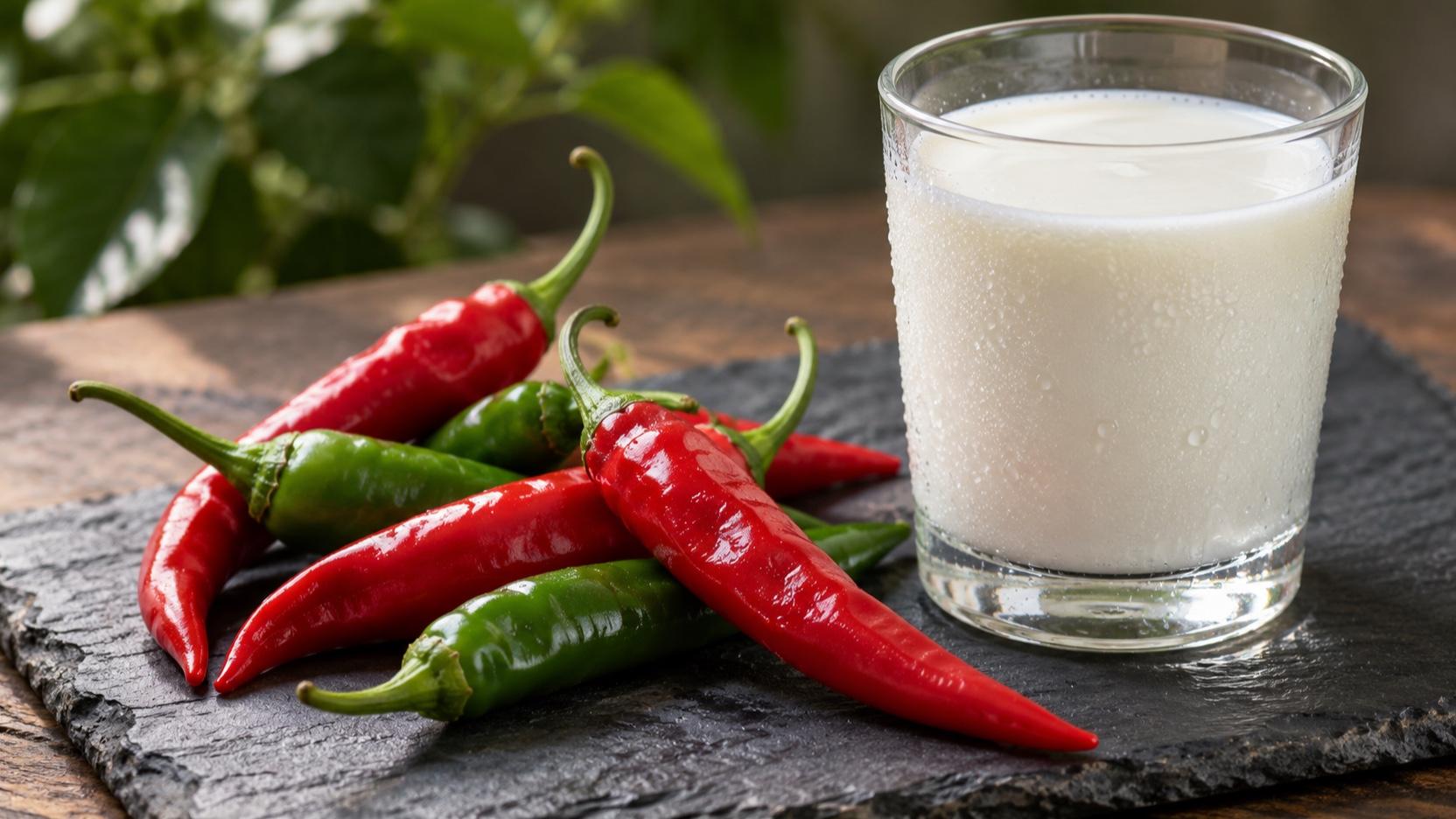
#If cold water fails, what actually extinguishes the burn? The answer has been known intuitively across traditional cuisines for thousands of years: Indian raita and lassi, Mexican horchata, and Thai iced tea with condensed milk. The definitive antidote to spicy food is dairy.
Dairy products—specifically whole cow milk, yogurt, sour cream, and ice cream—work through an exquisite biochemical mechanism driven by a specialized family of phosphoproteins called casein:
- The Structure of Casein: Casein makes up roughly 80 percent of the total protein content in bovine milk. Casein is an amphiphilic protein, meaning its long molecular structure contains both hydrophilic (water-loving) and hydrophobic (fat-loving) sections.
- The Detergent Action: In milk, casein proteins naturally organize into microscopic spherical clusters called micelles. These micelles feature oily, hydrophobic interiors shielded by water-friendly polar exteriors—behaving identically to dishwashing detergent.
- Stripping Capsaicin from the Receptors: When you drink milk or eat a spoonful of yogurt, the non-polar hydrophobic cores of the casein micelles come into direct contact with your tongue. Because capsaicin is also non-polar, it exhibits a powerful chemical affinity for the casein interior.
- Molecular Encapsulation: The casein protein wraps around the capsaicin molecule, physically prying it loose from its binding pocket on the TRPV1 receptor and encapsulating it within a soluble micellar cage.
- The Final Rinse: Because the exterior of the casein micelle is polar and water-soluble, your saliva and the liquid milk easily wash the trapped capsaicin down your esophagus, extinguishing the electrical fire at its source.
| Antidote Candidate | Dominant Active Mechanism | Scientific Efficacy Rating | Practical Culinary Recommendation |
|---|---|---|---|
| Cold Tap Water | Temporary thermal numbing; spreads hydrophobic oil | Very Poor (often exacerbates burn) | Avoid; leaves oil coating entire oral mucosa |
| Carbonated Soda / Beer | Low alcohol (<5%); bubbles irritate sensitized tissue | Very Poor | Avoid; bubbles amplify trigeminal pain |
| Whole Cow Milk | Casein protein encapsulates capsaicin like detergent | Optimal (gold standard antidote) | Drink slowly, swishing across tongue before swallowing |
| Full-Fat Yogurt or Raita | Dense casein matrix combined with cooling dairy lipids | Superior | Eat one or two spoonfuls; coats mucosal lining |
| Granulated Table Sugar | High sucrose density distracts sensory pain gating | Moderate | Hold a spoonful of sugar on tongue to blunt pain signals |
| Plant Milk (Almond/Oat) | Lacks casein; depends solely on minor plant oils | Low to Moderate | Ineffective compared to bovine dairy products |
For individuals with dairy allergies or lactose intolerance, alternatives rely on solubility chemistry. High-proof alcohol (above 35 percent ethanol) can dissolve capsaicin oils, though strong alcohol burns inflamed tissue; pure vegetable oil or olive oil can solubilize capsaicin through lipid dilution; and granulated sugar or honey provides sensory distraction through sweetness-mediated pain gating in the central nervous system.
The Scoville Hierarchy and Receptor Desensitization: How Tolerance Develops
#The intensity of heat across different chili peppers is measured using the Scoville scale, invented in 1912 by American pharmacist Wilbur Scoville. Originally, Scoville Heat Units (SHU) were determined through a subjective human sensory panel: chili oil was diluted in sugar water until a panel of five trained tasters could no longer detect any burning sensation. A score of 5,000 SHU meant the extract had to be diluted 5,000 times before its heat vanished.
Today, subjective human tasting has been replaced by high-performance liquid chromatography (HPLC), which precisely measures capsaicin and capsaicinoid concentrations in parts per million (ppm), converting mathematically to Scoville units:
- Bell Pepper (0 SHU): Contains zero capsaicin; completely sweet and benign.
- Jalapeno (2,500 to 8,000 SHU): Standard mild-to-moderate table heat.
- Habanero (100,000 to 350,000 SHU): Intense, lingering, systemic burn.
- Carolina Reaper and Pepper X (1,500,000 to 2,600,000+ SHU): Extreme weapon-grade botanical heat developed through selective agricultural breeding.
| Chili Cultivar | Botanical Species | Scoville Heat Units (SHU) | Typical Physiological Impact |
|---|---|---|---|
| Sweet Bell Pepper | Capsicum annuum | 0 SHU | Zero receptor binding; entirely sweet/crisp |
| Poblano Pepper | Capsicum annuum | 1,000 to 1,500 SHU | Mild, warm tingling across front of tongue |
| Jalapeno Pepper | Capsicum annuum | 2,500 to 8,000 SHU | Moderate trigeminal warmth; minor sweating |
| Cayenne Pepper | Capsicum annuum | 30,000 to 50,000 SHU | Pronounced burning; oral lacrimation triggers |
| Habanero / Scotch Bonnet | Capsicum chinense | 100,000 to 350,000 SHU | Severe oral burn; intense facial flushing and sweating |
| Ghost Pepper (Bhut Jolokia) | Capsicum chinense hybrid | 850,000 to 1,040,000 SHU | Blinding burn; hiccups, respiratory catch, endorphin high |
| Carolina Reaper | Capsicum chinense hybrid | 1,500,000 to 2,200,000 SHU | Extreme physiological stress; sustained visceral heat |
How do people build spice tolerance? If you eat spicy food regularly, your mouth does not build up a protective callous, nor do your taste buds die off. 
Instead, tolerance develops through a cellular phenomenon known as receptor desensitization:
- Depleting Substance P: When capsaicin repeatedly forces TRPV1 channels open, the nerve terminals continuously dump their supply of neurotransmitters, particularly Substance P, which transmits pain signals to the spinal cord. Over time, these neurotransmitter reserves become partially exhausted.
- Receptor Internalization: In response to chronic, relentless calcium influx, nerve cells protect themselves by pulling TRPV1 receptors off the cell surface and internalizing them inside endosomes, temporarily reducing the density of active thermal sensors on the tongue.
The next time you bite into a fiery dish and feel your heart race, take comfort in the science: you are not in mortal danger, your mouth is not on fire, and a cool glass of whole milk is waiting to wash the molecular tricksters away.