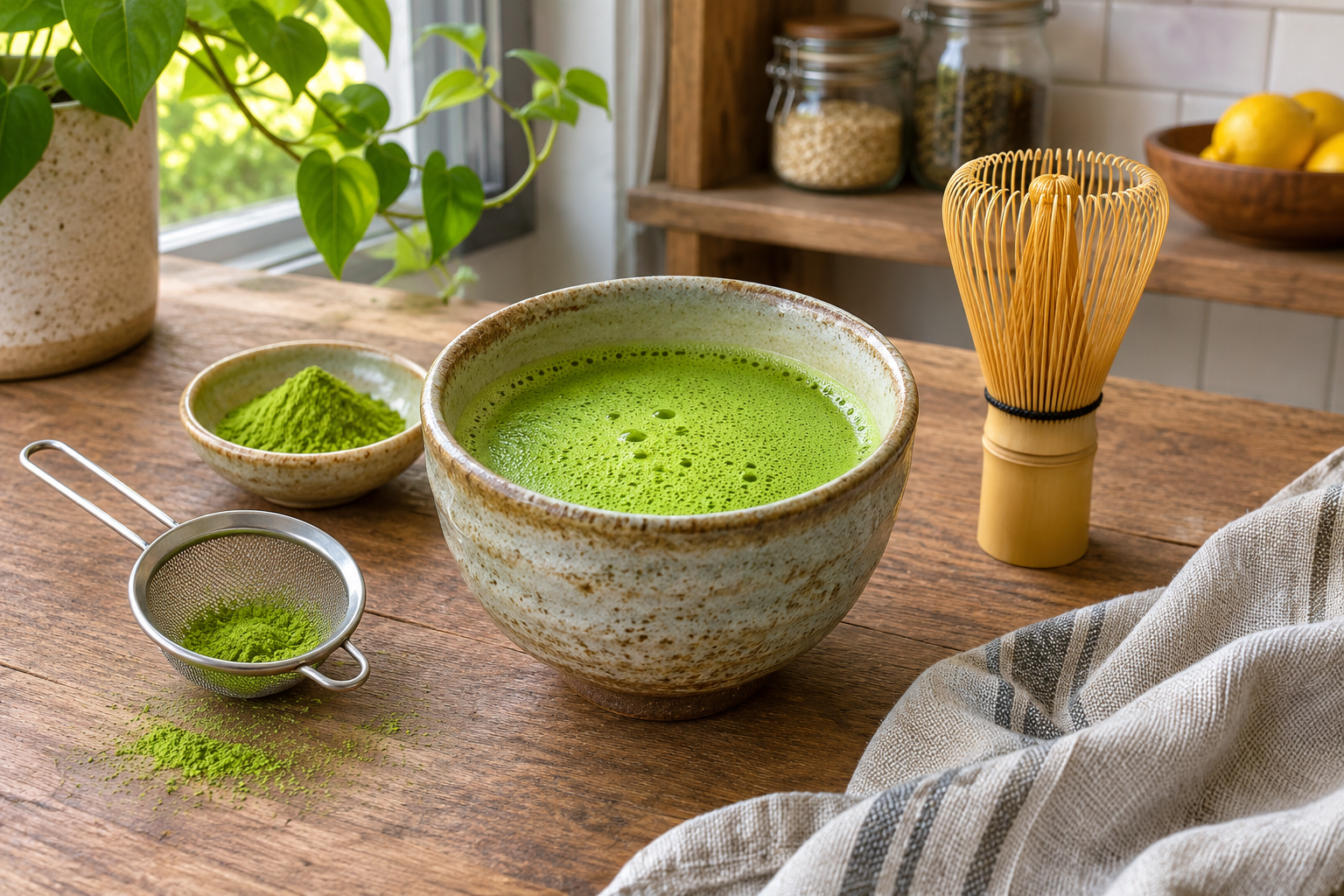
If there’s a little green pebble at the bottom of the matcha bowl, press it with the back of a teaspoon. A dab of dry powder in the middle tells you what to change on the next cup. I’d get the strainer out before reaching for a faster whisk.
For smoother matcha, sift the powder into a dry bowl, add the water and whisk the tea before adding milk or ice. Ippodo’s basic cold-whisked matcha is a useful starting point: sift 2 grams, add 60 millilitres of cold water and whisk briskly for about 15 seconds. Use that as a benchmark and change the amount of water to suit the drink you’re making.
Check what’s actually in the cup
#| What you notice | What I’d check | What to do |
|---|---|---|
| Dark lumps break open with dry centers | Powder clumped before or during whisking | Sift before adding water next time |
| The tea looks smooth, then a fine layer settles | Fine tea particles have had time to settle | Swirl gently before the next sip |
| Powder sticks in a ring on the bowl | The dry tea wasn’t all reached by the water | Sweep the edges with a whisk and mix the ring back in |
| The drink is smooth but there’s little foam | The tool, motion or serving style | Judge texture first and adjust whisking separately |
A quiet cup can still be smooth. For an iced latte, I’d check with a spoon before pouring the tea over ice. You can see a lump in the concentrated tea more easily than in a tall glass full of milk. If something looks like a wet green pebble, press it against the side of the bowl with the back of a spoon. A dry mark in the middle points toward a clump. Fine sediment at the bottom of a drink that has been sitting is a different thing.
Sift while you can still get at the powder
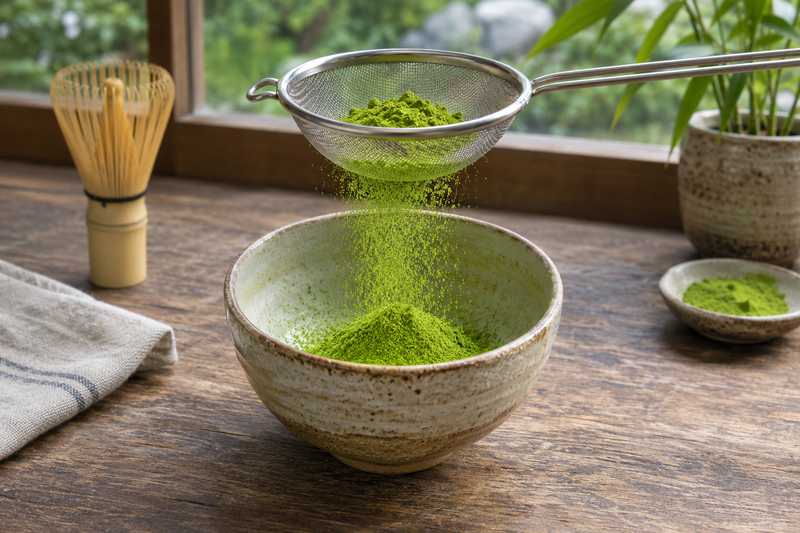
#Set a fine tea strainer over a dry bowl. Add the powder and use a clean, dry spoon to ease it through. Any grains that gather on the mesh can be pressed lightly with the back of the spoon. I’d measure the powder before sifting so there’s one less thing to guess about. A kitchen strainer works if the mesh is fine enough and you can keep it steady.
Tea powder can clump in the tin from moisture or static. Keep a wet spoon out of the container. If you make more than one cup, sift enough for each bowl as you need it or prepare a small amount in advance in a dry container. If the strainer is still damp from the previous cup and the powder sticks to the mesh, stop and dry it before trying again.
For this job I’d use a fine wire sieve. Check the mesh before you reach for the powder. You want enough resistance to break up little clumps while letting the powder pass. A mesh that lets everything fall through unchanged saves less work than a dry spoon and a careful pass over the bowl.
Whisk the tea before you build the drink
#I’d use a bowl wide enough to move the whisk without scraping its sides. Pour in the water and watch for powder left around the edge. Draw it into the water and whisk with brisk, small strokes. The cold-water method is useful if the drink is going over ice. For a hot preparation, use the temperature guidance for your tea and the method you’re following. Use water to whisk the tea first, then add the milk you like.
If you have a handheld frother, make sure its head stays in the liquid and start with enough room to catch splashes. As a first step I’d still sift. A spoon can press apart a few wet lumps and make a drink usable in a pinch. A whisk gives you a wider range of motion and can move more of the tea at once. If you get texture you like with a tool you already own, you can leave the shopping for another day.
An iced drink is where I’d be most tempted to rush. The milk is already in the glass and the ice is starting to melt. Give the tea its own bowl anyway. When it looks smooth, pour it in and stir to taste. If the flavor ends up too light, you can use less milk on the next cup while keeping the part of the method that worked.
The small bowl earns its place in an iced latte
#Say you’ve poured milk over ice and there’s a minute before you need to get out the door. Give the dry matcha a quick pass through the sieve into a separate bowl. As you whisk it with water, stop once to tilt the bowl and see whether powder is still stuck along the water line. Pull that back in. Look at the tea on the spoon. If it’s smooth enough for you, pour it into the milk and stir. The extra bowl makes the clump check possible while the tea is still concentrated.
I’d use the same approach if I wanted to serve a cold cup without milk. Whisk first, then taste and decide whether to dilute it. Starting with a tall glass of water makes it harder to find the powder that sticks near the bottom. A wider bowl gives a short whisk some room. If all you have is a frother and a tall cup, leave headroom and keep the mixing head below the surface while it’s on.
For two cups, sift both servings while the strainer is dry, then whisk each one when you’re ready to pour. The person getting the second glass can give it a stir if the fine particles have settled. Leave a teaspoon beside the second cup if it will be sitting for a while.
If it’s already clumpy
#If the tea is still in a small bowl, press any obvious lumps against the side and whisk again. If you see a ring on the surface, bring it toward the center. A fine strainer can catch the stubborn bits after you whisk. Expect to leave some tea behind if you strain out large clumps.
If you’ve already put everything into a tall iced glass, you can stir, then pour through a clean fine strainer into another glass if the texture bothers you. I’d make the next cup in the opposite order. Seeing powder pass through a dry sieve and seeing the whisk move freely in the bowl are two quick checks that save more time than trying to find every lump after adding the milk.