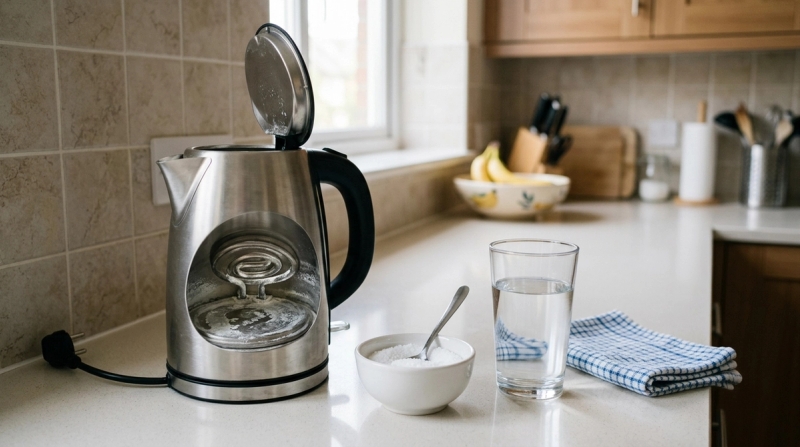
You know that chalky white layer that slowly takes over the inside of an electric kettle? Or those tiny white flakes floating around after the water boils?
That is usually electric kettle limescale. It looks unpleasant, but most of the time it is not mold and it does not mean your kettle is dirty in the usual sense. It is simply mineral buildup from hard water, mainly calcium and magnesium.
The good news: you can usually clean it at home without much effort.
To descale an electric kettle safely, unplug it, let it cool, add diluted white vinegar, food-grade citric acid, or a kettle-safe descaler, let it soak, rinse it properly, then boil plain water and throw that water away before making tea or coffee.
If you live in a hard-water area, especially in many parts of India, this is going to be a regular kettle problem. Your kettle may look cloudy or crusty even if you only boil plain water in it. That does not mean you are doing something wrong. It just means the water is leaving minerals behind.
This AllBlogs guide keeps things simple: what the white flakes are, how to remove them, what not to use, and how often to clean your kettle if your home, PG, hostel, or apartment has hard water.
What is electric kettle limescale?
#Limescale is the white or off-white mineral deposit left behind when hard water is heated.
Hard water contains dissolved minerals, mostly calcium and magnesium. When you boil the water, some of those minerals separate out and stick to the bottom and sides of the kettle. Over time, they form a chalky layer.
You may notice:
- A white or pale grey crust on the heating plate
- White flakes in kettle water
- A rough ring around the waterline
- Powdery residue when the kettle dries
- A cloudy look in boiled water
- Tea or coffee tasting a little flat or chalky
- The kettle taking slightly longer to boil
Limescale is not the same as mold. Mold is usually fuzzy, slimy, green, black, or patchy. Limescale is dry, chalky, flaky, and usually white.
If your kettle is used only for water, white flakes are far more likely to be mineral scale than mold.
That said, it is still worth cleaning. Nobody wants bits of scale floating in their tea.
Why does a hard water kettle get white flakes so quickly?
#A hard water kettle builds up scale because every boil leaves a little mineral residue behind. One boil may not show much. But after days or weeks, the minerals collect and become visible.
This is very common in Indian homes, apartments, PGs, hostels, and office pantries. Borewell water, tanker water, and some municipal water supplies can be quite hard. If your bathroom taps, buckets, tiles, showerhead, or steel vessels get white marks, your kettle probably will too.
Shared kettles usually scale even faster because:
- Many people use the same kettle
- Water is often left inside overnight
- The kettle may be boiled several times a day
- People sometimes boil tea, milk, noodles, oats, or soup directly in it
- Nobody knows when it was last cleaned
A kettle in a hostel room or office pantry can go from clean to crusty surprisingly fast.
Is limescale harmful?
#For most healthy adults, small amounts of limescale from drinking water are not usually a major safety issue. It is mainly a taste, appearance, and appliance-maintenance problem.
But heavy limescale can:
- Make water look cloudy
- Leave flakes in drinks
- Affect the taste of tea and coffee
- Make the kettle work harder
- Slow down boiling
- Collect around the spout filter
- Hide other residue if the kettle is also used for food or milk
So while a little scale is not a panic situation, it is better not to let it build up for months.
Why normal washing does not remove limescale
#Limescale is mineral buildup. It is not grease or food dirt.
That is why dishwashing liquid and regular scrubbing do not work well on it. You need a mild acid to dissolve the mineral layer.
This is also why you should avoid scraping the inside with a knife, spoon, steel wool, or rough scrubber. You may scratch the heating plate or damage the coating. Once the surface is damaged, the kettle may become harder to clean and less safe to use.
The better method is simple: soften the scale first, then wipe gently.
Vinegar vs citric acid vs kettle descaler
#The three most common options for descaling an electric kettle are:
- White vinegar
- Food-grade citric acid
- Kettle-safe commercial descaler
All three can work. The best choice depends on what you have at home, how much scale there is, and what your kettle manual allows.
Always check the kettle manual if you still have it. Some brands allow boiling the cleaning solution. Some recommend soaking only. If you use a commercial descaler, follow the label exactly.
A quick spelling note: many people search for “citri acid for kettle cleaning.” The correct term is citric acid. Use food-grade citric acid, not industrial acid or unlabelled cleaning powder.
What you should never use in an electric kettle
#An electric kettle is used for drinking water, and it has electrical parts. So please do not treat it like a bathroom tile or drain.
Avoid using:
- Bleach
- Toilet cleaner
- Drain cleaner
- Bathroom descaler not labelled for kettles
- Random strong acids
- Dishwashing liquid boiled inside the kettle
- Steel wool
- Knives or sharp tools
- Abrasive scrub pads on the heating plate
- Chemical mixtures
- Any product that is not safe for food-contact appliances
Also, never submerge the kettle base, plug, cord, or electrical connector in water.
And do not fill above the MAX line while descaling. Vinegar and descaling solutions can bubble or foam. Overfilling can cause spills and make a mess around the electrical base.
Safe electric kettle descaling checklist
#Use this kettle cleaning checklist when your kettle has white flakes, chalky residue, or a cloudy heating plate.
1. Read the manual if you have it
#Before you start, check the manufacturer’s instructions.
Look for:
- Whether vinegar is allowed
- Whether citric acid is allowed
- Whether the brand recommends only a specific descaler
- Whether the solution can be boiled
- Whether it should only be soaked
- Any warning about filters, coatings, sensors, or water-level windows
If the manual says one thing and a cleaning hack online says another, trust the manual.
2. Unplug the kettle and let it cool
#Switch off the kettle and unplug it from the socket.
If it has a separate base, lift the kettle off the base.
Let it cool before adding anything. Do not pour cold liquid into a very hot kettle, and do not clean it while it is connected to power.
3. Rinse out loose flakes
#Open the lid and check inside.
If there are loose white flakes, add a little plain water, swirl it around, and empty it. This removes the easy stuff before descaling.
Do not scrape the bottom. Just rinse.
4. Choose one descaling solution
#Pick one option. Do not mix cleaning products.
Option A: White vinegar
#Use this for light to medium limescale.
- Mix equal parts white vinegar and water
- Fill the kettle about halfway
- Stay below the MAX line and any cleaning limit mentioned in the manual
Option B: Food-grade citric acid
#This is a good option if you dislike the smell of vinegar.
- Fill the kettle about halfway with water
- Add 1 to 2 tablespoons of food-grade citric acid
- Stir gently if needed
Option C: Kettle-safe commercial descaler
#Use this for stubborn scale or if your kettle brand recommends it.
- Choose a product labelled safe for kettles or food-contact appliances
- Follow the exact dilution on the packet or bottle
- Follow the recommended soaking and rinsing instructions
Do not guess the amount. Stronger is not always better.
5. Soak, or boil only if allowed
#If your kettle manual says to soak only, do not boil the cleaning solution.
For normal buildup, soaking for 20 to 60 minutes is usually enough.
If the manual allows boiling:
- Bring the solution to a boil
- Switch off the kettle
- Let it sit while it cools for 20 to 30 minutes
- Stay nearby while it heats
Do not leave a kettle unattended while boiling vinegar, citric acid, or descaler.
6. Empty the solution
#Pour the used solution into the sink.
You may see cloudy water, loosened white flakes, or softened patches coming out. That is normal. It means the acid has started dissolving the scale.
If some scale is still stuck, repeat the soak once. Do not start scraping aggressively.
7. Wipe the inside gently
#Use a soft sponge, soft cloth, or non-abrasive brush.
Pay attention to:
- The heating plate
- Water-level window
- Spout area
- Lid edges
- Removable filter
- Any visible sensor area
If your kettle has a removable spout filter, take it out and rinse it separately. If it is crusty, soak it in the same mild descaling solution for a short time, then rinse it well.
8. Rinse several times
#This step matters more than people think.
Fill the kettle with clean water, swirl, empty, and repeat. Do this several times until there is no visible residue and no strong vinegar or chemical smell.
If you used vinegar, rinse extra well because the smell can hang around.
9. Boil plain water and throw it away
#Fill the kettle with fresh water to a normal safe level.
Boil it once, then discard that water.
If you still smell vinegar or descaler, repeat this once or twice. Do not use the first boiled water for tea, coffee, baby formula, instant noodles, or anything else.
This final flush removes leftover acidity, loosened minerals, and smell.
10. Leave the kettle open to dry
#After rinsing, leave the lid open for a while so the inside can air dry.
If you are not using the kettle immediately, keep it empty. Water left inside overnight makes limescale return faster.
How often should you descale a hard water kettle?
#There is no perfect schedule for every home. The honest answer is: descale when you see scale forming.
But as a practical guide:
- Very hard water and daily use: every 2 to 4 weeks
- Shared PG, hostel, or apartment kettle: every 1 to 2 weeks
- Moderate hard water: about once a month
- Soft or filtered water: every few months, or when scale appears
If white flakes return within a few days, your water is probably very hard, or water is being left in the kettle for too long.
How to reduce limescale in an electric kettle
#You may not be able to stop limescale completely if your water is hard, but you can slow it down.
Empty the kettle after use
#This is the easiest habit and probably the most effective.
Do not leave boiled water sitting in the kettle overnight. As the water cools and evaporates, minerals become more visible and stick to the surface.
Boil only what you need
#If you need one cup, do not fill the kettle to the top.
Heating less water means fewer minerals are left behind. It also saves electricity and helps the kettle boil faster.
Use filtered water if possible
#If you already use filtered, RO, or pitcher-filtered water for drinking, use it in the kettle too.
It may reduce scale, though it will not make the kettle completely maintenance-free.
Keep the kettle for water only
#This is especially important in hostels, PGs, and shared flats.
Once people start boiling milk, masala tea, soup, oats, Maggi, or reheating coffee directly in the kettle, the problem is no longer just limescale. Now you also have food residue, starch, proteins, smells, and sometimes burnt bits.
If possible, make one clear rule: water only.
Rinse it at the end of the day
#A quick rinse takes less than a minute. Empty the kettle, swirl some clean water inside, and leave it open to dry.
It prevents loose flakes from drying into a harder layer.
Clean the spout filter
#Many electric kettles have a small mesh filter near the spout. It catches white flakes, but it also collects scale.
Rinse it often. When descaling the kettle, clean the filter too.
Notes for Indian homes, PGs, hostels, and apartments
#Hard water is not limited to large houses or old plumbing. It is common in rented flats, student hostels, office pantries, PG rooms, and compact kitchens.
A few practical habits can save a lot of irritation.
Label the kettle “water only”
#It may sound unnecessary until someone boils masala tea in it and leaves it overnight.
A simple label can prevent most misuse in shared spaces.
Keep food-grade citric acid in the kitchen
#Citric acid is useful because it works well and does not leave the strong smell that vinegar does.
Store it in a sealed container and label it clearly so nobody mistakes it for salt, sugar, or something else.
Put kettle cleaning on a schedule
#In shared accommodation, “someone should clean it” usually means nobody cleans it.
Add kettle cleaning to the weekly or fortnightly cleaning rotation. It is a small task, but it keeps the kettle usable.
Pay attention when water sources change
#Some buildings switch between borewell water, tanker water, and municipal supply. The kettle may scale faster during certain weeks.
Clean based on what you see, not just the calendar.
Do not ignore electrical warning signs
#Descaling only removes mineral buildup. It does not fix electrical damage.
If a shared kettle leaks, sparks, trips the power, smells burnt, or makes crackling sounds, stop using it.
When descaling is not enough
#Sometimes the issue is not just limescale. The kettle may be damaged or unsafe.
Stop using it and consider repair or replacement if you notice:
- Water leaking from the base, seams, or water-level window
- Cracks in the body, handle, lid, or base
- Burning smell from the base, plug, or cord
- Sparking or crackling sounds
- Repeated power tripping
- Kettle switching off before the water boils, even after cleaning
- Deep reddish-brown rust that looks rough or flaky
- Loose plug or damaged cord
- Unstable connection between kettle and base
Do not keep using an electric kettle with structural or electrical problems. Unplug it and follow the manufacturer’s service advice, or replace it if it is no longer safe.
Quick kettle cleaning checklist
#Here is the short version.
- Unplug the kettle
- Let it cool
- Empty old water
- Rinse out loose white flakes
- Add diluted white vinegar, food-grade citric acid, or kettle-safe descaler
- Soak, or boil only if the manual allows it
- Empty the solution
- Wipe gently with a soft cloth or sponge
- Rinse several times
- Boil plain water and discard it
- Repeat the plain-water boil if smell or taste remains
- Leave the kettle open and empty to dry