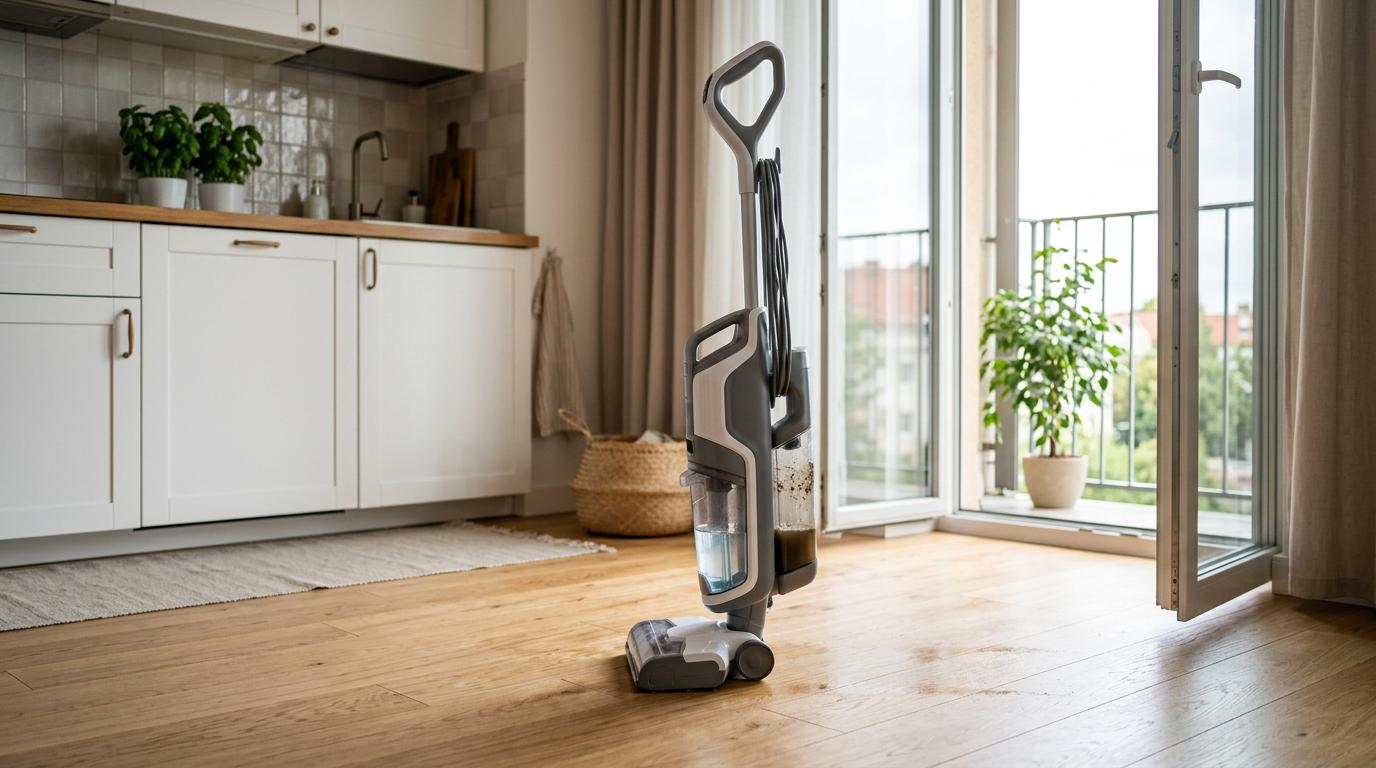
A wet dry vacuum cleaner for home is worth buying if your apartment has mostly sealed hard floors and you regularly clean dust, spills, wet footprints, pet hair, or kitchen messes. Skip it if your home is mostly carpeted, storage is tight, or you do not want to empty and rinse the dirty tank after every use.
A wet-dry vacuum cleaner sounds like the perfect cleaning shortcut. One machine that picks up dust, handles spills, and mops the floor at the same time? For an apartment, especially one with tile or vitrified flooring, that can be genuinely useful.
But it is not a magic appliance.
It will not deep clean thick carpets. It will not clean itself completely while you walk away forever. And it will definitely need a little care after every use.
That said, if your home has mostly sealed hard floors and your daily mess looks like dust, crumbs, tea spills, wet footprints, muddy balcony marks, pet hair, or kitchen splatter, a wet-dry vacuum cleaner can make cleaning feel much easier.
Before buying one, check the basics carefully: your floor type, tank size, battery life, noise level, storage space, self-cleaning feature, spare parts, and service support. These things matter far more in daily use than glossy product photos or big discount banners.
Here’s a practical, apartment-friendly checklist to help you decide.
What is a wet-dry vacuum cleaner for home?
#A home wet-dry vacuum cleaner is usually a compact vacuum mop or hard-floor cleaner. It is different from the large wet-dry shop vacuums used in garages, workshops, or construction sites.
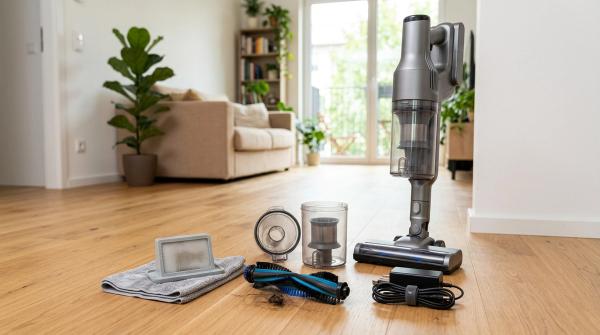
Most home vacuum mops are designed for sealed hard floors. They usually have:
- A clean water tank
- A dirty water tank
- A motorized roller brush
- Suction for dust, water, hair, and small debris
- A charging or storage dock
- In many models, a self-cleaning mode for the roller
The basic idea is simple. The machine releases clean water or cleaning solution, scrubs the floor with the roller, and sucks the dirty water into a separate tank.
That separation is the main benefit. You are not dipping a mop into the same dirty bucket again and again. Clean water goes out, dirty water comes back into another tank.
For apartments with tile, marble, granite, vinyl, laminate, or vitrified floors, this can be very convenient. It is also why searches for wet dry vacuum cleaner India are common, especially during monsoon season when wet footprints and muddy marks become a daily problem.
But it still depends on your home and your cleaning habits.
Is a wet-dry vacuum cleaner worth buying?
#Yes, it can be worth buying if your biggest cleaning problem is hard-floor mess.
Think about everyday apartment cleaning. Dust near the balcony. Crumbs under the dining table. Tea or coffee spills. Cooking splatter near the stove. Water marks near the sink. Muddy shoe prints at the entrance. Pet hair stuck to a slightly damp floor.
A vacuum mop handles these situations better than a dry vacuum because it does two jobs together. It vacuums and washes the floor in one pass.
But it is less useful if your home has mostly carpets, thick rugs, or many uneven floor transitions. It is also not ideal if you want a machine you can use and then ignore for several days.
After every cleaning session, you need to empty the dirty water tank. You should rinse it. The roller needs to dry properly. If the machine has a dock, it needs a fixed place in your home.
So the real question is not just, “Is a wet-dry vacuum better than a mop?”
The better question is, “Will I clean the machine after using it?”
If the answer is yes, a wet-dry vacuum cleaner can be a very helpful apartment appliance.
Apartment buying checklist: what to check before buying
#1. Start with your floor type
#Before looking at features, offers, colours, or smart displays, look at your floor.
A wet-dry vacuum cleaner is mainly made for sealed hard floors.
Good matches include:
- Ceramic tile
- Vitrified tile
- Sealed marble
- Sealed granite
- Vinyl flooring
- Laminate approved for wet cleaning
- Sealed hardwood, if the product manual allows it
Be careful with:
- Unsealed wood
- Damaged laminate
- Natural stone that needs special care
- Thick carpets
- Delicate rugs
- Floors with cracks or loose edges
Some vacuum mops can lightly refresh low-pile rugs if the manual says it is safe. But they are not proper carpet cleaners. If your apartment has more carpet than hard floor, a regular dry vacuum cleaner will usually be a better main appliance.
2. Check tank size, but do not blindly choose the biggest one
#Wet-dry vacuum cleaners have two separate tanks: one for clean water and one for dirty water.
A bigger tank means you can clean a larger area without stopping to refill or empty it. That sounds great, but there is a catch. Bigger tanks also add weight.
For apartments, the biggest tank is not always the best choice. You want enough capacity to clean your regular floor area, but not so much that the machine becomes tiring to push around furniture.
Also check how easy the tanks are to remove and rinse. This sounds like a small thing, but you will do it after almost every use. If the dirty water tank is awkward, drips while removing, or has corners that are hard to clean, it will become annoying very quickly.
A medium, easy-to-handle tank is often better than a large, clumsy one.
3. Take the self-cleaning feature seriously
#A self-cleaning vacuum mop is much easier to live with.
After cleaning the floor, you place the machine on its dock and start the self-cleaning cycle. The machine runs water through the roller and internal path to remove dirt, residue, and wet debris.
You still have to empty and rinse the dirty water tank. Self-cleaning does not remove that step. But it does make roller maintenance much easier.
Without self-cleaning, you may need to remove and wash the roller by hand more often. That is not impossible, but most people are enthusiastic for the first week and then slowly stop doing it properly. That is when the machine starts smelling, streaking, or cleaning badly.
If two models are similar and one has better self-cleaning, choose that one if your budget allows. It is one of those features that feels more useful after you actually start using the appliance.
4. Decide between cordless and corded
#A cordless wet dry vacuum is usually more convenient for apartments. You can move from the kitchen to the hallway to the balcony area without changing plug points. There is no cord dragging behind you, and that feels safer when water is involved.
But battery life matters.
Do not look only at the biggest runtime number in the advertisement. Check what that number actually means. Is it for eco mode? Normal mode? Wet cleaning mode? Boost mode?
Your real cleaning time may be shorter than the headline number.
Cordless models are ideal if:
- You clean in short sessions
- Your apartment is small or medium-sized
- You want quick cleanup after spills
- You dislike switching plug points
Corded models make sense if:
- You clean a larger area in one go
- You do not want battery anxiety
- You have convenient plug points
- You are okay with managing the cord
If you choose a corded model, check the cord length, cord storage, plug quality, and safety instructions in the manual.
5. Think about noise before buying
#Wet-dry vacuum cleaners are not silent. They run suction, a spinning roller, and water flow at the same time.
In an apartment, noise matters more than people expect. If you clean early in the morning or late at night, a loud machine can be irritating. It may also disturb children, elderly family members, pets, or neighbours through thin walls.
Check the manufacturer’s noise rating if available. Also read real user reviews for comments about sound. Sometimes a machine may not be extremely loud on paper, but the pitch of the noise can still feel harsh indoors.
A quieter machine is easier to use regularly. And with cleaning appliances, regular use is the whole point.
6. Plan storage and docking space in advance
#A vacuum mop needs more space than a basic mop.
Most models need a dock. Cordless models need charging access. The roller may need airflow to dry properly. And the machine should ideally sit on hard flooring, not on carpet or rugs.
Before buying, decide where it will live.
Ask yourself:
- Is there a plug point nearby?
- Will the dock block a walkway?
- Can the machine stand safely there?
- Is the space ventilated enough for drying?
- Can I remove the tanks easily in that spot?
- Will I realistically return it to the dock after each use?
Apartment storage is not a small detail. If an appliance is awkward to store, you will slowly stop using it. Most homes already have at least one appliance sitting in a corner for exactly this reason.
7. Look at edge cleaning and corners
#Most floor dirt hides near edges: along skirting boards, under cabinets, around dining chairs, near balcony tracks, and beside kitchen counters.
Vacuum mops can struggle with edges because the roller is usually placed inside a plastic housing. Some models clean closer to walls than others.
Before buying, check:
- Whether it offers one-side or two-side edge cleaning
- How close the roller reaches to the wall
- Whether the head is too bulky for your kitchen
- If it can go under low furniture
- How easily it turns around chair and table legs
Even a good vacuum mop will not clean every tight corner perfectly. You may still need a cloth or small mop for awkward spots. But good edge cleaning reduces that extra work.
8. Check weight and handling
#A wet-dry vacuum cleaner may look sleek in photos, but remember: it carries water.
The machine can feel heavier once the clean water tank is filled and the dirty tank starts collecting water and debris. Weight also matters when turning, lifting, or moving between rooms.
If possible, check:
- Weight with water filled
- Handle comfort
- Turning radius
- Whether it stands upright on its own
- Ease of carrying
- How it moves around furniture
- Whether older family members can use it comfortably
For a small apartment with tight spaces, handling may matter more than maximum suction power.
A powerful machine that feels heavy and awkward may end up being used less often than a lighter, easier one.
9. Check spare parts and service support
#A wet-dry vacuum cleaner has parts that wear out over time.
Common replacement parts include:
- Roller brushes
- Filters
- Cleaning brushes
- Dirty water tank parts
- Seals or small accessories
Before buying, check whether spare rollers and filters are easily available. This is especially important if you are buying a wet dry vacuum cleaner India model online. A machine can become frustrating if the motor works fine but you cannot find a replacement roller.
Also check service support. Is there a service centre in your city? Is pickup service available? Are replacement parts listed clearly? Are consumables reasonably priced?
Do not buy only because a model looks premium or is heavily discounted. After-sales support matters with appliances that handle water and moving parts.
10. Follow cleaning solution rules
#Many brands recommend using only their approved cleaning solution or plain water, depending on the model.
This is important.
Do not casually add dish soap, strong floor cleaner, bleach, phenyl, or random disinfectant unless the manual clearly says it is allowed. Foamy liquids can affect suction, dirty water separation, sensors, and internal parts.
Too much foam can travel where liquid should not go. Strong chemicals may also damage seals, tanks, rollers, or flooring.
The safest habit is simple: follow the product manual.
It may sound boring, but it can save your machine.
Wet-dry vacuum vs mop vs cordless vacuum vs robot vacuum
#Common buying mistakes to avoid
#Do not buy a wet-dry vacuum cleaner just because the product page says it can “replace sweeping and mopping forever.”
It may reduce both jobs. It may make daily cleaning faster. But it will not remove every bit of manual cleaning from your life.
Avoid these mistakes:
- Buying without checking floor compatibility
- Assuming it will deep clean carpets
- Choosing the biggest tank without considering weight
- Ignoring dirty water tank cleaning
- Using random cleaning liquids
- Buying a model with unavailable spare rollers or filters
- Storing it in a closed space while the roller is still wet
- Forgetting to check service support
- Expecting it to clean every corner perfectly
- Leaving dirty water inside the tank overnight
A wet-dry vacuum cleaner works best when your expectations are realistic.
Safety notes you should not skip
#Wet-dry vacuum cleaners use electricity, water, suction, and moving parts together. So safety matters.
Always follow your product manual first. Common manufacturer warnings include:
- Do not vacuum flammable or combustible liquids such as petrol, lighter fluid, solvents, paint thinner, or alcohol-based spills.
- Do not vacuum hot ashes, burning cigarette butts, matches, or smoking materials.
- Do not vacuum toxic dust, unknown chemical powders, hazardous materials, or anything you cannot identify.
- Do not use the appliance if the cord, plug, charger, battery, or body looks damaged.
- Do not use cleaning solutions that are not approved by the manufacturer.
- Do not overfill tanks beyond the marked limit.
- Do not store the machine with dirty water left inside.
- Do not place the charging dock in a wet area unless the manual allows it.
- Do not let children use the appliance without supervision.
If the mess looks chemical, hot, unsafe, or unknown, do not use a home vacuum mop on it.
Simple decision guide
#Buy a wet-dry vacuum cleaner if:
- Most of your floors are sealed hard floors
- You deal with both wet and dry messes often
- You want one tool for daily floor cleaning
- You have space for a dock
- You are willing to empty and rinse the tank after use
- Spare rollers and filters are available where you live
- You want easier cleaning during monsoon or after cooking
Skip it, or wait for now, if:
- Your home is mostly carpeted
- You dislike cleaning appliance parts
- You have no practical storage space
- You need deep rug or upholstery cleaning
- Local service support is unclear
- You only mop occasionally
- You already have a simple cleaning routine that works well
For many apartments, the best setup is a vacuum mop for hard floors plus a small dry vacuum for carpets, sofas, corners, and shelves.
But if you want only one floor-cleaning machine, choose based on your main floor type and your daily mess.
Final thought
#A wet-dry vacuum cleaner is a practical appliance, not a miracle appliance.
It works best in apartments with hard floors, regular dust, spills, wet footprints, and kitchen messes. It is especially helpful if you want to avoid sweeping first and mopping later.
But it does ask for a little discipline.
Empty the dirty tank. Rinse the parts. Let the roller dry. Check spare parts before buying. Use the right cleaning solution.
If that routine sounds manageable, a wet dry vacuum cleaner for home can make everyday floor cleaning feel much less tiring. If not, a good mop and a reliable dry vacuum may still be the simpler choice.