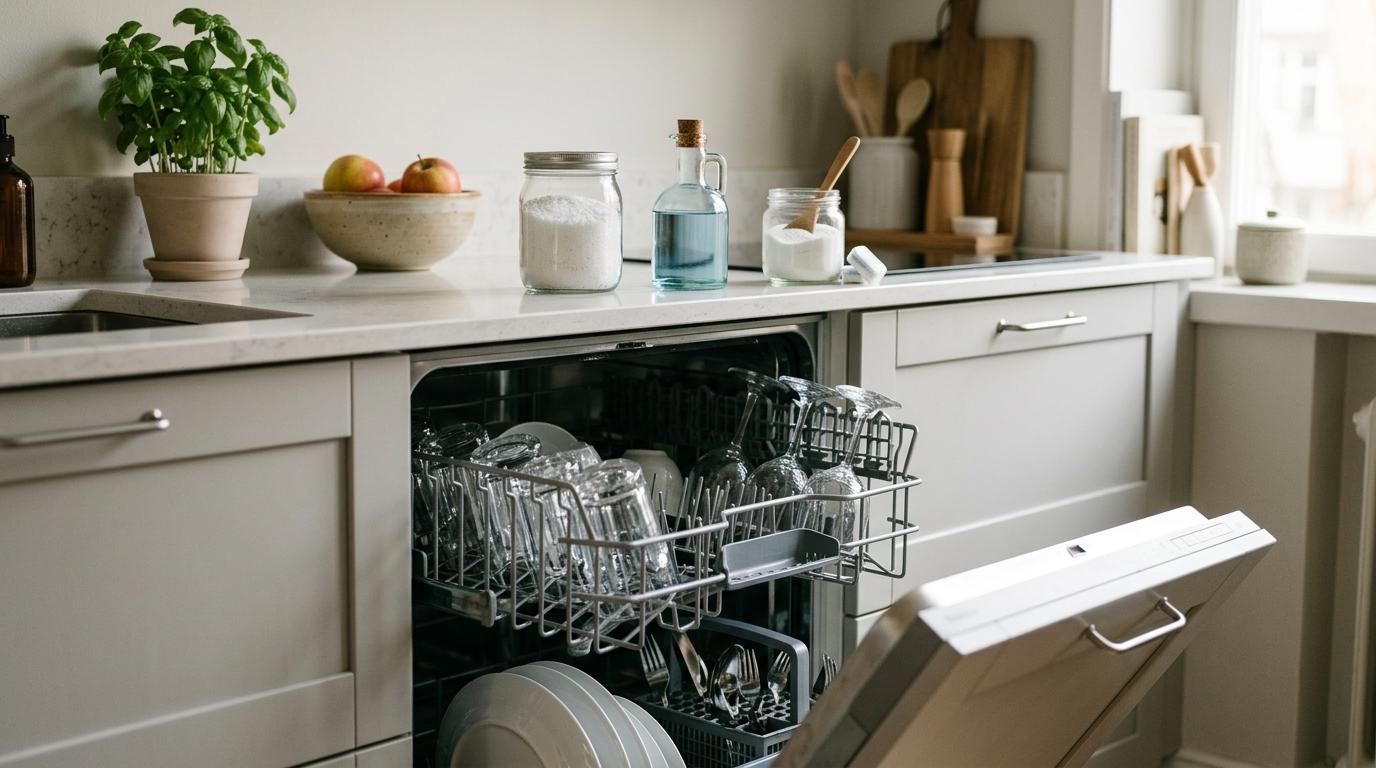
If you have just bought a dishwasher, remember this simple rule: dishwasher detergent cleans, dishwasher salt helps the machine manage hard water, and rinse aid helps dishes dry with fewer spots. They are not interchangeable. In hard-water homes and many Indian apartments, beginners should usually keep all three ready.
Quick Comparison: Dishwasher Salt vs Rinse Aid vs Detergent
#The Beginner Rule: Buy These Three Things
#If this is your first dishwasher, start with:
- Dishwasher detergent — powder, gel, or tablets.
- Dishwasher salt — not normal table salt.
- Rinse aid — not vinegar and not dish soap.
This is the least confusing setup. If your home has soft water, your dishwasher may use very little salt. But if you live in a hard-water area, or your building uses borewell, tanker, or mixed water, dishwasher salt becomes much more important.
This is also where many people get confused about dishwasher salt vs rinse aid. Dishwasher salt helps the machine manage hard-water minerals. Rinse aid helps clean dishes dry properly.
Dishwasher Detergent: The Product That Actually Cleans
#Dishwasher detergent removes food, oil, grease, dal, rice starch, tea stains, masala, and dried bits from dishes.
It is not the same as regular dishwashing liquid. Do not put normal handwash dish soap in a dishwasher. It creates too much foam and can leak out of the machine.
Dishwasher detergent is made for:
- Hot water
- Spray arms
- Low foam
- Long wash cycles
- Machine dishwashing
You will usually find it in three forms: powder, gel, and tablets.
Powder Detergent
#Powder detergent is usually the most budget-friendly option. It also gives you more control. For a light load, like cups, plates, and spoons, you can use a little less. For oily Indian cooking, greasy pans, masala residue, dried dal, rice starch, or cooker lids, use the recommended amount.
The main caution is moisture. Powder can clump if the pack is left open or stored near water. Keep it tightly closed and dry.
Dishwasher Tablets
#Tablets are the easiest option. You put one tablet in the detergent dispenser, close it, and start the cycle.
Many tablets are sold as all-in-one, 5-in-1, or multi-function tablets. These usually contain detergent and may also claim to include rinse-aid and salt functions.
For some homes, especially where the water is soft, that may work well enough. But in hard-water areas, tablets may not fully replace the dishwasher’s own salt system. Many dishwasher manuals still recommend using dishwasher salt according to local water hardness.
So tablets can make life easier, but they do not always mean you can forget salt and rinse aid.
Dishwasher Salt: The Hard-Water Helper
#Dishwasher salt does not clean food from your dishes. That is the detergent’s job.
Dishwasher salt helps the machine’s built-in water softener work properly. Hard water contains minerals such as calcium and magnesium. When this water is heated again and again, those minerals can leave behind:
- White marks
- Cloudy glasses
- Chalky deposits
- Limescale inside the machine
- Poor cleaning over time
The salt reservoir is usually at the bottom of the dishwasher tub, under a screw cap. You open the cap, fill it with dishwasher salt, close it tightly, and the machine uses it internally.
You should not normally see salt crystals floating around during a wash. If you do, the cap may be loose or some salt may have spilled while filling.
Why Dishwasher Salt Matters in Indian Homes
#In many Indian homes, water quality changes often. One week you may get mostly municipal water. Another week, your overhead tank may have borewell or tanker water mixed in. In apartments, this is common.
That is why a proper hard water dishwasher setup matters.
Most dishwashers let you set the water hardness level. This tells the machine how much softening it needs to do.
If the hardness setting is too low, the machine may not soften the water enough. If it is too high, it may use salt faster than needed.
During installation, ask the technician to set the water hardness level correctly. If you are renting a flat and the dishwasher was already installed, check the model number, download the manual, and set the hardness level again.
For Indian dishwasher maintenance, this is one of the most useful first steps.
Rinse Aid: The Drying Helper
#Rinse aid is a liquid that goes into a small reservoir near the detergent dispenser.
The dishwasher releases it near the end of the cycle. Its job is to help water slide off dishes instead of sitting on them as drops. That means better drying and fewer water marks.
Rinse aid is especially useful for:
- Glasses that come out with water spots
- Steel spoons and plates with marks
- Plastic containers that stay wet
- Short cycles or eco cycles where drying is weaker
Rinse aid does not clean dishes. It does not replace detergent. It also does not soften hard water, so it does not replace dishwasher salt.
A simple way to remember it:
- Dishes are dirty? Check detergent, loading, spray arms, and cycle.
- Dishes are clean but wet? Check rinse aid.
- Dishes are cloudy or chalky? Check dishwasher salt, hardness setting, and detergent amount.
First-Time Dishwasher Setup Checklist
#Use this if you are setting up a new dishwasher or using one in a new apartment.
1. Read the quick-start section of the manual
#Most dishwashers look similar, but small details can change by brand and model. The salt cap, rinse-aid port, and detergent box are usually easy to find, but check once before filling anything.
2. Set the water hardness level
#Use the manual chart, installation demo, or a water hardness test strip if you have one. This step is especially useful in Indian apartments where the water supply may be mixed.
3. Fill the salt reservoir
#Open the screw cap at the bottom of the dishwasher tub. For the first fill, many manuals ask you to add water first and then dishwasher salt. Use the funnel if your machine came with one. Some water may overflow while filling; that is normal.
4. Close the salt cap tightly
#This matters. A loose salt cap can let salty water enter the wash area and leave marks on dishes.
5. Fill the rinse-aid reservoir
#Pour slowly until it is full. Wipe spills immediately because rinse aid outside the reservoir can create foam.
6. Add detergent only before running a cycle
#Put powder, gel, or a tablet into the detergent dispenser just before starting the dishwasher.
7. Run the first cycle as your manual says
#Some people run an empty hot cycle after filling salt to clear any spilled salt water. Follow your dishwasher manual first.
Refill Checklist
#What Not to Use in a Dishwasher
#A dishwasher is not designed for normal sink products.
If you remember only two rules, remember these: do not use table salt and do not use regular dish soap.
Apartment Notes: Dishwashers in Indian Flats
#A dishwasher can work very well in an apartment, but water quality and loading habits matter.
Check these basics:
- Ask about the water source: municipal, tanker, borewell, or mixed supply.
- Set the water hardness correctly instead of relying on the factory setting.
- Keep dishwasher salt stocked if your area has hard water.
- Do not ignore warning lights.
- Scrape, don’t over-rinse: remove bones, lemon seeds, curry leaves, rice piles, and large food bits.
- Check water pressure if cleaning is poor, especially on higher floors.
- Clean the filter regularly because rice starch, oil, masala, and small food bits can collect there.
For oily cookware, choose the right cycle. A quick wash may not handle a greasy kadai, dried rice, or thick dal stains properly.
Maintenance Cost and Storage Tips
#Your monthly dishwasher supply cost depends on how often you run the machine, what type of detergent you use, load size, and water hardness.
Treat any price you see online as a moving estimate, not a rule. Actual cost depends on your city, brand, pack size, discounts, and number of washes.
Storage Tips
#- Keep detergent powder in an airtight container or tightly closed pack.
- Keep tablets in their original resealable pouch or box.
- Do not touch tablets with wet hands.
- Store rinse aid upright with the cap closed.
- Keep dishwasher salt dry until use.
- Keep all dishwasher supplies away from children and pets.
- Do not mix different products into one container.
Moisture is the main enemy. Powder can clump, tablets can soften, and rinse-aid spills can make the whole cabinet sticky.
Common Beginner Problems and What They Usually Mean
#Do not panic if the first few washes are not perfect. Most dishwasher problems are caused by settings, loading, or product use — not machine failure.
Final Takeaway
#For beginners, the easiest dishwasher setup is simple:
- Use dishwasher detergent every wash.
- Use dishwasher salt if your machine has a salt reservoir, especially in hard-water areas.
- Use rinse aid if you want better drying and fewer water spots.
Detergent cleans. Salt handles hard water. Rinse aid helps with drying. Once you get used to that, dishwasher maintenance becomes much less confusing.