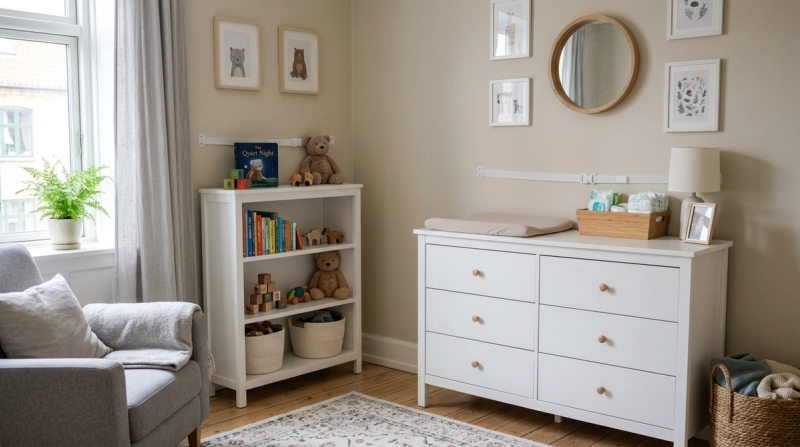
To anchor nursery furniture, secure dressers, bookshelves, changing tables, cube units, wardrobes, and nearby TVs to a strong wall support using the hardware recommended in the product manual. On drywall, that usually means fixing into studs. On brick, concrete, or masonry, you’ll need the right wall plugs, screws, and drill bits. For TVs, use TV-rated safety straps or a proper wall mount.
And if you are even a little unsure about your wall type, the hardware, or the installation, call a professional. This is one of those jobs where “probably fine” is not really good enough.
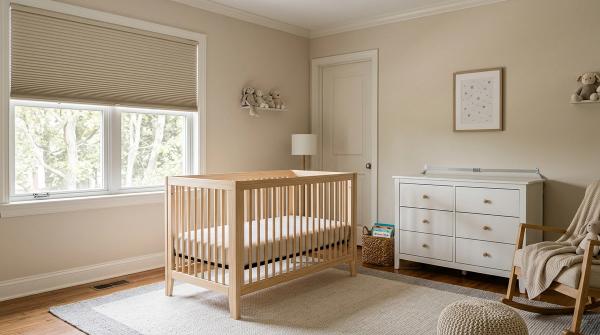
Setting up a nursery can feel like such a sweet, practical project. You choose where the crib will go, fold tiny clothes into drawers, stack nappies and wipes, and make room for blankets, books, bottles, toys, and all the baby things that somehow take over the house.
Then one day your baby rolls.
Then they pull up.
Then they open a drawer with the confidence of someone who has been managing household storage for years.
That is usually the moment furniture safety starts to feel less like a checklist item and more like real life.
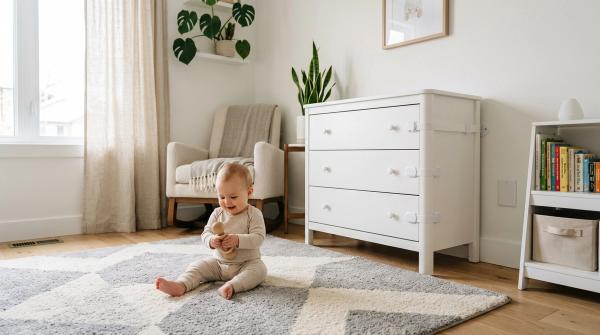
Furniture tip-overs can happen when a child pulls on a drawer, climbs a shelf, grabs a TV stand, or reaches for something tempting on top of a dresser. The good news is that a lot of this risk can be reduced with one very practical step: anchor the furniture before your baby starts climbing, not after.
This guide walks through why furniture anchors matter, which nursery items need attention, and how to think through the job safely without replacing your product manual or professional advice.
Why Anchoring Nursery Furniture Matters
#A dresser can look perfectly sturdy when all the drawers are closed. But open one or two drawers and the weight shifts forward. Add a curious baby pulling, leaning, or trying to climb, and that same dresser can become unstable much faster than you might expect.
The same is true for bookshelves, cube organizers, changing tables with storage, tall wardrobes, and TVs sitting on furniture. Babies and toddlers do not understand weight, balance, or danger. They just see handles, baskets, shelves, cords, and screens as interesting things to grab.
That is why dresser tip-over prevention is not only about buying a heavy dresser or a good-quality piece of furniture. It is about securing it properly to the wall.
A quick note on CPSC Anchor It and the STURDY Act
#The U.S. Consumer Product Safety Commission’s Anchor It campaign encourages families to anchor TVs and furniture, including dressers and bookcases, securely to the wall.
The CPSC also adopted a final consumer product safety standard to help reduce tip-overs involving dressers and other clothing storage units. The announcement was released on April 19, 2023, and the final rule’s effective date was updated to September 1, 2023. The STURDY Act is connected to stronger safety requirements for clothing storage furniture.
These rules are important because they help improve product safety. But they do not replace safe setup at home. If your furniture comes with anti-tip hardware, it still needs to be installed correctly.
What Nursery Furniture Should You Anchor?
#A simple rule: if it is tall, has drawers, has shelves, is top-heavy, holds a TV, or looks climbable to a toddler, it should be checked.
Before You Start: Please Read This First
#Anchoring furniture sounds simple, and often it is. But the right method depends on three things:
- The furniture design
- The wall type
- The anchor hardware
Start with the furniture manual. Then check what kind of wall you have. If you rent, check your landlord’s rules before drilling, while still keeping safety as the priority.
If you cannot identify the wall material, cannot find a secure fixing point, or are not sure whether the hardware is suitable, call a professional installer, carpenter, handyman, or childproofing specialist.
It may feel like “just a couple of screws,” but those screws need to hold when it matters.
Step-by-Step Anchoring Workflow
#Use this as a practical overview. Your furniture manual and wall-specific instructions should always come first.
Step 1: Walk through the room and make a list
#Start in the nursery, but do not stop there. Babies spend time in parents’ bedrooms, living rooms, grandparents’ homes, and shared family spaces too.
Check for:
- Dressers
- Changing tables
- Bookshelves
- Tall wardrobes
- Cube organizers
- Toy storage units
- TV stands
- TVs placed on dressers or consoles
- Storage cabinets in the baby’s play area
If your baby can reach it, pull it, climb it, or bump it, include it.
Step 2: Remove tempting things from the top
#Before you pick up the drill, make the furniture less interesting to climb.
Move these off high surfaces:
- Toys
- Remotes
- Snacks
- Favourite books
- Night lights with visible cords
- Phones or tablets
- Decorative objects
- Small baskets or boxes
Anchoring matters, but it works best alongside common-sense placement. Keep the things your child wants low, safe, and easy to reach.
Step 3: Choose the right anchor type
#Most nursery furniture can be secured with one of these:
- Furniture safety straps, often nylon or metal-reinforced
- Metal brackets, such as L-brackets
- Cable-style anchors
- TV safety straps or TV wall mounts, for televisions
Use the hardware supplied by the manufacturer if the manual tells you to. If you need a different kit, choose one made for that furniture type and your wall type.
Do not improvise with string, tape, thin wire, adhesive hooks, or random screws from a drawer. Something can feel strong in your hand and still be completely wrong for tip-over prevention.
Step 4: Identify your wall type
#Your wall decides what kind of fixing you need.
Common wall types include:
- Drywall over wooden or metal studs
- Brick
- Concrete
- Block masonry
- Plaster over masonry or framing
In many Indian apartments and compact homes, solid brick or concrete walls are common. In other places, drywall over studs may be more common. Both can be safe, but only if you use the right fasteners.
For drywall, the strongest fixing point is usually a stud. For masonry, you generally need masonry-compatible drill bits, wall plugs, and screws. Follow the anchor kit instructions carefully.
Step 5: Put the furniture where it will actually stay
#Place the furniture exactly where you want it before marking anything.
Then mark:
- The anchor point on the back of the furniture
- The matching point on the wall
- The stud location, if using drywall
- The drilling location, if using masonry
Try to keep the furniture close to the wall so the strap or bracket does not have a long loose gap. You may need a little space for skirting boards, baseboards, or plugs, but avoid a wide gap if you can.
Step 6: Attach the anchor to a strong part of the furniture
#This step really matters.
Do not attach the anchor only to a thin back panel if the manual warns against it or if the panel feels flimsy. Many dressers and shelves have a stronger top rail, side frame, or back frame. Use the fixing point recommended by the furniture maker.
If you cannot find a solid fixing point, pause and ask the manufacturer or a professional. It is better to take a little longer than to attach an anchor to a part that could tear away.
Step 7: Attach the anchor to the wall support
#Now secure the wall side.
For drywall, line up with a stud when the instructions require it. For brick, concrete, or block walls, drill the correct size hole and use the recommended plug or fastener.
Do not use drywall-only hardware in concrete or brick. Do not use masonry plugs in hollow drywall unless the product specifically says that use is allowed.
Tighten the hardware firmly, but do not overtighten so much that you crack the wall, strip the screw, or damage the furniture.
Step 8: Connect and tighten
#Connect the wall hardware to the furniture hardware. If you are using straps or cables, tighten them according to the instructions.
The goal is not to drag the furniture hard into the wall. The goal is to stop it from tipping forward if your child pulls, climbs, or opens drawers.
Some strap styles may allow a tiny bit of movement, but there should not be long slack hanging behind the furniture.
Step 9: Test it gently
#After installation, hold the top front edge of the furniture and give it a firm, controlled pull. It should feel secured to the wall and should not tip forward.
Do not yank it aggressively or climb on it to test it. If it shifts, loosens, or pulls away, stop using that piece in your baby’s space until the anchor is fixed properly.
Step 10: Check it again over time
#Anchors are not a “set it and forget it forever” job.
Recheck them:
- After moving furniture
- After deep cleaning
- After renovations
- After an earthquake or major wall vibration
- If your child has been pulling on the furniture
- Every few months during your babyproofing checks
Look for loose screws, cracked plastic pieces, slack straps, wall damage, or damage to the furniture itself.
Special Notes for Dressers and Changing Tables
#Dressers deserve extra attention because, to a toddler, drawers can look like a ladder.
For safer dresser use:
- Anchor the dresser even if it feels heavy.
- Keep heavier items in lower drawers.
- Do not leave several drawers open at once.
- Avoid putting toys, screens, or interesting objects on top.
- Use drawer stops or child-resistant drawer locks where appropriate.
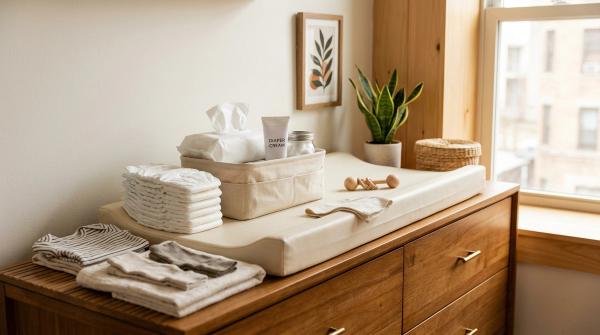
- Anchor the changing table if it has drawers, shelves, or a tall frame.
A changing table may feel safe because an adult is usually nearby during changes. But the furniture is still in the room the rest of the day. If it can be pulled, climbed, or tipped, secure it.
And yes, even the cute little dresser that seems like it “probably won’t move” should be checked. Babies are very good at proving adults wrong.
What About TVs Near the Nursery?
#TVs need their own safety plan.
If there is a TV in the nursery, bedroom, or play area, secure it. The CPSC Anchor It guidance includes TVs as well as furniture such as dressers and bookcases.
Safer options include:
- Wall mounting the TV according to the TV and mount manuals
- Using TV safety straps attached to a suitable wall support
- Securing both the TV and the furniture it sits on
- Keeping remote controls and cords out of reach
Do not assume a heavy TV stand is enough. If the TV sits on a dresser or console, both the TV and the furniture may need to be secured separately.
Rental and Small-Apartment Tips
#Renters often have an awkward problem: you need the home to be safe, but you may also have rules about drilling into walls.
Start by asking. Contact your landlord or building manager and explain that you need to install child safety anchors. Ask what types of wall fixing are allowed and whether there are rules for drilling into brick, concrete, tile, or shared walls.
A few practical tips:
- Get permission in writing when possible. A quick message is better than a hallway conversation nobody remembers later.
- Ask about the wall structure. Some buildings have hidden pipes, wires, conduits, or weak patches.
- Use the right fasteners for masonry. Many Indian apartments have brick or concrete walls, where ordinary screws may not hold safely without proper plugs.
- Do not rely on adhesive-only products for heavy furniture. They are not a substitute for properly installed anchors unless the product manual clearly says they are.
- Plan the layout before drilling. In small homes, every wall matters. Decide where the dresser, shelf, crib, and play mat will stay before making holes.
- Keep heavy storage low. Small apartments often push families to stack things upward. If you use vertical storage, anchor it.
- Avoid placing a TV on top of a nursery dresser unless both are secured correctly.
If your lease is strict, do not work around it with unsafe shortcuts. Ask for approved options or hire someone who can install cleanly and advise you about patching the holes later.
Small-Home Nursery Setup: Practical Notes for Indian Homes
#Not every baby has a separate nursery, and that is completely normal. Your baby’s space might be a corner of the parents’ bedroom, part of the living room, or a shared area with a wardrobe, dresser, and changing mat.
The safety rules are the same.
Focus first on the places your baby actually spends time:
- The dresser beside the bed
- The shelf near the play mat
- The TV console in the shared room
- The wardrobe near the changing area
- Open shelving used for nappies, wipes, toys, or books
For masonry walls, which are common in many Indian flats, make sure the correct drill bit, wall plug, and screw size are used. If the wall is crumbly, damp, tiled, or unusually thin, get help before installing anchors.
Also think about daily life, not just the tidy version of the room. A baby may pull up on furniture while you are folding laundry, taking a call, making tea, or answering the door. The safest setup is the one that still works during normal busy family moments.
Common Anchoring Mistakes to Avoid
#Try to avoid these shortcuts:
- Anchoring only to a removable top panel instead of a solid frame
- Screwing into thin backing board without checking the manual
- Using the wrong fastener for the wall type
- Anchoring the dresser but forgetting the TV sitting on top
- Leaving long slack in straps
- Using adhesive hooks or tape for heavy furniture
- Assuming low furniture cannot tip
- Forgetting furniture outside the nursery
- Moving furniture later and not reinstalling the anchors
- Ignoring loose anchors after cleaning or shifting things around
Most mistakes happen because the task seems small. Treat it a bit like installing a car seat: simple enough to do, but important enough to do carefully.
Quick Room-by-Room Safety Check
#Use this list before your baby starts crawling, pulling up, cruising, or climbing.
Nursery or baby sleep area
#- Dresser anchored
- Changing table anchored
- Bookshelf anchored
- Tall wardrobe anchored
- Toys removed from high surfaces
- Cords tucked away
- Heavy items stored low
Parents’ bedroom
#- Shared dresser anchored
- TV secured, if present
- Bedside shelves checked
- Wardrobe secured if climbable
- Laundry baskets and storage units placed safely
Living room or play area
#- TV anchored or wall-mounted correctly
- TV console secured if needed
- Bookshelves anchored
- Cube organizers anchored
- Decorative heavy items moved out of reach
Grandparents’ or caregiver’s home
#- Main storage furniture checked
- TV area checked
- Bookshelves checked
- Baby’s play corner checked
Babyproofing works best when every regular care space is included, not just the room with the crib.
Final Takeaway
#Anchoring furniture is one of the most useful babyproofing jobs you can do. It is not about panic, and it is not about creating a perfect home. It is about making normal rooms safer before your baby becomes curious, quick, and determined.
Start with the dresser. Then check shelves, changing tables, wardrobes, cube organizers, TV stands, and nearby TVs. Follow the manuals, match the hardware to your wall, respect rental rules, and call a professional when you are unsure.
A few well-placed anchors can make the nursery, and the rest of your home, much safer for everyday family life.