For most baby toys, start with the same simple routine: check the care label, remove visible dirt with soap and water, rinse when the material allows it, and let the toy dry completely before it goes back into a child's hands. The important part is knowing when that routine changes. A solid plastic cup can usually be washed in water; a wooden block or battery toy usually cannot. A toy that goes into a baby's mouth may also need sanitizing with a method the manufacturer allows.
You do not need to wash every toy after every touch. Focus on toys that are mouthed, visibly dirty, shared, used during illness, or damp after a bath. This guide gives you a practical way to sort them and choose a safe cleaning method without treating every toy like a bottle or every smudge like an emergency.
First, separate cleaning, sanitizing and disinfecting
#These words describe different jobs. Cleaning uses soap or detergent, water and rubbing to remove dirt and many germs. It comes first, even if you plan to use another product. A sanitizing or disinfecting product works less reliably through a layer of food, saliva or grime.
Sanitizing reduces germs to a level considered safe. Public-health guidance places toys that children mouth in this group. Disinfecting uses a stronger process to kill remaining germs and becomes more relevant when someone is sick or at higher risk of serious illness. That distinction matters: spraying a strong disinfectant on every toy each evening is not the default home routine, and a product suitable for a countertop is not automatically suitable for an object a baby will chew.
The care label and cleaning-product label both matter. They tell you whether a toy can be submerged, machine washed, placed in a dishwasher or treated with a particular sanitizer. If they disagree with a generic internet tip, follow the toy maker's limits and the product label. If a toy cannot be cleaned sufficiently for how it is being used, put it aside and ask the manufacturer or choose a washable alternative.
Sort the toy before you turn on the tap
#Look at the whole object, not only its main material. A plastic toy can have a speaker or a seam that traps water. A fabric rattle may contain an electronic sound unit. A wooden toy may have painted details or glued pieces. A bath toy may have a tiny hole that lets water in but makes the inside almost impossible to dry.
Put the toys into a few groups: fully washable hard toys; washable fabric toys; wipe-only wood or electronic toys; and water-trapping bath toys. Set aside anything with a damaged seam, loose part, cracked surface, exposed battery compartment or visible growth. Cleaning is not a repair for physical damage. Check age guidance as well, particularly if an older child's toys are mixed into the baby's basket.
Before you start, clear a clean drying space. Use a cloth or brush kept for this job, mild soap or detergent, clean water and a fresh towel. Keep cleaning chemicals out of children's reach. Wash your hands before handling clean toys and avoid putting a washed toy straight back into a dirty storage basket.
Solid plastic and silicone toys
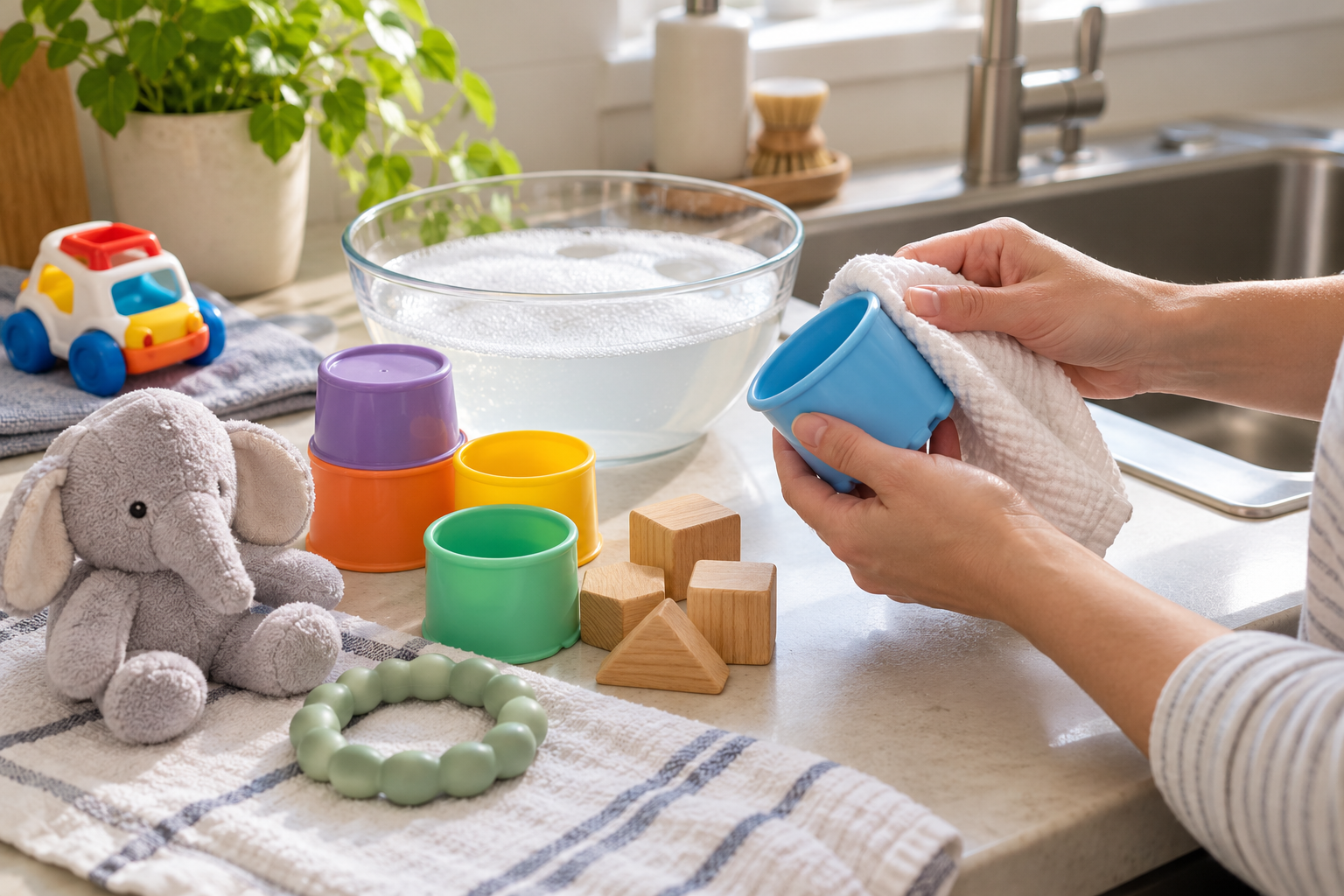
#For a simple, non-electronic plastic cup, stacking ring or one-piece silicone toy, wash all surfaces with soap and water. Rub grooves and joints where residue hides, rinse thoroughly, then place it on a clean towel to air-dry. If the item can be taken apart according to its instructions, separate the pieces so trapped water can escape. Reassemble only when every part is dry.
Do not assume all plastic or silicone tolerates heat. A dishwasher's hot cycle, boiling water or steam can distort some toys, weaken glued pieces or damage hidden components. Use a dishwasher or another heat method only when the maker says that particular toy can take it. For a mouth-contact toy that needs sanitizing, choose a compatible method described by the maker and the sanitizer label. Public-health guidance mentions a dishwasher sanitizing cycle for some nonporous items, but “some” is doing real work here.
Check the toy again after cleaning. A crack that stays sticky or a seam that still holds dirty water is a reason to stop using it while you check replacement options. The toy's surface and construction decide whether it is genuinely cleanable; its color or a marketing description does not.
Fabric, plush and crinkle toys
#Read the sewn-in label first. If a plush or cloth toy is machine washable, follow its temperature and cycle instructions, then dry it completely. A laundry bag can help keep loose pieces together, but it cannot make an unwashable toy machine safe. Pay attention to attached plastic rings, musical modules, glued eyes and stuffing that may retain moisture.
For a wipe-only fabric toy, use the maker's surface-cleaning directions and keep moisture controlled. Work on the dirty area, remove soap as instructed, and give the toy enough time and airflow to dry through the fabric before reuse. A damp outside does not tell you whether the filling is dry. If the toy smells musty, has visible growth, or repeatedly stays wet inside, replacing it may be more sensible than another surface wipe.
Shared soft toys deserve extra thought. A cloth toy that one baby has mouthed should be cleaned before another child uses it. This is especially relevant in a shared play space. If you cannot wash and dry it between users, keep it as one child's toy or choose an easier-to-clean option for sharing.
Wooden toys and painted surfaces
#Wood is a different cleaning job from solid plastic. Check the maker's instructions for the finish, paint and glued joints. For a wipe-clean wooden block, use a lightly damp cloth with a little suitable soap, remove residue as directed, and dry it promptly. Do not leave it soaking in a basin or put it through a dishwasher just because a similar-sized plastic block can go there.
Inspect the surface while it is dry. Splinters, flaking coating, a separating joint or a loose small piece call for removing the toy from play. A damp wipe does not fix those hazards. If the toy's finish or age suitability is unclear, contact the maker before trying a stronger cleaner, sanitizer or home treatment. Do not improvise a coating or oil for an object the baby mouths.
The practical tradeoff is simple: wood can be easy to wipe after ordinary play, but it is less forgiving of soaking and is harder to sanitize with methods designed for nonporous objects. If a toy will be mouthed and shared repeatedly, a washable alternative may fit that use better.
Electronic toys and battery compartments
#Keep water away from speakers, switches, ports and battery compartments. Follow the manual's wipe-clean method for the outer surface. Use a lightly damp cloth rather than immersing the toy or pouring water over it. Let the surface dry before use and check that covers and fasteners remain secure.
The inspection is as important as the wipe. If a battery compartment is damaged or can be opened by a child, remove the toy from use. Button and coin batteries are especially serious hazards when accessible. Do not try to solve a loose cover with tape and return it to a baby; use the maker's approved repair route or replace the toy. Also set aside toys with frayed wires or broken casing.
Some electronic toys have a removable fabric cover. Clean only the parts the maker says can be removed and washed. Keep the sound unit and contacts dry. If instructions have been lost, find the exact model's manual instead of applying the cleaning method for a different toy that looks similar.
Bath toys: dry the inside as well as the outside
#Bath toys are a special case because they can hold water long after the tub is empty. After each bath, empty water from any openings, rinse off bath residue as the maker directs, and leave the pieces separated in an airy place to dry. Avoid dropping wet toys into a closed bin. A one-piece design without an inaccessible hollow space is easier to inspect and dry.
For a squirting toy, ask a practical question: can you actually see, clean and dry its inside? If dark material, persistent residue or an odor appears inside a part you cannot open and clean, stop using it and replace it. Squeezing out cloudy water is evidence of a cleaning problem, not a reason to keep applying stronger chemicals to an inaccessible chamber.
Dry storage matters even when there is no visible problem. A bathroom shelf that lets water drain and air circulate is more useful than an attractive sealed tub full of damp toys. Check any suction cups, seams and joints during the same quick reset.
When should you clean again?
#A workable routine follows what happened to the toy, not an arbitrary calendar. Clean a toy when it is visibly dirty, after it has been mouthed by another child, after contact with a dirty public surface, or when bath water and residue remain. Toys that are regularly mouthed need closer attention than an untouched mobile kept out of reach. Make the routine more frequent when the same item cycles between mouths, floor and storage.
After an illness in the household, clean the toys in active use and follow current public-health advice for the illness and setting. Sanitizing or disinfecting may be appropriate, but only with a method compatible with the toy and labeled for that surface and purpose. If a child has a medical vulnerability, ask their care team for advice suited to them rather than relying on a generic schedule.
Do not turn a daycare cleaning schedule into an inflexible rule for a single-family home. Child-care settings have more shared contact and may follow local public-health rules. Their guidance is still useful for the order of operations: clean first, use a suitable sanitizer when needed, follow contact time and other label directions, and dry before storage.
A realistic clean-up of a mixed toy basket
#Imagine a basket with a silicone ring, stacking cups, a plush elephant, a wooden block, a bath duck and a musical toy. Start by checking labels and condition. If the stacking cups and silicone ring are intact and washable, clean and rinse them at the sink. If their manuals allow a sanitizing method and the ring is frequently mouthed, use that method when appropriate, then air-dry it on a clean surface.
Send the plush toy through its labeled wash cycle only if its construction allows it. Wipe the wood with a lightly damp cloth and dry it promptly. Wipe the musical toy without wetting its controls or battery area, and check the compartment cover. Empty the duck and see whether its inside can be inspected and dried; if not, consider replacing it with a toy that can be cleaned properly. Keep each item out of the basket until it is fully dry. Then wipe and dry the basket itself.
This is more useful than one “deep clean” rule. The same basin, machine cycle or spray cannot safely handle all six objects. Sorting them once also helps you decide what to buy next time: a washable design saves work when an item is likely to be mouthed or shared.
Cleaning mistakes that make the job harder
#Skipping the first wash. A disinfectant is not a shortcut through visible dirt. Remove residue first, then use a compatible sanitizing or disinfecting step if the situation calls for it.
Assuming heat is always better. Hot water, steam and dishwashers are useful only for toys approved for them. Heat can spoil a glued, painted, battery-operated or heat-sensitive item.
Mixing cleaning products. Follow one product's label and never combine cleaners unless the label specifically permits it. Keep products away from children, use ventilation when required and observe the stated contact time. Do not apply a surface disinfectant to a child's skin.
Storing toys damp. Dry the seams, hollow spaces and fabric filling, not just the visible side. Put clean toys in a clean, dry container. This is especially important for bath toys and anything with a closed compartment.
Trying to wash away a structural hazard. Loose parts, broken battery covers, splinters and cracked plastic need a safety decision. Removing dirt does not restore the toy's original condition. Check the exact product's age guidance and any relevant recall information before returning a questionable toy to play.
Keep the routine small enough to use
#Put a washable-today basket near the usual play area. Set mouthed or dirty toys there, rather than guessing later which ones need attention. At a convenient point, sort by material, clean each group as its instructions allow, and leave space for full drying. Keep a separate dry basket for toys ready to use. A caregiver taking over the routine can then see the status without relying on memory.
When buying a toy, look past the “easy clean” claim. Check whether the whole toy is washable, whether its parts come apart safely, how the inside dries, and whether the maker gives clear instructions. That one-minute check can save repeated uncertainty after the first spill or bath.
The basic rule stays simple: clean what the baby actually uses, match the method to the material, and let it dry fully. Use a compatible sanitizing or disinfecting step when the toy's use and the situation call for one. If a toy cannot be cleaned well enough or has become damaged, take it out of rotation instead of escalating to harsher treatment.