If you order tzatziki at a beachfront taverna in Greece, the waiter sets down a thick, snowy-white mound of dip that stands proudly in peaks on your spoon. It has the velvety body of clotted cream, a subtle garlicky warmth that blooms gently in your mouth without burning your throat, and a refreshing cucumber crunch that never weeps liquid onto the plate.
In contrast, most homemade tzatziki recipes produce a watery, runny puddle within fifteen minutes of sitting on the dining table. The cucumber leaches water, the yogurt separates into an unappetizing pale whey, and the garlic hits your tongue with an aggressive, acrid burn that overpowers everything else on your plate.
This failure happens because home cooks treat tzatziki like a tossed salad dressing rather than a cold dairy emulsion. A raw cucumber is ninety-six percent water. If you drop freshly grated cucumber into yogurt without removing that water first, osmotic pressure will relentlessly pull moisture into the dairy, destroying the fat structure of the yogurt.
Making authentic, restaurant-grade Greek tzatziki is remarkably simple once you understand the physics of cucumber dehydration, the required fat percentage of strained yogurt, and how to tame raw garlic by infusing it directly into extra virgin olive oil.
The Cucumber Physics: Salt Osmosis and the Towel Wring
#The single most critical step in making tzatziki happens before yogurt ever leaves the refrigerator. You must dehydrate your cucumber until it loses nearly three-quarters of its original liquid volume.
- Cucumber Selection: Use seedless English (hothouse) cucumbers or small Persian cucumbers with thin, edible skins. Traditional field cucumbers have thick, waxy, bitter skins and large watery seed cavities that make tzatziki watery and bitter.
- Peeling and Grating: Do not peel the cucumber completely. Strip away every other ribbon of skin using a vegetable peeler, leaving an alternating striped pattern of dark green skin and pale flesh. This retains vibrant green specks of color and a pleasant textural crunch in the finished white dip without introducing tough rind. Grate the cucumber on the large coarse holes of a standard box grater. Never use a fine grater or food processor, which pulps the cucumber into an un-drainable slush.
- The Salt Osmosis Treatment: Place the coarsely grated cucumber into a colander set over a large mixing bowl. Toss the cucumber with one teaspoon of fine sea salt. Salt draws out cellular water through osmosis, breaking down internal cell pressure. Let the salted cucumber sit in the colander for 20 to 30 minutes. You will see a steady stream of pale green liquid pooling in the bowl beneath.
- The Mechanical Wringing (The Non-Negotiable Step): Salting alone is not enough. Transfer the salted cucumber into the dead center of a clean, dry, lint-free kitchen towel or a multi-layered square of cheesecloth. Gather the corners of the towel together to form a tight pouch.
- Twisting with Force: Stand over your kitchen sink and twist the top of the towel tightly. Using both hands with maximum force, squeeze and wring the pouch repeatedly. Keep twisting and squeezing until not a single drop of liquid emerges.
- The Visual Check: Open the towel. The grated cucumber should not feel wet or mushy; it should look like a dense, dry, compacted green puck that crumbles apart in your fingers like dry shredded paper. If it still feels moist, wring it again.
The Yogurt Standard: Why 10% Milk Fat Matters
#You cannot make authentic Greek tzatziki with standard American-style plain yogurt, low-fat yogurt, or nonfat Greek yogurt.
Traditional Greek tzatziki depends on strained yogurt (straggisto) made from sheep's milk or whole cow's milk with a minimum fat content of 10%. Fat is not merely a source of rich flavor; it is a structural pillar of the emulsion.
- How Fat Stabilizes the Dip: High-fat yogurt contains suspended fat globules that coat your palate, creating a thick, luxurious mouthfeel that coats pita bread or grilled lamb without sliding off. More importantly, dairy fat absorbs the fat-soluble flavor compounds in raw garlic and olive oil, rounding out their harshness and distributing their aromas evenly across the sauce.
- The Problem with Low-Fat and Nonfat Yogurt: Nonfat "Greek" yogurt relies on added milk solids, gelatin, or gums to fake thickness. When mixed with salt, acid, and cucumber, these stabilizers break down quickly, releasing trapped moisture and turning your tzatziki into a runny, chalky soup within hours.
- Straining Regular Yogurt at Home: If your local supermarket does not stock authentic 10% Greek strained yogurt (such as authentic Greek imports like Fage Total 10% or Total 5%), you can make your own. Buy high-quality plain whole-milk yogurt. Line a fine mesh strainer with a coffee filter or paper towel, set it over a deep bowl, dump in the yogurt, and refrigerate for 8 hours. The yellow whey will drain out completely, leaving behind an ultra-dense, spreadable yogurt curd that rivals authentic Greek taverna standards.
The Garlic Taming Technique: Olive Oil Infusion
#The second most common flaw in home-cooked tzatziki is harsh, burning, bitter garlic. In an authentic Greek taverna, tzatziki has a pronounced garlic presence, but it tastes mellow, warm, and integrated—not like eating a raw clove.
Garlic contains two chemical compounds that are held in separate cellular compartments: alliin and an enzyme called alliinase. When you crush, mince, or grate garlic, the cell walls break, allowing the enzyme to convert alliin into allicin—the volatile chemical responsible for garlic's intense, pungent heat.
- The Microplane Grater: Never mince garlic with a chef's knife for tzatziki. Large chunks of raw garlic create harsh, bitter landmines when bitten into. Grate two to three medium fresh garlic cloves into a smooth, wet paste using a microplane rasp grater.
- The Olive Oil Taming Step: Immediately transfer the grated garlic paste into a small ceramic bowl and submerge it in two tablespoons of premium Greek extra virgin olive oil.
- Why Oil Tames Pungency: Olive oil coats the garlic particles, limiting atmospheric oxygen contact and slowing down the enzymatic conversion that produces aggressive allicin heat. Furthermore, allicin dissolves readily into fat. Letting the garlic sit in the olive oil for 10 to 15 minutes before combining with the yogurt infuses the oil with warm, aromatic garlic flavor while softening its harsh, throat-burning bite.
The Acid Debate: Red Wine Vinegar vs Lemon Juice
#Outside Greece, nearly every cookbook recipe calls for fresh lemon juice as the primary acid in tzatziki. In traditional Greek kitchens, however, the overwhelming acid of choice is red wine vinegar.
- Why Red Wine Vinegar Wins: High-quality Greek red wine vinegar possesses a complex, rounded, fruity acidity that balances the richness of 10% dairy fat without making the yogurt taste curdled or sour. Lemon juice contains citric acid, which can interact aggressively with milk proteins, causing delicate yogurt emulsions to loosen over time.
- When Lemon Is Used: Some Greek island regions, particularly the Cyclades, use a few drops of fresh lemon juice alongside vinegar for bright surface aroma. If you enjoy a touch of citrus brightness, use a ratio of two teaspoons of red wine vinegar to half a teaspoon of fresh lemon juice. Never use bottled lemon juice concentrate, which has an artificial metallic aftertaste.
Fresh Herbs: Dill, Mint, and Regional Traditions
#The debate between fresh dill and fresh spearmint in tzatziki is deeply rooted in regional Greek geography:
- The Mainland and Taverna Standard (Fresh Dill): Across Athens, Thessaloniki, and northern mainland Greece, finely minced fresh dill (anitho) is the dominant herb. Dill provides a grassy, anise-tinted freshness that cuts through rich roasted meats like pork gyros, lamb souvlaki, and beef biftekia.
- The Island Tradition (Fresh Spearmint): On islands like Crete, Rhodes, and Cyprus, cooks often add fresh spearmint (dyosmos) or a pinch of crushed dried wild mint. Mint gives tzatziki an intensely cooling, palate-cleansing finish that is particularly refreshing during scorching Mediterranean summers.
- The Execution: Whichever herb you choose, use only the tender leaves and discard woody stems. Mince the leaves finely with a very sharp chef's knife immediately before adding to the dip. Dull knife blades bruise delicate herb cell walls, turning fresh dill dark black and bitter instead of bright emerald green.
| Ingredient | Taverna Measurement | Function / Chemistry | Common Amateur Mistake |
|---|---|---|---|
| English Cucumber | 1 large (approx 350g) | Provides crisp refreshing texture | Using thick-skinned field cucumbers with watery seeds |
| Fine Sea Salt | 1 tsp (for cucumber osmosis) | Pulls out internal cell water | Salting yogurt instead of cucumber creates weeping liquid |
| 10% Strained Greek Yogurt | 500g (approx 2 cups) | Dense fat-emulsion foundation | Using 0% nonfat yogurt with gums and watery stabilizers |
| Fresh Garlic Cloves | 2-3 medium cloves | Aromatic backbone and savory depth | Dicing with knife creates bitter, spicy chunks |
| Greek Extra Virgin Olive Oil | 3 tablespoons (45ml) | Tames allicin and adds glossy sheen | Using neutral canola or vegetable oil lacking polyphenol flavor |
| Red Wine Vinegar | 1.5 - 2 tablespoons (25ml) | Balanced fruity acid without curdling | Dumping excess lemon juice that breaks dairy proteins |
| Fresh Dill Leaves | 2 tablespoons (finely minced) | Grassy herbal contrast to rich fat | Bruising herbs with dull blades turns them black |
Assembly Mechanics: Folding Rather than Whisking
#Once your components are prepped, assembling authentic tzatziki takes less than two minutes:
- Place your thick strained Greek yogurt into a wide mixing bowl.
- Pour in the garlic-infused extra virgin olive oil, red wine vinegar, and a half teaspoon of fine sea salt.
- Using a flexible rubber spatula or wooden spoon, gently fold the liquids into the yogurt until fully incorporated into a smooth, glossy base.
- Do not use a wire whisk or electric mixer. Whisking whips microscopic air bubbles into the yogurt, converting dense, luxurious dip into a foamy, airy cream that loses its substantial taverna mouthfeel.
- Add your bone-dry wrung cucumber shreds and finely minced fresh dill.
- Fold gently until the green cucumber threads and dill flecks are evenly distributed throughout the white yogurt.
- Taste a spoonful. The dip should taste cool, velvety, mildly acidic, and savory, with garlic humming in the background rather than dominating the forefront. Adjust seasoning with an extra pinch of sea salt or a few drops of red wine vinegar if needed.
The Overnight Maturation: Why Patience Creates Magic
#While you can technically eat tzatziki immediately after mixing, fresh tzatziki tastes unfinished. The raw garlic tastes slightly detached from the dairy, the cucumber has not yet absorbed the vinegar, and the olive oil sits on the surface of your palate.
Cover the mixing bowl tightly with plastic wrap, pressing the film directly onto the surface of the dip to prevent skin formation, and refrigerate for at least four to six hours—ideally overnight.
During this resting phase, two remarkable biochemical changes take place:
- The allicin in the garlic continues to soften and disperse throughout the milk fats, transforming from a sharp, pungent bite into a mellow, savory warmth that permeates every spoonful.
- The moisture between the cucumber cell walls and yogurt curds reaches complete osmotic equilibrium, solidifying the emulsion so it holds its shape permanently without weeping.
When you remove the bowl the next day, you will find a dip that is noticeably thicker, firmer, and far more harmonious than when you mixed it.
Traditional Taverna Plating and Serving Traditions
#Authentic Greek tzatziki is meant to be eaten as part of a shared meze spread, served family-style in the center of the table alongside warm grilled pita bread, roasted vegetables, and skewers of sizzling souvlaki.
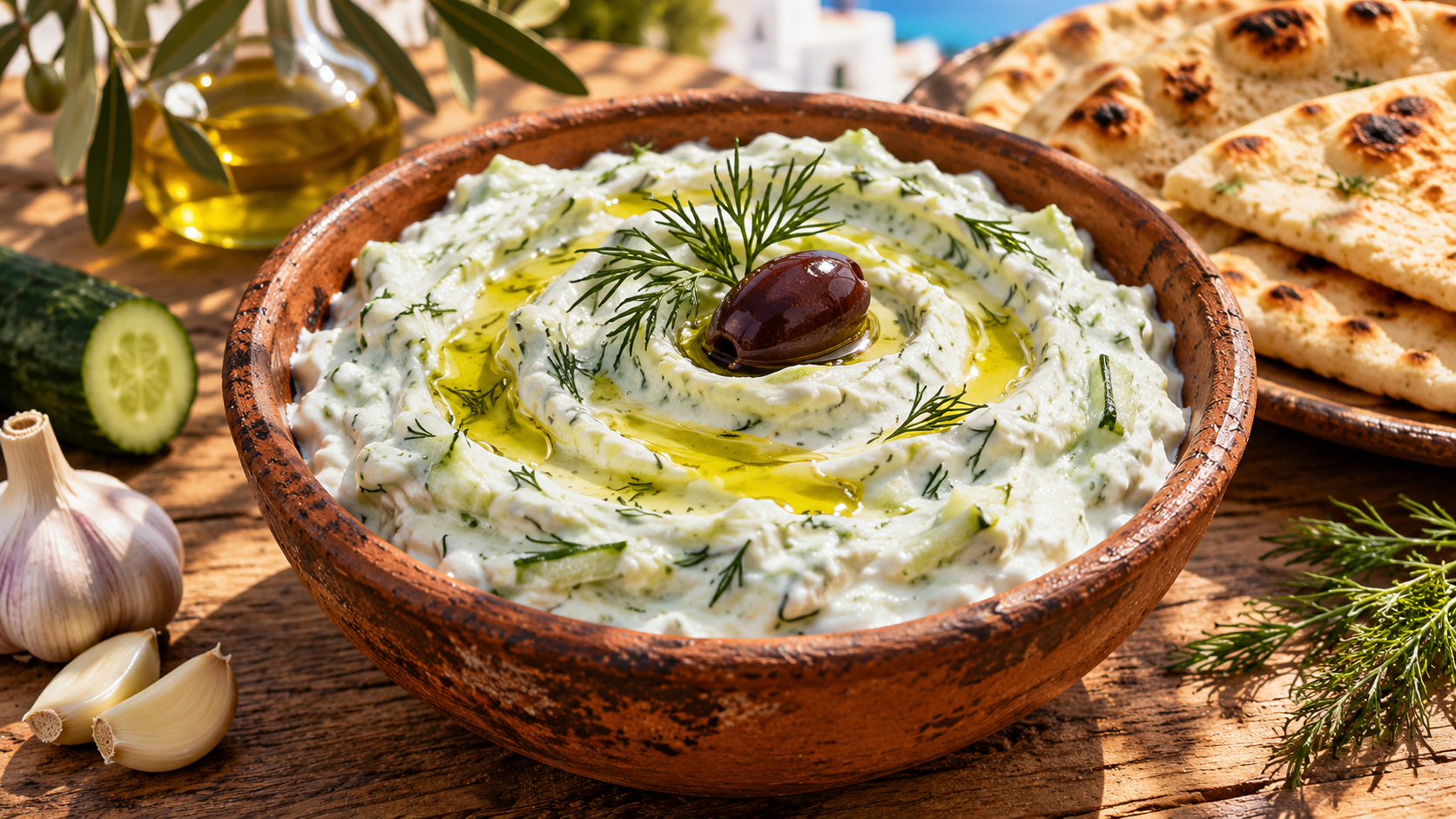
- The Shallow Earthenware Bowl: Spoon the chilled tzatziki into a shallow, rustic earthenware or ceramic bowl.
- The Back-of-the-Spoon Swirl: Use the back of a large metal soup spoon to spread the tzatziki outward toward the rim, creating a decorative circular swirl or well in the dead center of the mound.
- The Olive Oil Moat: Pour a generous tablespoon of top-tier Greek extra virgin olive oil directly into the central swirl, allowing it to pool in the hollow like a golden moat.
- The Garnishes: Place a single plump Kalamata olive in the center of the oil well, and garnish the snowy white crests with a small sprig of fresh dill or a light dusting of sweet paprika.
- Serving Temperature: Pull the bowl from the refrigerator fifteen minutes before serving. True Greek tzatziki should be cool and refreshing, but not ice-cold; slight warming allows the fruity polyphenols of the olive oil and the aromatics of the dill to bloom fully on the palate.
Troubleshooting Common Tzatziki Issues
#- The Dip Separated and Pooled Water at the Bottom: You did not squeeze the cucumber enough, or you used low-fat yogurt. To fix an already watery dip, spoon the tzatziki into a cheesecloth-lined sieve set over a bowl in the refrigerator for two hours to drain the excess liquid, then fold in an extra tablespoon of cold 10% Greek yogurt and a drizzle of olive oil.
- The Garlic Taste Is Blisteringly Hot and Overpowering: If your garlic was too aggressive, fold in another half cup of plain 10% Greek yogurt and a splash of olive oil to dilute the allicin concentration. Next time, let the microplaned garlic steep in the olive oil for twenty minutes before mixing.
- The Tzatziki Tastes Bland and Flat: This almost always means insufficient salt or acid. Dairy fats heavily mute seasonings. Stir in another quarter teaspoon of fine sea salt and half a teaspoon of red wine vinegar; you will instantly taste all the flavors snap into vibrant focus.
- The Herbs Turned Dark and Slushy: You chopped the dill with a dull blade or washed it without drying it thoroughly. Always spin herbs bone-dry in a salad spinner and mince them with a razor-sharp knife immediately before folding.
When prepared with proper moisture control and respect for authentic ingredients, homemade Greek tzatziki is a revelation. It proves that simple pantry staples—cucumbers, garlic, olive oil, and yogurt—can produce one of the world's greatest culinary masterpieces.