Ajinomoto is a brand name for MSG (monosodium glutamate), a seasoning made by fermenting plant starches and sugars. Food regulators in the US, the EU and India allow it, and for most people the normal amounts used in food are considered safe.
That does not mean you should shake it on everything. MSG still adds sodium, some people report mild short-term symptoms after large amounts, and Indian packs that contain added MSG must carry a warning for infants and pregnant women. Below is what it actually is, what the evidence says, and how to decide for your own kitchen.
Ajinomoto, MSG and glutamate: what the words mean
#In India, many people say "Ajinomoto" for the white crystals used in fried rice, noodles and Manchurian. Ajinomoto is actually the company and its brand. The ingredient inside is monosodium glutamate, or MSG.
MSG is the sodium salt of glutamic acid. Glutamic acid is an amino acid, one of the building blocks of protein. When it is free (not locked inside a protein), your tongue reads it as a savoury, brothy taste called umami.
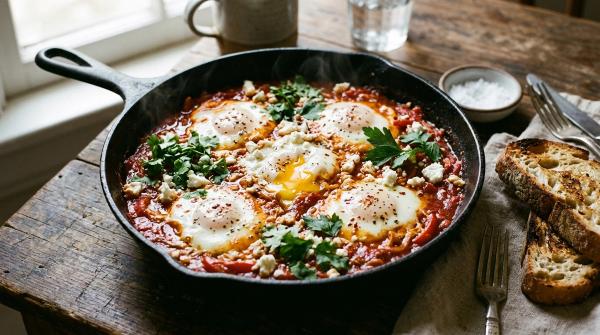
You already eat free glutamate without adding any powder. The US Food and Drug Administration (FDA) points out that tomatoes and cheeses naturally contain it. So do ingredients like yeast extract and hydrolysed vegetable protein. The FDA also notes that the free glutamate your body releases when it digests protein is chemically the same as the glutamate in MSG.
The story starts in Japan. In 1908, chemist Kikunae Ikeda worked out that glutamate was what gave kombu (kelp) broth its distinct taste, and he named that taste umami. The seasoning based on his work went on sale in 1909. That product is where the brand name Ajinomoto comes from.
So when an Indian recipe says "a pinch of Ajinomoto", it means a pinch of MSG. Other brands sell the same ingredient.
How MSG is made today
#MSG is not extracted from seaweed anymore. Today it is made by fermentation, in a process the FDA compares to making yogurt, vinegar or wine.
Here is the simple version:
- Start with a plant-based carbohydrate. The FDA lists starch, sugar beets, sugar cane and molasses. Ajinomoto says its Malaysian product starts from tapioca or sugar cane.
- Let microbes do the work. During fermentation, microbes turn those sugars into glutamic acid, the same basic idea as cultures turning milk into yogurt.
- Neutralise and crystallise. Ajinomoto describes a neutralisation and crystallisation step that turns the result into pure white crystals that dissolve easily in food.
The process matters for two reasons. First, it explains why regulators treat MSG as a single, well-defined substance rather than a mystery chemical. Second, it is the key to the veg and vegan question below, because what goes into the fermentation tank decides whether the product suits your diet.
Is Ajinomoto veg, non-veg or vegan?
#The short answer is that MSG made the usual way is plant-based. The raw materials are starches and sugars, and the work is done by microbes.
Ajinomoto states that its Malaysian AJI-NO-MOTO contains no animal-based ingredients and calls it vegetarian-friendly. It also says that product is halal certified by JAKIM, Malaysia's Islamic development department.
There is one real episode worth knowing, because it shows why "made from sugar cane" is not the whole answer. In late 2000 and early 2001, Ajinomoto's Indonesian unit withdrew its MSG products and ran apology advertisements. During an audit, Indonesia's Islamic scholars council had found that a pork-derived enzyme was used in the production process. The issue was not the main raw material. It was something used along the way.
For a strict vegetarian or vegan, that is the practical point. A product can start from tapioca and still use something you would not choose somewhere in the process. The way to know is the symbol on the pack and the manufacturer's own statement.
What to check on an Indian pack:
- The green or brown symbol. Under FSSAI's labelling rules, a pack must carry the brown triangle if it contains ingredients, food additives or processing aids of animal origin, and the green circle if they are of plant origin. Check the actual pack you buy, not a photo online.
- The country and the manufacturer. Statements about one country's product do not automatically cover another country's product.
- "Vegan" or halal certification, if that matters to you. These are separate from the green dot. Look for the certification on the pack, or ask the company directly.
If you avoid fermented foods for religious reasons, note that MSG is a fermentation product. Whether that matters is your call, not a food safety question. For other seasonings that may hide animal ingredients, our guide on mushroom seasoning walks through the same kind of label checks.
Is MSG safe? What regulators actually say
#This is the main question, so here is each regulator's position, with its conditions.
| Regulator | What it says | Conditions to know |
|---|---|---|
| US FDA | Added MSG is "generally recognized as safe" (GRAS) | Must be listed as "monosodium glutamate" on US ingredient lists |
| JECFA (joint FAO/WHO expert committee) | 1987 evaluation gave glutamates a group ADI "not specified" | Covers glutamic acid and its salts together; MSG is INS 621, a flavour enhancer |
| EFSA (European Union) | 2017 re-evaluation set a group ADI of 30 mg per kg body weight per day, as glutamic acid | Applies to glutamate additives E620 to E625; EFSA said some groups may go over it |
| FSSAI (India) | MSG (INS 621) may be added to specified foods at good manufacturing practice levels | Must be declared on the label with a warning for infants and pregnant women |
ADI means acceptable daily intake. It is the amount experts think you can eat every day over a lifetime without appreciable risk. It is a safety margin, not a line where harm starts.
"Not specified" sounds vague, but it means the committee did not set a numerical limit.
So JECFA and EFSA do not fully agree. JECFA saw no reason for a number. EFSA, looking again in 2017, chose to set one.
What EFSA's 30 mg/kg number means in practice
#EFSA based its number on an animal study where no harmful effect was seen at 3,200 mg of MSG per kg of body weight per day. It then divided by 100 as a standard safety margin.
Here is a worked example, using rounded numbers:
- A 60 kg adult times 30 mg per kg equals 1,800 mg of glutamic acid a day.
- Because MSG is heavier than plain glutamic acid (it carries sodium and water), that is roughly 2.3 g of MSG.
- That would be spread across the whole day's food, not one dish.
This is an example for understanding the scale, not a personal limit. Your body weight changes the number, and the ADI is built with a big margin.
The more useful part of EFSA's opinion is who it worried about. EFSA estimated that intake from additives could go above its ADI for some groups, including children, mainly through processed foods. It asked the European Commission to review maximum levels in foods like soups and broths, sauces, seasonings and condiments, and fine bakery wares.
In plain terms: the concern is less about the pinch you add at home and more about a diet full of packaged soups, instant noodles, snack seasonings and sauces, all adding up.
What a normal serving looks like
#The FDA says a typical serving of food with added MSG contains less than 0.5 g. That is far below the amounts used in the studies people quote when they say MSG is harmful.
Some of those scary studies also injected MSG under the skin of mice at very high doses. That is not how you eat food, so those results do not transfer well to a plate of fried rice.
The "Chinese restaurant syndrome" story
#A lot of MSG fear comes from one letter.
In 1968, a doctor named Robert Ho Man Kwok wrote to the New England Journal of Medicine about feeling numbness, weakness and palpitations after eating at Chinese restaurants. He listed several possible causes, including cooking wine, salt and MSG. The journal printed his letter under the title "Chinese-restaurant syndrome".
After that, many anecdotes followed. Early studies were often unblinded. People who already believed MSG made them sick were given MSG and asked how they felt. That setup tends to find what it is looking for.
The label also stuck to Chinese food in particular, even though tomatoes, mushrooms and parmesan carry natural glutamate too. Nobody named a syndrome after those.
What controlled studies found
#The better way to test this is a double-blind, placebo-controlled study. Neither the participant nor the researcher knows who got MSG and who got a dummy.
The largest of these, published in 2000 by Geha and colleagues, recruited 130 people who said they reacted to MSG. They were given 5 g of MSG, without food, on one day and a placebo on another. That is about ten times the typical serving the FDA describes.
What they found:
- 38.5% reported symptoms after MSG only.
- 13.1% reported symptoms after the placebo only.
- 14.6% reported symptoms after both.
- When the "MSG-only" responders were tested again, only about half reacted the same way.
- No persistent or serious effects were seen.
- When MSG was given with food, the responses were not observed.
The authors concluded that large doses of MSG taken without food may cause more symptoms than placebo in people who believe they are sensitive. But the reactions were inconsistent and not reproducible.
A review commissioned by the FDA in the 1990s, by the Federation of American Societies for Experimental Biology (FASEB), landed in a similar place. It described short-term, generally mild symptoms such as headache, numbness, flushing, tingling, palpitations and drowsiness in some sensitive people who took 3 g or more of MSG without food.
So the fair summary is this: a few people may feel something after a big dose on an empty stomach. Normal amounts in a meal have not been shown to cause a consistent reaction.
Who may want to limit MSG
#Safe for most people is not the same as right for everyone. These are the groups where cutting back makes sense. None of this replaces advice from your own doctor.
People who notice symptoms. If you feel unwell every time you eat a certain dish, you do not need a study to tell you to skip it. Keep a simple note of what you ate and how you felt. Remember that a heavy restaurant meal also brings lots of salt, oil and sometimes alcohol, so MSG may not be the cause. If symptoms are frequent or strong, talk to a doctor rather than guessing.
People on a sodium-restricted diet. MSG contains sodium. If a doctor has asked you to limit sodium, for example for blood pressure or kidney reasons, MSG counts toward that total. More on the numbers in the next section.
Infants and pregnancy, as the Indian label says. FSSAI requires packs with added MSG to say the product is not recommended for infants below 12 months and pregnant women. Follow the label. If you are pregnant and unsure about a specific food, ask your doctor.
Families eating a lot of packaged food. EFSA's concern was mostly about high intake from processed foods in children and other high consumers. Instant noodles, snack masalas, packet soups and ready sauces can all carry flavour enhancers. Cutting back on those helps for many reasons, not only MSG.
MSG vs salt: the sodium comparison
#MSG has sodium, but less than table salt, gram for gram.
- MSG is about 12% sodium by weight.
- Table salt is about 39% sodium by weight.
Here is what that means in a worked example:
| Amount | Approximate sodium |
|---|---|
| 1 g MSG | about 120 mg |
| 1 g table salt | about 390 mg |
| WHO adult limit | under 2,000 mg a day (under 5 g salt) |
So a pinch of MSG is not salt-free. But if you use a little MSG and reduce salt in the same dish, the total sodium can come down while the dish still tastes savoury.
The catch is that many restaurant-style Indo-Chinese dishes do not use MSG instead of salt. They use MSG plus salt plus soy sauce plus other sauces. In that case MSG adds to the sodium. If sodium is your worry, the salt and salty sauces usually matter more than a pinch of white crystals, because salt carries about three times as much sodium per gram.
How to spot MSG on Indian food labels
#Under FSSAI's Labelling and Display Regulations, additives on the ingredient list are shown by their function along with their name or INS number. INS stands for International Numbering System. MSG's number is 621.
So on an Indian pack, look for any of these:
- "Flavour enhancer (621)" or "Flavour enhancer (INS 621)"
- "Monosodium glutamate" written out
- A warning saying the package contains added monosodium glutamate and is not recommended for infants below 12 months and pregnant women
You may also see other numbers listed as flavour enhancers, such as 627 or 631. Those are not MSG. But if your goal is to avoid added flavour enhancers in general, read every number listed under that heading, not only 621.
If you travel, the same additive appears as E621 on European packs. Our guide to vegetarian food labels abroad covers how to read ingredient lists in other countries.
What "No added MSG" really means
#This label is more confusing than it looks.
"No added MSG" means the maker did not add MSG as an ingredient. It does not mean the food has no glutamate. Tomato, cheese, yeast extract and hydrolysed vegetable protein all bring free glutamate.
FSSAI addressed this in an order dated 31 March 2016, after the instant noodle controversy of 2015. It said:
- Glutamate is naturally present in common foods such as milk, spices, wheat and vegetables.
- There is no lab test that can tell whether glutamate in a finished product was added as MSG or was there naturally.
- Action against a manufacturer may be taken when the label says "No MSG" or "No added MSG" and MSG is actually found, or when inspection shows MSG was added without being declared.
The US is stricter on wording. The FDA does not allow "No MSG" or "No added MSG" on foods that contain ingredients like yeast extract or hydrolysed vegetable protein, because those carry free glutamate.
The practical takeaway: if you react to MSG, read the full ingredient list, not just the front-of-pack claim. If you do not react, "No added MSG" on its own does not make a snack healthier. Check the sodium and the rest of the ingredients.
FSSAI updates its rules from time to time. The label wording above comes from the consolidated version of the regulations published in September 2025. Before relying on it for a business or compliance decision, check the current text on FSSAI's own website.
How home cooks actually use Ajinomoto
#If you decide to use it, a little goes a long way. Ajinomoto itself describes MSG as self-limiting, meaning that adding too much makes food taste worse, not better.
Some simple ways to use it well:
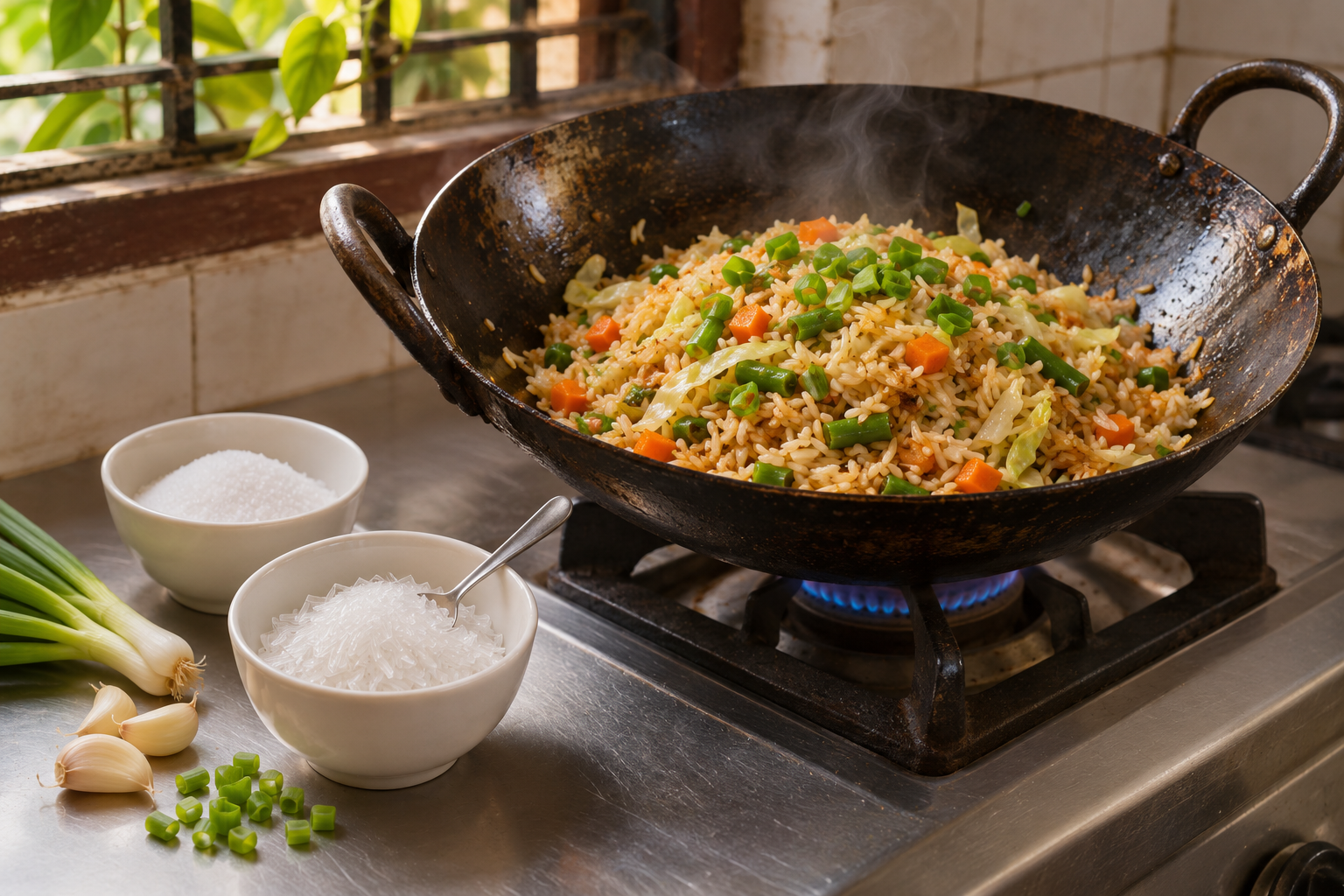
- Start with a pinch. For a family-size pan of fried rice or noodles, a small pinch is usually enough. Taste before adding more.
- Add it with the salt, then reduce the salt. Since MSG adds savoury depth and some sodium, cut back your usual salt a little and taste again.
- Use it in savoury dishes only. It works in fried rice, hakka noodles, Manchurian gravy, clear soups, stir-fried vegetables and some dry snack masalas. It does nothing useful in sweets.
- Dissolve it. It dissolves easily in hot liquid or in the sauce stage of a stir-fry. Sprinkling dry crystals on top at the end can give uneven pockets of flavour.
- Do not use it to fix weak cooking. If a dish is bland because the vegetables are boiled soft or the garlic was not cooked properly, MSG will not save it. Fix the technique first.
Getting umami without MSG
#You can skip MSG completely and still get a savoury taste. These foods naturally carry glutamate:
- Ripe tomatoes or a bit of cooked-down tomato
- Mushrooms
- Aged cheese like parmesan
- Kombu (kelp) in a soup stock, the same ingredient Ikeda started with
For Indo-Chinese food at home, good garlic, ginger, spring onion, a hot pan and a splash of soy sauce do most of the work. Many home cooks never add MSG and the food still tastes right.
A quick way to decide
#| Your situation | What to do |
|---|---|
| Healthy adult, no symptoms | A pinch in home cooking is fine; do not overuse |
| You feel unwell after MSG-heavy meals | Skip it, note other triggers too, and see a doctor if symptoms continue |
| Doctor has told you to limit sodium | Count MSG sodium, and watch salt and soy sauce first |
| Cooking for a baby under 12 months | Do not add it; follow the FSSAI label warning |
| Pregnant | Follow the label warning and ask your doctor about specific foods |
| Strict vegetarian, vegan or halal | Check the green symbol and certification on the actual pack you buy |
| Trying to avoid flavour enhancers | Read every number under "flavour enhancer", not just "No added MSG" on the front |
Ajinomoto is not poison and it is not magic. It is a fermented seasoning that regulators allow, that most people handle fine, and that still counts toward your sodium. Use it in small amounts if you like what it does, skip it if you do not, and read the back of the pack instead of the front.