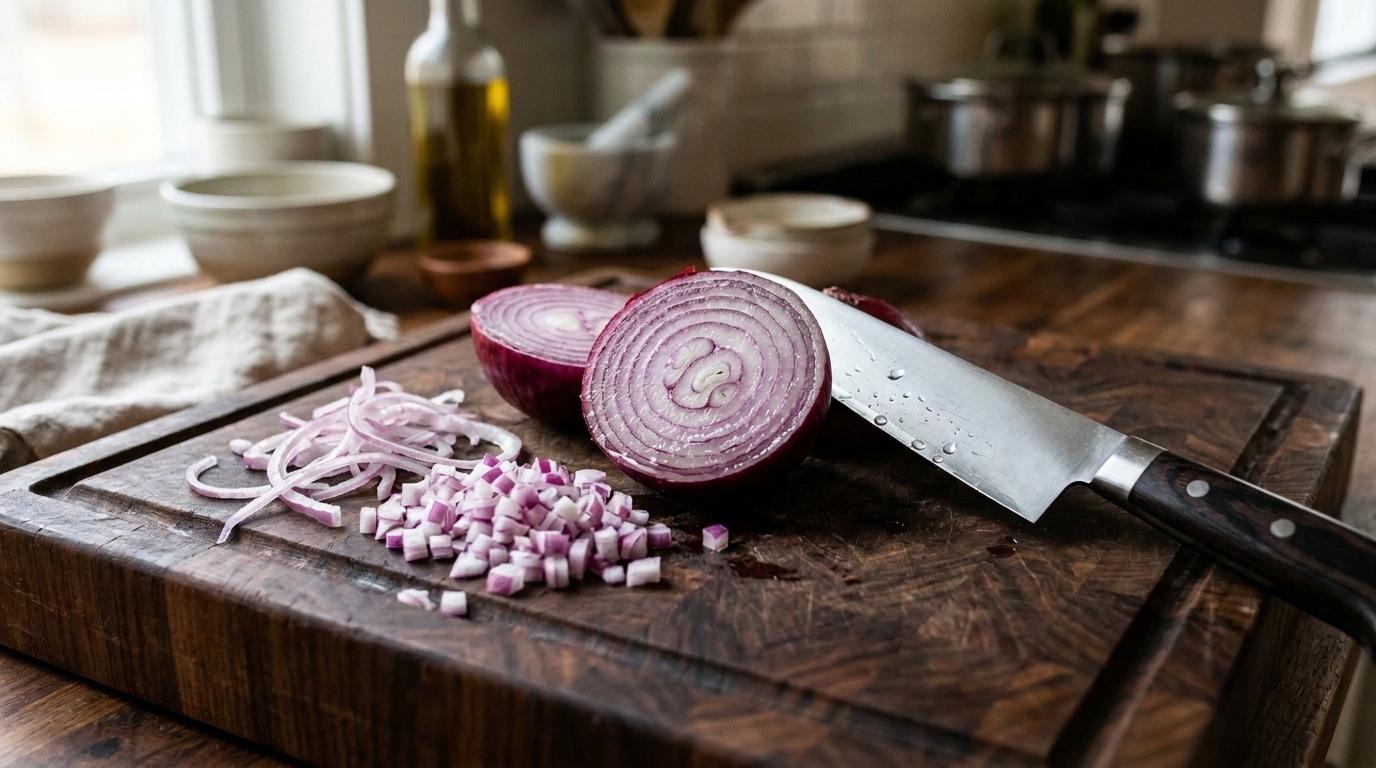
It is one of the most universal rites of passage in home cooking. You place a firm, golden onion on your cutting board, slice it in half, and begin dicing. Within thirty seconds, a prickly warmth creeps across your eyelids. Seconds later, a sharp stinging sensation overwhelms your vision. Tears stream down your cheeks, your nose begins to run, and you are forced to step away from the cutting board, wiping your eyes with your sleeve while blindly searching for a kitchen towel.
For generations, cooks have traded folklore to combat this culinary torment. People chew mint gum, hold crusts of dry bread between their teeth, light scented candles near the prep station, whistle while chopping, or run water from the kitchen tap. Almost all of these beloved home remedies are completely useless.
The stinging sensation is not a design flaw of the onion; it is a sophisticated biochemical booby trap developed over millions of years of plant evolution. The weeping response is driven by a volatile sulfur gas called syn-propanethial-S-oxide, known among organic chemists as the lachrymatory factor. Understanding how this compound is synthesized at the cellular level reveals why dull knives amplify the agony, how thermodynamic chilling neutralizes the gas, and how professional chefs prep dozens of onions daily without shedding a single tear.
The Kitchen Tearjerker: The Evolutionary Defense System of Alliums
#To understand why onions make you weep, you must consider the biological objective of the plant. An onion bulb (Allium cepa) is not a root; it is a modified underground biennial storage shoot composed of fleshy, concentric leaf bases packed with water, starches, and sulfur-rich nutrients. In natural ecosystems, these nutrient-dense subterranean bulbs represent an irresistible feast for burrowing rodents, soil nematodes, wild boars, and hungry herbivores.
Because an onion cannot run away, grow sharp thorns, or hide from burrowing pests, it evolved chemical warfare. Wild alliums absorb inorganic sulfates directly from the surrounding soil through their root systems. Inside the growing plant, sulfur atoms are synthesized into amino acids and stored as specialized organosulfur compounds known as S-alk(en)yl-L-cysteine sulfoxides.
In an intact, undamaged onion, these chemical compounds are entirely benign. You can hold a whole onion directly against your nose and breathe deeply; it will not smell pungent, nor will it sting your eyes. The onion stores the defensive ammunition in one cellular compartment and the molecular detonator in another. Only when an herbivore's teeth—or a cook's kitchen knife—crushes the plant tissue do the two components mix, unleashing an instantaneous chemical cloud designed to burn the mucous membranes of any animal bold enough to take a bite.
The Cellular Crash: How Knife Cuts Trigger the Enzymatic Chain Reaction
#The secret to the onion's chemical weapon lies in strict intracellular compartmentation. Inside every microscopic onion cell, biological membranes keep potentially volatile reactive chemicals safely segregated from the enzymes that activate them.
The primary chemical precursor is 1-propenyl-L-cysteine sulfoxide (abbreviated by biochemists as PRENCSO). This precursor resides inside the fluid cytoplasm of the plant cell. In contrast, the activating catalyst is an enzyme called alliinase, which is safely locked away inside the cell's membrane-bound vacuoles.
As long as the cell wall and vacuolar membranes remain intact, alliinase and PRENCSO never meet. But the instant a steel blade slices into the onion, thousands of plant cell walls are mechanically sheared open. Vacuoles rupture, spilling alliinase directly into the cytoplasm. What follows is one of the fastest, most potent cascades in plant enzymology.
In less than thirty seconds, a two-step biochemical reaction takes place:
- Step 1: Alliinase cleaves the sulfur-carbon bond of PRENCSO, rapidly hydrolyzing the precursor into pyruvate, ammonia, and an intermediate sulfur chemical known as 1-propenesulfenic acid.
- Step 2: Under normal plant conditions, this sulfenic acid would spontaneously condense into mild, flavorful thiosulfinates (the aromatic flavor compounds that give cooked onions their savory depth). However, in 2002, Japanese food scientists led by Dr. Shinsuke Imai discovered a previously hidden second enzyme: lachrymatory factor synthase (LFS).
- Step 3: Lachrymatory factor synthase intercepts the unstable 1-propenesulfenic acid and converts it into a volatile, gaseous compound: syn-propanethial-S-oxide.
| Chemical Stage | Primary Compound | Cellular Location | Biological Role |
|---|---|---|---|
| Storage Precursor | PRENCSO | Cytoplasm | Inactive sulfur-rich amino acid derivative |
| Primary Catalyst | Alliinase | Vacuole | Cleaves precursor upon mechanical cellular rupture |
| Secondary Enzyme | Lachrymatory Factor Synthase | Cytoplasm | Converts intermediate sulfenic acid into volatile gas |
| Active Tear Agent | Syn-propanethial-S-oxide | Airborne Vapor | Volatile organosulfur irritant triggering corneal pain |
Without lachrymatory factor synthase, onions would be as tear-free as garlic. Garlic belongs to the exact same Allium genus (Allium sativum) and contains abundant alliinase, but it lacks the lachrymatory factor synthase enzyme. When garlic is crushed, its intermediate compounds condense into allicin, producing intense pungency and garlicky aroma without generating the volatile tear gas that makes cooks weep.
The Chemistry of the Gas: Syn-Propanethial-S-Oxide
#The active lachrymatory agent, syn-propanethial-S-oxide (chemical formula C3H6OS), is a tiny, highly volatile organosulfur molecule. Because of its low molecular weight and weak intermolecular bonds, it possesses a remarkably high vapor pressure at room temperature.
The moment it is synthesized on the cutting board, the liquid compound transitions into a gas. It vaporizes into the surrounding ambient air and rises in an invisible plume directly toward the cook's face.
Once the airborne gas reaches your face, it encounters the thin, moist aqueous film that coats your eyes. When syn-propanethial-S-oxide dissolves into the water of the tear film, it undergoes a rapid hydrolysis reaction where sulfur gas mixes with water to form trace sulfuric acid, propanal, and sulfur byproducts.
The gas interacts with water to form trace quantities of dilute sulfuric acid, alongside propanal and hydrogen sulfide byproducts. While the concentration of sulfuric acid is microscopic—far too dilute to cause permanent tissue burns or blindness—it produces an intense chemical burn sensation on the ultra-sensitive surface of the eye.
The Eye Connection: Trigeminal Nerve Activation and Reflexive Tears
#The human cornea is one of the most densely innervated tissues in the entire human body. It contains roughly 300 to 600 times the sensory nerve density of human skin. This extreme sensitivity is an essential evolutionary safeguard; because eyesight is critical for survival, the cornea must detect foreign particles, dust, and toxic fumes instantly.
Sensory innervation of the eye is supplied by the ophthalmic branch of the trigeminal nerve (cranial nerve V1). The free nerve endings on the corneal epithelium are studded with specialized chemical receptor proteins, particularly transient receptor potential (TRP) channels such as TRPA1 and TRPV1.
When trace acidic ions and reactive sulfur molecules touch these receptors:
- Immediate Depolarization: The TRPA1 ion channels open instantly, causing calcium and sodium ions to flood into the corneal nerve terminals.
- Brainstem Signaling: An electrical distress signal shoots along the trigeminal nerve directly into the spinal trigeminal nucleus in the brainstem.
- Parasympathetic Reflex: The central nervous system interprets the chemical signal as an acute toxic threat and initiates an involuntary motor reflex. It fires parasympathetic impulses down the facial nerve (cranial nerve VII) to the lacrimal glands nestled beneath the upper eyelids.
- Reflex Tearing: The lacrimal glands flood the surface of the eye with copious watery tears designed to mechanically dilute, wash away, and neutralize the acidic irritant.
- Nasolacrimal Overflow: Excess tears drain into the lacrimal sac and empty directly into the nasal cavity, causing your nose to run simultaneously.
The tears produced when chopping onions are fundamentally different from emotional tears. Emotional crying contains elevated levels of prolactin, adrenocorticotropic hormone (ACTH), and leucine enkephalin. Reflexive onion tears are composed almost entirely of saline water and antibacterial lysozymes formulated strictly for chemical dilution and ocular flushing.
The Knife Physics: Why Dull Blades Cause Ten Times More Crying
#The single most influential factor determining how much you cry while cutting onions has nothing to do with personal sensitivity and everything to do with the geometry of your knife edge.
To understand why, we must examine plant cell biomechanics. Onion tissue is composed of rigid, hexagonal plant cells reinforced with cellulose, hemicellulose, and pectin. These microscopic cells measure approximately 100 to 200 micrometers in width and are pressurized with internal fluid turgor.
The Razor-Sharp Edge: Slicing
#A razor-sharp chef's knife features an apex bevel measuring less than 1 to 2 micrometers wide. When a sharp blade slides through an onion, the extremely narrow edge acts as a precision wedge. It glides between individual plant cell walls, severing only the exact cells directly in its microscopic path. The surrounding cell walls remain structurally intact, keeping vacuolar alliinase separated from cytoplasmic PRENCSO. Very little lachrymatory factor is produced, and the minimal gas generated stays close to the cutting surface.
The Dull Edge: Crushing and Aerosolization
#In contrast, a dull kitchen knife possesses a rounded, blunt apex measuring 10 to 50 micrometers or wider. Instead of slicing between cells, a dull knife acts as a blunt battering ram. As you press down, the blade exerts massive compressive force across a wide swath of onion tissue.
This compressive force creates a hydrostatic shockwave that bursts millions of onion cells simultaneously. Fluids from ruptured vacuoles and cytoplasm collide violently under pressure. Worse still, as the dull blade forces its way downward, the crushed onion tissue acts like a hydraulic pump, spraying microscopic aerosolized droplets of onion juice directly upward into the air. These airborne droplets rapidly evaporate, filling the kitchen with an overwhelming concentration of syn-propanethial-S-oxide.
| Mechanical Factor | Razor-Sharp Blade | Dull or Blunt Blade |
|---|---|---|
| Edge Apex Width | Under 2 micrometers | 15 to 50 micrometers |
| Primary Cutting Action | Precision shearing between cells | Compressive crushing and bursting |
| Cell Wall Rupture Rate | Minimal along blade-contact line | Massive across thousands of adjacent cells |
| Aerosolized Droplet Spray | Virtually none with clean fluid pooling | High hydraulic upward spray |
| Resulting Gas Concentration | Low and localized to board | Extreme with rapid room dispersion |
| Cook Tearing Experience | Mild to none | Severe immediate ocular burning |
Investing in a simple whetstone and keeping your chef's knife truly sharp eliminates more than 70 percent of onion-induced crying before you implement any other kitchen technique.
Temperature and Vapor Pressure: The Proven Power of Chilling
#After knife sharpness, thermodynamic temperature control is the most scientifically validated method to stop onion tears. The physics governing this technique involves two separate scientific principles: enzyme kinetics and molecular vapor pressure.
1. Slowing Enzymatic Reaction Velocity
#Alliinase and lachrymatory factor synthase are biological protein enzymes. Like virtually all enzymes, their catalytic reaction rate is heavily temperature-dependent. At room temperature (20 to 25 degrees Celsius), these enzymes operate at peak catalytic velocity, synthesizing lachrymatory gas in fractions of a second.
When an onion is chilled to refrigerator temperatures (around 4 degrees Celsius), the thermal kinetic energy of the molecules drops dramatically. The substrate molecules move sluggishly, and enzyme-substrate collisions occur far less frequently. By the time the slowed enzymes produce a small quantity of gas, you have already finished chopping the onion and placed it into a bowl.
2. Suppressing Volatile Vapor Pressure
#The second physical benefit of cooling is thermodynamic vapor pressure suppression. Vapor pressure is a measure of the tendency of molecules to escape from a liquid into the gaseous phase. As temperature drops, vapor pressure declines exponentially according to the Clausius-Clapeyron relation.
At 4 degrees Celsius, syn-propanethial-S-oxide molecules lack the thermal energy required to vaporize into the surrounding air. Instead of rising toward your eyes in a pungent gas cloud, the sulfur compounds remain trapped in liquid form on the cutting board and knife blade, washing away harmlessly during clean-up.
For maximum effectiveness, place unpeeled onions in the refrigerator for 30 to 45 minutes before chopping. Do not store onions permanently in the refrigerator for weeks, as the cold, humid environment encourages mold growth and causes starches to convert to sugars. A short 30-minute chill right before prep provides complete thermal protection without compromising onion quality.
Debunking Kitchen Folklore: Gum, Bread, Water, and Candles
#Generations of home cooking advice have yielded a colorful catalog of anti-crying tricks. When tested under controlled culinary laboratory conditions, almost all of them collapse.
| Popular Kitchen Myth | Supposed Mechanism | Scientific Reality | Verdict |
|---|---|---|---|
| Chewing Mint Gum | Forces mouth breathing, distracting eyes | Trigeminal receptors in the cornea respond independently of oral airflow | Ineffective |
| Holding Bread in Mouth | Spongy bread absorbs airborne sulfur gas | Bread in your mouth is too far from eyes to intercept airborne gas plumes | Ineffective |
| Burning a Candle Nearby | Flame burns and neutralizes sulfur gas | A small flame burns negligible gas and creates convection currents pushing fumes to your face | Ineffective and Counterproductive |
| Running Water Tap Nearby | Water attracts and absorbs ambient gas | Water has zero magnetic attraction to gas; ambient humidity does not stop direct corneal exposure | Ineffective |
| Wearing Contact Lenses | Physical barrier shields the cornea | Soft lenses physically cover the central cornea, blocking gas from TRPA1 nerve endings | Highly Effective |
| Wearing Swim or Onion Goggles | Creates an airtight seal around eyes | Eliminates all gas-to-cornea contact completely | Completely Effective |
Understanding the chemical pathways behind cooking also helps when exploring molecular food chemistry and high-heat flavor transformations. Just as heat drives non-enzymatic browning in the pan, physical and chemical controls govern the sulfur reactions on your cutting board.
The Master Prep Protocol: How Professional Chefs Prep Onions Without Tears
#Professional restaurant kitchens process hundreds of pounds of yellow and red onions every week. Line cooks do not wear bulky goggles or chew gum on the line. Instead, they rely on sound knife geometry, smart anatomical cutting order, and fluid airflow.
Follow this step-by-step master protocol to chop onions quickly, cleanly, and without shedding tears:
Step 1: Sharpen Your Chef's Knife
#Never attempt to dice an onion with a dull utility knife, a serrated steak knife, or an unsharpened blade. Hone your chef's knife on a ceramic rod or sharpen it on a 1000-grit whetstone. The blade should slice through a sheet of paper with zero resistance.
Step 2: Chill the Whole Onion
#Place whole, unpeeled onions in the refrigerator for 30 minutes, or in the freezer for 10 to 15 minutes. This suppresses alliinase enzyme kinetics and locks volatile sulfur compounds into the liquid phase.
Step 3: Position Kitchen Airflow
#Position your cutting board so air moves away from your face. A running stove exhaust hood set on high, or a small desk fan placed beside the cutting board blowing air gently across the board away from your body, will instantly sweep airborne syn-propanethial-S-oxide plumes away before they can drift upward into your eyes.
Step 4: Leave the Root Intact Until the End
#The root end of the onion (the hairy basal plate) contains the highest concentration of sulfur precursors and lachrymatory factor synthase in the entire bulb.
- Halve the onion cleanly from stem to root through the equator.
- Place the flat cut sides down on your cutting board immediately. Covering the exposed cut surfaces against the wooden board prevents gas from escaping into the air.
- Peel the paper-thin outer dry layers with your fingers.
- Make horizontal and vertical slices stopping just shy of the root basal plate. The intact root holds the onion layers together, preventing pieces from scattering and releasing gas.
- Slice across the onion to produce uniform, clean dice.
- Discard the dense root knob directly into your compost or trash bin.
Step 5: Transfer Diced Onions to a Covered Bowl
#Do not leave a growing mound of freshly diced onions sitting directly under your nose on the cutting board while you prep other vegetables. Scoop diced onions into a prep bowl and cover it with a small plate or damp kitchen towel. This simple step keeps the volatile gas trapped in the bowl while you continue cooking.
By combining a razor-sharp blade, cold bulb temperatures, strategic airflow, and proper root retention, you dismantle the onion's evolutionary defense mechanism. You can enjoy the rich, savory depth of alliums in every meal without paying the price in tears.