The Kitchen Dilemma: Expiration Dates vs True Egg Freshness
#Few culinary moments generate as much quiet anxiety as finding an open carton of eggs in the back of the refrigerator with a stamped date that expired ten days ago. For home cooks, bakers, and breakfast lovers, the dilemma is immediate. You need two eggs for a pancake batter or a frittata, but tossing out four remaining eggs feels wasteful, while cracking a spoiled egg into a bowl of dry ingredients risks ruining an entire meal.
Commercial egg cartons carry confusing labels. Depending on regional regulations, you might see a "sell-by" date, a "best-before" date, or a three-digit Julian pack date stamped on the side. None of these dates represent a microbiological deadline. In food safety science, an egg does not abruptly transform from wholesome to dangerous at midnight on the date printed on the cardboard. Instead, eggs undergo a gradual, predictable physical and chemical aging process that begins the moment they are laid.
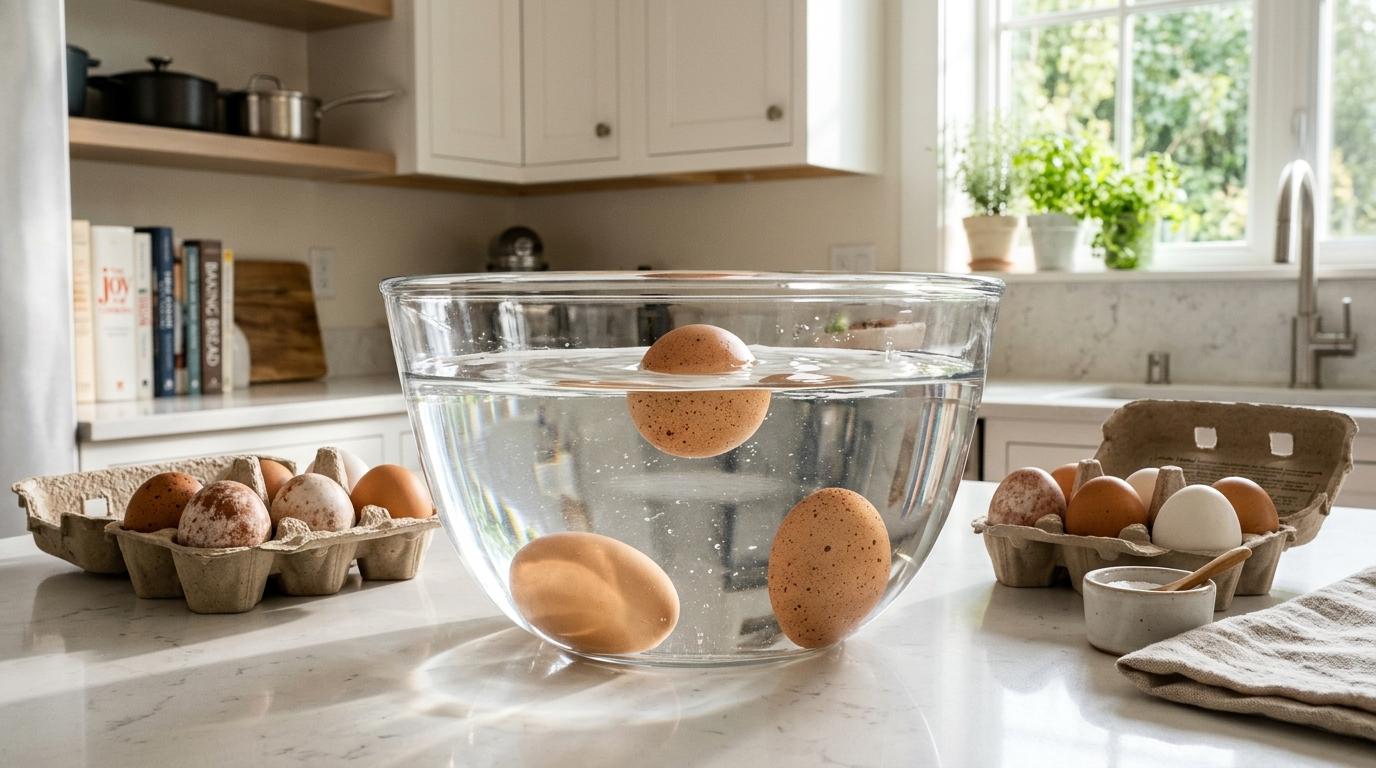
To evaluate whether an egg is fresh, aging, or truly spoiled without cracking it open, professional chefs and food scientists rely on the water submersion float test. It is one of the most reliable, non-invasive kitchen diagnostics available, requiring nothing more than a bowl of tap water and thirty seconds of observation. However, interpreting the results requires understanding the underlying physics of avian respiration, eggshell porosity, and the distinction between chronological age and bacterial contamination.
The Anatomy of an Eggshell: 17,000 Pores and the Protective Cuticle
#To understand why eggs behave differently in water over time, one must first look at the eggshell not as an impermeable barrier, but as a semi-permeable biological membrane. A standard domestic chicken eggshell is composed almost entirely of calcium carbonate crystals suspended in an organic protein matrix. Despite its rigid, protective feel, the shell is perforated by thousands of microscopic, funnel-shaped openings.
An average chicken egg features between 7,000 and 17,000 individual pores distributed across its surface, with a significantly higher concentration clustering around the blunt, wide end of the shell. In nature, these pores serve an evolutionary purpose: they allow oxygen to enter the developing embryo and permit metabolic waste gases, specifically carbon dioxide and water vapor, to escape into the atmosphere.
Covering the exterior of a freshly laid egg is the cuticle, frequently called the bloom. This thin, proteinaceous coating acts as nature's first line of defense. The bloom seals the entrance of the microscopic pores, preventing environmental dust, fungal spores, and common surface bacteria such as Salmonella Enteritidis or Pseudomonas from entering the porous interior. 
Beneath the mineral shell lie two fibrous keratin membranes: the outer shell membrane and the inner shell membrane. When a hen lays an egg, its internal temperature matches the hen’s body temperature, roughly 105°F (40.5°C). As the newly laid egg cools to the ambient temperature of the nest or packing facility, its internal contents contract slightly. This thermal contraction creates a localized vacuum that pulls the inner and outer membranes apart at the wide end, forming a tiny pocket of air known as the air cell.
The Physics of the Float Test: Moisture Loss, CO2 Evaporation, and Air Cell Expansion
#The mechanical foundation of the egg float test is governed entirely by Archimedes' principle and gas exchange. When an egg is placed in a liquid, it experiences an upward buoyant force equal to the weight of the fluid displaced. A freshly laid egg has a high proportion of water within both its albumen (egg white) and yolk, giving it an overall average density of roughly 1.08 grams per cubic centimeter. Because plain fresh water has a density of approximately 1.00 gram per cubic centimeter, the dense fresh egg readily sinks to the bottom.
As days turn into weeks inside a refrigerator or pantry, two continuous thermodynamic processes alter this density:
- Moisture Transpiration: The refrigerator is a naturally dehydrating environment. Water molecules within the watery albumen gradually evaporate through the 17,000 shell pores into the surrounding air. Over a month of storage, an egg can lose several grams of moisture.
- Carbon Dioxide Dissipation: Dissolved carbon dioxide ($CO_2$) in the albumen continuously diffuses through the shell pores. This loss not only increases the internal air volume but also fundamentally shifts the chemical pH of the egg white from a mildly acidic 7.6 to an alkaline 9.2 or higher.
As moisture and gas leave the egg, the physical volume of the liquid albumen shrinks. Because the rigid calcium carbonate shell cannot contract, atmospheric air is drawn inward through the pores to equalize internal pressure. This incoming air accumulates inside the air cell at the blunt end, causing the air pocket to expand from the size of a dime to the volume of a quarter or larger.
As the air cell grows, the egg’s overall mass decreases while its outer volume remains constant. Consequently, the mean density of the entire egg drops below 1.00 gram per cubic centimeter. The enlarged air pocket functions exactly like a miniature life jacket, causing the egg to pivot upright and eventually rise toward the water's surface.
The 3 Stages of the Water Submersion Test
#Executing the float test correctly requires simple equipment: a deep glass bowl, measuring cup, or wide transparent container filled with cold tap water. The water depth should be at least double the height of the egg so it has adequate room to float unimpeded without bumping into the bottom.
Gently lower the uncooked egg into the water using a slotted spoon to avoid cracking the brittle shell against the bottom. Observe how the egg settles:
| Observed Position in Water | Scientific Physical Condition | Approximate Age Range | Culinary Recommendation |
|---|---|---|---|
| Lies flat horizontally on the bottom | Tiny air cell (under 3 mm deep); high albumen density (over 1.05 g/cm3); maximum moisture retention. | 1 to 7 days from lay date | Ideal for poaching, frying sunny-side up, and delicate custard emulsification where thick albumen structure is essential. |
| Stands upright on pointed tip on the bottom | Moderate air cell (4 to 7 mm deep); partial moisture loss; albumen pH shifted to alkaline (roughly 8.8 to 9.2). | 2 to 4 weeks old | Excellent for hard-boiling, everyday scrambling, frittatas, and general baking; shells will peel cleanly after boiling. |
| Floats completely at or near the surface | Substantial air cell (over 8 mm deep); mean egg density has dropped below water density (under 1.00 g/cm3). | 5+ weeks old | Advanced age; requires a secondary sensory crack test. Safe to use in high-heat baking if scent and appearance are normal. |
Stage 1: The Sinker (Peak Freshness)
#When an egg settles firmly on the bottom of the vessel, resting horizontally on its side, it is at the pinnacle of biological freshness. The air pocket at the blunt end is negligible, usually less than 3 millimeters deep. The albumen is densely packed with thick ovomucin protein fibers, holding the yolk centered and upright.
Stage 2: The Tilter or Stander (Middle Age)
#When an egg rests its narrow, pointed tip on the bottom while its blunt end lifts into an angle—or stands completely vertical—it has entered its middle stage of maturity. The air cell at the wide end has expanded enough to exert significant upward torque, but the total mass of the egg is still heavy enough to overcome full surface buoyancy. These eggs are completely sound, flavorful, and safe.
Stage 3: The Floater (Advanced Evaporation)
#When an egg breaks away from the bottom and bobs freely at the surface of the water, its internal air bubble has reached critical volume. It has lost enough moisture through evaporation that the internal air chamber now displaces enough water mass to float the entire shell.
Why a Floating Egg Is Not Automatically Rotten: Age vs Pathogen Contamination
#One of the most widespread myths in home cooking is the assumption that a floating egg is packed with toxic bacteria and must be discarded immediately. This is biologically incorrect.
The float test is exclusively a measure of chronological age and dehydration, not a test for pathogenic contamination. 
To understand why, consider what causes foodborne illness in poultry. The primary pathogen associated with eggs is Salmonella enterica serovar Enteritidis. Salmonella can infect an egg in two distinct ways:
- Vertical Transmission: Bacteria inside the hen's reproductive tract infect the yolk or albumen before the shell forms.
- Horizontal Transmission: Environmental bacteria penetrate the shell pores after the egg is laid if the bloom is damaged or washed away.
Neither Salmonella nor common foodborne viruses produce noticeable amounts of gas as they multiply. A freshly laid, un-refrigerated egg infected with Salmonella will sink flat to the bottom of a water bowl, giving a completely false sense of security if tested for bacterial safety via water. Conversely, an egg stored in a clean, cold refrigerator for six weeks may lose enough moisture to float like a cork while remaining sterile and free of pathogenic microorganisms.
A floating egg is simply an old egg. Advanced age increases the statistical likelihood that protective albumen enzymes (such as lysozyme) have degraded, but it does not guarantee spoilage. Never throw away a floating egg without performing the subsequent crack-and-sniff evaluation.
The Ultimate Diagnostic: The Crack-and-Sniff Test for Hydrogen Sulfide
#While the float test provides a fast sorting mechanism, your nose remains the definitive scientific instrument for detecting rotten eggs. When an egg truly spoils, it is rarely due to Salmonella; rather, it is overrun by ambient spoilage bacteria such as Pseudomonas, Proteus, or Aeromonas.
These spoilage organisms consume the sulfur-containing amino acids (cysteine and methionine) found abundantly in egg whites. As these bacteria metabolize proteins in an anaerobic environment, they generate volatile organic sulfur compounds, most notably hydrogen sulfide ($H_2S$). 
Human olfactory receptors are evolutionarily calibrated to detect hydrogen sulfide at concentrations as low as 0.0005 parts per million. The pungent, nauseating, unmistakably foul stench of a rotten egg is instant and impossible to miss.
The Correct Protocol for Testing a Floating Egg:
#- Remove and dry: Remove the floating egg from the water bath and dry the exterior shell with a clean towel.
- Isolate in a clean dish: Crack the egg into a separate small white ceramic ramekin or glass bowl—never directly into a frying pan or mixing bowl with other ingredients.
- Perform the olfactory check: Bring your nose close to the ramekin and inhale gently.
- The Verdict: If the egg smells entirely neutral with no sulfur or ammonia notes, it is safe to cook. If even a faint whiff of rotten sulfur emerges, discard the egg and wash the ramekin in hot soapy water.
Albumen Viscosity and Yolk Height: What the Plate Test Reveals
#Once an egg is cracked onto a flat plate, you can observe its internal structural changes directly. Freshness produces dramatic differences in physical appearance:
[FRESH EGG: Compact thick albumen ring, plump spherical yolk centered high]
  _____     ( Yolk )
 /     \___/________\___ (Thick White)
/_______________________\ (Thin White edge)

[OLD EGG: Watery spreading albumen, flattened yolk drifting toward edge]
 ________( Flattened )________
/__________( Yolk )___________\
/______________________________\ (Spread-out watery white)
The Structure of a Fresh Egg
#In an egg cracked fresh from the farm, the white is distinctly divided into two visible zones: an inner ring of thick, gelatinous albumen and an outer perimeter of thinner white. The thick albumen stands tall and hugs the yolk tightly. The yolk itself is plump, spherical, and held securely in the center by chalazae—twisted, ropelike strands of protein anchored to the inner shell membranes.
The Breakdown of an Aging Egg
#Over time, endogenous enzymes (specifically lysozyme and ovotransferrin) break down the structural ovomucin protein network in the egg white. When you crack an older egg:
- The distinction between thick and thin albumen disappears; the white runs freely across the plate like water.
- The vitelline membrane surrounding the yolk stretches and weakens, causing the yolk to look flattened rather than domed.
- The chalazae weaken and dissolve, allowing the yolk to wander off-center.
- The color of the yolk does not reflect freshness; yolk hue is governed solely by the hen's dietary intake of carotenoid pigments (from marigold petals, yellow maize, or alfalfa).
Best Culinary Uses by Freshness: Why Older Eggs Peel Effortlessly When Hard-Boiled
#Recognizing the age of your eggs allows you to allocate them to the culinary techniques where their specific physical properties shine. Cooking with eggs of the wrong age is responsible for two of the most common kitchen frustrations: eggs that spread into stringy messes when poached, and hard-boiled eggs that tear into jagged chunks when peeled.
Why Fresh Eggs are Mandatory for Poaching and Frying
#When poaching an egg in simmering water or frying sunny-side up, you rely on thick albumen viscosity to hold the egg in a compact bundle. If you attempt to poach an older egg whose proteins have thinned, the watery white will disperse into ragged, ghostly tendrils across the saucepan, leaving behind a bare, overcooked yolk. Reserve your sinkers—eggs that lay flat in the water test—for poaching, soft boiling, and fried eggs.
Why Older Eggs Peel Effortlessly When Boiled
#Conversely, boiling extremely fresh eggs is a recipe for peeling disaster. In a fresh egg, the albumen has a lower pH (around 7.6 to 8.0) and contains abundant moisture. During boiling, the albumen proteins adhere aggressively to the keratin inner shell membrane. When you peel the cooked shell, large chunks of egg white tear away with it, leaving a pockmarked egg.
As an egg ages in the refrigerator:
- Dissolved carbon dioxide escapes through the shell pores, driving the albumen pH up to approximately 9.2.
- At this alkaline pH, the keratin inner shell membrane chemically releases its bond with the coagulated albumen proteins.
- The expanded air pocket at the base creates an immediate finger-hold under the shell.
When an older egg (one that stands upright on its tip in the water test) is boiled, chilled in an ice bath, and gently tapped, the shell slips off in two or three large, clean pieces.
Culinary Allocation Matrix:
#| Freshness Level | Physical Trait | Ideal Recipe Application | Techniques to Avoid |
|---|---|---|---|
| Very Fresh (Sinks flat) | High albumen viscosity; firm vitelline membrane; strong chalazae. | Traditional poached eggs, fried eggs sunny-side up, soft scrambled eggs, and rich egg custards. | Hard-boiling (inner membrane will fuse to shell, tearing whites during peeling). |
| Moderately Aged (Tilts or stands upright) | Balanced viscosity; alkaline albumen pH (8.8 to 9.2); enlarged bottom air pocket. | Hard-boiled eggs for deviled eggs or egg salad; omelets, frittatas, and everyday baking. | Poaching in plain simmering water without a fine-mesh strainer to drain thin whites. |
| Fully Aged (Floats, but odor-free) | Low albumen viscosity; fragile yolk membrane; large internal air cell. | Thoroughly baked cakes, quick breads, cookies, casseroles, and fully cooked quiches. | Raw preparations, mayonnaise, meringues (reduced foaming stability), or sunny-side up frying. |
Proper Storage Protocols: Refrigerator Temperatures, Cartons, and Why You Should Never Wash Eggs
#Maximizing egg longevity and preventing foodborne illness requires controlling environmental storage conditions. Follow these evidence-backed food safety rules:
1. Maintain Consistent Cold Storage Below 40°F (4°C)
#In North America, Japan, and Australia, commercial eggs are washed during processing to remove fecal contaminants, which strips away the protective cuticle bloom. Consequently, these eggs must be continuously refrigerated below 40°F (4°C) to prevent surface condensation and bacterial growth. In Europe and parts of the UK, hens are vaccinated against Salmonella and eggs are sold unwashed with their natural bloom intact, allowing for room-temperature storage in cool climates. Regardless of regional origin, once an egg is chilled, it must stay chilled; moving a cold egg to room temperature causes moisture to condense on the exterior shell, creating a liquid highway for bacteria to swim through the pores.
2. Store Eggs in Their Original Cardboard Carton
#The plastic egg trays molded into the doors of modern refrigerators are the worst place to keep eggs. Opening and closing the refrigerator door exposes eggs to frequent warm air blasts and physical vibrations that accelerate the breakdown of the yolk membrane. Furthermore, cardboard cartons shield the porous shells from absorbing strong ambient odors (such as onions, garlic, or melon) and prevent rapid evaporation.
3. Store Eggs with the Pointed End Facing Down
#Inside the carton, always position eggs with their blunt end facing upward and pointed end facing downward. Because the air cell is located at the blunt end, keeping it on top prevents the expanding air bubble from pressing against the yolk, keeping the yolk centered and surrounded by protective albumen.
4. Never Wash Eggs Before Refrigerating
#If you purchase farm-fresh, unwashed eggs with dirt or debris on the shell, resist the urge to wash them under a faucet before putting them in the fridge. Cold tap water causes the contents of the egg to contract, creating negative internal pressure that pulls wash water and surface bacteria through the shell pores directly into the white. Instead, dry-brush any debris off with a clean cloth, and only wash the shell with warm running water immediately before cracking it into the pan.
The Practical Kitchen Takeaway: Making the Float Test Routine
#Integrating the float test into your regular cooking workflow turns kitchen uncertainty into culinary precision. Rather than discarding cartons based on arbitrary date stamps or risking an entire recipe on an unverified egg, keeping a clear measuring container next to the prep station provides an instant, non-destructive answer.
When preparing breakfast scrambles, omelets, or hard-boiled eggs, test eggs in small batches. Allocate horizontal sinkers to delicate emulsifications and poaching pans where protein tightness defines the dish, reserve vertical standers for clean-peeling hard-boiled egg salads, and reserve surface floaters for the secondary crack-and-sniff test before baking.
By matching egg age directly to the cooking technique that suits its physical state, home cooks simultaneously eliminate household food waste and elevate culinary consistency.