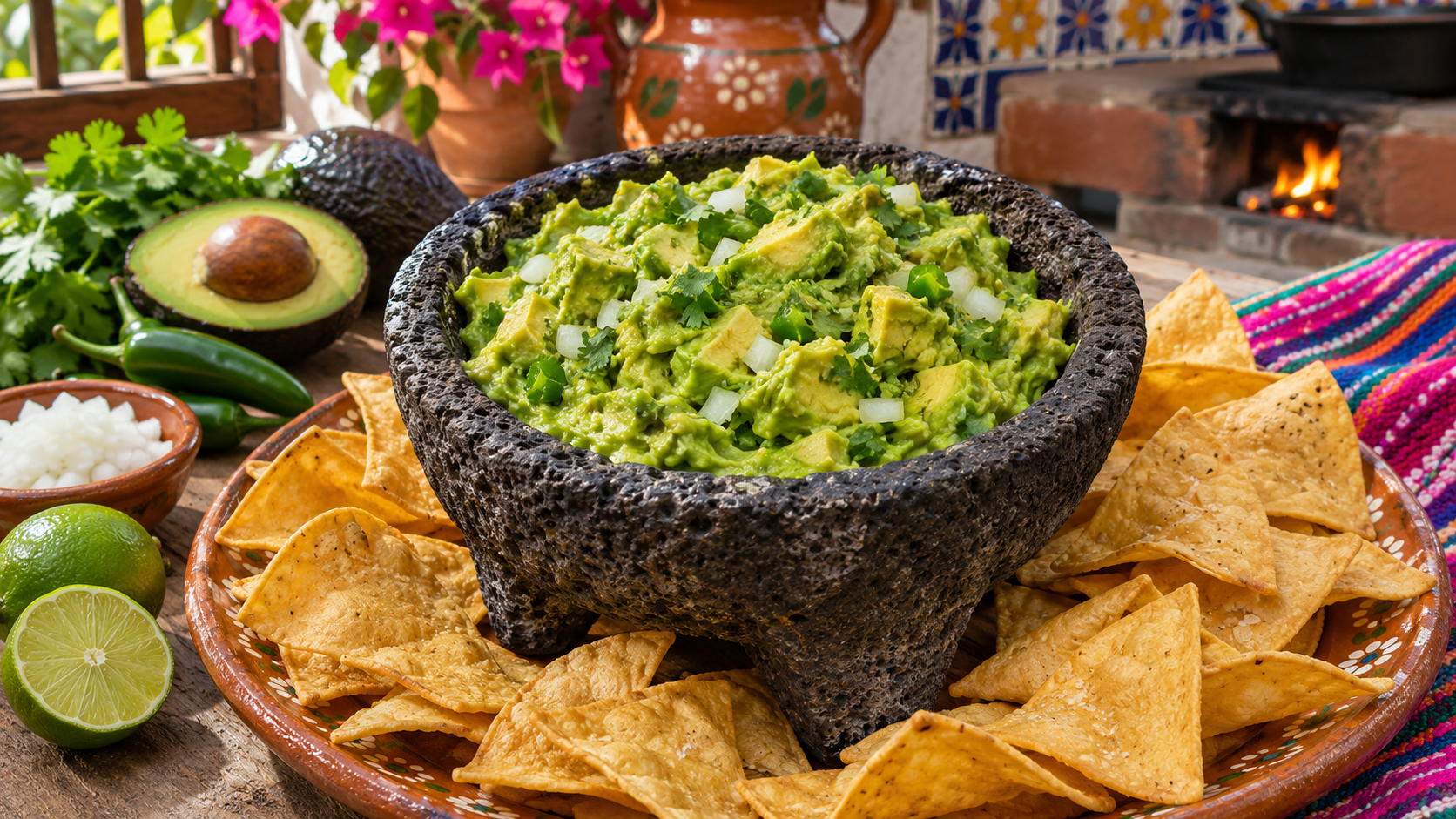
If you have ever ordered guacamole at an authentic taquería in Mexico City, Oaxaca, or Michoacán, you know the profound difference between real guacamole and the green pastes served in suburban restaurants across the globe.
In Mexico, guacamole is not a neon-green, silky baby-food puree loaded with sour cream, cream cheese, or garlic powder. It is a rustic, chunky, intensely aromatic preparation made fresh to order. You see large, buttery chunks of perfectly ripe avocado suspended alongside emerald flecks of fresh cilantro, crunchy white onion, and spicy minced serrano pepper, glistening with a gentle sheen of natural oil and smelling of warm lime and toasted corn.
The secret to this incredible flavor and texture lies in a five-hundred-year-old culinary technique developed by the Aztecs: crushing the aromatics in a volcanic stone mortar (molcajete) before the avocado ever touches the bowl.
When you grind raw onion, chile, and cilantro against coarse volcanic stone with rough sea salt, the stone ruptures cell membranes, releasing volatile aromatic oils that form a rich, juicy seasoning paste called el recaudo. When ripe avocado is folded into that fragrant paste, the rich vegetable fats absorb the oils immediately, creating a depth of flavor that tossing chopped vegetables into mashed avocado can never achieve.
This masterclass deconstructs avocado botany, ripeness indicators, stone mortar grinding mechanics, acid-fat ratios, and the real science of oxidation prevention.
The Taquería Rule: Zero Fillers, Zero Shortcuts
#Before looking at how to make authentic guacamole, you must eliminate the non-traditional ingredients that ruin it:
- Sour Cream and Mayonnaise (Strictly Banned): Adding sour cream or mayonnaise is a shortcut used by cheap buffets to stretch expensive avocados and prevent rapid browning. In authentic Mexican cuisine, dairy fat is considered an insult to the delicate, nutty richness of fresh avocado.
- Garlic Powder and Onion Powder (Strictly Banned): Commercial dehydrated powders add a stale, dusty, artificial aftertaste that lingers on your palate for hours. Authentic guacamole relies solely on crisp, sweet fresh white onion and freshly crushed aromatics.
- Blenders and Food Processors (Strictly Banned): Never puree avocado in a blender. High-speed blades whip air into the avocado fats, transforming dense, buttery flesh into a pale, foamy green paste with the texture of baby food. True guacamole must have textural contrast: creamy mashed avocado coating distinct, tender chunks that hold their shape.
- Cumin and Chili Powder (Strictly Banned): Ground cumin is a hallmark of Tex-Mex chili and fajitas; it has no place in classic Mexican guacamole. Cumin's pungent, dusty earthiness completely obliterates the fresh, clean botanical fragrance of the avocado and serrano pepper.
Authentic guacamole requires only six real ingredients: ripe Hass avocados, fresh white onion, fresh serrano chiles, fresh cilantro, coarse sea salt, and fresh lime juice. A seeded ripe Roma tomato is an optional traditional finish in central Mexico.
Avocado Botany: Why Hass Avocados Are Non-Negotiable
#You cannot pick up any green avocado in the supermarket and produce world-class guacamole.
The avocado world is dominated by two primary botanical families:
- Hass Avocados (The Gold Standard): Originally developed in California and now grown extensively in Michoacán, Mexico. Hass avocados have thick, pebbly skins that turn from dark green to deep purplish-black as they ripen. Most importantly, Hass avocados contain between 18% and 22% natural oil (primarily heart-healthy monounsaturated oleic acid) and very low moisture content. This high oil density produces a rich, velvety, buttery mouthfeel that emulsifies perfectly with lime and salt.
- Florida / Caribbean Green-Skin Avocados (The Watery Mistake): Large, smooth-skinned, bright-green avocados (such as Fuerte or Choquette varieties). While delicious sliced in fresh salads, green-skin avocados contain only 3% to 5% oil and nearly 80% water. If you mash a Florida avocado for guacamole, it releases watery pools that turn your dip into a thin, watery slush that slips off tortilla chips. Always buy Hass avocados.
The Ripeness Test: Yield, Color, and the Stem Nub
#Buying avocados that are either rock-hard or brown and rotten inside is the greatest frustration in home cooking. Here is how to select perfectly ripe avocados every time:
- The Color Check: Look for avocados with deep forest-green to purplish-black skins. Avoid bright emerald-green skins (unripe and rock-hard) and dull, ash-grey skins (overripe).
- The Palm Yield Test: Never press the tip of your thumb into the side of an avocado in the supermarket. Pushing with your thumb bruises the delicate flesh underneath, creating dark, mushy brown spots. Instead, cradle the avocado gently in the palm of your hand and apply soft, even pressure with your fingers. A ripe avocado should yield gently to slight pressure, feeling like a firm, chilled stick of butter.
- The Stem Nub Check (The Secret Trick): Look at the small wooden stem button at the top of the avocado. Flick it gently with your thumbnail. If the stem resists and stays locked on, the avocado is underripe. If the stem pops off effortlessly and reveals a vibrant, creamy lime-green crater beneath, the fruit is at absolute peak ripeness. If the crater underneath is dark brown or black, the avocado is overripe and full of brown streaks inside; put it back.
The Molcajete Technique: The Magic of El Recaudo
#The single technique that elevates authentic Mexican guacamole above all home imitations is the use of a molcajete—a traditional heavy mortar and pestle carved from porous, volcanic basalt stone.
The rough, micro-textured surface of volcanic stone acts like hundreds of tiny dull blades. When you grind vegetables against stone, you do not slice them cleanly like a steel knife; you rupture the plant cell walls under compressive pressure.
- The Recaudo Ingredients: Finely dice two tablespoons of crisp white onion (not sweet Vidalia or yellow onion; white onion has a clean, sharp, herbaceous punch). Mince one fresh serrano pepper (including seeds for authentic medium heat, or seeds removed for milder heat). Chop two tablespoons of fresh cilantro stems. Stems contain significantly higher concentrations of aromatic essential oils than delicate leaves.
- The Grinding Phase: Place the onion, serrano, cilantro stems, and one teaspoon of coarse kosher or sea salt into the bowl of the molcajete. The coarse salt crystals act as a rough abrasive against the volcanic stone.
- The Pestle Motion (The Mano): Take the stone pestle (mano) and grind the ingredients with a firm, circular, downward twisting motion against the curved walls.
- The Result: Within 60 seconds of vigorous grinding, the white onion, green pepper, and cilantro break down completely into a wet, fragrant, juicy emerald-green paste. The salt draws out the onion water through osmosis, while the volatile capsaicin from the pepper and essential oils from the cilantro dissolve into a unified aromatic emulsion. This is el recaudo—the flavor engine of true guacamole.
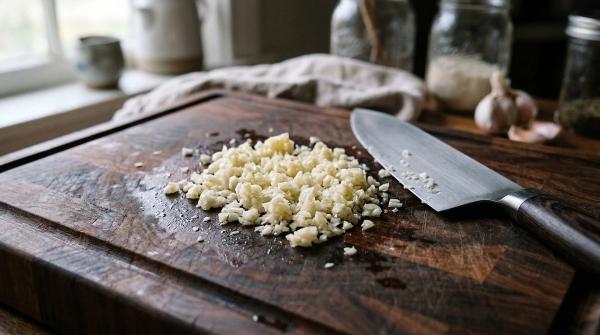
If you do not own a volcanic molcajete, achieve this exact physical effect by piling the onion, chile, cilantro stems, and coarse salt onto a cutting board and crushing them with the flat side of a heavy chef's knife or a flat-bottomed ceramic mug until a juicy paste forms.
The Gentle Mash: Preserving Irregular Chunks
#Now comes the moment to introduce the ripe Hass avocados:
- Prepping the Avocados: Slice three ripe Hass avocados in half lengthwise around the seed. Twist the halves in opposite directions to separate. Tap the blade of your chef's knife gently into the pit, twist sideways, and lift the pit out. Use a large metal spoon to scoop the flesh out of the skin in one whole hemisphere.
- The Grid Cut: Place the avocado halves flat-side down on your cutting board and slice them into 1/2-inch cubes.
- The Gentle Folding Motion: Add the diced avocado directly into the molcajete on top of your crushed aromatic paste.
- The Tool: Use a standard dinner fork or a wooden spoon. Never use a potato masher or whisk. Press down gently on approximately half of the avocado cubes, crushing them against the bottom stone so their soft flesh binds with the recaudo paste to create a creamy green sauce.
- The Chunky Texture: Leave the remaining half of the avocado cubes completely intact. Gently fold the intact chunks into the creamy base until every single piece is coated in the seasoned paste. You want a dramatic textural contrast: smooth, buttery, lime-scented avocado sauce enveloping distinct, tender chunks that you can bite into.
| Component / Step | Classical Specification | Function / Food Science | Common Amateur Error |
|---|---|---|---|
| Hass Avocados | 3 large ripe avocados (pebbly skin) | 18-22% monounsaturated oil foundation | Using watery Florida green-skin avocados |
| White Onion | 2 tablespoons (finely minced) | Sharp, clean allium crunch without sweetness | Using sweet yellow or red onions that overpower |
| Fresh Serrano Chile | 1-2 chiles (minced fine) | Bright, crisp vegetal heat cutting through rich fat | Using pickled canned jalapeños with vinegar brine |
| Fresh Cilantro | 2 tbsp stems (in paste) + leaves (finish) | Stems provide aromatic oils; leaves add visual color | Using dried cilantro flakes with zero flavor |
| Coarse Sea Salt | 1 teaspoon (coarse crystals) | Abrasive stone grinding aid and flavor amplifier | Adding salt only at the end without stone grinding |
| Fresh Lime Juice | 1 to 1.5 tablespoons (half a fresh lime) | Aromatic bright acidity balancing heavy fat | Dumping multiple whole limes that curdle texture |
| Roma Tomato | 1 medium (seeded and finely diced) | Juicy sweet contrast added at the very end | Using watery beefsteak tomatoes with wet pulp |
The Lime Restraint: Balancing Acidity Against Rich Lipids
#The second most common home cooking mistake is treating lime juice like a marinade. Pouring the juice of two or three whole limes into a bowl of guacamole turns it into an aggressively sour, watery soup that makes your mouth pucker.
In authentic Mexican cuisine, lime juice is an aromatic seasoning, not a dominant liquid:
- The Correct Ratio: For three medium Hass avocados, you need only one to one-and-a-half tablespoons of freshly squeezed lime juice—roughly the juice of half a juicy Persian or Key lime.
- The Culinary Purpose: Avocado flesh is extraordinarily rich, composed almost entirely of creamy fats. A small splash of fresh citric acid cuts through that heavy lipid coating on your tongue, waking up your taste buds and amplifying the natural nutty sweetness of the fruit.
- Add at the Finish: Squeeze the fresh lime juice over the mashed avocado at the very end of preparation, tossing gently to coat. Never use bottled lime juice concentrate, which contains sodium metabisulfite preservatives that give guacamole a chemical aftertaste.
The Tomato Finish: Seedless Flesh Folded Gently
#While some purists in Michoacán prefer pure green guacamole without tomato, central Mexican taquerías traditionally incorporate ripe red tomato for vibrant color contrast and refreshing sweetness:
- Tomato Selection: Use firm, ripe Roma (plum) tomatoes. Standard slicing tomatoes or beefsteak tomatoes contain massive cavities of watery gel and seeds that dilute your guacamole within minutes.
- Seeding: Cut the Roma tomato in half and use a spoon to scoop out and discard the watery seed cavities and jelly completely.
- Dicing and Folding: Cut the firm tomato walls into a tiny 1/4-inch dice. Gently fold the diced tomato and fresh cilantro leaves into the finished guacamole with one or two light turns of your spoon.
- Visual Presentation: The red tomato specks and dark green cilantro leaves should sit vividly suspended in the creamy light-green avocado like confetti.
The Oxidation Myth: How to Really Prevent Browning
#Few kitchen myths are as pervasive as the claim that placing an avocado pit in the center of your guacamole prevents it from turning brown.
- The Chemistry of Browning: When avocado flesh is sliced, an enzyme called polyphenol oxidase (PPO) is exposed to atmospheric oxygen. This enzymatic reaction oxidizes phenolic compounds into dark melanin pigments—the exact same chemical reaction that turns sliced apples brown.
- The Pit Truth: Leaving the avocado seed in the bowl does absolutely nothing chemically to stop enzymatic oxidation. If you lift the pit after four hours, you will see that the tiny circular patch of avocado directly underneath the seed stayed green purely because the physical weight of the seed blocked oxygen from touching that specific spot. Every square millimeter of surrounding exposed avocado turns unappetizingly brown.
- The True Oxygen Barrier: The only way to keep guacamole vibrant green for hours or overnight is to create a complete physical barrier against atmospheric oxygen.
- The Flush Plastic Wrap Method: Transfer your guacamole into a clean glass container. Use a rubber spatula to smooth the surface completely flat. Take a sheet of plastic wrap and press it directly onto the green surface of the guacamole, starting in the center and smoothing outward toward the edges to eliminate every microscopic air bubble.
- The Water Seal Technique (The Professional Secret): For 24-hour storage, pack the guacamole tightly into an airtight container and smooth the surface flat. Gently pour half an inch of cold tap water directly over the top of the guacamole. Water is an absolute, impenetrable oxygen barrier. When ready to serve, carefully pour off the surface water into the sink and give the guacamole a quick stir with a fork; the dip underneath will be as vibrant, neon-green, and fresh as the second it was made.
Serving Traditions: Warm Totopos and Taquería Pairings
#Authentic guacamole should be served immediately in the volcanic molcajete it was created in. The rough, porous black basalt stone retains cool cellar temperatures, keeping the avocado refreshing and cold throughout a meal.
- Warm Fresh Totopos: Never serve authentic guacamole with thin, powdery, over-salted commercial tortilla chips. Make traditional Mexican totopos by cutting day-old corn tortillas into triangles and frying them in hot oil for two minutes until golden, crunchy, and blistered, sprinkled immediately with sea salt.
- The Street Taco Accompaniment: Spoon generous mounds of fresh guacamole directly onto sizzling corn tortillas piled with crispy carnitas, charred carne asada, or al pastor pork. The cool, rich avocado fat creates the ultimate textural contrast against sizzling hot, spiced meats.
Troubleshooting Common Guacamole Problems
#- The Guacamole Tastes Flat and Greasy: You did not add enough salt. Avocado fats heavily suppress seasonings. Stir in another quarter teaspoon of coarse sea salt; salt unlocks the natural sweetness of avocado and makes the lime juice pop.
- The Guacamole Is Watery and Runny: You used Florida green-skin avocados, skipped seeding your tomatoes, or over-squeezed lime juice. Always stick to pebbly Hass avocados, scoop out tomato seeds, and measure lime juice with restraint.
- The Dip Tastes Harsh and Spicy: Your serrano pepper was hotter than expected. Fold in half of an additional diced ripe avocado with a tiny pinch of salt to dilute the capsaicin concentration.
- The Avocado Has Dark, Stringy Fibers: This happens when avocados are harvested from immature young trees. If your avocado flesh contains tough brown strings, press the flesh through a coarse sieve or pick them out with a fork; you cannot soften fibrous strings.
Mastering authentic Mexican guacamole is a testament to the power of traditional technique. Once you crush the fresh aromatics into a juicy stone recaudo and fold in buttery, chunky Hass avocados with restrained lime and salt, you will never look at store-bought dip the same way again.