What Is Garlic Confit: The Transformation from Pungent to Buttery Sweet
#Garlic confit is one of the most transformative preparations in classical culinary arts. The word confit comes from the French verb confire, meaning to preserve. Historically used for duck and pork, the technique involves gently poaching an ingredient submerged in fat at a very low, stable temperature over an extended period.
When applied to whole garlic cloves submerged in good extra virgin olive oil, confit completely reinvents the allium. Raw garlic is sharp, pungent, and sharp on the tongue. After ninety minutes of gentle thermal poaching at 200°F (93°C), the cloves turn soft and spreadable like warm room-temperature butter. Their harsh sulfurous bite dissolves entirely, replaced by a deep, mellow sweetness and rounded nutty complexity.
At the same time, the poaching oil absorbs volatile aromatic essences from the garlic and herbs. You end up with two culinary assets from one pan: spreadable golden garlic cloves that melt into sauces, and a luxurious infused garlic oil ready for finishing dishes.
However, garlic confit comes with a crucial caveat that every home cook must understand: food safety. Garlic submerged in oil is one of the primary vectors for foodborne botulism if stored improperly. Mastering confit means understanding both the culinary heat and the microbiological rules.
The Food Chemistry: How Low Heat Tames Harsh Allicin
#To understand why garlic confit tastes so fundamentally different from raw or roasted garlic, look at the chemical compounds inside an allium bulb.
Intact garlic cloves contain two separate compounds stored in separate cellular compartments:
- Alliin: A non-protein sulfur amino acid derivative with virtually no pungent aroma.
- Alliinase: A heat-sensitive enzyme stored in plant vacuoles.
When you mince, crush, or chew raw garlic, cell walls rupture. Alliinase immediately contacts alliin, catalyzing the rapid synthesis of allicin. Allicin is the potent defense chemical that gives raw garlic its sharp, burning pungency.
Thermal Inactivation of Alliinase
#In garlic confit, whole peeled cloves enter warm oil without being crushed or bruised. As the oil slowly warms past 140°F (60°C), thermal energy permanently denatures the alliinase enzyme before it can synthesize allicin.
With the pungent pathway deactivated, prolonged low heat (around 200°F / 93°C) allows natural plant sugars—fructose and sucrose—to slowly caramelize. Inulin, a complex carbohydrate stored in garlic, breaks down into simple sweet sugars. Simultaneously, sulfur molecules break down into mellow diallyl disulfides, imparting sweet, roasted, nutty flavor notes without any burnt bitterness.
If heat climbs too high (above 250°F / 121°C), garlic fries rather than poaches. The exterior develops a bitter, rubbery skin while the interior remains under-extracted. Low, controlled heat is mandatory.
The Critical Food Safety Science: Understanding Botulism and Garlic in Oil
#While garlic confit is deeply delicious, homemade infused oils demand strict microbiological respect. 
Garlic grows underground in continuous contact with soil. Soil naturally harbors spores of Clostridium botulinum, a rod-shaped bacterium capable of producing one of the most potent neurotoxins known to science.
The Perfect Anaerobic Storm
#Clostridium botulinum spores are extraordinarily resilient. In their dormant spore state, they survive normal boiling temperatures (212°F / 100°C) and dry heat. To produce the dangerous botulinum neurotoxin, the spores require four specific environmental conditions:
- Absence of oxygen (an anaerobic environment)
- Low acidity (a pH level above 4.6)
- Moderate temperature (between 50°F and 122°F / 10°C to 50°C)
- Available moisture (water activity above 0.93)
Garlic confit creates this exact storm. Garlic has a natural neutral pH between 5.3 and 6.3. When submerged entirely in olive oil, all oxygen is completely displaced. Garlic cloves contain roughly sixty percent internal moisture. If that jar of oil-submerged garlic sits on a warm kitchen counter or inside a weak refrigerator, dormant botulinum spores awaken, germinate into vegetative bacteria, and synthesize lethal neurotoxins.
The terrifying danger of botulinum toxin is that it produces no odor, no off-flavor, no color change, and no gas bubbles. A jar of deadly garlic confit looks, smells, and tastes completely normal.
The Golden Rules of Confit Storage: 40°F and the 4-Day Window
#Because home kitchens cannot safely pressure-can low-acid foods in oil to the 250°F (121°C) required to destroy botulism spores without destroying the olive oil, safety is governed entirely by temperature and time.
The United States Department of Agriculture (USDA) and the Food and Drug Administration (FDA) maintain strict, science-backed handling standards for homemade garlic in oil:
Rule 1: Rapid Ice-Bath Cooling
#Never leave hot garlic confit to cool slowly on your kitchen counter. Slow ambient cooling leaves the oil in the danger zone (between 70°F and 120°F) for hours, inviting rapid spore germination.
As soon as the confit leaves the oven or stovetop, transfer the pan or jar into an ice water bath. Rapidly drop the core temperature below 40°F (4°C) within two hours.
Rule 2: Constant Refrigeration at 40°F (4°C) or Lower
#Store homemade garlic confit in a clean, airtight glass jar exclusively in the refrigerator. Use an appliance thermometer to ensure your refrigerator runs between 35°F and 38°F (2°C to 3°C). 
Vegetative growth of Clostridium botulinum is arrested below 38°F (3.3°C). However, because home refrigerator doors open frequently and certain rare psychrotrophic non-proteolytic strains can slowly multiply near 38°F, refrigeration is not an indefinite shield.
Rule 3: The Non-Negotiable 4-Day Rule
#Any homemade garlic confit kept in the refrigerator must be consumed or discarded within four days. After day four, the statistical margin of microbiological safety degrades significantly. Mark the jar clearly with tape and the date of preparation.
Rule 4: Freezing for Long-Term Storage
#If you want to keep garlic confit beyond four days, the freezer is your best friend. 
Freezing halts all bacterial replication completely. Portion cooled garlic cloves and oil into silicone ice cube trays and freeze until solid. Once frozen, pop the cubes into a heavy-duty freezer zip bag and store at 0°F (-18°C) for up to three months. Whenever a recipe calls for garlic, pull out one cube, drop it into your warm skillet, and cook without thawing.
Oven vs Stovetop: Choosing the Best Cooking Method
#Home cooks frequently ask whether confit is best prepared in the oven or on top of the range.
| Method | Temperature Stability | Burn Risk | Monitoring Required | Best Application |
|---|---|---|---|---|
| Oven Poaching (200°F) | Excellent; 360-degree ambient heat | Extremely low; bottom heat is buffered | Minimal; check once halfway | Ideal method for home cooks; consistent and hands-off |
| Stovetop (Lowest Simmer) | Variable; concentrated burner contact | High; pan hot spots easily scorch cloves | Continuous; requires heat diffuser | Acceptable only with heavy cast iron and constant monitoring |
| Slow Cooker / Crockpot | Moderate; low setting fluctuates | Low to moderate | Low | Good for large batches; keep lid cracked if temperature exceeds 215°F |
| Sous Vide (190°F) | Precise to 0.1 degree | Zero scorching | Completely hands-off | Flawless consistency; requires vacuum-grade high-temp bags |
The oven method is overwhelmingly superior for domestic kitchens. Direct stovetop flame creates hot spots on the bottom of pans, causing cloves resting on the metal to fry, blister, and turn bitter before the oil heats evenly. An oven provides uniform convection heat from all directions.
Selecting Your Oil: Extra Virgin, Light Olive, or Neutral
#The fat you choose defines the character of the confit and the longevity of the infused oil:
- Extra Virgin Olive Oil: The gold standard. Rich, fruity, peppery, and packed with polyphenols that act as natural antioxidants. Confit made with extra virgin olive oil delivers deep Mediterranean flavor. Note that extra virgin olive oil will partially solidify and turn cloudy in the refrigerator; it liquefies again within minutes at room temperature.
- Pure or Light Olive Oil: A refined olive oil with a higher smoke point and neutral flavor profile. Excellent if you want the garlic flavor to dominate without the peppery grassiness of extra virgin oil.
- Avocado Oil: Rich in monounsaturated fats and thermally stable. Produces a very clean, mild confit with a vibrant golden-yellow hue.
- Neutral Seed Oils (Canola, Grapeseed, Sunflower): Acceptable for budget-conscious cooking, but lack the aromatic depth and mouthfeel of olive oil.
Never reuse commercial deep-frying oil or old cooking fats for confit. Always use fresh oil from a newly opened bottle.
Step-by-Step Recipe and Thermal Checkpoints
#Here is the exact tested method for preparing slow-poached garlic confit with zero burning and complete safety:
Equipment Needed
#- Small deep ceramic baking dish, ramekin, or oven-safe enameled mini cocotte (approx 2 to 3 cup capacity)
- Oven thermometer to verify actual interior oven heat
- Fine-mesh skimmer or slotted spoon
- Clean glass canning jar with airtight rubber seal or tight screw top
- Large bowl filled with ice cubes and cold water for rapid chilling
Ingredient Proportions
#- 3 to 4 whole heads of fresh garlic (approx 40 to 50 large whole cloves)
- 1.5 cups good-quality extra virgin olive oil (or enough to cover by 1/2 inch)
- 2 sprigs fresh rosemary
- 3 sprigs fresh thyme
- 1 dried Turkish bay leaf
- 1/2 teaspoon whole black Tellicherry peppercorns
Execution Steps
#- Step 1: Peel the garlic cloves carefully. Avoid slicing or crushing the cloves. Trim the dry wooden root tip flat with a paring knife. Discard any cloves that show green germ sprouts, brown soft spots, or surface mold.
- Step 2: Preheat your oven to 200°F (95°C). Verify with an internal oven thermometer that the oven is not running hot.
- Step 3: Arrange the cloves in a single or double layer in your ceramic baking dish. Tuck fresh rosemary, thyme, bay leaf, and peppercorns around the garlic.
- Step 4: Pour extra virgin olive oil over the cloves until they are completely submerged under at least half an inch of liquid. Exposed cloves will dehydrate and dry out during poaching.
- Step 5: Place the uncovered dish into the middle rack of the preheated oven. Bake for ninety minutes to two hours. Check at the sixty-minute mark: the oil should exhibit lazy, tiny pinprick bubbles rising occasionally. It should never boil or froth violently.
- Step 6: Test doneness at ninety minutes. Press a large clove with the back of a spoon; it should yield like softened cream cheese without resistance. The color should be pale golden-amber, never dark brown.
- Step 7: Remove from the oven. Immediately submerge the bottom of the baking dish into the prepared ice water bath, ensuring no water splashes into the oil. Cool until the dish is cool to the touch.
- Step 8: Discard the spent herb sprigs. Transfer the cooled cloves and oil into your sterilized glass storage jar. Seal tightly, label with the exact preparation date, and store directly in the refrigerator at 38°F or freeze into cubes.
How to Use Garlic Confit and Garlic Oil in Everyday Cooking
#Having a jar of garlic confit in your kitchen is like having an instant flavor accelerator on standby:
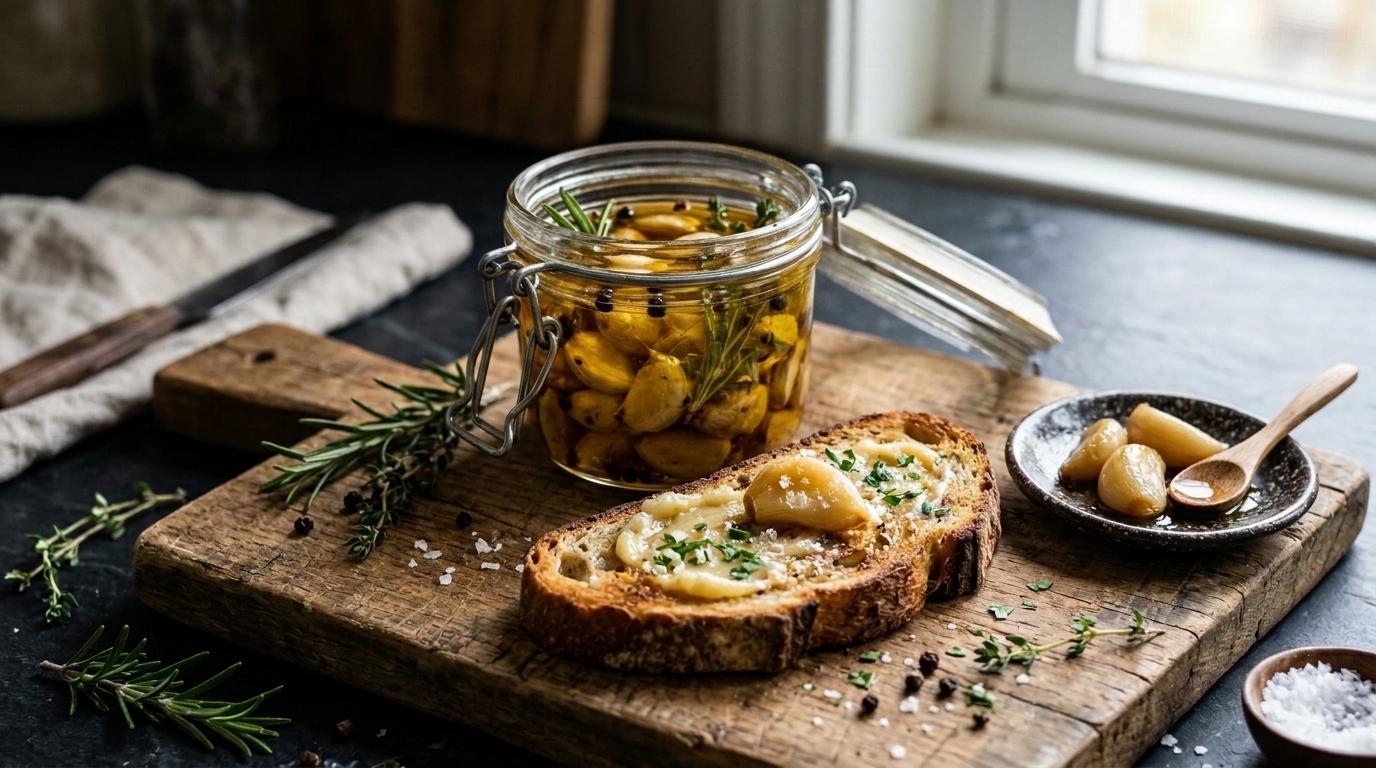
- Crusty Garlic Bread: Smear two or three warm confit cloves directly across toasted sourdough or warm baguette slices like butter. Sprinkle with flaky sea salt and cracked black pepper.
- Silky Mashed Potatoes: Mash eight to ten confit cloves into warm Yukon Gold potatoes along with butter and cream for sweet, mellow garlic mash without sharp raw garlic burn.
- Velvety Pasta Sauces: Mash confit cloves into warm marinara, cacio e pepe, or carbonara pans to emulsify rich body and sweet roasted depth.
- Salad Dressings: Whisk two tablespoons of the infused garlic olive oil with Dijon mustard, red wine vinegar, and honey for a restaurant-caliber vinaigrette.
- Pan Searing and Frying: Use the garlic oil as the cooking fat to fry sunny-side-up eggs, sear pork chops, or blister cherry tomatoes.
- Vegetable Roasting: Toss cauliflower florets, baby carrots, or green beans in garlic oil before roasting at high heat.
- Hummus and Dips: Blend four confit cloves into creamy homemade hummus, whipped feta, or Greek yogurt dips.
Troubleshooting Confit Texture and Flavor
#If your confit does not turn out as expected, consult this diagnostic guide:
| Observation | Root Cause | Prevention and Solution |
|---|---|---|
| Cloves turned rubbery and tough | Oil temperature was too hot (over 230°F), causing moisture to flash-boil | Lower oven heat to 190°F–200°F; use an oven thermometer to verify calibration |
| Cloves are bitter and dark brown | Cloves fried instead of poached; sugars scorched | Confit must be pale amber; discard burnt cloves as bitterness cannot be reversed |
| Oil solidified into a hard cloudy block | Extra virgin olive oil naturally contains high oleic monounsaturated fats | Normal behavior; leave at room temperature for 10 minutes to liquefy before serving |
| Cloves developed a bluish-green tint | Natural reaction between garlic sulfur compounds and trace copper/acid | Chemically safe to eat; occurs in younger garlic bulbs exposed to mild acids |
| Oil smells rancid or off | Expired oil was used or stored improperly | Always use fresh, reputable extra virgin olive oil with clear harvest dates |
Frequently Asked Questions
#Can you store garlic confit at room temperature?
#No. You must never store homemade garlic confit or garlic-infused oil at room temperature. Garlic grows underground where Clostridium botulinum spores naturally reside. When garlic is submerged in oil, it creates an oxygen-free, low-acid, moist environment—the exact biological condition required for botulism spores to germinate and produce deadly neurotoxins at temperatures between 50°F and 122°F (10°C to 50°C).
How long does homemade garlic confit last in the refrigerator?
#According to USDA and FDA food safety guidelines, homemade garlic confit must be kept at or below 40°F (4°C) and consumed within four days. While cold refrigerator temperatures inhibit bacterial growth, certain strains of Clostridium botulinum can slowly multiply over prolonged refrigeration. Discard any unused portions after day four.
Can you freeze garlic confit, and how long does it last?
#Yes. Freezing is the safest and most effective method for long-term storage. Spoon the cooled cloves and oil into silicone ice cube trays and freeze until solid, then transfer the frozen cubes to an airtight freezer bag. Frozen garlic confit keeps its rich flavor, velvety texture, and complete microbiological safety for up to three months.
What can you do with the leftover garlic-infused olive oil?
#The aromatic oil is a prized culinary byproduct. Use it as a finishing drizzle over Neapolitan pizza, warm pasta, or grilled steaks. Whisk it into vinaigrettes, brush it onto bread before grilling, or use it as the cooking fat for fried eggs, roasted vegetables, and skillet dinners. Always apply the same strict four-day refrigeration rule to the infused oil as the confit cloves.