The Core Rules of Real Spanish Paella
#Real Spanish seafood paella is not a seafood risotto, and it is definitely not yellow fried rice topped with frozen shrimp. 
The dish lives or dies on three things: the right short-grain Spanish rice, a rich homemade broth made from prawn heads, and leaving the pan completely alone once the liquid starts simmering. If you stir the pan like a risotto, you ruin it. 
When you cook paella the traditional way in a wide, shallow pan, the rice absorbs three times its weight in flavorful seafood stock. As the liquid boils off, the grains settle into a thin, even layer. In the last three minutes of cooking, the rice on the bottom of the pan fries in rendered olive oil, creating a toasted, crackling crust called socarrat. That crunchy bottom layer is what every Spaniard fights for at the table.
Making a restaurant-quality paella at home does not require special equipment beyond a good pan, but it does require precision. Here is how to master every step of authentic Paella de Marisco without turning your dinner into soggy rice porridge.
Why Spanish Bomba Rice Is Non-Negotiable
#If you take only one piece of advice from this guide, let it be this: do not make paella with long-grain rice, basmati, jasmine, or Italian Arborio.
Spanish Bomba rice (arroz bomba) is a round, short-grain rice grown primarily in the wetlands of Valencia and the Ebro Delta. What makes Bomba unique is its structure. It contains a high percentage of amylose starch, which allows each grain to absorb up to three times its volume in liquid without expanding width-wise or breaking open.
When you cook with Bomba rice, the grains stay separate, firm, and plump. Even after absorbing a massive amount of rich broth, they keep a pleasant chew in the center, which the Spanish call al dente. 
Here is what happens when people swap Bomba rice for common grocery store alternatives:
- Italian Arborio or Carnaroli: These are fantastic grains for risotto because their outer starch sloughs off easily during cooking, creating a creamy sauce. But in a paella, that same released starch turns your pan into a sticky, gummy porridge.
- Basmati or Jasmine: Long-grain rices absorb liquid quickly, but they lack the starch structure to create the caramelized socarrat base. They also stay dry on the outside rather than drinking in the olive oil and shellfish juices.
- Standard Medium-Grain Supermarket Rice: Most cheap generic white rice softens too fast and turns to mush within ten minutes of boiling.
If you cannot find authentic Spanish Bomba rice in your local market or online, the only acceptable backup is another Spanish round rice like Calasparra or Senia. If those are completely unavailable, a standard Japanese short-grain sushi rice can work in a pinch, but you must reduce the liquid ratio slightly so it does not turn soft.
The Secret Ingredient: Homemade Prawn-Head Broth
#The biggest mistake home cooks make with seafood paella is pouring boxed vegetable stock or plain chicken broth over their rice. 
In coastal Spain, paella gets 80 percent of its deep ocean flavor from the broth. You do not need to buy expensive seafood stock from a specialty store. The best stock in the world is already sitting in your kitchen: the heads and shells of the fresh raw prawns you bought for the recipe.
The heads of raw prawns are packed with flavorful juices and rich fats. When you fry them in olive oil and simmer them with water, those fats release into the liquid, turning it a deep reddish-orange color with an intoxicating aroma.
How to Build the Stock in 25 Minutes
#- Peel your raw jumbo prawns, leaving the tail on four or five of them for presentation if you like. Put the peeled prawn meat in a bowl in the fridge.
- Heat one tablespoon of olive oil in a deep saucepan over medium heat. Toss in all the prawn heads and shells.
- Fry the shells for about five minutes until they turn bright pink and smell fragrant. Take a wooden spoon or potato masher and firmly crush the prawn heads against the bottom of the pot. You will see rich orange oils squeeze out into the pan.
- Pour in 1.3 liters of cold water. Add half a yellow onion, a crushed garlic clove, and one bay leaf.
- Bring the pot to a boil, then lower the heat and let it simmer uncovered for 20 minutes.
- Strain the stock through a fine-mesh sieve into a clean bowl, pressing the shells firmly with the back of a ladle to extract every drop of liquid. Keep the strained stock warm on the back burner.
Before you start cooking the rice, crumble half a gram of real Spanish saffron threads between your fingers and drop them directly into the warm stock. The saffron will bloom immediately, turning the broth a glowing golden yellow and filling your kitchen with its signature earthy, floral aroma.
The Pan: Size, Material, and Heat Distribution
#The word paella actually refers to the pan itself, not the rice. 
A traditional paella pan is wide, completely flat, and shallow, with two red loop handles. The shallow design is not just for looks. It forces the cooking liquid to evaporate quickly into the air, and it ensures that the rice sits in a thin layer—never more than half an inch (about one centimeter) deep.
If you try to cook paella in a deep Dutch oven, stockpot, or high-sided skillet, the steam gets trapped inside. The trapped moisture drips back down onto the rice, steaming the top layer while boiling the bottom layer into mush. You will never get a crispy crust in a deep pot.
Choosing the Right Pan Size
#For 400 grams of Bomba rice (which easily feeds four to six people), you need a pan that is between 38 and 42 centimeters (15 to 16.5 inches) in diameter. 
- Carbon Steel (Traditional): Inexpensive, conducts heat rapidly, and builds a natural patina that makes developing socarrat almost effortless. You must dry and oil it immediately after washing, or it will rust.
- Enameled Steel: Highly durable, rust-proof, and easy to clean with soapy water. It takes slightly longer to heat up than carbon steel, but it cooks rice very evenly.
- Large Wide Stainless Steel Skillet: If you do not own a dedicated paella pan, use your largest 12-inch or 14-inch stainless steel frying pan. Cut the recipe in half so the rice stays in a thin layer.
If you are cooking on a standard domestic stovetop burner that is smaller than the pan, rotate the pan a quarter-turn every three to four minutes during the simmer. This prevents the center from cooking faster than the outer edges.
Sofrito: Building the Deep Flavor Foundation
#Before a single grain of rice touches the pan, you must build the aromatic foundation of the dish: the sofrito. 
In Spanish cooking, a seafood sofrito is surprisingly simple. You do not need celery, carrots, or heavy tomato paste. All you need are four ingredients: good Spanish extra virgin olive oil, sweet ripe tomatoes, fresh garlic, and sweet smoked Spanish paprika (pimentón dulce).
Grating the Tomatoes
#Never use canned diced tomatoes or concentrated tomato paste for paella. Canned paste contains too much acid and sugar, which burns easily and overpowers the delicate saffron.
Take four medium ripe tomatoes. Cut each tomato in half horizontally. Hold the tomato against the coarse side of a box grater and grate the flesh into a bowl, leaving the tough skins flat against your palm. Throw the skins away. You will be left with a fresh, sweet, pulpy tomato purée that cooks down cleanly.
Cooking the Base Step by Step
#Heat your paella pan over medium-high heat with 80 milliliters of good Spanish extra virgin olive oil. 
First, sear your peeled prawns and sliced squid rings for just 90 seconds. You are not trying to cook them through right now. You only want them to release their sweet surface juices into the olive oil. Pull the seafood out with tongs and set it on a plate.
Now drop your heat to medium. Add the grated tomato pulp and minced garlic to the pan drippings. Season with a generous pinch of sea salt.
Stir the mixture gently with a wooden spoon. At first, it will look wet and watery. Over the next six to eight minutes, the tomato water will evaporate completely. Watch for the oil to separate from the tomato solids. When you see a thick, jammy, dark red paste sizzling gently in clear olive oil, your sofrito is ready.
Sprinkle one teaspoon of sweet smoked Spanish paprika over the sofrito and stir it for exactly 20 seconds. Paprika has high sugar content and burns easily if left dry in hot oil. The moment you smell its smoky warmth, move to the rice immediately.
The Rice-to-Broth Ratio and Liquid Mechanics
#Cooking rice in an open pan is very different from cooking rice under a tight pot lid. Because the wide paella pan allows rapid steam evaporation, you need significantly more liquid than you would for standard steamed rice.
For Spanish Bomba rice, the golden ratio is 1 part rice to 3 parts liquid by volume, or roughly 400 grams of Bomba rice to 1.2 liters of hot stock. 
If you use too little liquid, the rice grains will remain chalky and hard in the center. If you use too much liquid, the pan will take too long to boil dry, turning the rice soft and wet before the bottom can fry into socarrat.
Toasting the Dry Grains
#Pour your 400 grams of dry Bomba rice directly into the sizzling sofrito. 
Do not wash the rice beforehand. Washing rice washes away the dry surface starch, which prevents the grains from absorbing the hot sofrito oil. 
Stir the dry rice through the tomato-garlic paste for two full minutes over medium heat. Watch the grains turn slightly translucent around the edges as they toast. This step coats every individual grain in flavored fat, creating a protective barrier that helps the rice cook evenly without bursting.
The Most Critical Rule: Never Stir the Pan
#Once your rice is toasted and coated in sofrito, pour in all 1.2 liters of your simmering saffron shellfish stock. 
Use a flat wooden spoon to gently distribute the rice evenly across the entire surface of the pan. Make sure there are no piles or bare spots; the rice should form one flat, uniform layer. 
Now, put the spoon down and walk away from it.
This is where most beginners make their fatal mistake. When people see rice boiling in liquid, their instinct is to stir it like a risotto or a curry. Do not touch it.
Here is why stirring ruins paella:
- Starch Release: Mechanical agitation knocks microscopic starch granules off the surface of the rice. Those starches dissolve into the hot broth, turning your clean, golden soup into a thick, cloudy gravy.
- Uneven Cooking: Stirring moves the cooler grains from the top to the bottom and pushes bottom grains to the surface, disrupting the natural steam channels that form as the liquid boils down.
- Crust Destruction: A proper socarrat requires the bottom layer of rice to sit completely still against the hot metal. If you stir the pan, that bottom layer never has a chance to settle, brown, and caramelize.
Let the pan boil vigorously over high heat for the first eight minutes. You will see large, active bubbles rolling across the entire surface. As the liquid level drops to the same height as the rice, turn the heat down to medium-low. 
Let it simmer quietly for another ten minutes. The broth will slowly disappear beneath the rice, leaving small steam holes (called chimneys) dotting the surface.
Adding the Seafood at the Right Time
#Seafood cooks in minutes. If you throw raw prawns, squid, and mussels into the paella at the beginning with the rice, they will spend 25 minutes boiling in liquid. By the time the rice is done, your prawns will be rubbery and your squid will taste like shoe leather.
The professional way to handle seafood in paella is staged addition.
About 10 minutes after adding the broth—when the liquid has sunk just below the top layer of rice—it is time to arrange your seafood:
- Mussels and Clams: Push the scrubbed shellfish hinge-side down into the rice so that when they open, their delicious salty liquor drains directly into the grains below.
- Seared Prawns: Lay the seared prawns in an attractive pattern over the surface.
- Squid Rings: Scatter the tender squid rings evenly between the prawns.
The residual steam rising from the bottom of the pan will gently cook the shellfish to absolute perfection in the final five to seven minutes without overcooking the delicate proteins.
How to Get the Crispy Socarrat Bottom
#The word socarrat comes from the Valencian verb socarrar, which means "to singe" or "to toast lightly." 
Socarrat is not burnt rice. Burnt rice is bitter, black, acrid, and unpleasant to eat. True socarrat is deep golden-brown, nutty, crunchy, and savory. It happens when the cooking broth has completely evaporated, leaving only the rendered olive oil and seafood drippings at the bottom of the hot pan. The bottom grains of rice fry in that sizzling oil, developing a shatteringly crisp texture.
Getting perfect socarrat is an exercise in listening and smelling. Here is how to execute it with complete confidence.
The Sound Test
#Once the liquid has completely vanished from the surface (around minute 18 of cooking), increase the heat beneath your pan to medium-high.
Lean in close and listen to the pan:
- Simmering sound (water present): A soft, muffled, bubbling sound. The rice is still steaming.
- Frying sound (oil present): A sharp, rhythmic, crackling noise. You will hear distinct pops, like tiny firecrackers going off against the metal. This means the water is gone and the rice has begun to fry in the oil.
The Scent Test
#As the crackling begins, watch the aroma rising from the pan:
- At first, the steam smells sweet, salty, and ocean-fresh.
- As the socarrat forms, the aroma shifts noticeably to toasted nuts, caramelized garlic, and toasted popcorn. This is the sweet spot.
- If you smell even a faint hint of harsh, acrid smoke or bitter charring, turn the heat off immediately. The line between golden caramelization and burnt carbon is about 45 seconds wide.
The Spoon Probe Check
#If you are unsure whether the crust has formed, take the tip of a table knife or the handle of a metal spoon and gently poke it down through the rice to the bottom of the pan in two or three spots. 
If the spoon slides smoothly across slick metal, the crust has not formed yet; give it another 60 seconds. If you feel resistance and a firm, gritty, crackling crust against the tip of the spoon, your socarrat is ready. 
Turn off the burner.
The Final Rest and Table Presentation
#Do not serve paella straight from the roaring flame.
The moment you kill the heat, drape a clean cotton kitchen towel or sheets of clean newspaper loosely over the entire pan. Let the paella rest undisturbed for five minutes.
This short rest is essential for two reasons:
- Moisture Equalization: As the pan sits off the heat, the intense heat trapped at the bottom dissipates upward through the rice. Any slightly firm grains on the very top absorb the remaining steam, leaving every grain perfectly tender.
- Crust Release: Just like searing a steak in a stainless skillet, the socarrat will release much more cleanly from the bottom of the pan after the metal cools slightly. If you try to scrape it immediately while the pan is smoking hot, the crust can tear and stick.
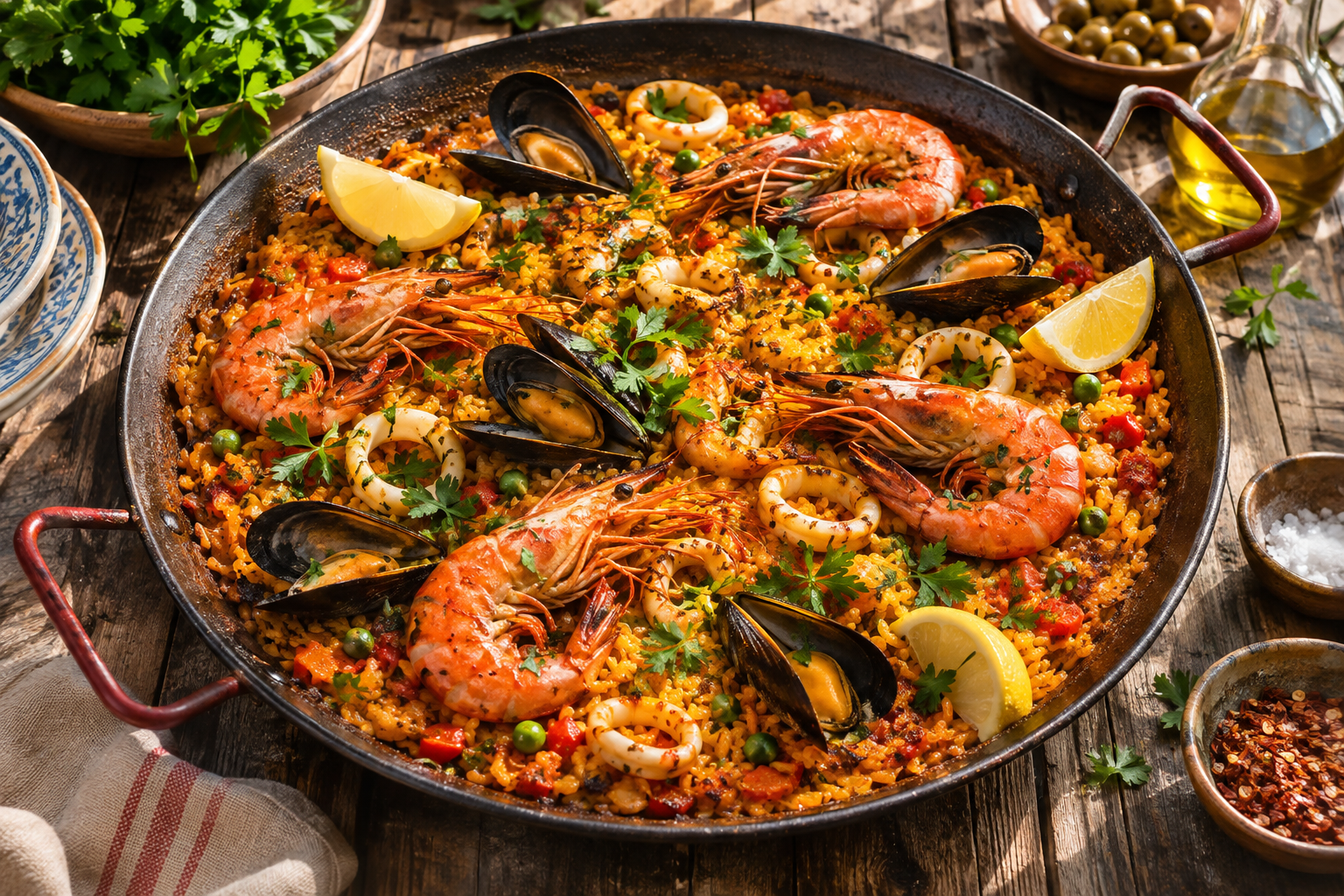
After five minutes, remove the towel. Cut a fresh lemon into thick wedges and scatter them around the edges of the pan. Sprinkle with a handful of freshly chopped flat-leaf parsley if you like a splash of green.
Carry the whole pan straight to the table. In Spain, paella is a communal celebration. Everyone grabs a large wooden spoon and eats directly from the pan, starting from their edge toward the center, scraping the golden, crunchy socarrat off the bottom of the pan as they go.
Troubleshooting: What to Do When Things Go Wrong
#Even experienced cooks occasionally run into unexpected pan quirks. Here is how to rescue your paella on the fly.
The Rice Is Still Hard, but the Broth Is Completely Gone
#This happens if your burner was set too high during the initial boil, causing the liquid to steam off into the air before the rice grains had enough time to absorb it.
The Fix: Do not stir the pan. Warm up half a cup of extra shellfish stock or hot water. Use a spoon to gently drizzle the hot liquid evenly over the surface of the rice. Cover the entire pan tightly with aluminum foil, drop the heat to the lowest possible setting, and let it steam for four to five minutes.
The Rice Is Mushy and Wet After 20 Minutes
#This happens if you used too much broth, used a pan that was too small, or kept the heat too low, preventing proper evaporation.
The Fix: Uncover the pan immediately. Turn the heat up to medium-high. Do not stir it. Let the intense heat drive the excess water out of the pan through rapid evaporation. Once the bubbling subsides and you hear the crackling sound of frying oil, drop the heat and finish the socarrat.
The Center Browns Much Faster Than the Outer Edges
#Most standard kitchen stoves have burners that are only six to eight inches across, while a good paella pan is 15 inches wide. Heat concentrates heavily in the center.
The Fix: Do not let the pan sit in one position. Every three to four minutes during the simmering phase, slide the pan so that a different quadrant sits directly over the flame. This ensures that every part of the pan receives equal cooking time and that your socarrat develops across the entire bottom, not just in a small circle in the middle.
Pair your fresh seafood paella with a chilled glass of crisp Spanish Albariño or a dry Rosado, and enjoy one of the greatest culinary traditions the Mediterranean has to offer.