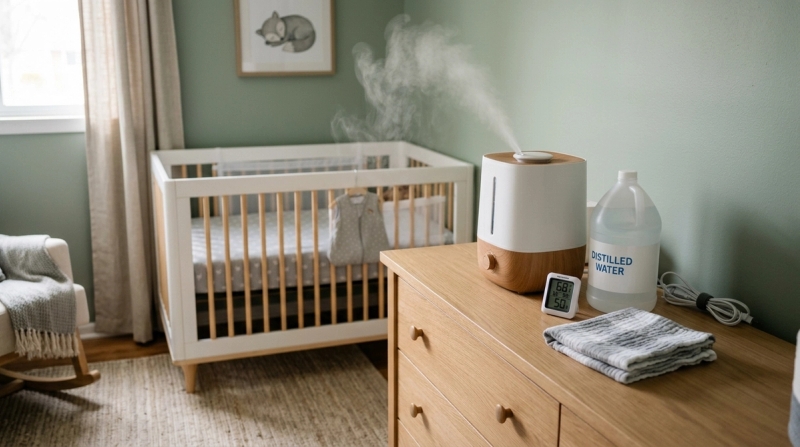
For safe baby humidifier cleaning, empty the tank every day, wipe it dry, and refill it with fresh water before the next use. Distilled water is best when you can use it. Clean portable humidifiers every third day, keep baby room humidity between about 30% and 50%, and make sure the humidifier and cord are well out of your baby’s reach.
Why Baby Humidifier Cleaning Matters
#Most parents choose a cool mist humidifier for a baby room. That makes sense because cool mist models do not use hot steam, so they avoid the burn risks that come with warm mist humidifiers or vaporizers.
Many cool mist humidifiers are ultrasonic or impeller models. These machines turn water into a fine mist and send it into the air. That is helpful when the air is dry, but if the water has a lot of minerals in it, or if the tank has mold, slime or buildup, the mist may carry more than just moisture.
The EPA notes that dirty ultrasonic and impeller humidifiers can release microorganisms and minerals into indoor air. Cleaning the humidifier is not just about making it look nice. It is part of nursery humidifier safety.
A good clean baby humidifier routine helps reduce slimy buildup, humidifier mold, chalky mineral scale, white mineral dust, musty smells and damp nursery conditions that can encourage mold growth.
Baby Humidifier Cleaning Checklist and Frequency Table
#Before cleaning any humidifier, check the manufacturer’s instructions. Some parts can be rinsed. Some should not be soaked. Some models have filters, wicks, cartridges or narrow channels that need special care.
As a general rule, the EPA recommends emptying portable humidifiers every day and cleaning them every third day. For a nursery, that is a smart routine to follow.
Important safety note: Never mix vinegar and bleach. Use one cleaning method at a time, rinse everything thoroughly and let the parts air dry.
Distilled Water and Humidifier Mineral Dust
#If you notice a thin white powder on furniture near a humidifier, that is probably humidifier mineral dust. It usually comes from tap water.
Tap water contains dissolved minerals such as calcium and magnesium. In an ultrasonic humidifier, those minerals can get pushed into the air with the mist. The EPA recommends using water with low mineral content, such as distilled water, to reduce minerals released into indoor air.
For a humidifier in a baby room, distilled water is usually the best choice.
Is filtered water enough?
#Usually, not really. A refrigerator filter or pitcher filter may improve taste and reduce some contaminants, but many common filters do not remove enough dissolved minerals to prevent white dust.
Is boiled tap water enough?
#Boiled tap water is not the same as distilled water. Boiling can kill many germs, but it does not remove dissolved minerals. Once that boiled water cools and goes into a cool mist humidifier, the minerals can still end up in the mist.
Why distilled water helps
#Distilled water is made by boiling water into steam and then condensing it back into liquid. That process leaves most minerals behind. Using distilled water can reduce white dust, slow mineral scale buildup, make cleaning easier and keep the mist closer to plain moisture.
If distilled water is hard to buy, store or afford all the time, do what you can. If you use tap water, be more watchful about white dust and more consistent with cleaning.
Cool Mist vs Warm Mist Humidifiers for Baby Rooms
#When choosing a humidifier for a baby room, the biggest safety issue is often not moisture. It is heat.
Cool mist humidifier for baby rooms
#A cool mist humidifier is generally preferred for nurseries because it does not use boiling water or hot steam. That matters even more once babies start rolling, crawling, pulling cords and reaching for everything they should not touch.
Cool mist models still need regular cleaning. Since they do not boil the water, they depend on your cleaning routine to prevent mold, mineral buildup and dirty mist.
Cool mist humidifiers are usually a better fit for nurseries, toddler rooms, shared bedrooms, small apartments and rooms where the humidifier may sit near furniture.
Warm mist humidifiers and vaporizers
#Warm mist humidifiers heat water to make steam. The problem is the heat itself. Hot water, hot steam or a hot heating element can burn a baby or toddler if the unit tips, spills or gets pulled down.
For that reason, warm mist humidifiers are usually not the best choice for rooms where babies or toddlers can reach the unit or cord.
Baby Room Humidity and Mold Prevention
#More mist is not always better. A humidifier should make dry air more comfortable. It should not make the nursery feel damp, heavy or swampy.
A good baby room humidity range is usually 30% to 50%. Once humidity goes above 50%, mold and dust mites are more likely to thrive, especially around windows, curtains, carpets, closets and bedding.
The easiest way to track this is with a small digital hygrometer. It is inexpensive, simple to use and more reliable than guessing by how the room feels.
Turn the humidifier down or off if you notice condensation on windows, damp bedding, wet carpet or furniture, a musty smell, visible mold or a room that feels heavy and sticky in the morning.
If the nursery is already humid, skip the humidifier. Running it in a damp room can make mold problems worse.
Where to Place a Humidifier in a Baby Room
#Humidifier placement matters. You want the mist to spread through the room without soaking the crib, furniture, walls or floor.
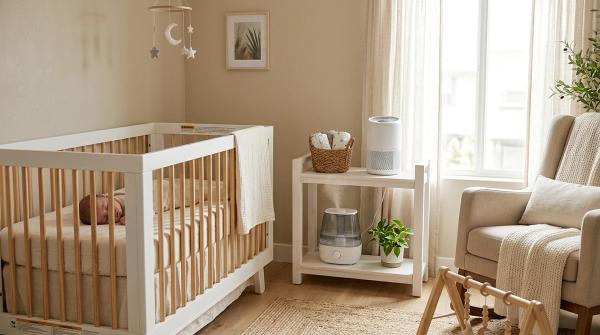
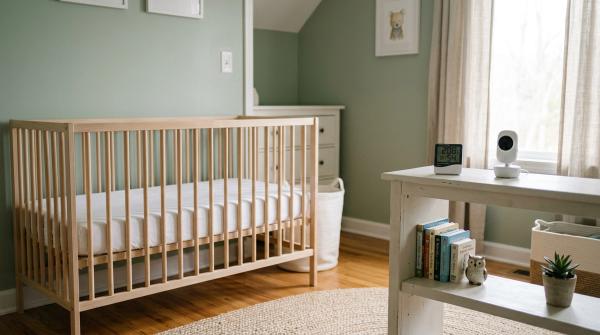
Place the humidifier on a stable, flat surface, out of your baby’s reach, away from the crib or bassinet, away from curtains and soft furniture, and in a spot where mist can spread without landing heavily in one area.
Avoid placing it on the crib rail, on the floor near a crawling baby, close enough for your baby to grab the cord, where mist blows directly at your baby, or where mist lands on bedding, walls, electronics or wood furniture.
A practical rule is to keep the humidifier a few feet from the crib and make sure the mist is not pointed at the baby’s sleep space. If anything nearby feels damp, move the unit farther away or lower the mist setting.
Cord safety matters too
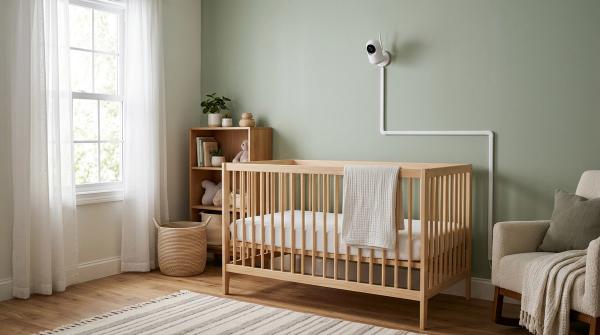
#Cord placement can be tricky, especially in apartments or small rooms where outlets are never exactly where you need them. Still, avoid loose cords near the crib or trailing across the floor.
Keep the cord behind furniture when possible, out of reach, away from walkways, and away from the crib, bassinet and play area. Do not run cords under rugs because they can overheat or become damaged without you noticing.
Common Nursery Humidifier Mistakes to Avoid
#Leaving old water in the tank
#Empty the tank every day. Even if water is left over, dump it out and start fresh.
Refilling without drying
#Topping off yesterday’s water keeps the tank wet all the time. Empty it, wipe it dry, then refill it.
Using tap water without watching for white dust
#Tap water can create mineral dust, especially in ultrasonic humidifiers. If you see white dust on nearby surfaces, switch to distilled water if possible and clean the unit.
Letting humidity climb too high
#More mist does not mean better air. Keep baby room humidity below 50% to reduce mold risk.
Pointing mist at the crib
#The crib should stay dry. Mist aimed directly at your baby can dampen bedding and nearby surfaces.
Adding essential oils
#Do not add essential oils unless the humidifier is specifically designed for them and your pediatrician says they are appropriate. Many baby humidifiers are made for plain water only. Oils can damage the machine, and scented mist may irritate some babies.
Forgetting filters, wicks or cartridges
#If your humidifier has a filter, wick or cartridge, check the manual for replacement timing. A clean tank will not help much if another damp part is overdue for replacement.
When to Skip the Humidifier
#You do not need to use a humidifier every night. Sometimes skipping it is the safer choice.
Skip the humidifier if you do not have time to clean it, the tank smells musty, you see slime, mold or heavy scale, the unit creates white dust with tap water and you do not have distilled water, the room humidity is already above 50%, windows are fogging, or bedding and furniture feel damp.
A dry room is usually better than running a dirty humidifier in the nursery.
When to Ask the Pediatrician
#A humidifier can add moisture to dry air, but it is not a medical treatment. It should not replace medical advice.
Ask your pediatrician if your baby has trouble breathing, is wheezing, has a persistent cough, seems unusually sleepy or hard to wake, has symptoms that worry you, or has a known respiratory condition and you are not sure whether a humidifier is a good idea.
If your baby is in distress, do not wait to see whether a humidifier helps. Seek medical care.
Buying and Maintenance Checks for Parents
#If you are buying a new humidifier, do not get distracted only by cute designs or extra features. The real question is: can you clean it without wanting to give up?
Look for a wide tank opening, simple parts, clear cleaning instructions, auto-shutoff, a visible tank and easy-to-find replacement filters, wicks or cartridges.
For small apartments, also think about where the humidifier will actually go. The safest model is not very helpful if there is no stable surface away from the crib or no safe way to manage the cord.
Quick Baby Humidifier Cleaning Routine
#If you only remember one routine, make it this:
- Every morning, empty the tank.
- Wipe it dry.
- Before use, refill with fresh distilled water.
- Every third day, clean and descale according to the manual.
- Weekly or as directed, disinfect if the manufacturer recommends it.
- Always keep humidity below 50%, cords out of reach and mist off the crib.
That is the heart of baby humidifier cleaning. Small daily habits do most of the work.