A good baby gate buying checklist starts with a very practical question:
Where is the gate going?
That one answer changes almost everything.
At the top of stairs, use a hardware-mounted baby gate. No exceptions. For lower-risk spots, like doorways, hallways, kitchens, or room entrances, a pressure-mounted baby gate may be a good fit if the opening is flat, sturdy, and the gate can be installed tightly.
Before you buy, take a few minutes to measure the space, check the walls and baseboards, read the product details, and look up recalls through the U.S. Consumer Product Safety Commission at cpsc.gov.
Baby gates look simple, but they are not one-size-fits-all. A gate that works perfectly in a kitchen doorway may be the wrong choice for stairs. A gate that fits a newer apartment may not sit right in an older home with thick trim or uneven walls. And even the best gate still has to be installed correctly.
This guide walks through what to check for stairs, doorways, kitchens, bathrooms, rentals, and small apartments so you can choose a gate that fits your home and your daily routine.
Quick Comparison: Pressure-Mounted vs. Hardware-Mounted Baby Gates
#Most baby gates fall into two main categories: pressure-mounted and hardware-mounted.
The simple version: pressure-mounted gates are convenient. Hardware-mounted gates are more secure. For stairs, especially the top of stairs, choose hardware-mounted.
Where to Use Each Type of Baby Gate
#Top of Stairs
#Use a hardware-mounted baby gate at the top of stairs.
This is the spot where you really do not want to take chances. A pressure-mounted gate can loosen, shift, or pop out if enough force hits it. Many also have a bottom bar, which can be a tripping hazard for adults, especially when carrying a baby, laundry basket, groceries, or anything else that blocks your view.
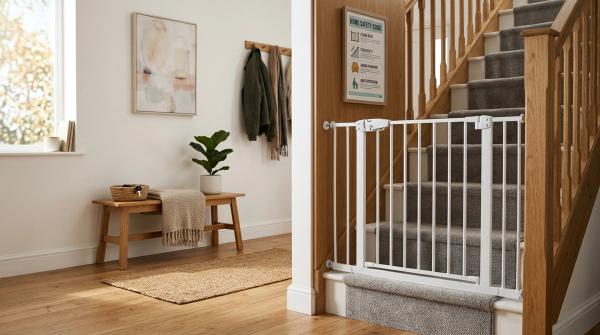
For a baby gate for stairs, choose one that clearly says it is made for stair use. Install it exactly as the manufacturer instructs. The mounting points should be solid, such as wall studs, solid wood trim, a secure door frame, or a proper banister adapter kit.
A good top-of-stairs gate should swing open like a door, latch securely, and never require anyone to step over it.
Bottom of Stairs
#The bottom of stairs gives you a little more flexibility.
A hardware-mounted gate is still a strong choice, especially in a high-traffic area. A pressure-mounted gate may be okay at the bottom of stairs if it sits on the floor level, fits tightly, and does not rest on a step.
Do not place a gate halfway up the stairs. The goal is to stop your child before climbing starts.
If one side is a wall and the other is a banister, check whether you need a banister adapter. Rounded posts, unusual shapes, and metal spindles can make standard flat mounting cups less reliable.
Doorways and Hallways
#Doorways and hallways are where pressure-mounted gates often make the most sense. They are useful for blocking bathrooms, bedrooms, laundry rooms, home offices, or any room that is not ready for a crawling baby or curious toddler.
Before buying, make sure both sides of the opening are flat and sturdy enough to hold pressure. Loose trim, narrow molding, uneven walls, or delicate plaster can make a gate less stable than it looks.
For doorways you walk through often, look for a walk-through gate instead of one you have to step over. A one-handed latch is also helpful because, realistically, you will probably be carrying a child, a coffee, a basket of laundry, or all three.
Kitchens
#A kitchen gate is mostly about controlling access.
It can help keep a child away from hot pans, sharp tools, cleaning supplies, pet bowls, breakable dishes, and the general chaos that comes with cooking.
For a standard kitchen doorway, a pressure-mounted baby gate may work well if the doorway is flat and the gate can be tightened properly. If the opening is wide, angled, or not a standard doorway, you may need a hardware-mounted or configurable gate.
Choose a kitchen gate that adults can open and close easily every time. If it is annoying to use, someone will eventually leave it open. That tends to happen faster than anyone expects.
Bathrooms
#Bathrooms are full of hazards: medicines, cleaning products, water, slippery floors, hard surfaces, toilets, drawers, and cabinets. A doorway gate can help, but it should not be the only babyproofing step.
If the bathroom doorway is standard and flat, a pressure-mounted gate may be enough. If the doorway is narrow, check the gate’s minimum width before buying. Some gates look compact online but still need more room than a small bathroom doorway has.
Living Rooms and Play Areas
#For open living rooms, you may need a wider child safety gate or a play-yard style barrier. These can be helpful when you want to create one safer play area in a room with electronics, plants, stairs nearby, or furniture you do not want climbed.
Measure the full span carefully. Wide gates often need wall cups, hardware support, or approved extension panels. Do not assume one extra-wide gate will fit every open layout. It might not.
Apartment Babyproofing: Gate Checks for Renters and Small Spaces
#Apartment babyproofing can be a little tricky. You may be dealing with landlord rules, narrow doorways, thick baseboards, metal railings, or walls that are difficult to drill into.
Still, the main safety rules do not change.
If Your Apartment Has Stairs
#If there are stairs inside your apartment or rental home, use a hardware-mounted gate at the top.
If drilling is a concern, talk to your landlord early. Explain that this is a child safety issue, not just a decorating preference. Small holes can usually be patched later, but a top-of-stairs gate needs a secure mount.
If the staircase has banisters, look for a compatible banister installation kit. These kits can create a flatter, stronger mounting surface without drilling directly into the banister. Just make sure the kit works with your exact gate and railing shape.
If You Cannot Drill in Doorways
#For regular doorways and hallways, a pressure-mounted baby gate is often the easiest rental-friendly option. It creates a boundary without permanent holes.
Check for:
- Flat surfaces on both sides
- Enough width for the gate’s adjustment range
- No loose trim
- No crumbling paint or fragile plaster where the pads sit
- A door swing that will not hit the gate
If Your Apartment Is Small
#In a small apartment, think in zones. You probably do not need a gate in every doorway. You may only need one or two good boundaries between your baby’s main play space and the kitchen, bathroom, stairs, or entryway.
Ask yourself:
- Where does the baby spend the most time?
- Which room has the most hazards?
- Which doorway do adults use the most?
- Will a swing-open gate block a cabinet, closet, or front door?
- Can you open the gate while holding a child?
Small spaces make convenience extra important. A gate can be technically safe, but if it is frustrating to use, it probably will not be used consistently.
Measuring and Fit Checks Before You Buy
#Do this before you add a gate to your cart. A few minutes with a tape measure can save you from returns, bad fits, and unsafe setups.
1. Measure the Opening in More Than One Place
#Measure the width:
- At the floor
- Around latch height
- Near the top of where the gate will sit
Older homes and apartments are not always square. A doorway may be slightly wider at the top than at the bottom. A pressure-mounted gate needs enough adjustment range to handle that difference.
2. Check the Gate’s Width Range
#Every gate has a minimum and maximum width. Make sure your opening fits within that range without pushing the gate to its absolute limit.
If you need extensions, use only the extensions approved by the gate manufacturer. Mixing parts from different gates can affect the latch, the frame, and how securely the gate holds.
3. Look at Baseboards and Trim
#Baseboards can turn a simple doorway into a more complicated fit.
The bottom of the gate may touch the trim while the top touches the wall, which can create an uneven setup.
For pressure-mounted gates, check whether the side spindles adjust independently. This can help when the top and bottom contact points do not line up perfectly.
For hardware-mounted gates, make sure the screws will go into a solid surface and that the baseboard does not block the lower bracket.
4. Find Solid Mounting Points
#For a hardware-mounted baby gate, do not rely on hollow drywall alone. The screws need to bite into something strong, such as a stud, solid wood frame, or manufacturer-approved mounting board.
If the stud is not where you need the gate, follow the instructions for approved mounting options. Some setups may need a wood mounting board secured properly before the gate brackets are attached.
5. Check the Floor
#Uneven flooring can affect how a gate swings, latches, or sits under pressure.
Look for:
- Sloped floors
- Thick rugs
- Raised thresholds
- Stair nosing
- Tile transitions
- Loose floor trim
At the top of stairs, avoid any setup that makes an adult step over a bar or awkward edge.
6. Think About the Latch Side
#A gate can fit the opening and still be frustrating, awkward, or unsafe if it opens the wrong way.
Before buying, picture how you will use it every day:
- Which side will you stand on when opening it?
- Will the gate swing toward the stairs?
- Will it block a hallway?
- Can you open it with one hand?
- Does it close and latch clearly?
For stair gates, follow the manufacturer’s directions for swing direction and stopper use.
Label, Standard, and Recall Checks
#A baby gate is safety equipment, so the label matters.
When shopping, check the packaging, product page, and instruction manual for safety information. In the U.S., look for gates that say they meet the applicable ASTM standard for safety gates and enclosures. You may also see JPMA certification on some products.
Also do a gate recall check through the U.S. Consumer Product Safety Commission at cpsc.gov. Search by brand and model number if you have it. Recalls can involve latch problems, spacing issues, or other safety defects, so it is worth checking before you install.
Keep or write down:
- Brand
- Model name
- Model number
- Manufacture date, if listed
- Customer service contact
- Instruction manual link or copy
This makes it easier to check future safety notices or order the right parts later.
Room-by-Room Baby Gate Checklist
#Use this quick checklist before buying.
Common Baby Gate Mistakes to Avoid
#Using a Pressure-Mounted Gate at the Top of Stairs
#This is the big one. Pressure-mounted gates are not the right choice for the top of stairs. Use a hardware-mounted baby gate designed for stair use.
Measuring Only Once
#A doorway can be wider at the top than at the bottom. Baseboards can also change the usable width. Measure in several places, not just one.
Ignoring the Bottom Bar
#Many pressure-mounted gates have a bottom bar. That may be fine in a doorway, but it is not something you want at the top of stairs. It can also be irritating in a hallway that gets a lot of traffic.
Mounting Into Weak Surfaces
#A hardware-mounted gate is only as strong as what it is attached to. Screws in weak drywall, loose trim, or shaky banisters will not give the same security as a solid mounting point.
Choosing Looks Over Fit
#A gate that matches your decor but does not fit well is not the right gate. Fit, latch quality, and correct installation matter more than color or style.
Forgetting to Recheck After Installation
#Gates get used all day. They need to be checked regularly.
Look for:
- Loose screws
- Shifting pressure pads
- A latch that does not catch cleanly
- Bent parts
- Missing wall cups or hardware
- A child trying to climb or shake the gate
If something feels loose, do not ignore it. Stop using the gate until it is fixed according to the manual.
A Simple Baby Gate Buying Checklist
#Before you buy, answer these questions.
Location
#- Is this for the top of stairs?
- Is this for the bottom of stairs?
- Is it for a doorway, hallway, kitchen, bathroom, or play zone?
- Will adults walk through often?
Gate Type
#- Do I need a hardware-mounted gate?
- Is a pressure-mounted gate safe for this spot?
- Does the gate say it is suitable for stair use, if I am using it near stairs?
Measurements
#- What is the width at the floor?
- What is the width at latch height?
- Are there baseboards or uneven trim?
- Is the floor level?
- Do I need approved extensions?
Mounting Surface
#- Are there wall studs or solid wood where the brackets go?
- Is one side a banister?
- Do I need a banister adapter kit?
- Are the walls strong enough for pressure pads or hardware?
Apartment and Rental Fit
#- Am I allowed to drill where needed?
- If not, is there an approved adapter option?
- Can holes be patched later?
- Will the gate block doors, cabinets, or walkways?
Safety Label and Recall Check
#- Does the product list an applicable ASTM safety standard?
- Is there a model number and manufacturer information?
- Have I checked cpsc.gov for recalls?
- Do I have the instruction manual?
Daily Use
#- Can adults open it with one hand?
- Does it latch clearly?
- Will everyone in the home close it every time?
- Is there any part someone might trip over?
Final Note
#This guide is general information for choosing and installing babyproofing gates. It is not a replacement for your specific product manual or professional childproofing advice. Always follow the manufacturer’s instructions for the exact gate, location, and hardware you are using.