If you’re standing in the baby-care aisle wondering, “Do I need a sunscreen stick or a lotion?” the most practical answer is: probably both, but for different moments.
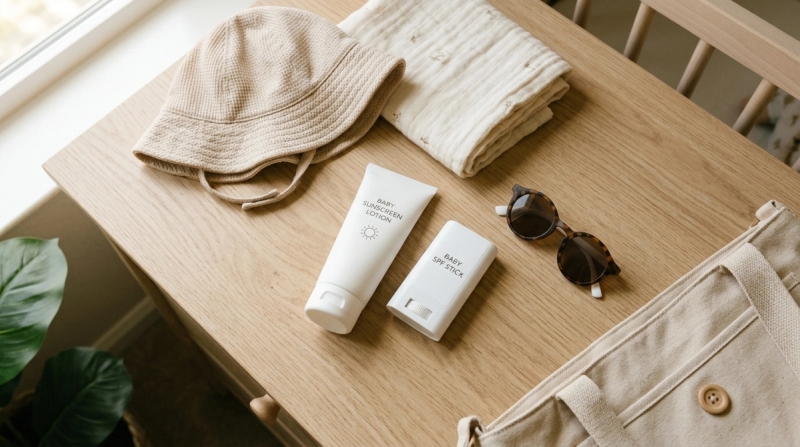
Use baby sunscreen lotion for the first proper layer before you go outside, especially on bigger areas like arms, legs, neck, and feet. Keep a baby sunscreen stick for the small, fussy spots — cheeks, ears, nose, hands, tops of feet — and for quick touch-ups when your child is wriggling, sweaty, or absolutely done cooperating.
For babies under 6 months, though, sunscreen should not be your main plan. Shade, clothing, hats, and avoiding direct sun come first. For babies 6 months and older, a broad-spectrum, water-resistant SPF 30+ sunscreen can be used on exposed skin.
New parents already have enough to manage. Sun protection should feel simple, not like another complicated routine. So let’s break it down in a real-life way.
First Things First: Babies Under 6 Months Need Shade First
#Before comparing baby sunscreen stick vs lotion, start with your baby’s age.
The FDA and AAP advise keeping babies under 6 months out of direct sunlight as much as possible. Their skin is very delicate, and the safest plan is to use physical protection first.
For babies under 6 months, focus on:
- Deep shade from a tree, umbrella, stroller canopy, or covered area
- Lightweight, tightly woven clothing that covers arms and legs
- A wide-brimmed hat that shades the face, ears, and neck
- Outdoor time earlier in the morning or later in the afternoon
- Avoiding strong midday sun, especially in hot weather
This is especially important in Indian summers, where heat and humidity can become intense very quickly. Sunlight also reflects off roads, terraces, balconies, sand, water, and light-coloured walls, so babies may get more sun exposure than you realise.
Once your baby is 6 months or older, the AAD recommends using broad-spectrum, water-resistant SPF 30+ sunscreen on exposed skin. Even then, sunscreen is only one part of sun protection. It should be used along with shade, hats, clothing, and sensible outdoor timing.
Sunscreen does not mean your child can safely stay in strong sun for longer.
Baby Sunscreen Stick vs Lotion: Quick Comparison
#Both lotion and stick sunscreen can be useful. The real question is not, “Which one is better?” It is, “Which one is better for this situation?”
Simple takeaway: Use baby sunscreen lotion as the main layer, and use a baby sunscreen stick for touch-ups and tricky little areas.
When Lotion Makes More Sense
#A baby sunscreen lotion is usually the better choice before you leave home.
It spreads more easily over larger areas like arms, legs, shoulders, the back of the neck, and the tops of the feet. You can also feel where you’ve applied it, which helps you avoid those random missed patches that somehow always happen when you’re in a rush.
Lotion is useful when:
- You are getting ready before a park visit
- Your toddler will be outdoors for more than a few minutes
- Several exposed areas need coverage
- You have time to apply sunscreen properly
- You want a more even first layer
Mineral sunscreens can take a little extra rubbing to spread well. A slight white cast is normal with zinc oxide or titanium dioxide formulas. Many parents don’t mind this because it helps them see where the sunscreen has actually gone.
When a Stick Makes More Sense
#A baby sunscreen stick is a lifesaver when the job is small, quick, or your child has decided they are not sitting still.
Sticks are handy for the face, ears, nose, backs of hands, and tops of feet. They are also great for travel, beach bags, diaper bags, playground visits, school pickup, weddings, or any moment when pulling out a bottle of lotion feels like too much.
A stick is useful when:
- You need to reapply quickly
- Your toddler keeps moving away
- You want less mess on your hands
- You are covering small areas
- You are outside and don’t want lotion spilling in the bag
The only thing to remember is that one quick swipe is usually not enough. Sunscreen sticks need several slow, overlapping passes so enough product actually gets onto the skin.
Think of it like colouring in a shape. If you leave gaps, those gaps are still exposed.
India Heat, Travel, and Monsoon Context
#For families in India, baby sun safety is not just a summer concern.
In many cities and towns, babies and toddlers sweat quickly because of the heat and humidity. Sunscreen can wear off faster during travel, outdoor functions, temple visits, beach trips, hill-station walks, school runs, market visits, and even long car rides.
Monsoon weather can also be misleading. A cloudy day may feel cooler, but sun protection still matters if your child is outdoors for a while. You do not need to overcomplicate it. Think shade, breathable clothes, hats, and water-resistant SPF 30+ sunscreen for children 6 months and older on exposed skin.
A few practical reminders:
- Keep sunscreen in the diaper bag, but avoid leaving it in very hot places for long
- Use shade during travel breaks, outdoor events, and long waits
- Reapply after heavy sweating, water play, or towel-drying
- Do not rely only on clouds during monsoon outings
- Pair sunscreen with hats and clothing, especially during peak heat
Mineral SPF 30+ Label Checklist
#When choosing a mineral sunscreen for baby, turn the pack around and read the label. The front may say “gentle,” “baby-safe,” or “natural,” but the actual protection details matter more.
Look for:
- Active ingredients: zinc oxide and/or titanium dioxide
- Broad-spectrum protection: helps protect against both UVA and UVB rays
- SPF 30 or higher: suitable for exposed skin on babies 6 months and older
- Water-resistant: helpful for sweat, humidity, and water play
- Fragrance-free: often better for sensitive baby and toddler skin
- Baby or child-focused formula: not always required, but easier for parents to identify
Do not choose sunscreen only because the SPF number is very high. A higher SPF does not make sunscreen an all-day shield, and it should never be a reason to keep a baby or toddler in strong sun for longer.
How to Apply Sunscreen Without Making It a Battle
#Even the best sunscreen for babies will not help much if it is applied too thinly, too late, or only once.
Here is a simple routine that works in real life.
Before Going Out
#- Apply sunscreen before outdoor exposure, not after your child is already in full sun
- Use lotion for larger exposed areas
- Cover easy-to-miss spots like ears, back of neck, tops of feet, backs of hands, and hairline
- Use enough product so the skin is properly covered
- Let the sunscreen settle before dressing, buckling into a stroller, or heading out
Using a Baby Sunscreen Stick
#- Do not rely on one swipe
- Use several overlapping passes on the same area
- Pay attention to curved spots like cheeks, ears, nose, and shoulders
- Rub in gently if the label directions say to do so
- Check edges around hats, sleeves, sandals, and collars
Reapplication
#- Reapply at least every two hours when outdoors
- Reapply sooner after water play
- Reapply after heavy sweating
- Reapply after towel-drying
- Use a stick for quick touch-ups, but use lotion again if larger areas need fresh coverage
And because it’s worth repeating: sunscreen does not make direct sun safe for unlimited time. Keep using shade, hats, covered clothing, and breaks from heat.
Common Baby Sun-Protection Mistakes to Avoid
#Mistake 1: Using sunscreen as the only protection
#Sunscreen helps, but it is not the whole plan. Babies and toddlers still need shade, hats, clothing, and smart timing.
Mistake 2: Forgetting tiny exposed areas
#Ears, hands, feet, the back of the neck, and the hairline are very easy to miss. These are exactly the areas where a baby sunscreen stick can be useful.
Mistake 3: Applying too little
#A rushed, thin layer can leave gaps. Lotion should be spread carefully. Sticks should be applied with slow, overlapping strokes.
Mistake 4: Skipping reapplication
#Sweat, water, wiping, towels, and time all reduce coverage. Reapplication is part of using sunscreen properly, even if it feels like one more thing to remember.
Mistake 5: Trusting cloudy weather
#Clouds can make outdoor time feel safer than it is. During monsoon or humid weather, keep the same basic infant sun protection habits.
So, Which Should New Parents Buy?
#If you are buying only one product, start with a baby sunscreen lotion. It is more practical for full, even coverage before going outdoors.
If you can, use both:
- Baby sunscreen lotion for the first layer at home
- Baby sunscreen stick for the face, ears, hands, feet, and quick reapplication outside
This combination is especially useful for toddlers, travel, humid weather, and busy days when perfect routines are simply not happening.
The goal is not to build a fancy sunscreen collection. The goal is simple, repeatable baby sun safety that you can actually manage.