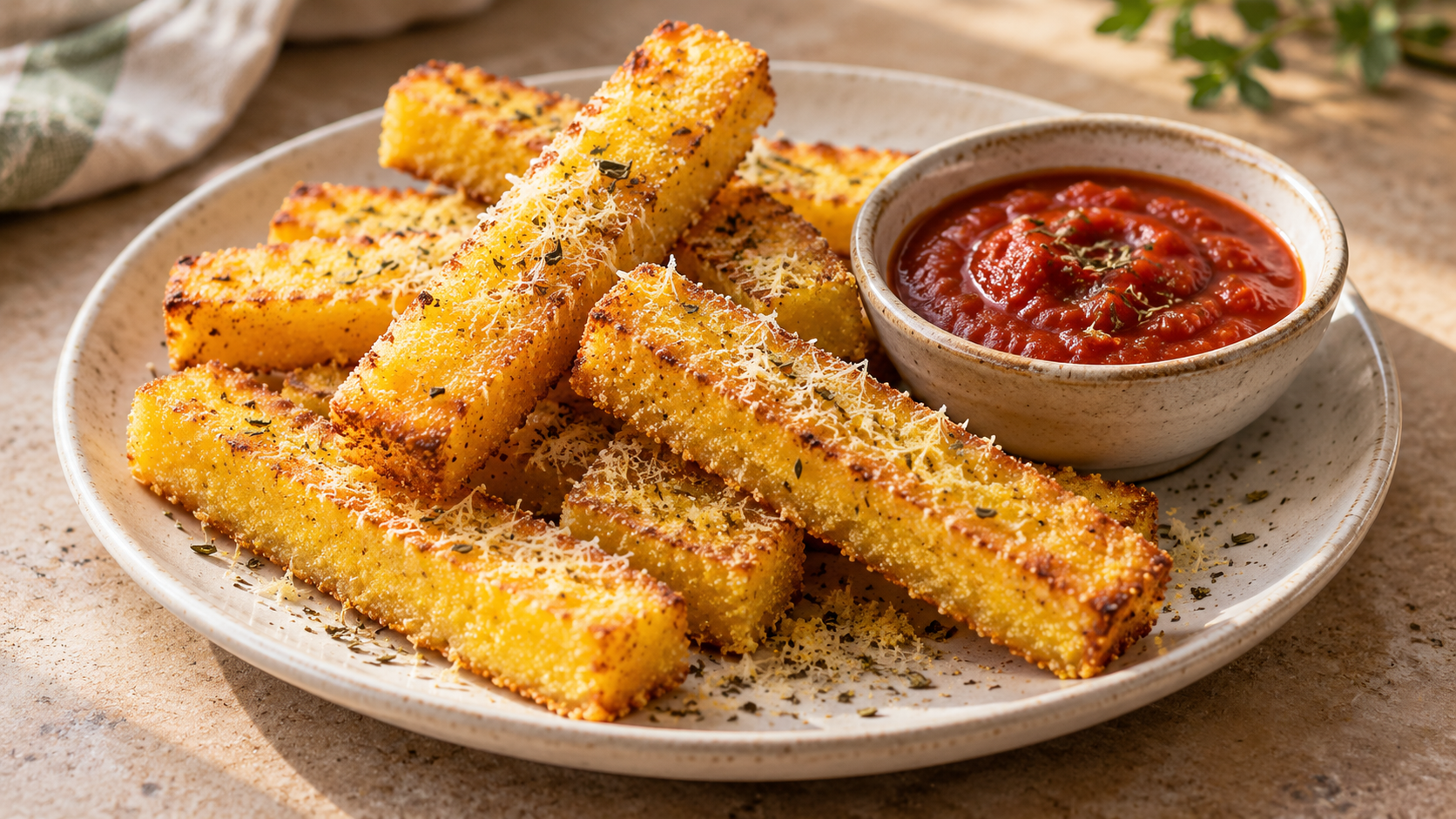
Baked polenta fries start with cooked cornmeal that is chilled until firm, cut into batons and baked with a light coating of oil. The result should have golden edges and a soft, creamy middle. If the slab cannot hold a clean cut before it goes into the oven, it is not ready to become fries.
This version uses quick-cook polenta, a little hard cheese and oregano. The measured recipe appears in the recipe card; the guide explains the choices and the checks that matter along the way. Plan for chilling as well as cooking. Quick-cook describes the first stage, not the whole meal.
What polenta fries actually are
#Polenta is a cornmeal preparation associated with northern Italian cooking. Served straight from the saucepan, it can be soft enough to spoon. Allowed to set, it can be sliced and cooked again. Polenta fries use that second form: their shape comes from cutting a firm slab, rather than shaping raw dough or coating strips of potato.
That distinction helps set expectations. These are not supposed to have the fluffy centre of a potato chip or the stretch of a cheese stick. A little cornmeal texture is normal. Look for a contrast between the browned surface and the tender interior, rather than trying to make every part completely dry.
They fit naturally beside roast vegetables, a salad or a main dish with a sauce. As a snack, keep a dip alongside the plate. A spoonful of sauce on each bite gives you more control over texture than pouring sauce over the whole batch.
Buy the right kind of polenta
#The word on the front of the packet is only the starting point. Check whether the contents are dry grain, an instant product or a cooked block.
| Product | What it means for this recipe |
|---|---|
| Dry quick-cook or instant polenta | The intended ingredient for the recipe card; check its cooking directions before starting |
| Traditional dry polenta | Needs its own longer cooking method; do not use the instant timing |
| Ready-cooked firm polenta | Already past the saucepan and setting stages; slice and season it separately |
| Cornflour, cornstarch or a cornmeal baking mix | Not the ingredient specified here |
Manufacturers use different milling and processing methods. A packet called cornmeal is not automatically a direct replacement for quick-cook polenta. Choose a product explicitly intended for making polenta, with directions that make clear how it cooks.
If you already own traditional polenta, there is no need to treat it as a bad ingredient. It simply belongs to a different schedule. Cook it properly according to its packet before considering a set-and-bake preparation. Trying to save time by stopping early can leave you with grain that is thick but still unpleasantly gritty.
For a first batch, avoid making several substitutions at once. Using the specified quick-cook product gives you a clearer starting point than changing the grain, cheese, liquid and baking method together.
Check the packet before committing the ingredients
#Polenta recipes use different liquid ratios because the products and intended results differ. Soft polenta for a bowl and firm polenta for slicing do not have the same job. Do not combine the liquid quantity from one recipe with the cooking time from another and assume they are interchangeable.
The card below uses the quick-cook polenta base documented by Jennifer Joyce for Jamie magazine, served here without its separate pesto recipe. The added guide focuses on recognising the stages and making practical decisions. It is a researched preparation, without a claim of personal kitchen testing.
Read your packet before putting the stock on the heat. If its instructions differ substantially from the card, choose a compatible product or a method written for that particular polenta. A clear method is more useful than trying to rescue an uncertain combination after everything is in the pot.
Keep the packet beside you while cooking, especially if it is a brand you have not used before. Once the grain starts thickening, it is easy to forget whether the quoted time was for instant polenta or the traditional kind.
Set up the tin and tray first
#You need a saucepan, whisk, sturdy spoon or spatula, a lined setting tin, a knife and a baking tray. The tin gives the cooked polenta its slab shape; the baking tray gives the cut pieces room to brown. They have different jobs, even if you happen to use one pan for both stages.
Prepare the setting tin before cooking. Hot polenta is easier to spread while it is still workable, so searching for baking paper after taking the pan off the heat makes the job harder. Smooth it into a reasonably even layer, including the corners, rather than leaving a high mound in the centre.
Before cutting, think about the tray as well. Lay the fries out in one layer with visible spaces. If a larger batch needs another tray, use one. Doubling the ingredients does not mean that the original tray has gained twice the surface area.
That is also a useful reason to make a modest first batch. You can learn how the polenta sets and how your oven browns it without managing multiple trays or a crowded serving schedule.
Three checkpoints that matter more than a perfect timer
#The saucepan: thickened and properly cooked
#Add the polenta gradually while whisking. A sudden heap is harder to mix evenly than a steady stream. Follow the specified quick-cook method, stirring as required, and pay attention to the mixture rather than leaving it unattended because the ingredient is labelled instant.
The aim is a cohesive mixture that can be spread into a tin. Do not confuse the first sign of thickening with proof that every type of cornmeal has finished cooking. The product directions still matter.
If the mixture has a few lumps, address them while it is still in the saucepan. Once spread into a slab, the same lumps become part of the pieces you are trying to cut. Adding more cheese is a seasoning choice, not a reliable way to correct a poorly mixed base.
The refrigerator: firm enough to lift and slice
#Chilling is part of the method. It is not a decorative pause that can always be removed when dinner is late. The slab needs to support itself when released from the tin and hold its edges under a knife.
Check a corner before cutting the whole batch. If it bends into a soft scoop or smears across the board, stop and give it more refrigerator time. Cutting a few test pieces is more useful than turning the entire slab into fragile strips and hoping the oven will repair them.
Keep the pieces broadly similar. A few rough edges are fine; a tray containing both tiny slivers and large blocks is harder to judge. The smaller pieces may be ready while the thickest ones still need time.
The oven: browning on the surfaces
#A finished fry should have colour, especially at its edges and underneath. Carefully lift one with a spatula to look at the base. The clock tells you when to check; it cannot show you what is happening beneath the food.
Oven performance, tray size and the dimensions of the pieces all affect the result. Start checking around the stated baking time, then use colour and texture to decide whether the batch needs longer. Do not keep baking indefinitely just to make the centre as crisp as the outside. A creamy centre is part of the dish.
When the fries are soft, broken or uneven
#Work backwards from the stage where the problem first appeared. A slab that broke on the board needs a different response from a solid batch that stayed pale in the oven.
| What you notice | What to check first | Practical response |
|---|---|---|
| Pieces collapse while cutting | Whether the slab is fully chilled and firm | Stop cutting and refrigerate longer; reconsider the base method if it never sets |
| Pale sides and a soft surface | Tray crowding, oil coverage and actual browning | Separate the pieces and continue checking; use another tray if needed |
| Some pieces darken much earlier | Unequal sizes or uneven browning across the tray | Remove ready pieces and check the rest individually |
| A crunchy coating surrounds gritty grain | Whether the polenta was fully cooked before setting | Next time correct the saucepan stage; surface browning cannot replace it |
| Good fries soften after serving | Whether they were piled up or covered in dip | Serve in a shallow layer and keep sauce alongside |
These are troubleshooting checks, not a promise that every failed batch can become perfect fries. If the base never became sliceable, spooning it into a bowl may be more sensible than repeatedly trying to force a clean cut. That changes the serving, but avoids making a small cooking problem into a larger one.
Change one thing on the next attempt. For example, if the slab was firm but the tray was crowded, solve the tray problem before changing the liquid ratio. Otherwise you will not know which change helped.
Flavour choices and dietary checks
#Oregano and hard cheese give this version a simple savoury direction. You do not need a long seasoning list to make the corn flavour useful. Pick a dip that brings a different quality: tomato sauce for a bright contrast, a herby sauce for freshness, or a creamy dip if that suits the rest of the meal.
Treat these as serving choices rather than measured additional recipes. A shop-bought sauce can keep the preparation manageable. Taste it alongside a finished fry before adding extra salt to the entire plate, particularly when the stock and cheese are already seasoned.
If vegetarian suitability matters, check the hard cheese for vegetarian rennet and use vegetable stock. Do not assume that every cheese sold as a Parmesan-style topping has the same ingredients or dietary status. Use the label on the actual product you buy.
Corn is naturally gluten-free, but the finished dish depends on every ingredient and its handling. Choose appropriately labelled polenta, stock, cheese and dipping sauce when gluten avoidance is necessary. Breadcrumbs are not part of this version; adding a breadcrumb coating changes that check.
For a dairy-free or vegan meal, select a recipe designed for that purpose rather than assuming an unmeasured cheese substitution will behave identically. This card contains cheese, and the result described here is based on that formulation.
Make the chilling stage work with dinner
#This is a useful preparation to split across two sessions. Make and refrigerate the slab first, then cut and bake when you need the side dish. A refrigerated slab prepared the day before is an established option in published polenta-fries methods.
For an illustrative dinner plan, imagine serving the fries with roast vegetables and a salad. Prepare the slab ahead, make the salad while the fries bake, and put the dip into a bowl before taking the tray out. This is a sequencing example, not a tested combined cooking schedule. Check oven space and the vegetables' own temperature requirements before planning both on the same rack.
The important distinction is between preparing early and baking early. The slab can wait in the refrigerator; the finished fries are more enjoyable when served with their freshly browned surfaces. If guests are arriving over a long period, consider baking smaller batches instead of making one large mound at the start.
Store and reheat with safety and texture in mind
#Refrigerate cooked polenta promptly in shallow containers. USDA home guidance says to refrigerate perishable leftovers within two hours, or within one hour above 32°C/90°F, and keep the refrigerator at 4°C/40°F or below. Do not leave the slab on the counter for its entire setting period.
Use refrigerated leftovers within three to four days. Reheat leftovers to 74°C/165°F, checking the centre rather than judging only the browned edges. Reheating does not make food safe if it has already been left out too long.
For texture, an oven gives you a chance to restore the surface. Spread the pieces out again and check that they heat through. A microwave may be convenient for warming, but do not expect it to reproduce the same dry, browned finish.
Store the dip separately. When reheating, take only the portion you intend to eat so the rest can remain refrigerated. If your main aim is a crisp snack for guests, making the slab ahead and baking it close to serving is the simpler plan than relying on reheated fries to match a fresh batch.