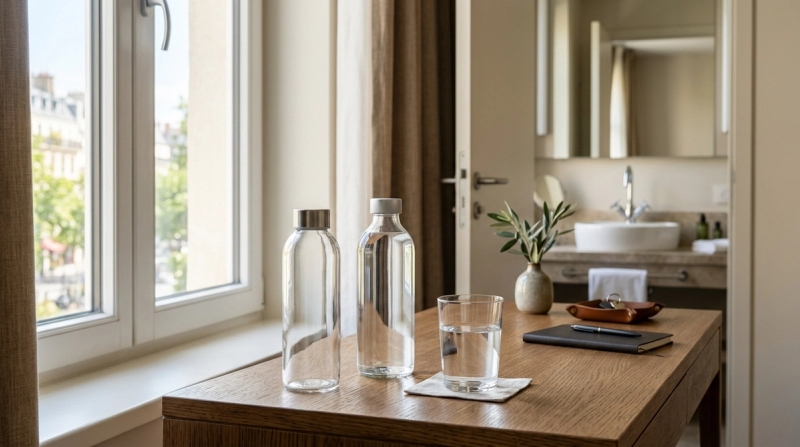
You’ve finally made it to your hotel.
Maybe you’ve been on a plane all day. Maybe your taxi driver took the scenic route without asking. Maybe you dragged your suitcase over six blocks of cobblestones and now you’re standing in your room, sweaty, tired, and extremely thirsty.
Your reusable bottle is empty. There’s a sink right there.
And then the thought hits: can I actually drink hotel tap water?
The honest answer is: it depends.
In some places, hotel tap water is completely fine. In others, it’s something you should avoid. And in plenty of destinations, the smartest move is to check before you fill up.
Hotel tap water safety depends on more than the star rating of the hotel. It depends on the country, the city, the local water system, the building’s pipes, storage tanks, filters, and whether there are any current water warnings.
A luxury hotel can still have water you shouldn’t drink. A simple guesthouse can have perfectly safe tap water.
So instead of guessing, use this practical traveler’s checklist.
No panic. No overthinking. Just a few quick things to check before you drink from the hotel sink.
Quick Answer: Is Hotel Tap Water Safe?
#Sometimes, yes.
Hotel tap water is usually safe in places with reliable public drinking-water systems, but you should still check local advice before assuming.
Here’s the short version:
- Hotel tap water can be safe in destinations with strong public water systems.
- Do not assume it is safe just because the hotel looks clean, modern, or expensive.
- If official travel advice says to avoid tap water, avoid it.
- If tap water is unsafe, be careful with ice, toothbrushing, and rinsing your bottle too.
- Boiling can kill many germs, but it does not remove chemicals, heavy metals, or lead.
- Reusable bottles are only helpful if you keep them clean.
The safest habit is simple: check the destination, ask the hotel, look for local alerts, and use bottled or properly treated water if anything feels uncertain.
Why Hotel Tap Water Safety Varies So Much
#Hotel water safety is not only about the country you’re visiting. It’s also about what happens to the water before it reaches your glass.
There are two main things to think about.
1. The Local Water System
#Some cities have excellent drinking-water systems, regular testing, modern treatment plants, and strong safety rules. In those places, locals and visitors commonly drink tap water without any issue.
Other places may have older infrastructure, inconsistent treatment, storm damage, agricultural runoff, or water that is not recommended for travelers.
And even in countries where tap water is usually safe, temporary problems can happen.
For example:
- Flooding
- Broken water mains
- Construction work
- Power outages
- Boil-water notices
- Contamination alerts
- Damage after storms or natural disasters
Water quality can also vary a lot within the same country.
The tap water in a major city may be fine, while water in a rural village, remote island, mountain lodge, or beach town may not be treated to the same standard.
So “Is tap water safe in this country?” is a useful starting point, but it’s not the whole answer.
2. The Hotel or Rental Building
#Even if the city water is safe, it still has to travel through the building.
That means pipes, tanks, pumps, filters, faucets, and sometimes rooftop storage tanks.
A well-maintained hotel may have a good internal water system. Some resorts even have their own filtration or purification setup.
But older buildings, rusty pipes, dirty tanks, rarely used taps, or poor maintenance can create problems.
This applies to more than hotels. Hostels, apartments, guesthouses, vacation rentals, homestays, and remote lodges can all vary.
A beautiful rental with great photos does not automatically mean the tap water is safe to drink.
Hotel Tap Water Checklist: What to Check Before You Drink
#Before you refill your bottle from the hotel sink, run through this quick checklist.
1. Check Official Destination Advice
#Before your trip, or when you arrive, look up official water and health guidance for your destination.
Good places to check include:
- Your government’s travel advisory website
- CDC Travelers’ Health pages
- Local health department updates
- City or regional water authority notices
- Hotel or host information for the exact area where you’re staying
Look specifically for food and water safety advice.
If official guidance says travelers should avoid tap water, do not drink hotel tap water unless it has been properly treated.
Also check for temporary alerts. A city with normally safe water can still have a short-term boil-water notice after flooding, pipe repairs, or contamination.
2. Ask the Hotel or Host
#This is one of the easiest checks, and hotel staff are used to hearing the question.
Instead of only asking, “Is the water safe?” try asking more specific questions:
- “Do guests usually drink the tap water here?”
- “Do you recommend bottled water for drinking?”
- “Should I use bottled water to brush my teeth?”
- “Is the ice made from filtered or purified water?”
- “Does the hotel use city water, well water, storage tanks, or filters?”
- “Are there any current boil-water notices?”
Pay attention to the answer.
If staff hesitate, seem unsure, give a vague response, or say most guests use bottled water, take that seriously.
For vacation rentals, ask the host before you arrive. If the answer is unclear, plan to buy sealed bottled water or bring a reliable water treatment method.
3. Look at the Water
#Looking at water cannot prove it is safe. Clear water can still carry germs or contaminants.
But your senses can help you spot obvious problems.
Run the tap for about 30 seconds. Then fill a clear glass and take a look.
Watch for:
- Cloudiness that does not clear
- Brown, yellow, or rusty color
- Floating particles
- Sediment
- Strong sulfur smell
- Sewage, algae, chemical, or metallic odors
- A strange taste, if local guidance says tap water is drinkable
A mild chlorine smell can be normal in treated municipal water.
But if the water looks, smells, or tastes wrong, don’t drink it. Ask the hotel and use bottled or treated water instead.
4. Ask Which Tap to Use
#In many modern hotels, the bathroom tap and kitchenette tap come from the same treated water supply.
But that is not always true.
In older buildings, rural properties, remote lodges, or places with storage tanks, some taps may be safer than others. Sometimes the kitchen tap is the recommended one. Sometimes no tap water is recommended at all.
If you are not sure, ask:
“Which tap is safe for drinking?”
It’s a small question that can save you a lot of trouble.
5. Don’t Trust Appearances Alone
#A fancy lobby does not guarantee safe water.
A small family-run guesthouse does not automatically mean unsafe water.
What matters is the local water quality, the building’s plumbing, the hotel’s maintenance, and current guidance.
If you’re unsure, choose the safer option. Buying bottled water or using a purifier is a lot easier than losing two days of your trip to stomach problems.
Tap Water vs Bottled Water vs Filtered Water
#There is no perfect option for every trip.
The best choice depends on where you are, your health, your budget, your tolerance for risk, and how much plastic waste you want to avoid.
Option 1: Hotel Tap Water
#Hotel tap water is the easiest choice when it is safe. It’s cheap, convenient, and avoids extra plastic.
It is usually a good option when:
- Official advice says tap water is safe
- The hotel confirms guests drink it
- There are no local boil-water alerts
- The water looks and smells normal
- You are not especially vulnerable to stomach illness
Be more cautious if:
- Travelers are advised to avoid tap water in that destination
- The hotel recommends bottled water
- The building is very old or poorly maintained
- The water comes from a well, tank, or unknown source
- You have a sensitive stomach
- You have a medical condition
- You are pregnant, immunocompromised, or traveling with young children
Option 2: Bottled Water
#Factory-sealed bottled water is usually the simplest backup when tap water is not recommended.
Use bottled water for:
- Drinking
- Brushing teeth
- Taking medication
- Mixing baby formula, unless a doctor gives different advice
- Rinsing retainers, aligners, mouthguards, or medical devices
- Final rinsing of reusable bottle caps and mouthpieces
Always check the seal before drinking. The cap ring should be intact. If the bottle looks like it has already been opened, choose another one.
The downside is obvious: bottled water can be expensive, heavy to carry, and bad for plastic waste.
In places without reliable recycling, the waste adds up quickly. But when tap water is unsafe and you do not have a reliable purifier, sealed bottled water is often the safest practical choice.
Option 3: Filtered or Purified Water
#Travel filters and purifiers can be very useful, but you need the right one for the risk.
This is where many travelers get tripped up.
A simple carbon filter can improve taste and reduce some odors or chemicals, depending on the product. But a basic filter is not the same as a purifier.
Many basic bottle filters do not remove viruses. Some may not fully remove bacteria or parasites either.
For higher-risk destinations, look for a product that clearly says it treats:
- Bacteria
- Protozoa or parasites, such as Giardia and Cryptosporidium
- Viruses, if they are a risk where you’re traveling
- Sediment
- Microplastics, if that matters to you
- Chemicals or heavy metals, but only if the product is specifically designed for that
Read the instructions, even if you’re tempted to skip them.
Filters and purifiers only work if you use them correctly, clean them properly, and replace cartridges or parts on schedule.
If official advice says water should be boiled or avoided, do not assume a regular bottle filter is enough.
Ice Rules: When to Skip It
#Ice is one of those things travelers forget about until the drink is already in their hand.
But if the tap water is unsafe, the ice may be unsafe too.
Freezing does not reliably kill bacteria, viruses, or parasites. If contaminated water is frozen into ice, it can still make you sick when it melts.
Use these simple rules:
- If tap water is safe and the hotel says the ice is made from safe water, ice is usually fine.
- If local advice says not to drink tap water, skip ice unless you know it is made from purified water.
- Avoid ice from street vendors or unknown sources in higher-risk areas.
- At restaurants and bars, ask if the ice is made from filtered or purified water.
- If you’re unsure, order drinks without ice.
This applies to cocktails, soft drinks, smoothies, iced coffee, blended drinks, and anything else served over ice.
If the water source is unclear, think twice.
Brushing Your Teeth: Use the Same Rule as Drinking
#A lot of travelers remember not to drink the tap water, then brush their teeth with it without thinking.
If the tap water is unsafe to drink, it is not ideal for brushing either. You may spit most of it out, but small amounts can still be swallowed.
Use safe water for:
- Wetting your toothbrush
- Rinsing your mouth
- Cleaning retainers or aligners
- Taking tablets or supplements
- Rinsing mouthguards
- Cleaning small cuts near your mouth
A simple trick: keep one bottle of safe water next to the bathroom sink.
That way, when you’re tired or half-asleep, you don’t automatically reach for the tap.
Be extra careful with children, since they are more likely to swallow water while brushing.
Coffee, Tea, and Hotel Kettles
#Hot drinks can be safer than cold tap water, but only if the water gets hot enough.
Boiling is one of the most reliable ways to kill many germs in water. CDC guidance commonly recommends bringing water to a rolling boil for at least one minute. At higher elevations, three minutes is often recommended.
So if you properly boil water in a clean kettle and let it cool, it can be useful for:
- Drinking
- Tea
- Coffee
- Cleaning bottle parts
- Brushing teeth, once cooled
But boiling has limits.
Boiling does not remove chemical contaminants, heavy metals, lead, or other non-living pollutants. If the issue is old pipes, industrial contamination, chemical runoff, or lead, boiling may not be enough.
In some cases, boiling can even concentrate contaminants as water evaporates.
Be careful with in-room coffee makers too. Some machines heat water for brewing but may not bring it to a full rolling boil. If local tap water is not recommended, use bottled or properly treated water in the coffee machine.
Also, take a quick look inside the kettle or machine if you can. If it smells odd, has residue, or looks dirty, ask for a replacement or use another water source.
How to Make a Safer Decision by Country or City
#People often ask, “Can you drink hotel tap water in this country?”
It’s a fair question, but local detail matters.
A better approach is:
- Start with official country advice. Check your government travel page or CDC Travelers’ Health.
- Narrow it down to the city or region. Water quality can vary a lot within one country.
- Look for local notices. Search for boil-water advisories or municipal water updates.
- Ask your hotel, host, or tour operator. They know the property and the area.
- Think about your own risk. If you get stomach issues easily, are traveling with children, are pregnant, immunocompromised, or have a packed itinerary, be more cautious.
Try not to rely only on old forum posts or random social media comments.
Water systems change. A comment from five years ago may be completely wrong today.
Reusable Water Bottle Hygiene While Traveling
#Reusable bottles are great for travel. They save money, reduce plastic, and make it easier to stay hydrated.
But they can get nasty fast.
A damp bottle can develop smells, residue, and biofilm. Caps, straws, bite valves, and silicone seals are especially easy to forget about.
Here’s how to keep your bottle cleaner on the road.
Wash or Rinse It Daily
#Empty your bottle at the end of the day.
If local tap water is safe, wash it with warm water and soap, then rinse it well.
If local tap water is not safe, do not use it for the final rinse on anything that touches your mouth. Use bottled water, boiled and cooled water, or properly treated water instead.
Clean the Mouthpiece
#The mouthpiece touches your hands, your bag, airplane trays, café tables, and your mouth.
So yes, it needs attention.
If your bottle has a straw, bite valve, or narrow cap, use a small brush if you have one. If not, soak and shake it with safe soapy water, then rinse it with safe water.
Let It Dry Open
#Leave the cap off overnight when possible.
Drying helps reduce the damp conditions where bacteria and other microbes like to grow.
Don’t Mix Unsafe Water With Safe Water
#If you accidentally fill your bottle with questionable tap water, empty it and clean it before refilling.
Don’t just top it up with bottled water and hope it balances out. Unfortunately, that’s not how it works.
Be Careful in Transit
#At airports and train stations, refill only from fountains or stations clearly marked for drinking water.
On airplanes, do not fill your bottle from the bathroom tap unless it is clearly labeled as potable. If you are unsure, ask the cabin crew for drinking water.
Simple Travel Water Rules to Remember
#If you want a quick decision system, use this:
- Green light: Official advice says tap water is safe, the hotel confirms it, there are no local alerts, and the water looks and smells normal.
- Yellow light: Advice is unclear, the building is old, the water tastes or smells strange, or your stomach is sensitive. Use bottled, boiled, or properly filtered water.
- Red light: Official advice says avoid tap water, there is a boil-water advisory, the hotel recommends bottled water, or the water looks contaminated. Do not drink it untreated.
In red-light situations, remember the full list.
Avoid tap water for drinking, brushing teeth, ice, rinsing your bottle, and taking medication.
Frequently Asked Questions
#Can you drink hotel tap water?
#Sometimes.
Hotel tap water may be safe in destinations with reliable drinking-water systems and well-maintained buildings. But you should check official destination advice, local notices, and hotel guidance before drinking it.
If you are unsure, use bottled or properly treated water.
Is hotel bathroom tap water safe to drink?
#In many modern hotels, bathroom tap water comes from the same supply as other taps.
But this can vary, especially in older buildings or places with storage tanks and complicated plumbing.
If you are not sure, ask the hotel which tap is safe for drinking, if any.
Can you drink hotel tap water in Europe?
#In many parts of Europe, tap water is regulated and commonly consumed.
But it still depends on the country, region, and building. Check official travel advice and ask your hotel, especially if you are staying in an older property, rural area, island destination, or anywhere the hotel recommends bottled water.
Does boiling hotel tap water make it safe?
#Boiling can kill many bacteria, viruses, and parasites when done properly.
A rolling boil for at least one minute is commonly recommended, or three minutes at high elevations.
But boiling does not remove chemical contaminants, heavy metals, lead, or some pollutants. If the problem is chemical contamination or old plumbing, boiling may not be enough.
Is hotel ice safe?
#Only if it is made from safe water.
If tap water is not recommended where you are staying, avoid ice unless the hotel or restaurant confirms it is made from purified water.
Freezing does not reliably make contaminated water safe.
Can I brush my teeth with hotel tap water?
#If the tap water is safe to drink, yes.
If it is not safe, or you are unsure, use bottled water, boiled and cooled water, or properly treated water for brushing and rinsing.
Is bottled water always safer when traveling?
#Factory-sealed bottled water is often the easiest safe choice in places where tap water is not recommended.
Check that the seal is intact before drinking.
Bottled water is not ideal for cost or plastic waste, but it can be the right safety choice when tap or treated water is not reliable.
Are travel water filters enough?
#It depends on the filter and the water risk.
Basic carbon filters may improve taste, but they may not remove bacteria, parasites, or viruses.
For higher-risk areas, use a purifier or treatment method that clearly matches the hazards listed in official travel advice.
Always follow the product instructions, even if they’re annoying.
Can I use hotel tap water to wash fruit?
#If the tap water is not safe to drink, do not use it as the final rinse for fruit or vegetables you will eat raw.
Use bottled water, boiled and cooled water, or properly treated water instead.
In higher-risk places, choose food that is cooked and served hot, or fruit you can peel yourself.
What if I already drank questionable tap water?
#Don’t panic.
One sip does not mean you will definitely get sick.
Switch to safe water right away and pay attention to how you feel. If you develop severe diarrhea, fever, blood in your stool, ongoing vomiting, dehydration, or symptoms that worry you, get medical advice.
Final Takeaway
#So, can you drink hotel tap water?
Sometimes, yes. But check first.
Safe drinking water for travelers depends on the destination, the local situation, and the specific hotel or rental you’re staying in.
A quick check with official advice and hotel staff can save you from a miserable stomach bug.
Use bottled or treated water when needed. Skip ice when the source is unclear. Brush your teeth with safe water in higher-risk areas. Keep your reusable bottle clean.
It’s a small routine, but it makes travel easier.
Safer hydration, less guesswork, and one less thing to worry about when you just want to enjoy the trip.