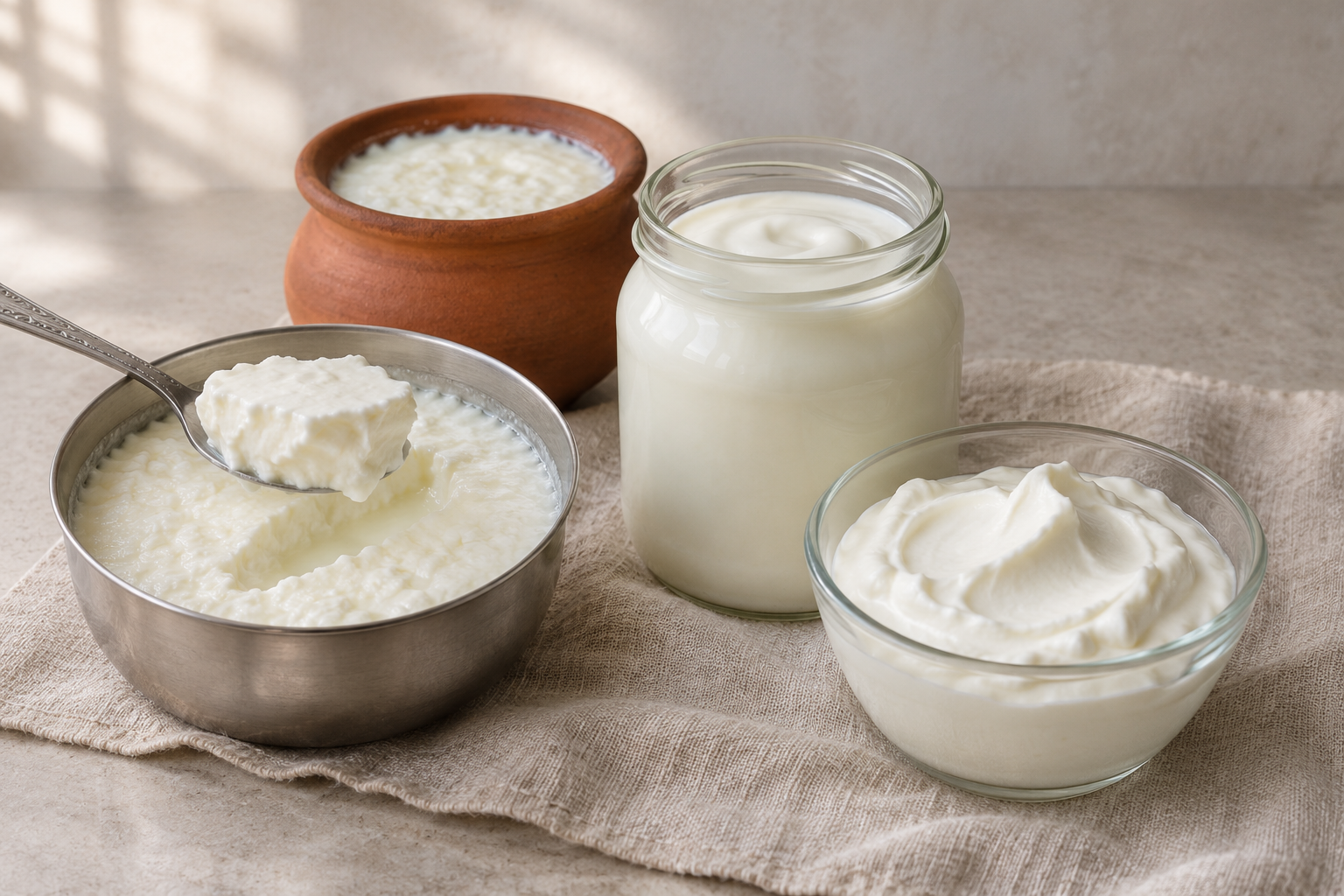
Curd and yogurt are close cousins, not exact twins. Both are milk that bacteria have soured and thickened. The real difference is which bacteria do the work: Indian dahi (curd) can be set with any suitable lactic acid bacteria, while yogurt is made with two specific bacteria working together.
For most home cooking, plain curd and plain yogurt can stand in for each other. You only need to adjust for thickness, sourness and heat. The rest of this guide shows where the difference matters, what the labels mean, and how to swap them in raita, curries, marinades and baking without spoiling the dish.
The short answer in one table
#If you only want the quick version, this covers it. Each row is explained further down.
| Point | Indian curd (dahi) | Yogurt |
|---|---|---|
| What sets it | Lactic acid bacteria, often from a spoon of yesterday's curd | A fixed pair: Streptococcus thermophilus and Lactobacillus delbrueckii subsp. bulgaricus |
| Usual texture | Softer set, can be uneven, some whey on top | Smoother and more uniform |
| Taste | Ranges from mild to quite sour depending on culture, time and weather | More predictable tang batch to batch |
| Where you usually get it | Set at home, from a local dairy, or packed as "dahi" | Packed and sold as "yogurt" or "yoghurt" |
| Legal definition in India | Defined separately under FSSAI fermented milk rules | Defined separately, with its own culture and composition rules |
| Swap in cooking | Yes, with small adjustments | Yes, with small adjustments |
So when someone says "curd and yogurt are the same," they are mostly right in the kitchen. When someone says "they are different," they are right about the starter culture and the label.
What India's food rules actually say
#A lot of articles repeat the difference without showing where it comes from. In India, it comes from the Food Safety and Standards (Food Products Standards and Food Additives) Regulations, 2011. The fermented milk standard sits in sub-regulation 2.1.13 of the dairy chapter. The version checked for this article is the FSSAI compendium marked Version 3, dated 7 May 2025.
That standard first defines fermented milk in general: milk soured by suitable microorganisms so the pH drops, with or without the milk setting. Then it lists specific products by their starter culture.
Dahi: lactic acid bacteria
#For dahi, the starter is simply "lactic acid bacteria." The rule does not name one fixed species. That matches how dahi is made in most homes. You add a little old curd to warm milk, and whatever mix of bacteria lives in that spoonful does the job.
Plain dahi must also keep the same minimum fat and milk solids-not-fat as the milk it was made from. So dahi made from toned milk and dahi made from full cream milk are held to different levels. If packaged plain dahi does not say which milk class was used, the standard for dahi made from mixed milk applies.
Yoghurt: a fixed pair of bacteria
#For yoghurt, the starter must be symbiotic cultures of Streptococcus thermophilus and Lactobacillus delbrueckii subsp. bulgaricus. "Symbiotic" just means the two help each other grow and sour the milk faster together than alone.
The rule also allows an "alternate culture yoghurt," made with Streptococcus thermophilus plus other Lactobacillus species.
Packaged yoghurt has its own composition table. Full-fat yoghurt must have milk fat of at least 3.0% and not more than 15%, at least 8.5% milk solids-not-fat, at least 2.9% milk protein, and titratable acidity of at least 0.6% (a measure of how sour it is, counted as lactic acid). Partly skimmed and skimmed versions have lower fat limits.
Live bacteria in packed products
#For packaged fermented milks covered by this standard, the starter bacteria must be viable, active and abundant up to the "best before" type date. The total count must be at least 10 million colony forming units per gram (written as 10 to the power 7 cfu/g in the rule).
There is one big exception. If the product is heat treated after fermentation, the live-bacteria requirement does not apply, and the product must be named "Heat Treated" followed by the product name. So a heat-treated pack can be real fermented milk and still have few or no live cultures left.
The "curd" label story
#In January 2023, FSSAI notified that the word "curd" would be removed from the fermented milk standard. After many representations, a March 2023 FSSAI press release said businesses could still write "Curd" with a regional name in brackets, with examples such as "Curd (Dahi)", "Curd (Mosaru)" and "Curd (Thayir)".
The 2025 compendium also records a later amendment that lets producers use a regional name with "dahi" in brackets. It notes that this amendment was kept in abeyance by an FSSAI direction dated 12 July 2023. In simple words, the exact label wording has moved around. Check the current FSSAI standard before relying on it for a business label.
These standards are for food sold by businesses. The curd you set in your kitchen is not tested against them, which is one reason homemade dahi varies so much.
How the US defines yogurt, for comparison
#Rules differ by country, so don't assume India's definitions apply everywhere. As one example, the US standard of identity for yogurt (21 CFR 131.200) requires a culture containing Lactobacillus delbrueckii subsp. bulgaricus and Streptococcus thermophilus. It sets at least 3.25% milkfat for regular yogurt, with lower-fat versions allowed, at least 8.25% milk solids not fat, and a pH of 4.6 or lower.
A US pack can say "contains live and active cultures" only if it has at least 10 million CFU per gram at manufacture. Yogurt heat treated after culturing must say it does not contain live and active cultures.
The pair of bacteria is the same idea in both countries. What changes is the paperwork around fat, solids and label wording.
No, curd is not set with lemon or vinegar
#Many top search results say curd is made by adding lemon juice or vinegar to milk. That is a mix-up.
When you add lemon juice or vinegar to hot milk, it splits into solid lumps and watery whey within minutes. That is chhena, which is pressed to make paneer. It is not dahi.
Dahi is a fermented milk. Bacteria slowly eat some of the milk sugar and turn it into lactic acid over several hours, and that slow souring is what sets the milk into a soft, spoonable curd. Under the FSSAI standard, dahi is defined by its lactic acid bacteria, not by an added acid.
So if a recipe says "curd," don't make it with lemon. Use dahi or plain yogurt.
Why homemade dahi and store yogurt feel different
#Even though both are fermented milk, they rarely feel the same on the spoon. Four things explain most of it.
The starter. A spoon of old curd carries a mixed, unknown set of bacteria that changes over weeks. A yogurt maker uses a defined culture every time. That is why one household's dahi can taste quite different from another's. A defined pair gives a steadier tang.
Temperature and time. At home, curd sets fast in hot weather and slowly in winter. Longer setting means more acid, so a firmer but sourer curd, and often more whey on top. Factories control temperature, so each tub sets the same way.
The milk. Full cream or buffalo milk gives a thick, rich set. Toned or skimmed milk gives a thinner, more watery set. Some store yogurts add milk solids, which helps give that smooth, dense body.
What else is in the pack. Read the ingredient list. Some packed products list only milk and cultures. Others list added milk solids, sugar, starch, stabilisers or flavour. Two tubs that both say "plain" can still behave differently in cooking.
If your home dahi is getting too sour too quickly, our guide on fresh curd vs sour curd covers timing and how sourness changes through the day.
Homemade curd vs store-bought: which to pick
#Neither is "better" across the board. It depends on what you need from it.
| You want | Homemade dahi | Packed dahi or yogurt |
|---|---|---|
| Control over milk and sourness | Yes, you pick the milk and when to chill it | No, but each tub is consistent |
| Same result every time | Hard, it changes with weather | Yes |
| Known culture on the label | No | Often, especially for yogurt |
| Plain ingredients only | Yes, just milk and starter | Depends on brand, read the list |
| Thick texture without straining | Only with rich milk | Common, sometimes from added solids |
| Ready when you need it | Needs planning, it takes hours to set | Yes, off the shelf |
Five label checks before you buy
#When you stand in front of the dairy shelf, check these quickly.
- Name. "Dahi", "curd" or "yoghurt" tells you which standard the maker is following. In India, the type should be declared on the pack.
- Plain or flavoured. Sweetened, flavoured and fruit versions are fine to eat as a snack but usually wrong for savoury cooking.
- Heat treated. If the name says "Heat Treated", don't expect live cultures.
- Added cultures. If extra cultures such as Lactobacillus acidophilus or Bifidobacterium are added, Indian rules require a declaration on the label.
- Ingredient list. Milk and culture is the simplest. Added starch or stabilisers can make it thicker but can also behave differently when heated.
Set curd vs Greek yogurt vs hung curd vs chakka
#This is where most recipe confusion happens. The names sound different, but the main change is how much whey has been removed.
| Product | What it is | Texture | Best for |
|---|---|---|---|
| Set curd (dahi) | Milk fermented in the bowl it is served in, not stirred | Soft, wobbly, some whey | Eating plain, raita, kadhi, chaas |
| Regular plain yogurt | Fermented with the yogurt pair, often stirred smooth | Pourable to spoonable | Breakfast, dressings, baking |
| Greek or Greek-style yogurt | Yogurt with much of the whey strained out | Thick, dense, less sour taste per spoon | Dips, high-protein bowls, thick marinades |
| Hung curd | Dahi tied in muslin and left to drain at home | Thick, creamy, like soft cheese | Dips, tikka marinades, sandwich spreads |
| Chakka | FSSAI's legal name for strained dahi or yoghurt | Semi-solid, smooth | Base for shrikhand |
| Shrikhand | Chakka with sugar and milk fat, often cardamom and saffron | Thick sweet | Dessert |
Hung curd and Greek yogurt are basically the same idea. One starts from dahi, the other from yogurt. Under FSSAI rules, both strained dahi and strained yoghurt fall under "chakka," the product made by removing whey from plain dahi or plain yoghurt.
One detail from the rules is useful here. For normal fermented milks, removing whey after fermentation is not allowed. Only concentrated products like chakka can do that. So a pack labelled plain dahi or yoghurt should not have been strained, while thick strained products belong in the concentrated group.
If you want to try this at home, shrikhand starts from hung curd, and Greek tzatziki needs thick strained yogurt to stay creamy.
Can you use yogurt instead of curd? Dish by dish
#Yes, in most dishes. The trick is to think about three things: how thick it is, how sour it is, and whether it will be heated.
Raita, chaas and lassi
#Swap freely. Plain yogurt makes a smooth, mild raita. Home dahi gives a more traditional, slightly sour taste.
If you use Greek yogurt, whisk in a little water or milk first. Otherwise the raita turns into a dip. For chaas and lassi, regular plain yogurt or dahi works best. Greek yogurt needs a lot of thinning and tastes richer.
Raita is a perishable dish, so keep it cool. Our guide on how long raita can sit outside covers timing and spoilage signs.
Curries, kadhi and gravies
#This is where people get split, grainy gravies. Yogurt and curd are both acidic, and that acid already makes their milk proteins fragile. When you heat them suddenly, the proteins clump into small lumps and the gravy looks curdled. This happens to dahi and yogurt alike, so swapping one for the other is not the cause.
What helps:
- Use full-fat. Fat sits between the proteins and makes clumping less likely. Low-fat and skimmed versions split faster.
- Add starch. Kadhi already has besan whisked into the curd, which follows the same idea. For other gravies, a food chemistry column from Ricardo suggests cooking a paste of about 2 teaspoons of cornstarch in 1/3 cup of water, then mixing it into 3/4 to 1 cup of yogurt before adding it.
- Warm it slowly. Stir a few spoons of the hot gravy into the whisked curd first, then add the curd back to the pan.
- Keep the heat low. Add curd off the heat or on low flame and stir. Don't let it boil hard right after adding.
Very sour dahi is more likely to split and also makes a sharper gravy. For gravies, fresh, mild curd or plain yogurt is the safer pick.
Marinades for tikka, tandoori and kebabs
#Plain yogurt and dahi both work. What changes is how well the marinade sticks.
Loose dahi with a lot of whey slides off the meat or paneer and drips in the oven. For tikka-style dishes, use hung curd or Greek yogurt, or drain your dahi in a muslin-lined sieve for a while until it is thick. A thick marinade clings, holds the spices and chars better.
If a recipe was written with thick yogurt and you only have runny dahi, don't just pour it in. Drain it first.
Baking
#In cakes, muffins and quick breads, plain dahi and plain yogurt behave much the same. Both bring moisture and acid, and recipes often pair that acid with baking soda.
Greek yogurt and hung curd are different because they have less water. Cook's Illustrated tested this and suggests using two-thirds of the amount of Greek yogurt called for and making up the rest with water. In their test, draining a cup of plain yogurt for two hours removed about a third of a cup of liquid, which is why the two-thirds ratio works.
So, as an example, if a muffin recipe asks for 1 cup of regular yogurt and you only have Greek yogurt or hung curd, use about 2/3 cup and add about 1/3 cup water.
Avoid sweetened or flavoured yogurt unless the recipe asks for it. It changes both sugar and flavour.
Dips, spreads and sandwiches
#Thick is what you want here. Greek yogurt and hung curd both work. Regular yogurt or set dahi will make a runny dip unless you strain it.
Indian sweets
#Shrikhand needs chakka or hung curd. Mishti doi is its own sweetened, set curd, so plain yogurt won't give the same result. For yogurt bowls and parfaits, either works.
Decision table: the recipe says one thing, you have another
#Use this when you are standing at the counter with the "wrong" tub.
| Recipe asks for | You have | Use it? | What to change |
|---|---|---|---|
| Curd or dahi | Plain yogurt | Yes | Nothing for raita; for gravies use full-fat and add slowly |
| Curd or dahi | Greek yogurt | Yes | Thin with water or milk for raita and gravies |
| Plain yogurt | Home dahi | Yes | Taste it first; if very sour, use a little less or add some milk |
| Greek yogurt | Home dahi | Yes, after straining | Hang in muslin until thick |
| Hung curd | Greek yogurt | Yes | Use as is |
| Regular yogurt, for baking | Greek yogurt or hung curd | Yes | Use 2/3 the amount and add water for the rest |
| Plain curd or yogurt | Sweetened or flavoured yogurt | Usually no | Only for desserts or smoothies |
| Fresh, live curd to set new dahi | Heat-treated pack | No | Live cultures are likely gone, so it may not set milk |
Probiotic claims: what you can and can't say
#This part gets oversold, so let's keep it accurate.
Dahi and yogurt are both fermented foods. The International Scientific Association for Probiotics and Prebiotics (ISAPP) defines fermented foods as foods made through desired microbial growth and enzyme changes. It defines probiotics separately: live microorganisms that, when taken in adequate amounts, give a health benefit to the host. ISAPP also says plainly that fermented foods are not the same as probiotics.
So a bowl of dahi or yogurt is a fermented food with live bacteria (unless it was heat treated). It is not automatically a "probiotic" in the scientific sense. That word should be tied to specific strains with evidence for a specific benefit.
A few practical points follow from this:
- Packaged dahi and yoghurt in India must carry high live starter counts until their date, unless heat treated. That tells you the bacteria are alive, not that a health benefit has been proven.
- For probiotics in dairy products, FSSAI points to the ICMR guidelines for evaluating probiotics in food. A pack that adds named strains must declare them.
- Cooking kills the live bacteria. Heating destroys them, so a curry made with curd does not deliver live cultures.
- The EU restricts the word "probiotic" on food, but it has approved one claim that live yogurt cultures improve lactose digestion in people who have trouble digesting lactose, according to ISAPP.
What about "curd is healthier than yogurt" or the reverse? There is no general answer. Plain, unsweetened versions of both are similar foods. The bigger differences usually come from the milk (full fat vs skimmed), added sugar, and whether the product is heat treated. Pick plain and check sugar.
If you have a medical condition, a weak immune system or you are thinking about probiotics for a specific health reason, talk to your doctor rather than relying on a label.
If you live outside India
#Recipes from Indian kitchens say "curd" because that is what most Indians call dahi in English. Outside India, the shop shelf will say "yogurt."
For most Indian recipes, buy plain, unsweetened, full-fat yogurt. Skip anything labelled vanilla, honey, fruit or "lightly sweetened." If the recipe needs thick curd, buy Greek-style yogurt or strain regular yogurt.
You can also set your own dahi. Warm milk, stir in a spoon of plain yogurt that says it has live cultures, cover it and leave it somewhere warm until set. Strictly speaking, what you get is closer to yogurt, because your starter carried yogurt cultures. In the kitchen, it behaves like homemade dahi. After a few rounds of using each batch to start the next, the texture and sourness will settle into your own "house" curd.
Bought a big tub and won't finish it? Our guide to freezing yogurt explains what happens to texture and the best ways to use it after thawing.
If you are deciding between a thick high-protein yogurt and a drinkable option, the kefir vs Greek yogurt comparison covers that choice.
Common mistakes to avoid
#- Making "curd" with lemon or vinegar. That gives chhena or paneer, not dahi.
- Pouring cold, sour curd straight into a boiling gravy. Whisk it, use full-fat, temper it and keep the heat low.
- Using Greek yogurt one-for-one in baking. Use about two-thirds and add water.
- Using runny dahi for tikka. Drain it first so the marinade sticks.
- Grabbing sweetened yogurt for raita. Check that the tub says plain.
- Assuming every pack has live cultures. "Heat Treated" on an Indian label or "does not contain live and active cultures" on a US label means it won't set new curd.
- Treating "probiotic" as a promise. Fermented and probiotic are not the same thing.
The bottom line
#Curd and yogurt are both fermented milk. The real difference is the starter: dahi uses lactic acid bacteria in general, while yogurt uses a set pair of bacteria, and India's FSSAI rules define them separately. At home, that difference mostly shows up as texture and sourness.
For cooking, think about thickness, sourness and heat rather than the name. Plain curd and plain yogurt swap easily in raita and baking. Use full-fat and low heat in gravies. Strain for marinades and dips. And keep label rules in mind, because FSSAI has changed the curd wording before, so recheck the current standard if you are labelling a product.