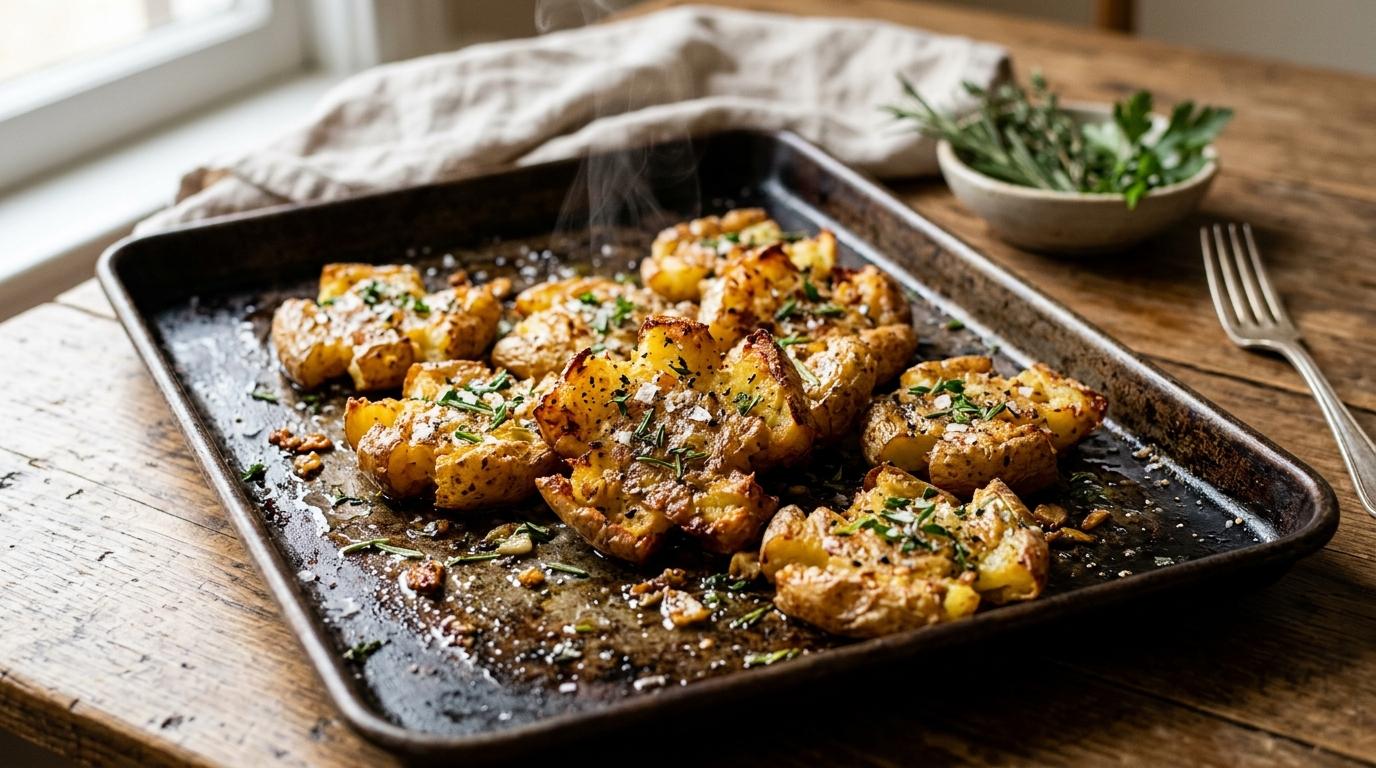
If you have ever tried making smashed potatoes at home, you already know the common disappointment. You boil some small potatoes, crush them with the bottom of a drinking glass, drizzle them with oil, and bake them for half an hour.
What comes out of the oven is usually not what you pictured. Instead of shatteringly crisp, deeply browned edges with a fluffy, buttery interior, you end up with potatoes that are soft, slightly greasy, and limp. Or worse, the potatoes crumble into loose mash on the baking sheet before they ever get a chance to crisp.
There is real food science behind achieving that signature glass-like crunch. Smashed potatoes are not just roasted potatoes pressed flat; they rely on gelatinized surface starches, moisture evaporation, and precise heat management.
Once you understand why the technique works, you will be able to make restaurant-quality smashed potatoes every single time with zero guesswork.
The Secret to Truly Crispy Smashed Potatoes: Why Most Recipes Fail
#Most home recipes fail for three straightforward reasons: excess surface water, incorrect potato variety, and burnt garlic.
Water is the number one enemy of crispiness in cooking. When food is wet, the surface temperature cannot rise above 100°C (212°F)—the boiling point of water. The Maillard reaction, which is the chemical reaction between amino acids and reducing sugars that creates deep golden-brown crusts and complex savory flavors, only kicks into high gear above 140°C (285°F). 
If your potatoes go into the oven damp, the heat from the oven spends the first twenty minutes simply evaporating steam rather than frying the skin in oil. By the time the surface finally dries out, the interior has overcooked into mush.
The second mistake is adding raw minced garlic to the potatoes before they go into a 220°C (425°F) oven for forty minutes. Garlic burns quickly at high temperatures. Burned garlic turns bitter and acrid, completely ruining the sweet, earthy flavor of the potatoes.
The third mistake is crowding the baking pan. If the flattened potatoes are touching each other, the escaping steam gets trapped between them, effectively steaming the potatoes instead of roasting them.
Fixing these three issues turns a mediocre side dish into the star of your dinner table.
The Food Science: Alkaline Water and Surface Starch Slurry
#The single biggest game-changer for smashed potatoes is adding half a teaspoon of baking soda (sodium bicarbonate) to your boiling water.
Potatoes are held together by pectin, a structural plant carbohydrate found in cell walls. Pectin breaks down much faster in an alkaline environment (a high pH) than in neutral or acidic water. 
When you boil potatoes in water with baking soda, the exterior layers of the potato break down rapidly while the center cooks through gently. As the potatoes boil, this softened exterior sloughs off slightly, creating a thick, rough, starch-rich slurry across the surface of each potato.
When you drain the potatoes and let them steam-dry, that surface starch paste dries into a matte, powdery white coating. Once that dehydrated starch hits hot oil on a searing baking sheet, it fries into microscopic, jagged bubbles that turn into an ultra-crispy, blistered crust. 
This simple alkaline boiling step creates roughly three times more crunchy surface area than boiling in plain water.
Which Potatoes Work Best? (Waxy vs Starchy)
#Not all potatoes behave the same way under pressure. Potatoes generally fall on a spectrum between starchy (like Russets) and waxy (like red bliss boiling potatoes).
- Yukon Gold or Dutch Yellows (The Best Choice): These are medium-starch, thin-skinned potatoes. They have enough starch to build a crisp outer shell, but enough waxy moisture to hold their round disc shape when pressed flat without shattering into pieces. The yellow interior cooks up rich, dense, and naturally buttery.
- Baby Red Potatoes (Good, but Less Crisp): Red potatoes are very waxy with high moisture content. They hold their shape exceptionally well when smashed, but their lower starch content means the edges will never get quite as blisteringly crisp as Yukon Golds.
- Large Russet Potatoes (Avoid for Smashed): Russets are high in starch and low in moisture, making them perfect for French fries or baked potatoes. However, their cells separate easily when cooked; when you try to smash a boiled russet, it usually disintegrates into mashed potato rubble.
Look for baby or creamer Yukon Gold potatoes roughly the size of a golf ball (about 4 to 5 centimeters in diameter). Uniform sizing ensures they all become tender at the exact same minute.
The Complete Two-Step Cooking Method
#Making perfect smashed potatoes involves two distinct stages: the parboil-and-dry phase, followed by the high-heat roast-and-baste phase.
Step 1: The Cold-Water Alkaline Boil
#Always start your potatoes in cold, salted water rather than dropping them into boiling water. 
If you drop whole cold potatoes into boiling water, the outside cooks and turns mushy long before the core becomes tender. Starting in cold water allows the potato to heat evenly from skin to center.
Fill a large pot with cold tap water, add 1 tablespoon of kosher salt, and stir in 1/2 teaspoon of baking soda. Add 2 pounds (900 grams) of scrubbed baby potatoes. 
Bring the pot to a vigorous boil over high heat, then reduce the heat to medium-low so the water maintains a steady, rolling simmer. Cook for 18 to 22 minutes. Test for doneness using a thin paring knife or metal skewer; the knife should slide into the thickest center with zero resistance. If you feel a firm core, simmer for another three minutes.
Step 2: The Critical Steam-Dry
#Drain the potatoes thoroughly into a colander. 
Now comes the step that most people skip: let the drained potatoes sit in the warm colander or on a wire rack for 8 to 10 minutes undisturbed. 
You will see heavy steam rising off the potatoes. As the moisture leaves, the skins will turn from shiny and wet to completely dry, pale, and matte. This dehydration is what allows the olive oil to fry the surface rather than steam it.
Step 3: Preheating the Sheet Pan
#While the potatoes are drying, preheat your oven to 220°C (425°F). 
Place a large, heavy-rimmed baking sheet on the middle rack inside the oven while it preheats. Smashed potatoes need immediate bottom heat the second they touch the pan. 
When the oven reaches temperature, carefully pull out the hot sheet pan using oven mitts and drizzle 1 tablespoon of extra virgin olive oil over the surface. The oil will shimmer immediately.
Step 4: The Controlled Smash
#Transfer the warm, dried potatoes onto the hot oiled sheet pan, leaving at least 1 to 2 inches of space between each potato.
To smash them, use a flat-bottomed vessel such as a heavy glass tumbler, a wide metal measuring cup, or a smooth wooden meat mallet. Lightly rub the bottom of your glass with a drop of olive oil so it does not stick to the potato skin.
Press down firmly and evenly right in the center of the potato until it flattens into a disc roughly 1/2-inch (1.2 cm) thick. Do not smash them so thin that the potato splits apart into fragmented chunks; you want one continuous disc with jagged, broken edges around the rim. Those uneven, cracked edges are where maximum crunch develops.
Step 5: The Olive Oil Roast
#Drizzle another 2 tablespoons of extra virgin olive oil evenly over the tops of the smashed discs. Use a pastry brush to ensure the oil gets into every deep crack and crevice. 
Season generously with freshly cracked black pepper and a pinch of kosher salt.
Slide the baking sheet into the oven at 220°C (425°F) and roast undisturbed for 35 to 40 minutes. Do not flip them halfway through; keeping the flat bottoms in direct contact with the hot metal pan allows them to develop an incredible, deep-golden crust that tastes like the edge of a diner hash brown.
The Garlic Herb Butter Dilemma: When to Add the Garlic
#Here is how you get rich, aromatic garlic herb flavor without burning the garlic to a crisp: create a warm compound butter and apply it as a finishing baste during the final five minutes of roasting.
While the potatoes are roasting, melt 3 tablespoons of unsalted butter in a small bowl. Stir in:
- 4 cloves of garlic, finely minced
- 1 tablespoon of fresh rosemary, finely chopped
- 1 tablespoon of fresh thyme leaves
At the 35-minute mark, check your potatoes. The edges should be dark golden-brown and rigid to the touch. 
Remove the sheet pan from the oven, brush the warm garlic herb butter generously over the blistered surface of each potato, and return the pan to the oven for just 4 to 5 minutes. 
That brief five-minute blast is enough to gently cook out the raw bite of the garlic and bloom the fragrant oils in the rosemary and thyme, leaving the garlic sweet, toasted, and aromatic rather than burnt and bitter.
Finish immediately with a generous sprinkle of flaky sea salt (such as Maldon) and finely chopped fresh flat-leaf parsley.
Summary Comparison of Cooking Techniques
#To understand why this method produces superior results compared to traditional roasting, review the practical differences below:
| Method Factor | Standard Roasted Potatoes | Basic Smashed Potatoes | Scientific Smashed Potatoes |
|---|---|---|---|
| Boiling Water | Plain tap water | Salted tap water | Salted water plus baking soda |
| Surface Starch | Minimal breakdown | Moderate cracked skin | Thick, rough gelatinized starch slurry |
| Moisture Control | Tossed in oil immediately | Smushed warm onto cold tray | 10-minute steam-dry before pressing |
| Pan Temperature | Cold baking sheet | Cold baking sheet | Preheated 220°C sheet pan with oil |
| Garlic Addition | Added at start (burns) | Added at start (burns) | Basted during final 5 minutes |
| Resulting Crunch | Smooth outer skin | Partially crisp on edges | Glass-shattering craggy blistered shell |
Air Fryer Method: Faster Crunch in Smaller Batches
#If you are cooking for one or two people and do not want to heat up your main oven, an air fryer works exceptionally well for smashed potatoes because the intense convection fan circulates dry air rapidly around the food.
- Parboil and Dry: Follow the exact same cold-water boil with baking soda and steam-drying steps above.
- Preheat Air Fryer: Set your air fryer to 200°C (400°F) for 3 minutes.
- Smash on a Board: Flatten the dried potatoes on a clean cutting board rather than inside the fryer basket. Drizzle both sides with olive oil.
- Single Layer Only: Place the smashed potatoes in the air fryer basket in a single layer. Never stack them. Most standard baskets can fit 4 to 5 potatoes at a time.
- Cook Time: Air fry at 200°C (400°F) for 15 to 18 minutes until deeply browned and crunchy.
- Finishing Baste: Brush with your garlic herb butter during the last 2 minutes of air frying.
Flavor Variations and Dipping Sauces
#While garlic, rosemary, and sea salt is the timeless combination, the craggy texture of smashed potatoes makes them a perfect vehicle for bold toppings and sauces:
- Parmesan Crust: During the final 10 minutes of roasting, sprinkle freshly grated Parmigiano-Reggiano or Pecorino Romano over the tops. The cheese melts into the cracks and bakes into a crisp, savory frico crust.
- Sour Cream and Chive: Top warm potatoes with a dollop of cold sour cream or Greek yogurt, finely snipped chives, and smoked paprika.
- Spicy Herb Chimichurri: Spoon a bright, acidic sauce made from fresh parsley, cilantro, red wine vinegar, garlic, and red pepper flakes over the hot potatoes to cut through the richness of the butter.
- Smoked Paprika and Garlic Aioli: Serve with a quick dipping sauce of mayonnaise, grated garlic, lemon juice, and Spanish smoked paprika.
Make-Ahead, Reheating, and Storage Rules
#Smashed potatoes can easily be prepped ahead of time, which makes them ideal for dinner parties or holiday meals like Thanksgiving and Christmas.
How to Prep Ahead (Up to 24 Hours)
#You can complete the entire first half of the recipe a day in advance:
- Boil the potatoes with baking soda until knife-tender.
- Drain and steam-dry thoroughly.
- Smash them onto a parchment-lined baking sheet.
- Let them cool completely to room temperature, then cover loosely with parchment paper or plastic wrap and place the baking sheet in the refrigerator for up to 24 hours.
Chilling the smashed potatoes actually works in your favor. Cold air in the refrigerator acts as a dehumidifier, further drying the surface starches and leading to an even crispier crust when roasted. 
When ready to cook, let the sheet sit at room temperature for 15 minutes, drizzle with olive oil, and roast directly at 220°C (425°F) for 35 to 40 minutes as directed.
Storing and Reheating Leftovers
#Store any leftover smashed potatoes in an airtight container in the refrigerator for up to 4 days.
- Never Use a Microwave: Microwaving excites water molecules inside the potato, turning the crispy exterior rubbery and soggy in thirty seconds.
- Oven Reheating: Spread leftovers on a baking sheet and bake at 200°C (400°F) for 8 to 10 minutes until hot and re-crisped.
- Air Fryer Reheating: Place cold potatoes in a single layer at 190°C (375°F) for 4 to 5 minutes. The circulating hot air restores full crunch almost immediately.
Frequently Asked Questions
#What is the best potato variety for smashed potatoes?
#Small to medium Yukon Gold or baby Dutch yellow potatoes are the gold standard. They contain a medium-starch, thin-skinned flesh that holds its structural disc shape during smashing without turning into crumbly mash, while roasting into a creamy, buttery interior. Avoid large russet potatoes, which crumble apart easily when flattened, and avoid ultra-waxy red boiling potatoes, which stay dense and do not crisp as well.
Can you boil and smash the potatoes ahead of time?
#Yes. You can boil, steam-dry, and smash the potatoes up to 24 hours in advance. Arrange the smashed discs on a parchment-lined baking sheet, let them cool completely, cover loosely with plastic wrap or parchment, and refrigerate. The cold refrigerator air actually dries the surface starches further, creating even crispier results when you roast them. Bring to room temperature for 15 minutes, drizzle with olive oil, and roast as directed.
Why did my smashed potatoes turn out soggy instead of crispy?
#Sogginess is caused by three common mistakes: excess surface moisture from skipping the steam-drying step, using too little high-smoke-point oil (the bottoms need to shallow-fry on the hot baking tray), or overcrowding the pan. If potatoes are packed tightly together, escaping steam is trapped between them, steaming the skin instead of crisping it. Leave at least 1 inch of clear space around each smashed potato.
How do you reheat leftover smashed potatoes to make them crispy again?
#Never use a microwave, which turns the crisp skin rubbery and soggy. Instead, reheat in a preheated oven or toaster oven at 200°C (400°F) for 8 to 10 minutes on a baking sheet, or in an air fryer at 190°C (375°F) for 4 to 5 minutes. The high circulating dry heat re-crisps the external starches rapidly without drying out the soft interior.