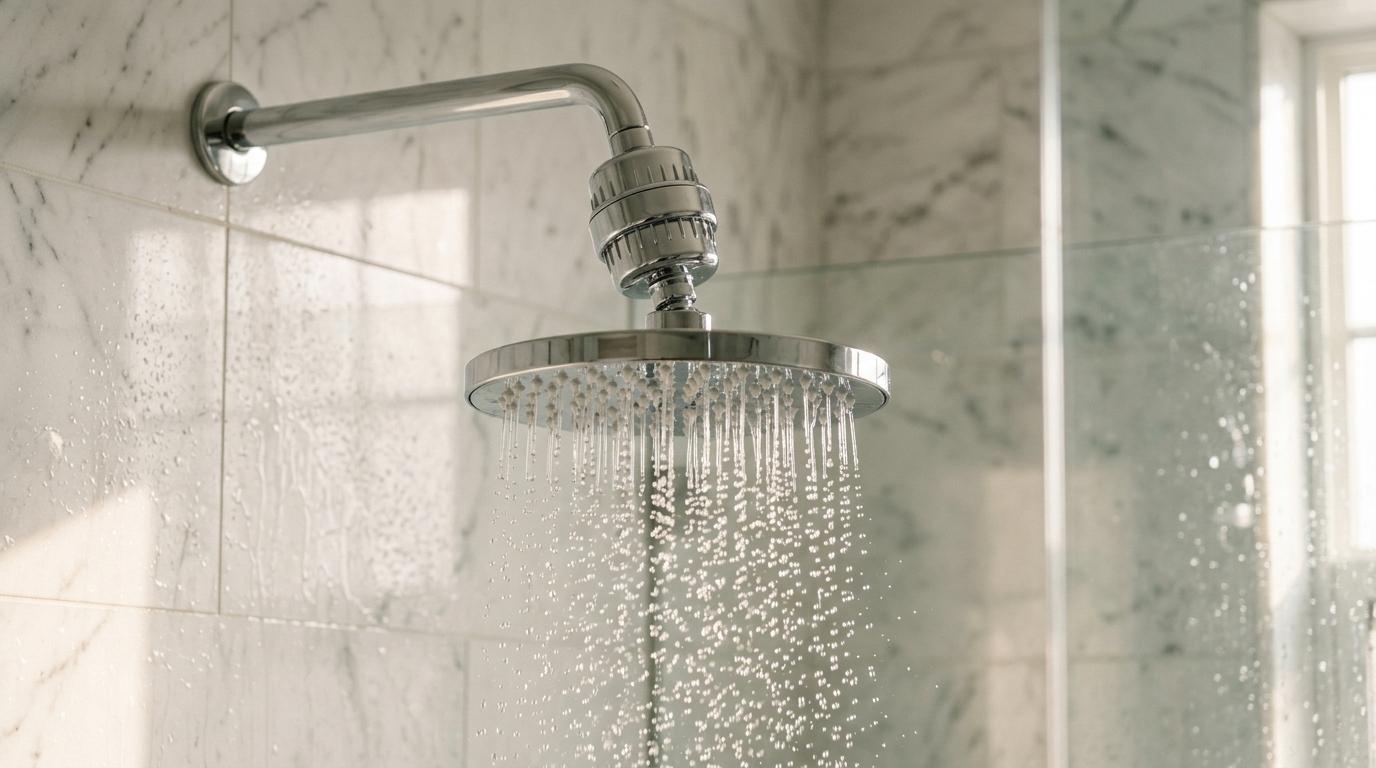
No screw-on shower filter will soften your water. If you installed a popular multi-stage shower cartridge hoping to stop bathroom limescale or fix mineral-crusted hair, you already know the frustration: the crusty white rings on your tiles do not budge, and your water still feels stiff.
That does not mean your shower filter is useless. It just means the packaging lied about what the filter actually does. 
A good shower filter is exceptional at stripping out free chlorine, chlorine byproducts, and oxidized sediment. That alone makes your skin itch less and keeps your hair from feeling like straw after a hot wash. But removing the dissolved calcium and magnesium that define hard water requires an entirely different physical process. 
Here is what shower filters actually do, why no palm-sized cartridge can soften your shower water, and the exact steps that protect your hair and skin when you live in a hard-water home.
What Hard Water Actually Is (And What It Does in the Shower)
#Hard water is not dirty water. It is clean, potable water that picked up high concentrations of dissolved minerals—predominantly calcium and magnesium ions—as it filtered through limestone, chalk, or dolomite deposits underground before reaching municipal pipes.
These minerals are dissolved at the ionic level. They are not floating specks of sand or rust that you can trap in a physical mesh. When water evaporates on your glass shower door or chrome faucet, these minerals fall out of solution and recrystallize as hard, chalky calcium carbonate, commonly called limescale.
Inside the shower, dissolved calcium and magnesium cause two specific headaches:
- The Soap Curd Reaction: When you lather traditional bar soaps or sulfate-based body washes, the calcium ions bond directly with fatty acid molecules. Instead of creating a slick, bubbly lather that rinses clean, they form an insoluble, sticky precipitate known as soap curd or soap scum. This film clings to your skin, clogging pores and causing that tight, squeaky feeling after rinsing.
- Hair Keratin Disruption: Hair shafts are made of overlapping protein shingles called cuticles. In soft water, these cuticles lie flat and smooth. In hard water, calcium and magnesium ions bind to the negative charges on your hair protein, forcing the cuticles to lift and flare open. Moisture escapes from the hair cortex, dirt clings more readily, and your hair ends up feeling rough, tangled, and dull.
Understanding this chemical reality is the key to seeing through filter marketing. To eliminate these problems at the source, you have to physically remove the dissolved calcium and magnesium ions.
Why Screw-On Shower Filters Cannot Soften Water
#Every week, another sleek shower head goes viral promising "fifteen stages of filtration" that "soften hard water instantly." 
Here is why that claim is physically impossible:
1. The Volume and Dwell Time Problem
#True water softening requires ion-exchange resin beads. As hard water flows across these beads, calcium and magnesium ions swap places with sodium or potassium ions bound to the resin surface. 
This ion-exchange process takes time and contact area. A standard residential shower head blasts out between 1.8 and 2.5 gallons of water every single minute. The cartridge inside a screw-on shower filter holds roughly two or three tablespoons of filter media. Water passes through that cartridge in less than half a second. That is not nearly enough dwell time or surface area to exchange dissolved minerals at volume.
2. The Saturation and Regeneration Barrier
#Even if a shower cartridge were packed entirely with ion-exchange resin beads, those microscopic beads have a finite capacity. In moderately hard water (say, 150 parts per million), a small shower filter would exhaust its ion-exchange capacity within one or two fifteen-minute showers. 
In a whole-house water softener, the large resin tank holds cubic feet of beads that regenerate automatically every few nights by flushing with gallons of concentrated salt brine from an external tank. A small plastic screw-on canister has no salt tank and cannot regenerate itself. Once the beads are coated with calcium, they are permanently dead.
3. The Physical Size of Dissolved Ions
#Mechanical filtration traps particles by size. A sediment filter might catch particles down to 5 microns (like sand or rust flakes). A high-end drinking water carbon block might filter down to 0.5 microns. 
A dissolved calcium ion, however, is smaller than a single nanometer—thousands of times smaller than the tightest mesh you could fit in a shower head without choking your water pressure down to a trickle. 
Unless your filter has a regenerating salt reservoir or uses a high-pressure reverse osmosis membrane that runs on a booster pump, it cannot soften water.
What Shower Filters Actually Remove (And Why They Still Matter)
#If shower filters do not soften water, why do thousands of people swear their eczema calmed down or their scalp stopped flaking after installing one?
Because shower filters do one crucial job exceptionally well: they neutralize chlorine and heavy metals.
Municipal water utilities use chlorine or chloramines to disinfect water pipes and kill bacteria. By the time that water reaches your bathroom, chlorine has done its job. But when chlorine comes out of your hot shower head, three things happen:
- Hot water aerosolizes chlorine into a gas, which you breathe in directly inside an enclosed shower stall, irritating lungs and sensitive nasal membranes.
- Free chlorine is a potent oxidizing agent. It oxidizes the natural oils (sebum) on your skin and scalp, destroying your moisture barrier and leaving skin tight, dry, and prone to inflammation.
- Chlorine strips the protective outer lipid layer of hair strands, bleaching dyed color and breaking down the protein structure.
When you install a quality shower filter, you remove that oxidizing chlorine bath. Your skin feels noticeably softer and your scalp stops itching not because the water is soft, but because the chemical bleach has been removed.
The Filter Media Breakdown: What Is Actually Inside the Cartridge?
#Modern shower filters use a blend of three primary media. Understanding each one helps you avoid buying decorative plastic gimmicks like ceramic vitamin balls or maifan stones that do virtually nothing.
| Filter Media | What It Removes | Temperature Limit | How It Works |
|---|---|---|---|
| KDF-55 (Copper-Zinc) | Free chlorine, lead, mercury, nickel, copper | Works best in hot water | Redox (oxidation-reduction) electron transfer |
| Calcium Sulfite (CaSO3CaSO_3CaSO3) | Free chlorine and chloramines | Extremely heat resistant | Rapid chemical reduction in split seconds |
| Activated Carbon Block | Volatile organic compounds (VOCs), odors, sediment | Degrades above 105°F (40°C) | Physical adsorption into microscopic pores |
| Vitamin C (Ascorbic Acid) | Chlorine and chloramines | Heat stable | Acid-base chemical neutralization |
| Mineral/Tourmaline Balls | Minor physical sediment baffling only | Inactive | Marketing gimmick; no measurable filtration |
1. KDF-55 (Kinetic Degradation Fluxion)
#KDF-55 is an alloy of high-purity copper and zinc. It is the gold standard for shower filtration because it loves hot water. Standard activated carbon degrades rapidly when exposed to hot shower temperatures, but KDF-55 thrives in heat.
It works through an oxidation-reduction (redox) reaction. When water passes through the copper-zinc granules, an electrochemical reaction takes place: zinc gives up electrons, and free chlorine gains them, converting harsh, irritating chlorine into harmless, water-soluble chloride ions. KDF-55 also binds to dissolved heavy metals like lead and mercury, plating them onto the zinc alloy.
2. Calcium Sulfite
#Calcium sulfite is a white, crystalline chemical compound that neutralizes chlorine in fractions of a second. It is roughly 100 times more reactive with chlorine than activated carbon and works even in high-flow, high-heat scenarios. If your shower filter has a very fast flow rate, high-grade calcium sulfite is doing the heavy lifting.
3. Vitamin C (Ascorbic Acid)
#Vitamin C cartridges use food-grade ascorbic acid to neutralize chlorine and chloramines. When chlorine hits ascorbic acid, it converts into dehydroascorbic acid and neutral salts. It is gentle and exceptionally effective on chloramines (chlorine bonded with ammonia), which are notoriously difficult for standard carbon to trap. The downside is that vitamin C cartridges dissolve continuously and need frequent replacement (often every 4 to 8 weeks).
4. What About "Mineral Balls"?
#Many cheap shower heads sold online feature transparent handles packed with colorful orange, grey, and white ceramic or tourmaline beads. Marketers claim these beads "ionize," "alkalize," or "energize" your water. In laboratory tests, these ceramic beads do nothing measurable to water chemistry. They add slight mechanical backpressure to the spray plate, but they do not soften water, remove chlorine, or balance pH. Skip any filter that relies on mineral balls instead of certified KDF-55 and calcium sulfite.
The TDS Meter Myth: Why Your Tester Reads the Exact Same Number
#One of the most common complaints from consumers who buy a shower filter goes like this: 
"I bought a TDS pen, tested my tap water at 320 ppm, then tested the water coming out of my new shower filter, and it was still 320 ppm! The filter is a scam."
This test fails because it relies on a fundamental misunderstanding of what a TDS meter actually measures.
A handheld TDS meter does not measure water purity, water hardness, or chlorine levels. It measures electrical conductivity. Pure water ($H_2O$) does not conduct electricity. When mineral salts dissolve in water, they split into positively and negatively charged ions (calcium, magnesium, sodium, potassium, chloride, sulfate), allowing electrical current to pass between the meter's two probes. The meter measures that current and estimates the Total Dissolved Solids in parts per million.
When your shower filter neutralizes chlorine via KDF-55, it converts free chlorine into chloride ions. Chloride ions are dissolved salts that conduct electricity. When water flows past harmless calcium and magnesium ions, they stay in the water and conduct electricity. 
Therefore, a shower filter that is functioning at 100% efficiency—stripping out every molecule of chlorine, rust, and heavy metal—will show the exact same TDS reading as the unfiltered tap water. The only residential filter technology that lowers TDS is reverse osmosis, which strips all dissolved minerals down to pure water. Do not throw away a perfectly functional shower filter just because your TDS meter did not change.
How to Test if Your Shower Filter Is Actually Working
#Instead of using a TDS meter, use tools that actually measure what a shower filter is engineered to remove:
Test 1: The OTO Chlorine Drop Test
#Buy a simple, inexpensive swimming pool or aquarium chlorine test kit (orthotolidine or DPD reagent). 
- Run your shower hot for two minutes. Fill a small clean cup with shower water.
- Add three drops of the test reagent.
- If the water turns yellow or pink, free chlorine is present and your filter is either worn out or ineffective.
- If the water remains crystal clear, the filter is successfully destroying chlorine.
Test 2: The Scent and Steam Check
#Turn on your hot shower, close the bathroom door, and let the room steam up for three minutes. Open the door and step in. Unfiltered municipal water smells faintly like an indoor swimming pool due to aerosolized chloramines. A working KDF or calcium sulfite filter will produce steam that smells completely neutral, like pure rain.
What Actually Protects Your Hair and Skin in Hard Water?
#Since screw-on filters cannot soften water, how do you handle mineral hardness if you cannot install a whole-house water softener? You use targeted habits that prevent the minerals from sticking.
┌────────────────────────────────────────────────────────┐
       │             THE 3-STEP HARD-WATER SHOWER ROUTINE       │
       └────────────────────────────────────────────────────────┘
                                    │
                                    ▼
       ┌────────────────────────────────────────────────────────┐
       │ 1. FILTER THE WATER (KDF-55 / Calcium Sulfite)         │
       │    Removes free chlorine, heavy metals, and sediment.  │
       │    Stops chemical oxidation and skin barrier damage.   │
       └────────────────────────────────────────────────────────┘
                                    │
                                    ▼
       ┌────────────────────────────────────────────────────────┐
       │ 2. CHELATING WASH (Every 7–14 Days)                    │
       │    Use shampoo with Tetrasodium EDTA or Citric Acid.   │
       │    Chemically unbinds calcium & magnesium from hair.   │
       └────────────────────────────────────────────────────────┘
                                    │
                                    ▼
       ┌────────────────────────────────────────────────────────┐
       │ 3. ACIDIC RINSE / SYNTHETIC CLEANSERS                  │
       │    Switch from traditional lye bar soaps to syndets.   │
       │    Dilute apple cider vinegar rinse restores cuticles. │
       └────────────────────────────────────────────────────────┘
1. Use a Dedicated Chelating Shampoo Every 1 to 2 Weeks
#Clarifying shampoos remove surface styling oils, but chelating shampoos remove bonded mineral metals. Look on the ingredient label for chelating agents:
- Tetrasodium EDTA or Disodium EDTA
- Sodium Gluconate
- Citric Acid or Phytic Acid
These molecules act like microscopic claw traps. They wrap around calcium and magnesium ions clinging to your hair cuticles, break the chemical bond, and pull them into solution so they rinse cleanly down the drain. If your hair feels brittle, straw-like, or looks brassy from hard-water minerals, a chelating wash once every ten days resets your hair texture completely.
2. Switch from Traditional Bar Soap to Synthetic Cleansers (Syndets)
#Traditional bar soaps are made by saponifying oils with lye (sodium hydroxide). When those natural fatty acids meet hard water, they instantly precipitate into sticky soap scum on your skin.
Synthetic detergent bars (syndet bars like Dove or gentle liquid body washes based on cocamidopropyl betaine or sodium cocoyl isethionate) do not react with calcium. They lather freely even in 300+ ppm hard water and rinse away without leaving a film on your skin barrier.
3. Finish with an Apple Cider Vinegar (ACV) Rinse
#Hard water has an alkaline pH (typically 7.8 to 8.5) due to dissolved carbonates. Your hair and skin have a naturally acidic pH around 4.5 to 5.5. Washing in alkaline hard water forces hair cuticles wide open.
Mixing one tablespoon of raw apple cider vinegar into two cups of water and pouring it over your hair as a final rinse immediately lowers the surface pH. The acid snaps the hair cuticles shut, trapping moisture inside, smoothing frizz, and boosting natural shine without any expensive salon treatments.
Real Water Softening Options for Showers: What Works and What Doesn't
#If you truly want soft water in your shower, here are the realistic mechanical solutions ranked from easiest to most comprehensive:
Option A: Portable Inline Shower Water Softeners (Real Salt Regeneration)
#There are genuine, compact water softeners designed specifically for showers. These units connect between your shower arm and shower head, but they look like miniature scuba tanks (roughly 12 to 18 inches tall). 
Inside is a genuine bed of ion-exchange resin. Because they actually contain resin, they soften water 100%. Every one to two weeks, you unscrew the top, pour in two cups of ordinary table salt, and run water through the regeneration cycle to flush out the trapped calcium. 
- Pros: Delivers 100% softened, silky water in rental apartments without plumbing changes.
- Cons: Bulky inside a small shower stall; requires manual salt regeneration every couple of weeks.
Option B: Point-of-Entry Whole-House Water Softener
#If you own your home, this is the definitive fix. An ion-exchange water softener is installed in your garage, basement, or utility room where your main municipal water line enters the house. It treats every drop of water before it reaches your water heater, shower heads, washing machine, and dishwasher.
- Pros: Eliminates limescale everywhere, protects plumbing fixtures, doubles appliance lifespans, soft water from every tap.
- Cons: High upfront cost; requires floor space, a nearby drain, and hauling 40-pound bags of salt periodically.
Option C: Physical Water Conditioners / Descalers (TAC Technology)
#Template Assisted Crystallization (TAC) cartridges do not remove calcium or magnesium. Instead, they transform dissolved minerals into microscopic, inert crystal seeds that cannot bond to pipes or tile surfaces. 
- Pros: Zero salt, zero wastewater, low maintenance.
- Cons: Does not soften water in the traditional sense; water still tests as hard, and soap scum reduction is less pronounced than with ion exchange.
How to Buy and Maintain a Shower Filter the Right Way
#If you decide to buy a shower filter to eliminate chlorine and protect your skin barrier, follow these buying and maintenance rules:
1. Insist on Verified Media Weight
#Check the specifications. A reputable filter clearly lists the percentage of certified KDF-55 and high-purity calcium sulfite. If a company hides behind vague proprietary terms like "18-Stage Himalayan Detox Matrix," move on.
2. Monitor Water Pressure Drops
#Over time, the sediment pre-filter and KDF granules inside the cartridge trap rust flakes and municipal pipe grit. When your shower spray noticeably loses pressure, the filter is clogged. For most households, cartridges need replacement every 5 to 6 months (roughly 10,000 gallons for a two-person household).
3. Flush Before First Use
#Whenever you install a fresh filter cartridge, run cold water through it at full blast for 60 to 90 seconds outside your shower spray. High-grade carbon and KDF media shed harmless black carbon dust when first wetted. Flushing clears this dust before it can spray onto your shower walls.
The Verdict
#Shower filters do not soften water, and they will not stop limescale from accumulating on your shower glass. If a product claims to do that in a palm-sized screw-on head without a salt tank, it is misleading you.
However, a high-quality KDF-55 and calcium sulfite shower filter is one of the most effective upgrades you can make for dry, itchy skin and brittle hair. By eliminating harsh chlorine and oxidizing heavy metals, it removes the chemical aggressors that make hard water feel so damaging. Pair a verified chlorine filter with a monthly chelating shampoo and syndet body wash, and you will get the healthy hair and soft skin you wanted—without having to buy into impossible filter promises.