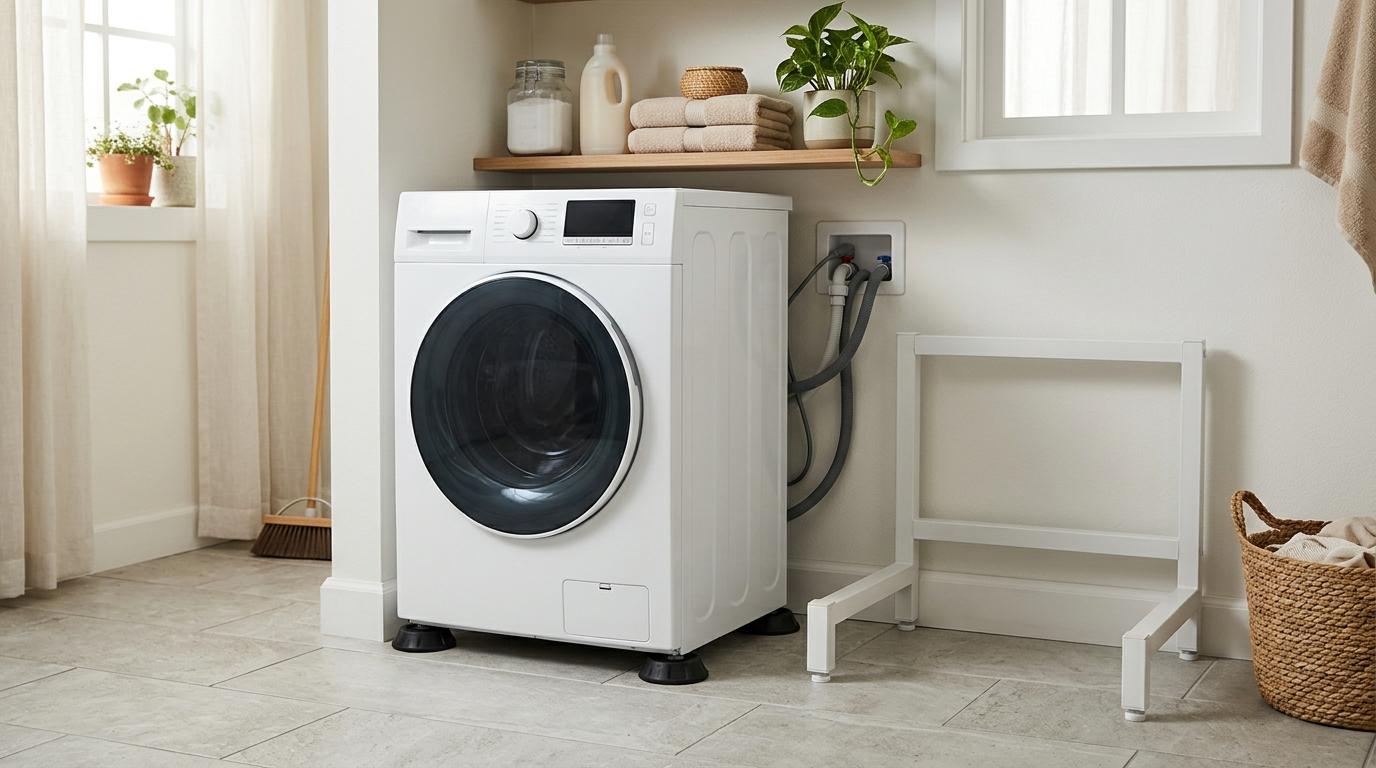
Short answer: If your washing machine is shaking, thudding, or sending vibration through the floor, washing machine anti-vibration pads are usually the better first thing to try—especially in an apartment.
A washing machine stand makes more sense when your machine is kept in a wet bathroom, balcony, or utility area and you want to lift it away from water.
But before buying either one, do the boring-but-important checks first: remove the shipping bolts, level the washer, make sure all four feet touch the floor, and balance the laundry load. A lot of “washer vibration problems” are really installation or loading problems.
A shaking washing machine can be genuinely frustrating. It can annoy downstairs neighbours, leave marks on rented flooring, and make the whole room feel like it is vibrating. Sometimes the machine even starts “walking” during the spin cycle, which is not just irritating—it can be unsafe.
Still, a stand or mat is not always the answer. Sometimes the washer was not installed properly. Sometimes one heavy bedsheet is sitting on one side of the drum. And sometimes the floor simply needs a little help from anti-vibration pads.
This guide explains the difference between anti-vibration pads, anti-vibration mats, and washing machine stands in a simple way—especially for apartments, renters, and homes where space is limited.
Quick Verdict: Pads, Stand, or Service?
#Choose based on what you are actually trying to fix.
- Choose washing machine anti-vibration pads if your washer is level but vibration is still travelling into the floor.
- Choose a washing machine stand if the washer is in a wet bathroom, balcony, or utility area and you want to keep it away from damp flooring.
- Avoid weak or wobbly stands for high-speed front-load machines. They can make shaking worse.
- Call service if the machine still shakes badly after leveling, balancing the load, and removing shipping bolts.
Major appliance brands such as Whirlpool, LG, and Samsung usually give similar advice: remove transport bolts, level the machine, use a firm floor, balance the clothes properly, and call service if vibration continues.
Why Washing Machines Shake So Much
#A washing machine shakes the most during the spin cycle. That is when the drum spins fast to push water out of wet clothes.
If the clothes are spread evenly, the machine usually handles the spin without much trouble. But if heavy wet clothes collect on one side, the drum becomes unbalanced. Then the washer may pull side to side, bang, vibrate, or slowly move across the floor.
Common causes include:
- Washing one heavy bedsheet by itself
- Washing a single blanket
- Towels or jeans clumped together
- Thick cotton sarees bunched on one side
- Too few clothes in the drum
- Too many clothes packed inside
- A washer that is not level
- A weak, uneven, or flexible floor
Front-load washing machine vibration can feel stronger because these machines often spin at higher speeds. They also have heavy internal parts designed to control movement, so when something is even slightly off, you notice it.
In apartments, the floor can make the problem worse. Vibration can travel through tile, concrete, or the building structure. That is why your washer may not sound too loud inside your home, but the flat below may hear a repeated dull thud during every spin cycle.
Check These Things Before Buying Anything
#Before spending money on anti-vibration pads, a mat, or a stand, go through this checklist. It may feel basic, but these checks solve a lot of washing machine vibration problems.
1. Check Whether the Shipping Bolts Were Removed
#This is very important for new front-load washing machines.
Shipping bolts hold the drum in place during transport. They must be removed before the washer is used. If they are still fitted, the machine can shake violently, bang loudly, or even jump across the floor.
Look at the back of the machine. If you are not sure what to look for, check the manual or call the installer. Do not keep running the washer if you suspect the shipping bolts are still in place.
2. Level the Washing Machine
#Washing machine leveling is one of the most important fixes.
Place a spirit level or bubble level on top of the washer and check:
- Left to right
- Front to back
Adjust the washer feet until the machine is level. Then check that all four feet are firmly touching the floor. Even one loose foot can cause rocking during the spin cycle.
If your washer has lock nuts on the feet, tighten them after adjusting. Otherwise, the feet may slowly loosen again.
3. Test for Rocking
#Hold the washer at two opposite top corners and gently try to rock it.
It should feel solid. If it moves, one foot is probably not set correctly or the floor is uneven. Fix this before adding any accessory. Pads will not help much if the machine is already wobbling.
4. Look at the Floor
#A washing machine needs a firm floor. If the floor flexes, bounces, or feels hollow, vibration will travel more easily.
Anti-vibration pads can reduce vibration transfer, but they cannot turn a weak floor into a strong one. This matters a lot in older apartments, laundry corners, and balcony setups.
5. Balance the Laundry Load
#Avoid washing one heavy item by itself. Add a few smaller items so the weight spreads more evenly.
If the washer stops and shows an imbalance error, pause the cycle and rearrange the clothes. Spread heavy items around the drum instead of leaving them in one lump.
6. Do Not Overload the Drum
#A packed drum does not give clothes enough space to move. It can reduce washing quality and increase vibration.
Leave enough room for clothes to tumble or move freely, depending on your washer type.
7. Run a Test Spin
#After leveling the washer and adjusting the load, run a spin cycle.
If the machine is now stable, you may not need anything else. If the washer is stable but the floor still hums, vibrates, or thuds, anti-vibration pads can help.
What Are Washing Machine Anti-Vibration Pads?
#Washing machine anti-vibration pads are small pads placed under the washer’s original feet. They are usually made from dense rubber, silicone, or another vibration-dampening material.
They do not repair the machine. They do not replace leveling. And they will not fix shipping bolts, broken suspension parts, worn bearings, or other internal problems.
What they can do is reduce how much vibration passes from the washer into the floor.
Think of them as a buffer between the machine and the surface below it.
When Anti-Vibration Pads Make Sense
#Anti-vibration pads are usually a good choice when:
- The washer is already level
- All four feet touch the floor firmly
- The machine is on a hard surface
- The laundry load is balanced
- The washer still makes the floor hum or shake
- You live in an apartment
- You want to reduce noise for downstairs neighbours
- You are renting and want to protect the flooring from marks
Pads are especially useful for apartment residents because they are small, removable, and do not permanently change anything in the home.
They also keep the washing machine close to the floor. That matters because a lower machine is usually more stable. This is one big reason pads are often a safer first choice than raising a front-load washer on a weak stand.
Anti-Vibration Pads vs Anti-Vibration Mat
#People often use these terms as if they mean the same thing, but they are slightly different.
Anti-Vibration Pads
#These go under each washer foot. Good ones usually have a small cup or recessed area so the washer foot sits inside and does not slide around.
They are simple, low-profile, and easy to remove.
Anti-Vibration Mat
#An anti-vibration mat is a larger sheet placed under the whole machine. It may protect the floor and reduce some vibration transfer.
But the mat must be firm. If it is too soft or spongy, the washer can sink unevenly and become less stable. That can actually make shaking worse.
For most apartment homes, sturdy individual pads are easier to place, clean, and inspect.
What to Check Before Buying Anti-Vibration Pads
#You do not need to chase fancy brand names. Focus on build quality.
Before buying washing machine anti-vibration pads, look for:
- Dense material: Choose firm rubber or a similar material. Avoid soft foam.
- Cup design: The washer foot should sit inside the pad, not just on top of it.
- Correct size: The pad should fit your washer feet properly.
- Good grip: It should hold well on tile, vinyl, stone, or other hard floors.
- Low height: Low-profile pads are usually better for stability.
- Load support: The pads should be made for washing machines, not light furniture.
- Easy cleaning: Useful if your washer is near a bathroom or balcony.
Pads should feel firm, not bouncy. The goal is to dampen vibration, not make the machine sit on springs.
What Is a Washing Machine Stand?
#A washing machine stand is a frame that raises the machine above the floor. It may be made of metal, plastic, or a mix of both. Some stands have adjustable corners, and some come with wheels.
In many Indian homes, washing machines are kept in bathrooms, balconies, or utility spaces where the floor often gets wet. In that case, a stand can help because it lifts the machine away from water and dampness.
A stand can also make loading and unloading easier, especially for top-load washing machines.
But a stand is not automatically good for vibration. In fact, a weak stand can make vibration worse.
When a Washing Machine Stand Makes Sense
#A stand may be useful if:
- Your washer is in a bathroom
- The machine sits in a wet balcony area
- Water often collects around the base
- You want to reduce contact with damp flooring
- You use a top-load washer
- You want a little extra height for easier access
- The stand is strong, stable, and correctly sized
For top-load machines, a sturdy stand can be practical in homes where wet floors are common.
But the washer still needs to be level. A stand does not remove the need for proper installation.
When You Should Avoid a Washing Machine Stand
#Be careful with stands if your main problem is vibration.
A stand raises the washing machine’s centre of gravity. If the stand is light, narrow, loose, or flexible, the washer may shake even more.
This is especially risky with front-load washing machine vibration. Front-loaders spin fast, and a wobbly stand can amplify the movement.
Avoid a stand if:
- It rocks when empty
- It has thin or weak corners
- The wheels do not lock properly
- The washer is already walking during spin
- The floor is uneven or slippery
- You plan to stack pads, mats, and a stand together
- The stand looks smaller than the washer footprint
A weak stand can turn a small vibration issue into a safety problem, and nobody wants that.
What to Check Before Buying a Washing Machine Stand
#If you really need a stand, focus on stability first.
Check for:
- Strong frame: It should not twist or bend under weight.
- Rust-resistant material: Important for bathrooms and balconies.
- Wide base: A wider stand is usually more stable.
- Firm corner supports: The washer feet should sit securely.
- Good rubber contact points: These reduce slipping.
- Reliable wheel locks: If it has wheels, all locks must hold properly.
- Correct size: The stand should match the washer footprint.
- No wobble: Test it before placing the machine on it.
For high-speed washing machines, a fixed stand without wheels is usually safer than a trolley-style stand.
Anti-Vibration Pads vs Washing Machine Stand
#Apartment and Renter Considerations
#Apartment laundry setups are different from independent homes. You may have neighbours below, shared walls, less space, and stricter flooring rules.
Noise Travels Through Floors
#Washing machine noise in an apartment is not only air noise. Vibration can move through the floor structure. That is why the flat below may hear a deep thudding sound during spin.
Anti-vibration pads can reduce that transfer when the machine itself is working normally.
Rental Flooring Can Get Damaged
#Many apartments have tile, vinyl, laminate, or finished flooring. If a washer shifts during spin, the feet can leave scratches or marks.
Pads help reduce direct rubbing between the washer feet and the floor.
Avoid Permanent Changes
#Renters should avoid drilling, fixing platforms, or changing plumbing and electrical points without permission.
Pads are usually safer because they are removable. A stand can also be removable, but it takes more space and must be stable.
Wet Bathroom Setups Need Extra Care
#In many Indian homes, the washing machine sits in or near a bathroom. If the floor gets wet often, a stand may protect the washer base from dampness.
But do not ignore vibration safety. A raised washer still needs a solid, level base.
Neighbour Complaints Are a Useful Warning
#If downstairs neighbours complain about spin-cycle thudding, check the basics first. Level the machine, balance the load, and confirm all feet are firmly on the floor.
If the washer is otherwise fine and vibration is still travelling through the floor, anti-vibration pads are worth trying.
Can You Use Pads and a Stand Together?
#Usually, it is better not to stack too many solutions.
Do not put soft pads on a wobbly stand and expect the setup to become stable. Multiple layers of rubber, matting, wheels, and metal framing can create too much movement.
A simple rule:
- Use pads when the main issue is vibration or apartment noise.
- Use a stand when the main issue is wet flooring or height.
- Do not use a stand to fix a washer that is already shaking violently.
If you must use a stand in a damp area, choose the sturdiest one you can find and make sure the washer is level on top of it.
Safety Warnings
#Stop using the washer and check the problem if it:
- Bangs hard against the cabinet
- Walks across the floor
- Moves position during every spin cycle
- Makes grinding, scraping, or metal sounds
- Shows repeated unbalanced load errors
- Shakes violently even after leveling and load balancing
Do not open the machine casing or try internal repairs yourself. Suspension parts, shock absorbers, bearings, drum parts, electrical systems, and motor parts should be handled by a trained technician.
Also avoid makeshift fixes like bricks, loose wooden blocks, folded cloth, or uneven platforms. These can make the washer unstable.
When to Call Service
#Call brand service or a qualified technician if:
- Shipping bolts are removed but the washer still jumps
- The machine is level but the drum feels unusually loose
- You hear grinding or scraping during spin
- The washer repeatedly fails to complete spin cycles
- Error codes keep coming back after you rearrange clothes
- The vibration suddenly became much worse
- The machine shakes even with normal balanced loads
Pads and stands are external supports. They cannot fix worn suspension, damaged bearings, internal drum problems, or a bad installation.
Simple Buying Decision
#Here is the easiest way to decide.
Buy Washing Machine Anti-Vibration Pads If:
#- You live in an apartment
- Your washer is already level
- The floor carries vibration
- You want less washing machine noise in the apartment
- You need a renter-friendly solution
- You have a front-load washer and want to keep it low and stable
Buy a Washing Machine Stand If:
#- Your washer sits in a wet area
- You are mainly worried about dampness
- You use a top-load washer
- You can find a very stable stand
- You are not trying to fix violent shaking
Call Service If:
#- The machine shakes violently after basic checks
- You hear grinding or metal sounds
- The drum feels loose
- The washer keeps showing imbalance errors
- The problem started suddenly without any clear reason
Final Takeaway
#If your main problem is washing machine shaking, start with the basics first. Remove shipping bolts, level the washer, check the floor, and balance the laundry load.
After that, washing machine anti-vibration pads are usually the most practical choice for apartment homes. They reduce vibration transfer while keeping the machine low and stable.
A washing machine stand is useful in wet bathroom or balcony laundry areas, but it should not be treated as a vibration cure. For a front-load washer that already shakes hard, a weak stand can make things worse.
Keep it simple: level first, use pads for vibration, use a stand for wet-floor protection, and call service if the shaking is violent or keeps coming back.