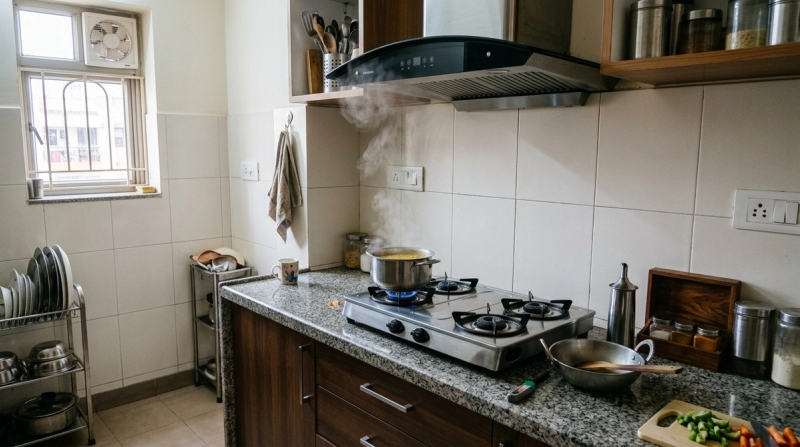
Here’s the simple answer: if your apartment allows ducting, buy a ducted chimney. Match the chimney width to your hob — 60 cm is fine for most 2 or 3-burner cooktops, while 90 cm is usually better for 4-burner hobs. If you cook oily Indian food every day, a baffle filter chimney is still a very practical choice. If your cooking is lighter and you want easier day-to-day maintenance, a filterless auto-clean chimney can work well.
Before buying, don’t just look at touch controls, curved glass, motion sensors, or showroom discounts. First check ducting, chimney size, suction power, filter type, maintenance, installation cost, and safe ventilation around gas cooking.
A kitchen chimney is not bought for decoration. Most Indian homes need it for tadka, frying, steam, pressure cooker vapour, masala smells, and that sticky layer of oil that slowly settles on tiles and cabinets. The right chimney can make your kitchen much easier to live with. The wrong one can become an expensive showpiece.
This checklist is for Indian apartment kitchens, especially small and medium-sized homes, renters, and practical buyers who want a chimney that actually suits their cooking.
1. First check whether ducting is possible
#Before you compare models, ask one basic question:
Can the chimney throw air outside?
This matters more than the design, colour, glass shape, display panel, or brand name.
Ducted chimney
#A ducted chimney pulls smoke, oily air, steam, heat, and cooking smells through the filter and sends them outside through a duct pipe.
For most Indian kitchens, this is the better option.
Best for:
- Daily Indian cooking
- Frying, tadka, and masala-heavy food
- Small closed kitchens
- Homes where smell and heat build up quickly
- Families cooking proper meals every day
Main thing to remember:
You need an outlet. Some apartments already have an exhaust opening. In others, you may need a 6-inch core-cut hole in an exterior wall. This depends on your building rules, landlord permission, and kitchen layout.
If you are renting, do not assume drilling is allowed. Chimney installation can involve wall cutting, duct routing, electrical work, and sometimes cabinet modification. Always check first.
Ductless chimney
#A ductless chimney, also called a recirculation chimney, does not send air outside. It pulls air through filters, often including carbon filters, and releases it back into the kitchen.
Best for:
- Rented apartments
- Kitchens where ducting is not allowed
- Homes where cutting an exterior wall is not possible
Main thing to remember:
A ductless chimney does not remove heat or moisture from the kitchen. It can reduce smoke and smell to some extent, but it cannot perform like a properly installed ducted chimney.
Also, carbon filters need replacement. Always check the exact replacement cost and interval for your model before buying.
Apartment checks before buying
#Before finalising the chimney, check these things:
- Does your kitchen already have an exhaust hole?
- Does your society allow wall core-cutting?
- If you are renting, has the landlord approved it?
- Can the duct pipe go outside without too many bends?
- Is there enough space above the hob?
- Will the outlet disturb a neighbour’s window, balcony, or common shaft?
- Can the duct route be kept short and direct?
A ducted chimney can also perform badly if the ducting is poor. Long pipes, narrow pipes, and too many sharp bends reduce actual suction. So don’t only believe the suction number on the box. Look at the installation path too.
2. Chimney size: 60 cm or 90 cm?
#The chimney should be at least as wide as your hob. Smoke and steam do not rise in one straight line. They spread, especially when you use a kadhai, pressure cooker, dosa tawa, or wide frying pan.
If the chimney is narrower than the hob, some smoke will escape and settle on your tiles, cabinets, and nearby walls.
A common mistake is buying a 60 cm chimney for a 4-burner hob because it is cheaper or fits neatly between cabinets. It may work if you mostly use the centre burners, but it will not cover the full cooking area properly.
60 cm vs 90 cm chimney sizing table
#If your hob is between two sizes and you have the space, choose the bigger chimney. A 90 cm chimney over a 3 or 4-burner cooktop gives better coverage, especially for Indian cooking where the pan is often wider than the burner.
3. Filter type: baffle filter or filterless chimney?
#For Indian cooking, filter type matters a lot. Our kitchens deal with oil, steam, masala vapour, smoke, and sticky grease almost every day.
You may still see mesh filter chimneys, but for regular Indian cooking, most buyers usually compare these two options:
- Baffle filter chimney
- Filterless chimney
Baffle filter chimney
#A baffle filter chimney uses stainless steel panels with curved or layered paths. Air passes through the filter, while heavier grease particles hit the metal surface and collect in the filter area or oil tray.
Good for:
- Daily Indian cooking
- Deep frying
- Heavy tadka
- Oily and spicy food
- Families cooking two or more meals at home
Things to keep in mind:
- The filters need regular cleaning.
- They can look greasy if ignored.
- You may need to soak and scrub them every few weeks.
- Cleaning is not difficult, but it is still a chore.
For heavy Indian cooking, a baffle filter chimney is still one of the most practical choices. It physically traps a lot of grease before it reaches the motor area, which makes it more forgiving for oily cooking.
Filterless chimney
#A filterless chimney does not have a removable baffle filter in the same way. It uses suction and internal airflow design to separate grease, usually collecting oil in a tray.
Good for:
- Light to medium Indian cooking
- People who want less filter-cleaning work
- Homes where frying is occasional
- Buyers who prefer simpler routine maintenance
Things to keep in mind:
- It still needs cleaning.
- The oil tray must be emptied and washed.
- If you cook oily food often and ignore auto-clean, grease can build up inside.
- Not every filterless chimney handles heavy frying equally well.
A filterless chimney is convenient, but it is not magic. If your kitchen sees daily frying, tadka, and oily cooking, a baffle filter chimney may be the safer choice.
4. Auto-clean is helpful, but it is not magic
#Auto-clean sounds like the chimney will clean itself completely. That is not how it works.
In many auto-clean chimneys, the feature heats the grease around the motor housing. The melted grease then drips into an oil collector tray. You remove the tray, empty it, wash it, and put it back.
This is genuinely useful in Indian kitchens because grease quickly becomes sticky when it mixes with dust and masala vapour.
Auto-clean is useful for:
#- Reducing grease build-up inside the chimney
- Making regular cleaning easier
- Reducing the need for frequent deep cleaning
- Helping maintain suction if used regularly
Auto-clean does not mean:
#- No cleaning at all
- No oil tray washing
- No baffle filter cleaning
- No servicing ever
If you buy a baffle filter chimney with auto-clean, you still need to clean the baffle filters. If you buy a filterless chimney with auto-clean, you still need to clean the oil tray.
Think of auto-clean as a useful helper, not a maintenance-free promise.
5. Kitchen chimney suction power: how much is enough?
#Chimney suction power is usually shown in m³/hr. It tells you how much air the chimney can move in one hour under rated conditions.
For regular Indian apartment kitchens, many buyers start around 1,200 m³/hr, especially if they cook with frying, tadka, and strong masalas. Larger kitchens, open layouts, or heavier cooking may need more. Always compare the model’s manual, installation guide and service support instead of relying only on a marketplace listing.
But suction power is not just about the number printed on the box. A high-suction chimney with poor ducting can still feel weak.
A simple calculation often used is:
Kitchen length × width × height × 10
For example, if your kitchen is 3 m × 3 m × 3 m, the volume is 27 m³.
27 × 10 = 270 m³/hr
That gives a basic air-change estimate. But Indian cooking can produce much more smoke, oil vapour, steam, and smell than this formula captures. That is why many practical buyers choose a higher suction chimney than the basic calculation suggests.
Suction checklist
#Before choosing suction power, ask:
- Is the kitchen closed or open-plan?
- Do you fry often?
- Is the duct pipe short and direct?
- Are there too many bends in the duct?
- Is the duct pipe wide enough?
- Can you tolerate noise at high speed?
- Will you actually use the highest speed setting?
Higher suction usually means more noise at full speed. A chimney with multiple speed settings is useful. You can use low speed for boiling or light cooking and high speed for frying, tadka, or heavy masala cooking.
6. Maintenance and hidden costs
#The chimney price is only part of the total cost. Many people budget for the appliance but forget installation, ducting, filter replacement, cleaning, and service charges.
Use this checklist before paying.
One-time costs
#- Chimney price: Depends on size, suction, filter type, brand, design, and features.
- Installation charges: Basic installation may not be included.
- Duct pipe: Some chimneys include a short flexible pipe. Extra length or better ducting may cost more.
- Core-cutting: If there is no outlet, a wall opening may be needed. Check society and landlord rules first.
- Electrical point: The chimney needs a suitable power socket near the installation area.
- Cabinet modification: If modular cabinets are already installed, adjustments may add to the cost.
Recurring costs
#- Baffle filter cleaning: Can be done at home or through paid cleaning.
- Oil collector tray cleaning: Needed in auto-clean and filterless chimneys.
- Carbon filter replacement: Needed for ductless chimneys.
- Professional service: May be needed if suction drops, noise increases, or grease build-up becomes difficult to manage.
Time cost
#This is the cost people forget.
If the chimney is hard to reach, you will clean it less often. Before buying, check whether you can comfortably remove the filter or oil tray.
If the chimney is installed too high or boxed tightly inside cabinets, maintenance becomes irritating. And once cleaning becomes irritating, it usually gets delayed.
7. Safety notes for gas cooking ventilation
#A chimney helps remove smoke, grease, moisture, and cooking pollutants, but it should be installed and maintained properly.
The EPA advises reducing indoor cooking pollutants through ventilation and keeping grease filters clean. In a regular Indian kitchen, that simply means: use ventilation while cooking and don’t let grease collect for months above a gas flame.
Keep these points in mind:
- Use the chimney or another ventilation source while cooking.
- Use higher speed during frying or high-heat cooking.
- Clean grease filters and oil trays regularly.
- Do not allow oil to build up near the flame zone.
- If you use gas appliances indoors, install a carbon monoxide alarm.
- Use qualified professionals for gas lines, electrical work, wall mounting, and chimney installation.
- Do not attempt DIY repairs on gas appliances or chimney electrical parts.
This is not about panic. It is basic kitchen upkeep. Ventilate properly, clean grease regularly, and call a professional when gas or wiring is involved.
8. Final kitchen chimney buying checklist
#Use this quick checklist when comparing models online or in a showroom:
- Choose ducted if your apartment allows it.
- Choose ductless only if ducting is not possible.
- Pick 60 cm for most 2 to 3-burner cooktops.
- Pick 90 cm for most 4-burner hobs.
- Prefer a baffle filter chimney for heavy oily Indian cooking.
- Consider a filterless chimney for light to medium cooking and easier routine maintenance.
- Look for an auto-clean chimney, but remember that trays and filters still need cleaning.
- Start around 1,200 m³/hr suction for regular Indian cooking.
- Check the duct route, not just the suction number.
- Ask about installation, duct pipe, core-cutting, and service charges.
- Confirm society or landlord permission before buying.
- Keep grease filters and oil trays clean after installation.
A good kitchen chimney is not necessarily the fanciest one. It is the one that fits your hob, matches your cooking style, vents properly from your apartment, and is easy enough to maintain so you actually keep using it.