Leftover turkey keeps for 3 to 4 days in the fridge, as long as it went in within 2 hours of coming out of the oven and your fridge is at 40°F (4°C) or below. After that, freeze it or toss it. That's the USDA's guidance, and it covers the stuffing, gravy and most of the other cooked dishes on the table too.
The numbers are the easy part. What goes wrong is everything around them: the bird sitting out through a second round of pie, a whole carcass shoved into the fridge, a big pot of gravy that never really cools. This guide is about those parts. How long the turkey can sit out, how to pack it away, how long each dish keeps, when to freeze, and how to reheat turkey without drying it out.
A quick note on where this comes from. The rules below are USDA and FDA guidance for the United States, which is where Thanksgiving and most of these searches come from. Every temperature has a Celsius figure next to it. If your own food safety agency gives different numbers, go with the ones for where you live.
How long can turkey sit out?
#Two hours. That's the whole rule, and it's tighter than most people think.
Bacteria grow fastest between 40°F and 140°F (4°C and 60°C) and can double in number in as little as 20 minutes. The USDA says cooked food has to be back in the fridge within 2 hours of cooking, or within 2 hours of coming out of an appliance that was keeping it warm. When the room or the table is above 90°F (32°C), like an outdoor meal in summer heat, that drops to 1 hour. Anything perishable that's been out longer than that gets thrown away.
The clock starts when the food comes off the heat, not when you sit down to eat. Say the turkey comes out of the oven at 2:00 pm, rests, gets carved and carried to the table. By 4:00 pm the leftovers should already be in containers in the fridge, which usually means someone starts packing up while everyone is still on a second plate. That's normal. Nobody needs to feel rude about it.
There is one way to hold food longer, and that's keeping it truly hot. The USDA says hot food stays safe at 140°F (60°C) or above, and it suggests setting the oven high enough to hold the turkey at that temperature, covered in foil so it doesn't dry out. "Warm" doesn't count, though. The USDA also says it's not a good idea to keep food hot for more than 2 hours, mostly because it dries out. If you want seconds later, chill the food and reheat a plate.
Get it off the bone and into shallow containers
#Big, dense food cools slowly, and slow cooling is how bacteria get their window. So the job after dinner is to make everything smaller and shallower.
Carve the bird first. The USDA says to cut turkey into smaller pieces before it goes into the fridge: slice the breast, and the legs and wings can stay whole.
Take the stuffing out of the bird, all of it, and store it in its own container. The USDA does not recommend refrigerating a whole cooked turkey with the stuffing still inside, because the middle takes too long to get cold.
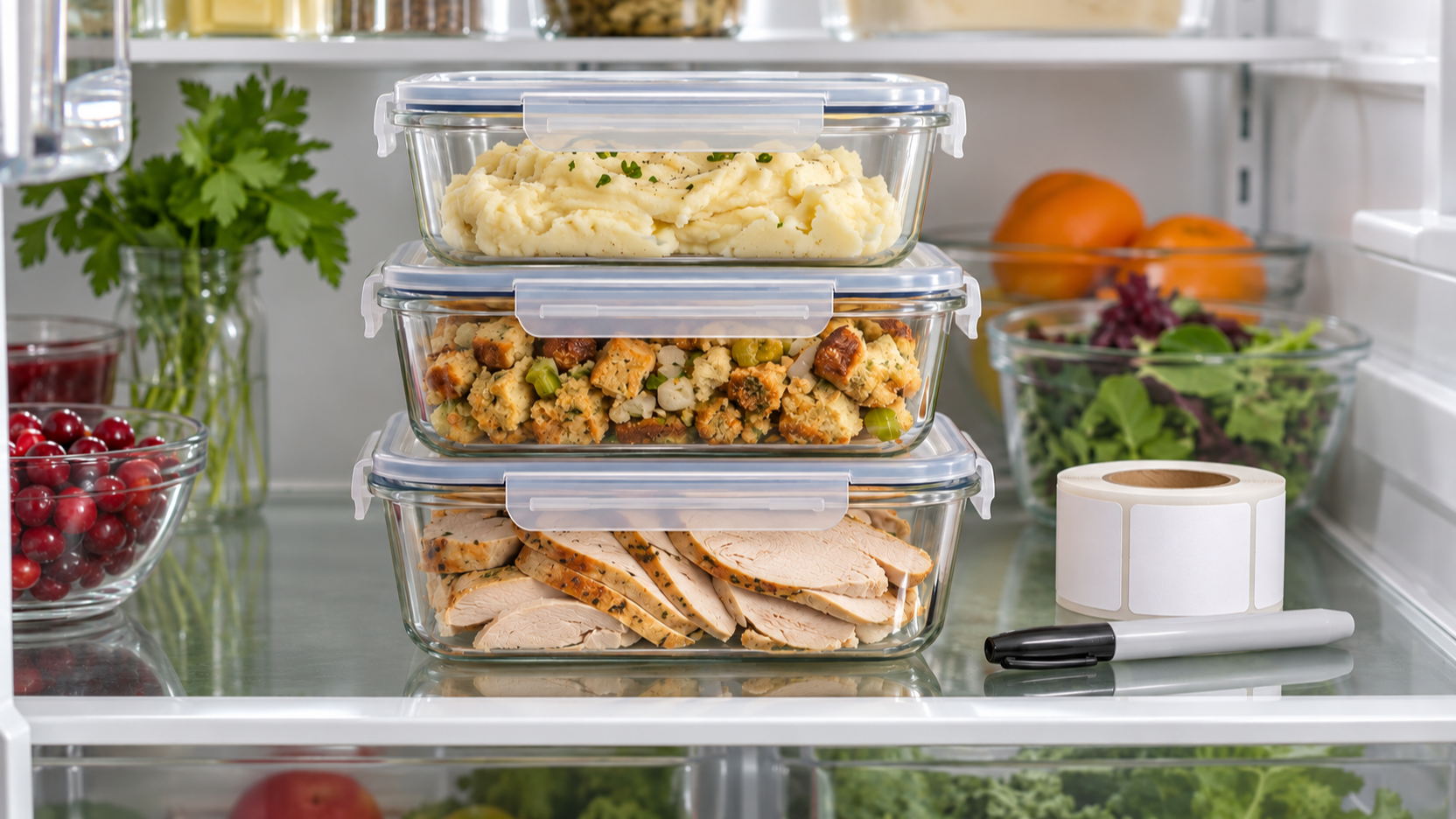
Then use shallow containers. A big pot of mashed potatoes or gravy cools slowly in the middle, so divide it into several shallow containers. Cover or seal everything, which keeps bacteria out, holds in moisture and stops the turkey from tasting like the cranberry sauce next to it.
And don't wait for it to cool on the counter. The USDA says hot food can go straight into the fridge, or into an ice or cold water bath first. Letting the pots sit on the stove "so they don't heat up the fridge" just burns through your 2 hours.
If you're still planning the cooking and want a bird that carves into evenly sized pieces, our spatchcock turkey guide covers that side of it. For the temperature checks below, how to use a food thermometer correctly shows where to put the probe.
How long does each dish keep?
#Here is the dish-by-dish version. Fridge times assume 40°F (4°C) or below and a start within 2 hours of cooking. Freezer times assume 0°F (-18°C) or below and are about quality, not safety. The USDA says frozen food kept at that temperature stays safe indefinitely. It just gets drier and tastes tired the longer it sits.
| Dish | Fridge | Freezer (quality) | What to know |
|---|---|---|---|
| Sliced or pulled turkey | 3 to 4 days | About 4 months plain; up to 6 months covered in broth or gravy | Other USDA pages say 2 to 6 months. Reheat to 165°F (74°C). |
| Stuffing or dressing | 3 to 4 days | 4 to 6 months | Cool it in shallow containers. Reheat to 165°F (74°C). |
| Gravy | 3 to 4 days | 4 to 6 months | Bring to a rolling boil when you reheat it. |
| Mashed potatoes, green bean casserole and other cooked sides | 3 to 4 days | USDA gives 3 to 4 months for cooked leftovers in general | Safe to freeze, but texture and toppings may suffer. |
| Cranberry sauce | No dish-specific USDA figure; use 3 to 4 days | No dish-specific USDA figure | Eat it cold. A store-bought can or jar with its own label instructions wins. |
| Dinner rolls | Not on the USDA chart | Not on the USDA chart | Quality question more than a safety one. Wrap well and freeze what you won't finish. |
| Pumpkin or pecan pie | 3 to 4 days after baking | 1 to 2 months after baking | Fridge within 2 hours. Yes, pumpkin pie too. |
| Custard or chiffon pie | 3 to 4 days after baking | Do not freeze | Same 2-hour rule. |
| Hard-cooked eggs | 1 week | Do not freeze | The plain boiled egg, before anything gets mixed in. |
| Egg, chicken or ham salad | 3 to 4 days | Does not freeze well | Use this window for deviled eggs too, since the USDA chart has no row for them. |
| Turkey soup or stock | 3 to 4 days | 2 to 3 months | Bring to a rolling boil when you reheat it. |
A few of those rows need a plain explanation.
The USDA's own pages don't agree on freezer time for turkey. One leftovers page says 3 to 4 months. The turkey dinner page says 4 months for plain turkey and 6 months if it's covered in broth or gravy. The cold-storage chart and the roasting guide say 2 to 6 months. That's a quality range, so nothing is unsafe at either end. For planning, I'd aim to eat frozen turkey within about 3 to 4 months, and cover it in gravy or broth when you freeze it if you want it to hold up longer.
For the sides, the USDA has no row for every dish on a Thanksgiving table. Where it has nothing specific, I've used its general rule for cooked leftovers, which is 3 to 4 days in the fridge, and said so in the table. The rolls row is a judgment call rather than a USDA number, and so is the cranberry sauce shortcut. If a jar or package has its own storage instructions, follow those.
Deviled eggs are the one I'd treat carefully. A plain hard-cooked egg keeps a week. Once the yolk is mashed with mayonnaise and sitting out on a platter, it's closer to egg salad, and egg salad is a 3 to 4 day food.
For everyday leftovers outside the holiday table, see our general post on how to freeze, thaw and reheat leftovers safely. The same 2-hour rule shows up in our posts on leftover pizza and reheating rice.
A day-by-day plan for Thanksgiving leftovers
#This is an example, not an official schedule. Say dinner is on Thursday and you count that day as day 0. The USDA's 3 to 4 day window then ends on Sunday (day 3) or Monday (day 4). Planning to finish by Sunday leaves you a day of slack.
- Thursday. Everything is chilled within 2 hours of cooking. Turkey is carved off the bone, stuffing is out of the bird, gravy and sides are in shallow containers. Pies are in the fridge too.
- Friday. Sandwiches, reheated plates, whatever you've been looking forward to. Then look at what's left and freeze anything you already know you won't finish: a portion of turkey, a tub of gravy, a stuffing casserole.
- Saturday. Last day to freeze. Anything you haven't eaten and don't plan to eat by Sunday goes into the freezer today, labelled and dated.
- Sunday. Final planned meals from the fridge. Pie is still fine for another day.
- Monday. This is day 4, the outer edge of the USDA window. If something is left in the fridge, I'd let it go rather than gamble. If you can't say for sure when something was cooked, treat it as past its time.
Why freeze on Friday or Saturday rather than on day 4? Food that goes into the freezer earlier comes out in better shape, and you're not squeezing a decision into the last hour.
How to freeze leftover turkey and sides
#Yes, you can freeze leftover turkey, and the USDA says it's safe to freeze turkey and the trimmings, even if the turkey was bought frozen. The goal is to keep air and ice crystals off it so it doesn't dry out.
Pack turkey in portions you'll use in one go, say enough for a sandwich lunch or one family dinner. You'll thaw the whole bag or tub, so small portions mean you never thaw more than you need. Gravy and stock work the same way, in small containers.
The USDA says to wrap leftovers tightly for the best quality. Freezer bags work well for sliced turkey. Press out as much air as you can before sealing, and lay the bags flat so they freeze as a thin sheet and thaw faster later.
If you can, add a little broth or gravy to the turkey before you seal it. The USDA gives turkey covered in broth or gravy a longer quality window than plain turkey, so slice first, pack the slices and pour on enough to coat them.
Label every package with what it is and the date it went in. A freezer full of unlabelled white bags is how good turkey ends up thrown away in March. Our freezer inventory guide has a simple system for this, and how to prevent freezer burn explains what the grey dry patches mean and whether to keep the food.
Skip the freezer for custard and chiffon pies, hard-cooked eggs and egg-based salads, which the USDA chart says don't freeze. Baked pumpkin and pecan pie can go in for 1 to 2 months.
How to thaw and refreeze Thanksgiving leftovers
#The USDA lists three safe ways to thaw leftovers: in the fridge, in cold water and in the microwave. Not on the counter.
- In the fridge. The slowest, and the one where the food stays safe the whole time. After thawing, use it within 3 to 4 days or freeze it again.
- In cold water. Faster, but you have to keep an eye on it. The food must be in a leak-proof bag, because water getting in can carry bacteria in with it. Food thawed this way should be cooked before it goes back in the freezer.
- In the microwave. Fastest. Keep heating until the food hits 165°F (74°C) on a food thermometer. Food thawed this way can be refrozen after it's been heated to that temperature.
You can also skip thawing. The USDA says it's safe to reheat frozen leftovers straight from the freezer in a saucepan or the microwave for soups and stews, or in the oven or microwave for casseroles and combined dishes. It just takes longer. For the turkey dinner specifically, it says side dishes can go from the freezer straight into the oven.
Refreezing has two easy cases. If you froze a big container and only need part of it, thaw it in the fridge, take what you need and put the rest back without reheating it. And if you reheated a frozen leftover to 165°F (74°C) and some is left, that remainder can be frozen again. Expect some loss of quality each time, so it's still better to freeze in small portions and thaw only what you'll eat.
How to reheat turkey without drying it out
#Reheat turkey to 165°F (74°C) inside. That's the USDA's number for leftovers, and you need a thermometer to know you've hit it. The FDA says color is not a reliable sign of doneness, so steam and a hot-looking edge don't count.
Moisture is a separate question, and it comes down to three things: smaller pieces, a little liquid and a lid.
In the oven
#This is the best way to keep turkey juicy.
- Slice the turkey or cut it into smaller pieces. The USDA does not recommend reheating a whole turkey. Slices heat evenly, and a whole bird doesn't.
- Lay the pieces in a shallow dish in a single layer. A snug layer heats faster than a pile.
- Add a splash of broth or water. The USDA's own guidance says to add a little broth or water and cover.
- Cover tightly with foil. Trapped steam is what stops the slices drying out.
- Set the oven to no lower than 325°F (163°C). That's the USDA's minimum for reheating meat and poultry.
- Check the temperature in a few places and pull it out when the thickest piece reads 165°F (74°C). Thin slices get there quickly, so start checking early rather than trusting a timer.
You may see recipes that warm turkey gently in a very low oven to about 130°F (54°C). That aims at texture and serving warm, not at the USDA's safety figure for leftovers that have been sitting in the fridge. I'd rather protect moisture with broth, foil and small pieces, and still reach 165°F (74°C).
On the stove
#Put slices in a skillet or wide pan with a little broth, cover with a lid and heat over low to medium heat, turning the pieces once. It's quick for a single serving. You still want 165°F (74°C), so put the thermometer in the thickest slice.
In the microwave
#It's fine for a quick plate if you're careful. The USDA says to cover the food and rotate it for even heating, arrange it in a covered microwave-safe glass or ceramic dish with some liquid if needed, vent the lid so steam can escape, and let it stand before checking the temperature. Because microwaves leave cold spots, take the temperature in several places. They can also dry the outside of lean meat before the middle is hot, so heat in short rounds and turn or stir the pieces between them.
Gravy, stuffing and the rest
#Gravy, soups and sauces should be brought to a rolling boil, not just warmed. Stir it so the middle gets as hot as the edges.
Stuffing goes into the oven, covered, at no lower than 325°F (163°C), or into the microwave, until the center is 165°F (74°C). A splash of broth stops it going dry. Casseroles and mashed potatoes follow the same pattern: cover, heat until hot all the way through, and stir if you can. Cranberry sauce and anything else you serve cold only has to stay cold.
Don't use a slow cooker to reheat
#The USDA says not to reheat leftovers in a slow cooker. It takes too long to climb through the 40°F to 140°F (4°C to 60°C) range. Reheat in the oven or microwave first, and then you can keep the reheated stuffing hot in a preheated slow cooker on the table.
What about the carcass?
#Don't leave it on the counter while you decide what to do with it. Pick the meat off and get that into containers first, then bag the bones and chill them too. They're on the same 2-hour clock.
If you want stock, make it that evening or the next day. Once it's made, it's a leftover like any other. The USDA chart puts soups and stews at 3 to 4 days in the fridge and 2 to 3 months in the freezer, and reheated stock should come to a rolling boil.
Don't have the energy for stock after a big meal? That's fine. Bag the carcass and freeze it for later. The USDA doesn't give a time for bones specifically, so I'd treat it like the rest of the cooked leftovers and not leave it for months.
Long dinners, buffets and outdoor tables
#Thanksgiving dinners tend to run long, and that's where the 2-hour rule gets broken without anyone noticing. A few habits fix most of it.
Keep hot food hot. The USDA says to use chafing dishes, slow cookers or warming trays so it stays at 140°F (60°C) or above. Carve half and keep the rest in an oven set high enough to hold it at that temperature, covered in foil, rather than carving everything at once.
Keep cold food cold. Nest serving dishes in bowls of ice, or use smaller trays and swap them for fresh ones from the fridge often. Anything cold that has been out for more than 2 hours at room temperature, or 1 hour above 90°F (32°C), gets thrown out.
Set a time. If dinner is at 3:00 pm, decide before you sit down that the leftovers get put away at about 4:30 pm. It's much easier to stick to when it was agreed up front.
If you've bought a cooked turkey dinner rather than cooking one, the same rules apply, with a few extras. If it's picked up hot, keep it hot at 140°F (60°C) or above and eat within 2 hours. If you'll eat later, take the stuffing out of the bird, cut the turkey into smaller pieces and refrigerate everything in separate shallow containers. If the packaging carries a USDA inspection seal, follow its directions for storing and reheating, because that product was processed under controlled conditions.
Can you tell by smell?
#No. The USDA's advice is never to taste food to decide whether it's safe, because you can't see or taste harmful bacteria. The FDA says the same thing from another angle: don't taste food that looks or smells questionable. A clean smell and a normal look aren't evidence that leftovers are fine.
That's why dates and times matter more than your nose. Label what you freeze, and remember when dinner was cooked. If you can't say how long something has been in the fridge, if it sat out all evening, or if the fridge lost power for hours, go with the USDA's rule: when in doubt, throw it out.
The FDA says food poisoning symptoms in healthy people usually last a few hours or a few days, but it can be severe for older adults, young children, pregnant people and anyone with a weakened immune system. Symptoms such as vomiting and diarrhea can start anywhere from a few hours to several days after eating. If they're severe, or if you're in one of those groups, talk to a doctor rather than waiting it out. In the US, the USDA Meat and Poultry Hotline also opens for a few hours on Thanksgiving Day if you have a question.